There are many logistics and transportation companies which still lag behind in automation. The reason being technology has always been seen as an added expense, not an enabler. In a point of fact, technology allows for automation, which reduces cost and enables visibility for every process.

In order to revolutionize the trucking business, getting developed a logistics and transportation app can help companies maximize delivery volumes in minimum time. Through an automated promise-management system, it will become way simpler to track fleet, routes, shipments, drivers, and everything that will help standardized and organize the operations better.
An on-demand logistics app when fortified with fully-functional and planned features and robust technology backing it can help attribute in delivering quality services. That’s why we’ve thought to unfold this topic which will take you towards nitty-gritty required in a full-fledged on-demand trucking app.
Types of Logistics & Transportation App Solutions
1. Fleet management Apps
Fleet management app helps you to organize, manage and coordinate work vehicles from a central information system to keep the overall fleet operation running smoothly. Fleet management apps help in improving performance, reduce costs, and provide compliance with government regulations.
2. Logistics Apps
Just imagine Uber- A taxi app solution where riders book a taxi, enter the drop off location, travel and then bill. Similarly, on-demand logistics apps allow users to choose & book a trucking vehicle, ship their logistics and make bills or payments. On-demand logistics apps help you to connect with your users and provide them instant services on fewer taps.
3. Inventory and Warehouse App Solutions
Warehouse App solutions aim to increase visibility with suppliers, ensure received assets are in the right location, know the current status and location of all assets, streamline the picking process, and eliminate manual loading verification processes etc.
Do not find what you want? Discuss your requirements in Logistics App Development
Get in Touch
The Features of On-demand Logistics App
1. Customer App or User Panel Modules
- User Authentication: The user can easily sign-up, register and login via social media channels, email id.
- Profile Creation and Profile Management: The user can create a profile, enter personal details like name, address, phone no.
- Book a vehicle(s): Users can select from a range of vehicle and make the bookings.
- Schedule bookings: Under this feature, users can pre-book for a scheduled time and manage the bookings for set date and time.
- Get fare estimation: Get a rough estimation of the fare that will be charged for the distance you want to travel.
- Billings and payments: Select Payment Option (Card, Cash or Wallet)
- Track shipments: Track drivers’ current location on the map this way you can track the shipments.
- Contact Driver: Call driver to coordinate shipments pickup locations.
- Cancel Booking: Cancel the booking anytime in a single tap.
- Push notifications: Get notification alerts (Arrival time, Late Arrival, Coupons etc.)
- Rate driver: Give ratings and reviews to the driver for their performance.
2. Driver App Modules
- Driver Authentication: Just like the user panel, the drivers can also register with their email ids or social account. Here you can also add driver’s authentication feature where he needs to add his license status, details of qualifications and disqualifications (if any), an account number for funds transfer (can be tailored as per the requirements).
- Manage requests: View and manage (accept/reject) the incoming requests for pickup and delivery of shipment or carriage.
- Check shippers details: Driver can check the details of the exporter, consignor or shipper who is responsible for initiating a shipment. Details include name, address, phone no, drop-off address, invoice etc.
- Check freight details: Drivers can reckon the costs of the weight of the goods, fuel, toll charges as per the distance covered.
- GPS route tracking: Drivers can determine the optimized route to travel to the destination with the help of GPS.
- Payments: The user payments via any mode enabled in the app can be recorded by the driver and he can smoothly accept the payments whether it is COD or by card.
3. Admin Panel
- Secure login: Admin can securely login with the email id and password from any web browser.
- Admin dashboard: Admin can view summary on Dashboard, no. of active drivers, their LIVE location, shipments completed, all customers etc.
- Manage drivers: Admin can add new drivers, update driver details, Activate/Deactivate drivers.
- Manage shippers: Admin can view all registered customers, message them personally, broadcast message and block customers.
- Manage fleet & vehicles: Admin has the ability to add types of trucks and fleet info.
- ‘
- Manage dispatchers: Under this section, admin can view, add, delete and update dispatcher’s information.
- Billing and invoice: Admin can see payments each driver has earned and can manage the cash in/out.
- Evaluate trip reports: An admin can further note the trip history of every driver and take the next step.
- Referral Rewards: Admin can add/edit promo codes and referral points for customer retention.
Note: There are even higher levels of functionalities and features that can be added as per the requirement and specifications. The list of these features does not indicate our limitation to offerings.
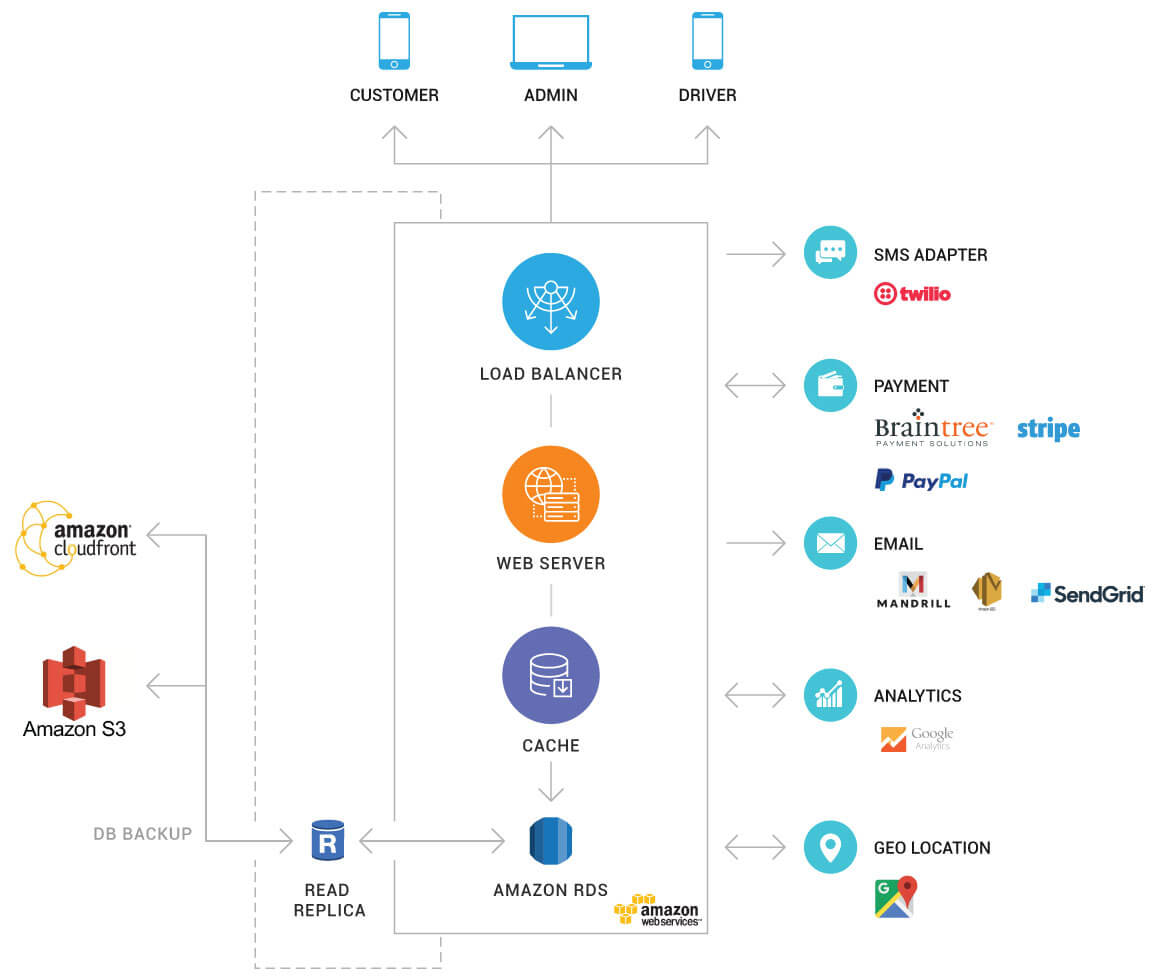
The Technology Stack behind On-demand Logistics and Transportation App
Cost to Develop An On-demand Logistics & Transportation App
According to our estimation and developing similar kind of logistics apps with customized features for different clients, the costs heavily depends upon the number of features and complexities involved in the app.
You would need to pay for following services when going for similar kind of app development:
- Design
- iOS and Android native app development
- Backend development
- Web development
- Project management
- Quality assurance
A total of cost for a simple logistics and transportation app development may land to $25,000-$40,000 and can go as high as $100,000-$150,000.