On-demand Tutor Finding App Development: Cost and Key Features

This year, 2022 takes over the digital reins of ocean-wide industries.We cannot agree more about how Covid-19 has underlined the weakness in systems across industries and highlighted the holes in the companies showing their lack of online resources to cope up with the unexpected times.The online education industry is no more untouched.The novel coronavirus has made history and provided many work settings a new norm. Where online tutor finder app development is one of the applications topping the charts.elearning app developmentThese days on-demand tutor app has seen a huge spike. Students across the world having a clear objective to topics they need more attention are enrolling for different courses and making their ways to opt for subject matter experts worldwide.

While the self-directed eLearning was already on boom but the pandemic has prompted it as a voluntary compulsion rather than leaving as an option.

Let’s look at some new facts and figures:

  • Time across online tutoring platforms has been increased by 54% since the outbreak.
  • The private tutoring market in the US alone will grow by $7.37 billion by 2023.
  • CAGR expected in these private tutoring programs in the US is almost 8%.

Development Process of An On-Demand Tutor App

As we have witnessed the potential of on-demand tutor app landscape, now it’s time to dig deep on the development. Here is the list of possible features an ideal on-demand tutor app must possess:

Features of On-demand Tutor Mobile App

Student App Features

  • Signup/Login : Students can login with their email id and password or alternatively use their social login details of Facebook.
  • Browse and Search Tutor : Students can select their preferred education field or subject and view the list of tutors and meet the subject expert of their choice, online or in-person.
  • View Tutor’s Profile : Students can view the tutor’s profile and the view details like teaching experience, course specifications, qualification, reviews, hourly rates, etc.
  • Post Requirement : As per the students’ requirements, they can post their flexible time to study, subjects they need the most attention, course they prefer to cover to find a suitable tutor.
  • Book Tutor : Students can book an online tutor and built competency in any skill or subject.
  • Chat/Message : Through this feature, students can chat and send a message to tutors. Discuss any concerns, time table, or negotiations.
  • Rate and review : Students can rate tutors for their teaching knack, subject skills, behavior, and professionalism.
  • Online Payment : Students can make online payments if they take online classes from the tutor through secured payment gateways.
  • Push Notifications : This feature allows students to receive notifications and alerts about classes, special offers, or events.

<h2″>Tutor App Features

  • Sign Up : Just like the user or student app, teachers can also sign up from their email id or social channel like Facebook.
  • Profile Creation : This feature allows tutors to create a dynamic profile where they can show their qualifications, teaching experience, skills and degrees and teaching time schedules.
  • Accept/Reject Bookings : Tutors can accept bookings and also reject bookings of students if in case the schedule or their post requirements does not match with them.
  • View Tuition Bookings : This feature enables tutors to view all their ongoing tuition details and edit their future bookings in case of any plan changes.
  • Check Earnings : Under this feature, tutors can check their total earnings on a daily, weekly, and monthly basis.
  • Whiteboard : Tutors can access whiteboard that lets them write, draw, graph functions, and share files if they are hired for online classes.
  • LIVE Video Call : Online video calling feature for seamless tutor and student communication.

Admin Panel Features

  • Dashboard : The dashboard gives a birds-eye view to admin where he can check the total number of registered students, tutors, total bookings, ongoing live classes, and total earnings.
  • Tutor Management : Admin can manage all tutors- add, update and edit details and activate or deactivate their accounts.
  • Student Management : Likewise, Admin can manage all students- add new students, update and edit their details and send them messages, books on their behalf.
  • Reports and Earnings : Admin can set commissions, check weekly and monthly reports of tutors’ earnings and streamline cash management processes.
  • Sending Messages : Admin can send in-app messages to students personally or broadcast to all those registered.
  • Push Notifications : This feature allows Admin can send alerts or notifications to students and tutors for any offers, events, discounts, etc.
  • Review Management : Admin can manage the reviews and ratings given by the students to the tutors.

Total Cost of Developing an On-demand Tutor App

The Factors That Regulates the On-demand Tutor App Development Cost are:

1. Hourly Rates of App Development Company

The hourly rates of the software companies depend on their team size and popularity that comes with their service portfolio and experience.

The general hourly rates of the companies range from:

  • Small companies with strength (11-50) – Hourly Rates $25-$49
  • Mid-size companies (51-200) — Hourly Rates $50 -$99
  • Large app development companies — Hourly Rates $100 -$149

2. Platforms and Devices

Do you want to develop the tutor finder app for both iOS and Android platforms? Different platform (native or hybrid) plays an important factor in deciding the cost of a mobile app. In case you want to develop a native app for both iOS and Android, different teams would be working for both platforms which double the development cost.

3. Features and Functionalities

The number of implemented features, functionalities, third party APIs, and the complexity involved in building them are the biggest cost drivers in any mobile app development.

The exact cost can be estimated only after the company discusses with you the scope of your project with detailed requirements.

4. UI/UX Design

The UI/UX designing includes various stages like app prototyping or wireframing, and testing, and then it goes for development. The more the no. of features, the higher would be the app designing task and so will the cost get affected.

5. Backend Integration & Testing

An important component that can reduce or increase the costs is the integration of a third-party service to enable a certain feature in the mobile app. One of the other key steps of developing an app is testing the app for any bugs and system errors.

6. App Maintenance

App maintenance includes code optimization, stability and performance improvement, continuous bug fixing and version updating. Mostly, the app maintenance cost may account for one-fifth of the original price of development.

Related reading : How to Develop an Education and eLearning App?

On demand Tutor App from Codiant

A Ballpark Figure

According to our estimation and developing similar kind of tutor apps with customized features for different organizations, the total cost for a tutor finder app development may land to $25,000-$40,000 and can go as high as $40,000-$70,000.
Want To Know How Much Does It Cost To Develop A Mobile App At Codiant?

Request a Quote

Why Discovery Phase Is An Important Stage In Software Development?

The influence of the discovery phase in mobile app development or web development cannot be left unseen.

This deduction has become more of a cliché nowadays.

Not much time ago, we had faced various clients onboard one came up with a slew of ideas to develop mobile apps but was facing a hard time deciding which idea to chase and take ahead.

While the other client was on the same shoes of having good ideas but can’t seem to execute on them.

Another found it brainstorming and challenging to implement the idea as the current app environment was too competitive and dynamic.

And we also can’t forget the unexpected complexities, missing features, unrealistic deadlines, and an imaginary budget that comes as a surprise in the mid of the project development.

Exactly these sets of turbulences and disorders in the project planning cause scope creep, budget overspending, and missed deadlines.

Taking this into consideration, we’ve been perfecting the discovery phase into our app development process frequently. Only by initiating the project with this phase, we have helped clients gain transparency in their product vision, create apps in the set timeline and budget, and deliver a competitive product that stands out in the market.

In this post, we will emphasize how discovery phase inclusion will help you create a better application and how it works at Codiant.

We will also underline the key elements of the discovery phase that visibly transforms an idea into reality and help you reach closer and feel your final product even before its completion.

What is a Discovery Phase and Why Does it Matter?

The Discovery phase is the most initial, first, and foremost stage of product development that involves the following undertakings:

From Business Orientation:

  • Collecting and analyzing information about the project
  • Doing a deep analysis of the product idea and its relevance
  • Conducting exploratory research (includes user interviews, surveys & field study)
  • Studying its intended market and target audience
  • Understanding their needs, requirements, and behavior
  • Evaluation of all the possible challenges and potential hurdles

From Development Orientation:

  • Software requirement specification
  • Gathering technical requirements
  • Creating a development plan split into milestones
  • Feature listing and flow discussion with a client

Depending upon the project’s scope, the discovery phase can last from one-two weeks to two months. The cost to it may be fixed or calculated based on the time spent i.e. hourly rates.

Team Involved For Discovery Phase:

  • Project Manager
  • Business Analyst
  • UX Researchers
  • Technical Lead

What Do We Deliver At The End?

As a result, our team has a detailed understanding of the outcomes to aim for, we know the user’s pain points, highly convertible points and sometimes our deep research also brings lucrative ideas recommended for your app solution that you can take forward in the market.

The minimum deliverables at the end of the discovery phase we provide you are:

  • Software requirement specification/ Scope document
  • Technology stack and technical architecture
  • User persona, user journey maps and needs statements
  • Interactive wireframes/ App prototype
  • Development timeline
  • Estimated investment/ Budget

The Pricing Model Suitable For Project Discovery Phase

A. Fixed Price

If you choose this model, you will have to pay a fixed cost pre-discussed before the discovery phase. We work only on the proposed document given to you. You will know the end deliverables. It cannot be modified in between.

B. Time and Material Model

Also known as the pay-as-you-go model, in this model you pay for the hourly rates i.e. the number of hours our team spent on your project. This model is best suited if you want the flexibility to adjust requirements, replace features, or modify the scope in between or have dynamic requirements.

How It All Starts?

1. Initial Contact

As you come in touch with us, we analyze your project requirements and provide you a rough estimate (a free quote) that is basically a document covering the cost and timeline needed to complete your project.

Once we come to an agreement, we assign a business analyst who will be the primary point of contact to do the planning with you, then we sign a contract and kickstart the discovery phase.

2. Planning

In this phase, we will take a close meeting with you via Skype call/telephonic/mail as a communication tool to gather data. Since this phase is the foundation for the discovery phase, we want your active participation to know your requirements like no. of platforms, targeted country, the target audience to name a few.

3. Discovery Phase

The main steps we include in a discovery phase are:

Defining the Goals

At the beginning of the stage, our team establishes the problem statement. Our main goal here is to look for the aims of the project to solve. Our main checkpoints here are analyzing the time to market, checking the competition, understanding the revenue model, checking the plan for marketing and acquiring customers, and finding the target audience.

Market Research & Competitor Analysis (Upon Request)

In the next step, we gather information about customer needs and market drivers. We work upon questions like:

  • The current demand for your app in the market
  • Pain-points addressed by your users
  • Best time to sell/launch your product
  • Does your app stand parallel or a notch above to your competitors?
  • Determine the opportunities for expansion or growth in the market

This in-depth market research helps in drawing the following benefits:


The Main Objective of Competitor Analysis is to:

  • Conduct gap analysis
  • Perform a SWOT analysis (Strength, weakness, opportunities, and threats)

The Business Model Canvas (Upon Request)

The business plan or lean canvas is a brilliant tool for startups. This model helps you to break down your idea into key assumptions. It replaces elaborate business plans with a single page business model. This is how it look likes.

Customer Journey Map

A customer journey map helps us understand what customers go through, how the customer experience quality can be improve and can ensure consistency across all channels.

At Codiant, we create a customer journey map by covering the following steps:

UX Concept and Wireframes

The research done in the previous step helps us in creating low fidelity prototypes of the app. In simple words, you will get a high-level vision of your app layout also known as wireframes. This will help you identify the user experience and in case if you require any changes in the flow it can be corrected here itself.


Want to learn how we reach this stage of wireframes? View the UX Case Study of an On-demand Delivery App – Groceeri done at Codiant!

CLICK HERE


4. Detailed Project Estimation

This is the final stage of the discovery phase, here our development team plans the product architecture and breaks down the product’s functionality into project milestones with standard timelines.

We provide you with the optimal technology stack that matches best to your product features and budget.

Here we also mention the number of team members that will work on your project from each department (we allocate members based on your project timeline).

We work on the agile model and do scrum meetings.

The End Product

This way our discovery phase ends here, at the end of the phase we pass all the deliverables that include:

  1. Competitive analysis
  2. Software specifications
  3. Wireframes
  4. Detailed project estimation- all required for kickstarting the development of your project.

At this point in time, you can decide if you want to take your project ahead with us for the next stage that is design, development, app deployment, testing and maintenance!

If you have any doubts about taking the discovery phase or you just want to discuss your app development needs this phase or not, please do not hesitate to contact us.

We would love to answer your questions based on the mobile app or web product development.

Key Strategies Adopted by Mobile Wallet App Companies for Driving Consumers

The mobile wallet industry has been on a rapid growth trajectory. The overcrowded mobile wallet space in the app store is the living testament of it.

The growth in the industry has been further spurred amid Covid-19 as cashless payments became a new norm.

While most customers rely on the options provided by their smartphone vendors, like Apple Pay, Samsung pay, or Android, the others are depended upon the top market players ranging from tech firms like Google wallet, Paypal, Venmo and other card issuers.


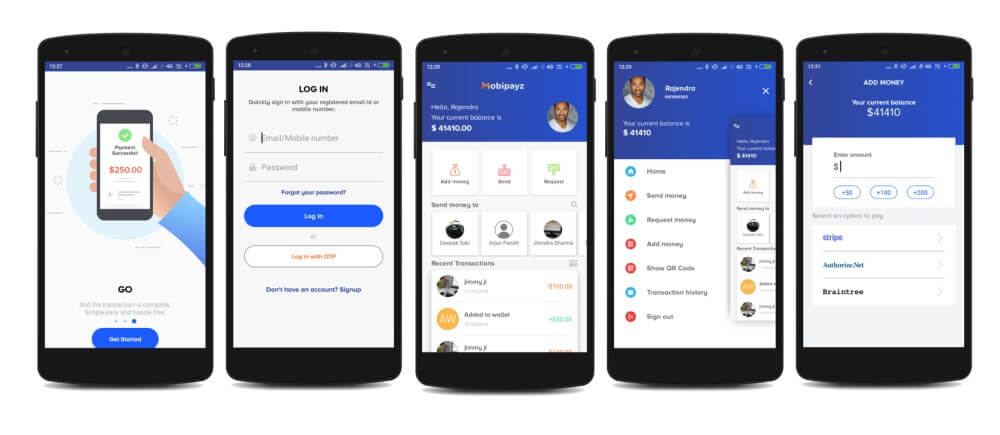
mobipayz

Click on the image to see the demo of Mobipayz

With that exponential growth, a digital wallet app company would no wonder expect to see an increased adoption.

Through this article, we hope to provide the key strategies one should follow after a successful mobile wallet app development to ensure a fast and successful market entry.

We will highlight the competitive nature of the market and shed some light on its predicted future trajectory and the challenges that the industry must overcome in order to continue its growth momentum.

Generally, the online payment market players group their marketing strategy as per segmentation, targeting and positioning.

  1. Segmentation helps in grouping the market in smaller groups having same or similar taste/ preferences/ choices.
  2. Targeting strategy helps companies to address the dynamically changing needs of the customers.
  3. Last Positioning strategy helps in increasing brand visibility in diverse markets amongst the customers globally.

1. Segmentation Strategy

Mobile wallet app companies can adopt two types of segmentation strategy: Psychographic and Demographic.

In psychographic strategy you will carry out promotions taking into account your consumers buying behavior based on his/her lifestyle, interests in activities, and social background of the customers.

While in demographic strategy you will group your customers on variables such as age, gender, income, religion and nationality. This demographic segmentation will help you divide a large population in chunks of similar customer groups.

This segmentation will help you derive:

  • How profitable is each customer segment?
  • What is the lifetime, or total, customer value (TCV)?
  • What cross-sell and/or up-sell opportunities exist?

As a result, carrying out promotion based on this segmentation will help you in market expansion (E.g. if you know your customers uses mobile banking features like balance check, fund transfers and remote payments) you can expand in similar range (e.g. by offering them digital wallet services and near-field communication payments).

2. Targeting Strategy

After a successful segmentation, next step comes deciding a targeting strategy (a subset of segmentation). To implement targeting strategy, mobile wallet companies should work on concentrated and mass marketing.

In concentrated target marketing you will carry out promotions in a well-defined population or a specific market niche (E.g. targeting users interested in personal financial management tools).

You can do this by gaining market intelligence, understanding consumer purchasing trends, and planning your routes to market through custom mobile wallet app development.

In mass marketing you will present the same product to the entire targeted market.


wallet-cta

3. Positioning Strategy

Positioning marketing means you have to design a unique brand image with your service offerings that fits in your target market’s mind.

You can develop a position strategy by following ways:

  • Positioning by unique mobile wallet app features
  • Positioning by offers and deals
  • Positioning by app behavior or user experience of mobile wallet app
  • Positioning by different culture and symbols (country-based culture)

Competitive Analysis

In the digital payment industry you may face competitors based on the factors such as:

  • User-friendly interface
  • Convenience of transaction
  • Customer service
  • Features, offers and deals that attract customers

Bottom Line :

Most payment industries have evolved their mobile app strategies by segmenting their customers to improve their product cross-selling, customer retention and acquisition efforts.

Just after mobile wallet app development, you must also work on which consumer segment you wish to target through your mobile offerings. This strategic investment will help you drive market differentiation for long time.

Related article: Cost and Features of Mobile Wallet App Development