Your Complete Guide to Music Streaming App Development

Key Features, Business Model and the Cost Involved Music streaming apps have been winning the ears tremendously since its inception. Apps like Apple Music, Spotify, Pandora, Tidal and more have become the favorite fancy sparking millennials interest. With easy accessibility and tons of features, these music apps have aced the personalization technology and have made millions flock towards it. Cheers to advanced music streaming app development services. The technologies, business model, game-changing features and monetization tactics have played on it strength to give financial muscles to service providers. In this client guide, we will discuss all these growth engines that will help you reach the long-term ambitions you’ve marked for the music industry.
Topics Covered:

  1. Music Streaming App Market Overview
  2. Popular Music Streaming Apps
  3. Types of Music Streaming Services
  4. How to Develop A Music App: Key Features
  5. App Licensing
  6. Technology Stack
  7. Music App Monetization Strategies
  8. The Business Model of Spotify
  9. Cost to Develop a Music Streaming App

Music Streaming App Market Overview

Music streaming is like the heart and soul of the U.S music industry. Its popularity is only surging by leaps and bounds day by day and the statistics coming are just astonishing. Here are the latest reports from top research companies showing the towering figures:

  • The music streaming market is projected to reach $10 billion in 2023.
  • User penetration is expected to hit 12.0% by 2025.
  • The average revenue per user is expected to reach US$28
  • In global comparison, the highest music revenue will be generated in the US in 2020 amounting to $6,000 million.
  • Spotify claims a 35% market share with 286 million monthly active Spotify users and 130 million premium subscribers.

Apple Music

Launched in 2015, apple music is an exclusive iPhone app with 70 million songs. With the tagline “Where music comes to life” it truly delivers on it! It has been so popular since, that it has positioned itself as a potential competitor to big names like Spotify, Google play music and Amazon music. Despite having a ton of curated playlists, several handcrafted music picked by musicians and tastemakers, it still lacks the simple sharing options like that of Spotify.

Tidal

Launched on October 24, 2014, Tidal is the only music streaming app which offers lossless audio streaming. The service acts as a bridge that unifies artists and fans. It offers the exact reproduction of original songs. This process aka lossless streaming if you are a premium subscriber. It consists of a collection of 60 million songs with a special focus on urban music. Despite Spotify and Youtube music leading the charts, tidal remains a strong player.

Pandora

There was a time when Pandora had a limited library, but recently its deals have bolstered its music selection. Being in a neck to neck competition with Spotify, it remains the most popular radio streaming service in the states.

SoundCloud

A single app for all indie song lovers across the world, Soundcloud is an exceedingly famous Android music streaming app. The service has the potential to avail around 150 million tracks. Second largest to that of the collective numbers of its competitors. Exclusive to indie music, it remains generic with features that of playlists and stations.

Spotify

Spotify is like a breath of fresh air when it comes to talking about music streaming apps. A huge library, Music discovery, Customized playlists, Smart algorithms; Spotify has it all. It is shareable on multiple platforms, and most of its models are free.
Types of Music Streaming Services

There are majorly three types of music streaming services: Radio, On-Demand Music Streaming (often called as music library), and Cloud Storage. Let’s understand their nature and attributes:

1. On-Demand Streaming Services

Apps like Spotify, Apple Music, and Tidal are the best example of on-demand music streaming. If you are looking to build one, you only have to create a server-based music library where you can upload millions of tracks and limit its accessibility to customers as per your terms and conditions. Like competitors generally bifurcate it to the Freemium model and Paid subscriptions.

2. Radio Stations

Unlike on-demand streaming apps, Radio Stations do not allow users to play songs on-demand. Rather, the service has a virtual DJ that picks and plays songs in order. Mostly the songs are tuned with your personal preferences. The best presenters of radio apps are Pandora, Shoutcast and iHeartRadio. Plus, radio station apps cannot play songs on-demand, not even in the blue moon. The reason being their licensing agreements. Further, these apps are relatively low-priced compared to their rivals like on-demand streaming services.

3. Cloud Storage

In cloud storage apps, you can give your users audio file hosting capabilities. Means, your users can use the app to upload their favorite music, stream audio and make a file transfer to other people. So, eventually, you’ll be a cloud storage provider to back-up songs. Popular cloud storage app market players allowing users to save their music catalog online are AudioBox, CloudPlayer, Google Play, and Groove Music.

How to Develop a Music App: Key Features

To create your own music streaming service you need to ponder upon the features that would increase accessibility, user stickiness, and convenience. Here we have created a draft of essential music app features (fit for basic music app development) plus an advanced set of features (perfect for anyone looking to monetize and compete with current music market players).

  • User Registration: A must-have feature enabling the user to create their own personalized virtual music room in the app. It’s good to make this process of sign-up/login fast through social logins like Facebook or Google. Other options like email address, mobile and password combinations are also a requisite.
  • My Profile: Once the user creates an account he/she should be able to set their music listening preferences, languages, edit their profile, manage subscription details, etc.
  • Discover Music: Allow your users to browse and search music of their choice by filters like song, album, movie, artist, lyrics, genre, mood, etc.
  • Browse Categories: Let your users search the best music by genres like Pop, Blues, Folk, Alternative, Oldies, Heavy metal, Jazz, classical, hip hop, electronic, Reggae and many more.
  • Voice Search: This feature enables your users to search for music by voice.
  • My Music: Users can maintain their own music catalog by downloading their favorite songs or tracks, creating playlists, following playlists and artists. The downloaded songs can be played offline.
  • Social Sharing: Through this sharing feature, users can share playlists with their friends through social media.
  • Offline Availability: Allow your users to play a song when they are offline or do not have an internet connection.
  • Personalization: This is an advance feature in which app learns about user choices and gives personalized suggestion as ‘Recommended For You’, lists ‘Recently Played’ music, ask for your mood and suggests mood-based tracks.
  • Radio Station: This feature allows user to fetch stations where they can find arrays of songs based on their current activities like parties, commute, morning, reading, and workout.
  • Purchase Subscription: Depending upon your business model you can provide freemium and premium or subscription (monthly/annually) modules to access unlimited songs.
  • Payment Gateway Integration: For buying subscriptions allow your users to make online payments through multiple payment modes like debit/credit cards, net banking, mwallets, UPI, etc.
  • Coupons/Offers: This feature is optional here users can apply coupons earned while making payments for subscriptions.
  • Updates and Notifications: To keep your users coming back you can send them notifications of new releases, music events, LIVE shows, etc.
  • Multilingual: Users can set languages of their own preference.
  • Help & Support: Users should be able to check the app’s privacy policy, terms of use, FAQs, and contact for online assistance.
  • Rating and Review: Upon users’ experience with your app you can request them to leave ratings and reviews to help others check the feedback and attract more downloads.

App Licensing

Music streaming app services cannot be run without licensing. As the owner of the app, you need to get a license of the app for using and running music content. Because for every stream of music you have to pay royalties to right holders. Else, it would be considered as copyrights violation. There are two types of copyrights in a song; one is owned by the songwriter/composer and the publishing company and other by the sound recording label.

  • To buy the Public Performance Rights in the USA you have to contact the American Society of Composers, Authors and Publishers (ASCAP) or you may also contact BMI or SESAC.
  • To buy the rights in the UK you can contact PPL PRS.

Technology Stack

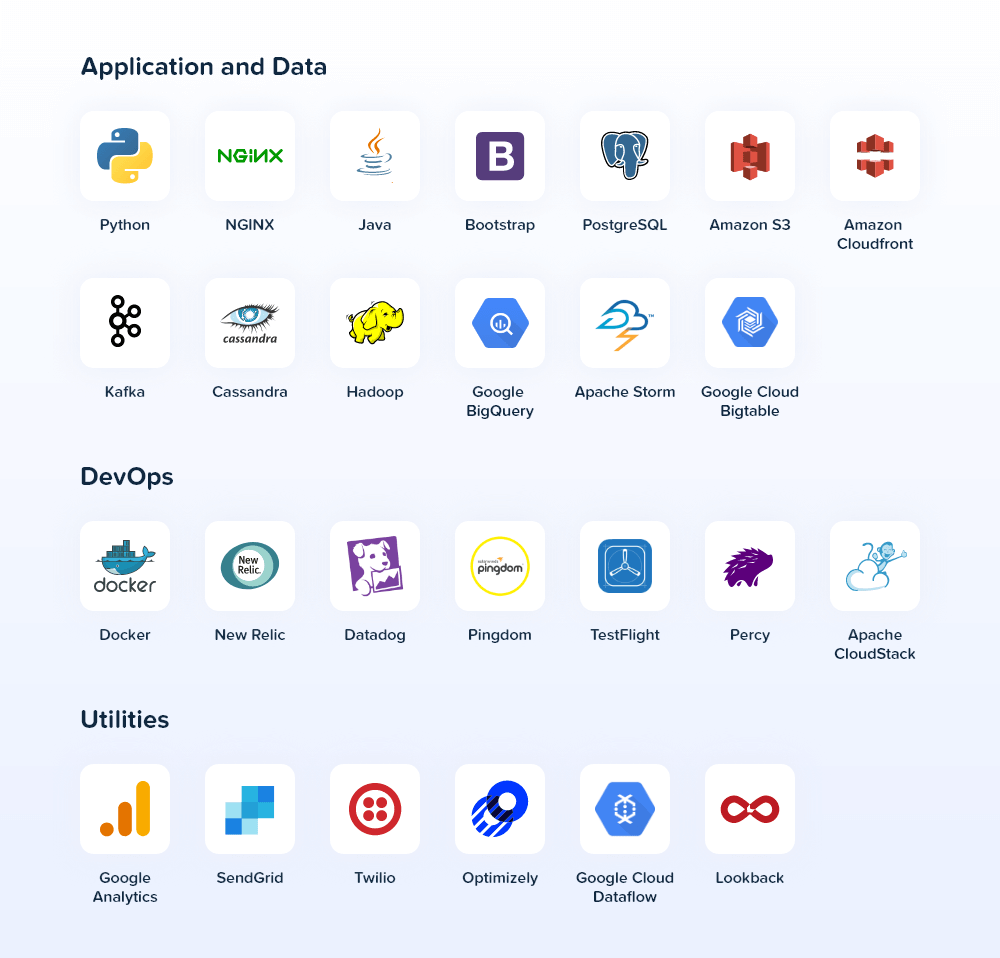
Spotify being an ideal example for a music streaming app, let’s have a look at what technologies are used by the app.
How to Monetize a Music Streaming App

1. Advertisements

Ads play an essential role in the monetization process of any service. Ads generate spaces for triggering revenue generation. Ads in music apps can be categorized into two categories: Display Ads and In-Content Ad Streaming. Display ads are graphic which occupies the screen for a few seconds in between, before or after tracks. Whereas in content streaming is little clips of audio or video which play before or after the track. Generally, these ads can be played at intervals of 15 -20mins. This ad scheme of display and content streaming works well in the freemium model. The more the ads stream the more revenue is generated. For e.g.: YouTube Music add ads before playing the track. However, Spotify uses another type of ad. There’s Spotify Ad Studios for Artists. The service analyzes the genre of your music and shows it to fans of similar genres and artists.

2. Subscription

The subscription-based model is as simple as ordering a pizza with extra cheese, it doesn’t change the original concept of the pizza but simply exemplifies its taste. Likewise in music when users upgrade to a premium version, they get something extra, say features like unlimited music downloads or those extra goodies that were not available in the freemium version. For a sum of money, one can get extra benefits and better incentives. A lot of music streaming services offer monthly subscriptions to get access to unlimited music (e.g. Apple Music, Amazon Music, Pandora, etc.). Such a monetization strategy allows companies to get revenue regularly. It’s the most popular variant for music streaming apps since the music company has to pay for licenses regularly.

3. In-App Purchases

No revenue generation activity is complete without in-app purchases. It is the most bankable app monetization strategy. This gives the user a free will to choose what they want and only pay for that specific selection. Users generally confuse subscriptions with that of in-app purchases, but one has to realize that subscriptions come with the extra baggage of everything available in that price range. Whereas in-app purchases give them the option to handpick exclusive choices such as playlists, high-quality access, and better user interface and only pay for them. On the other hand, it is easy for the app company to earn through such offerings as individual purchasing yield more profits than that of bulk purchases.

4. Availability On Multiple Platforms

Higher app representation results in higher reachability. Your music streaming app should be present on every platform- be it mobile, smart TVs, PC, or other gaming consoles and speakers. When your music streaming app is visible on multiple platforms there is a high possibility that it will be preferred more as it has already been instilled in the memory of the viewer/users of that or many other platforms.

5. Freemium App

There is no denying that apps that offer free versions with less or equivalent access to premium services are preferred over the ones which do not follow this model. This does not exactly mean that the exclusive content isn’t protected but a glimpse of it is accessible to all. For e.g.: Spotify launched its app based on the freemium model but, it’s worth noting that it was ad-supported. This model attracts more people onto your platform. They may be freemium subscribers but they have greater chances of converting to potential paid ones.

The Business Model of Spotify

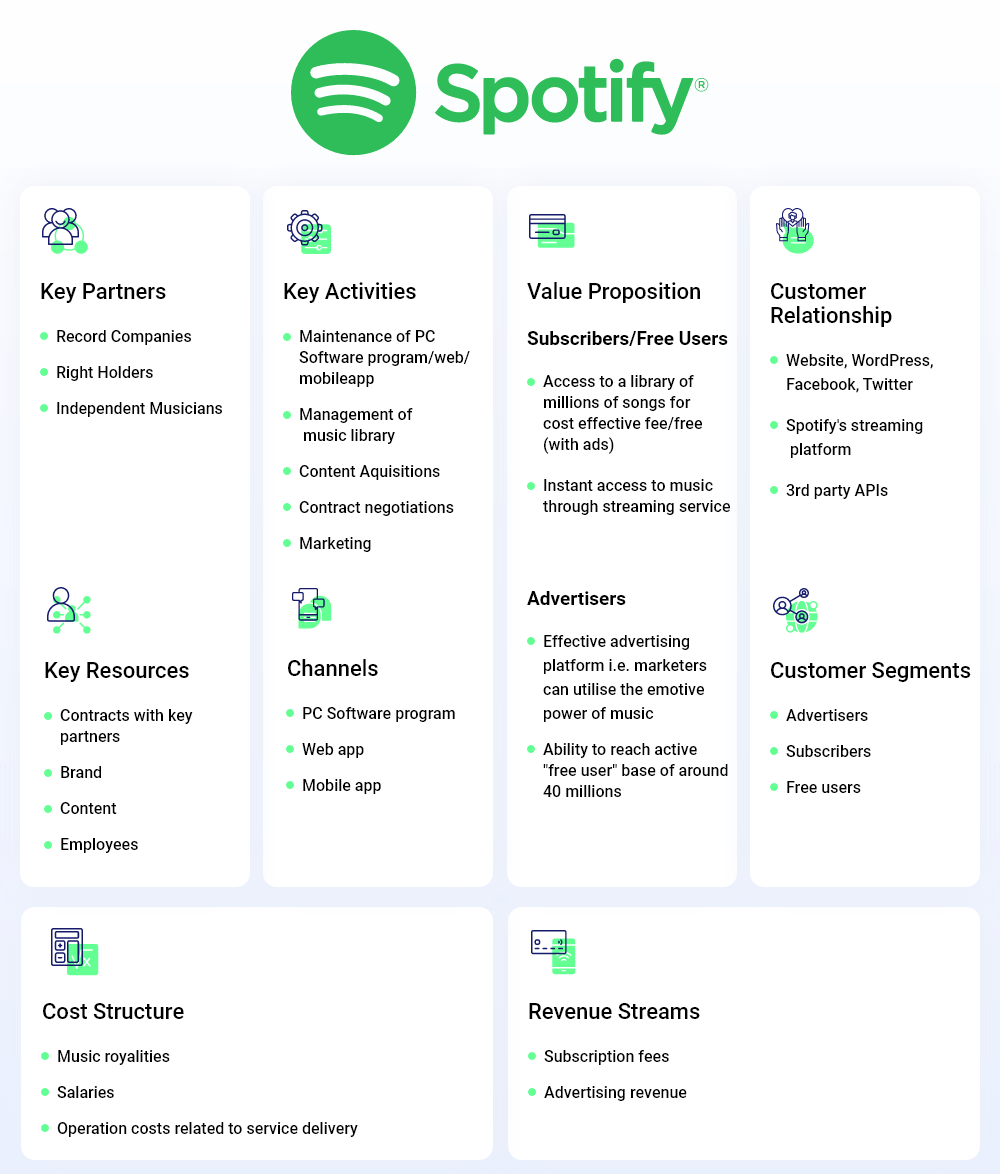
Next, let’s understand how the popular music app Spotify operates and earns money. Below designed is the business model canvas of Spotify.
The Total Cost Involved In Music Streaming App Development

The total cost to create a music streaming app solution depends on the following factors:

  • Market Investigation (App discovery)
  • App Prototype and Wireframing
  • UI/UX design
  • Minimum Viable Product (MVP)
  • Technical specifications
  • Development (No. of App Platforms)
  • Key Features Involved
  • QA and Testing
  • App Release and Deployment
  • Maintenance and support

Further, it also depends on the team size and geographic location of the app development team. As the hourly rates change country-wise. Read more : How to Make a Social Video App like TikTok?

A Ballpark Figure

While it is hard to estimate the total cost without knowing the detailed project scope but a rough estimate could be around USD 12,000- $20,000.

How Codiant Can Help You?

Codiant is a top on-demand app development company that holds an astute experience in developing apps of all types. We as a music streaming app Development Company have helped a couple of businesses develop music apps with hyper-personalization features and omnichannel experience. If you’re looking to develop a music app from scratch or looking for a ready to market app with your own customization and branding, Codiant can be your right technology partner. We provide pre-made music streaming app. Our white-label product “Music App” is fully customizable and can be reskinned to your brand design. Download the app now to view its basic functionalities.

How to Create a Workout and Personal Fitness Trainer App?

As a fitness app trainer or a Gym owner you know the power of Fitness App. It’s more than a mere app solution allowing you to track your client’s runs or workout activities. It’s a live wire and everyone’s new go-getter milestone, health benchmark and a Virtual Gym having a personal trainer. The tricky thing is that only a few personal trainers or Gym owners know how to create an ideal fitness workout and exercise app or a personal trainer app that easily helps them retain valuable users and create a consistent source of revenue for their business. If you’re looking to reach your target market, engage valuable users and stand out from competitors you’re in the right place.

In this blog, you’ll find the foolproof feature set, tools and technologies that must be integrated while workout and exercise fitness app development. By the end of the post, you will learn:

  1. Features That Optimizes Your Customer’s Experience
  2. Important Functionalities & Tools That Will Help You Reach Your Target Market
  3. Different Executive Models To Generate Revenue

This prototype of fitness app solution will help you generate more leads, engage new users and retain the existing users, but first let’s demystify types of fitness apps and analyze the current fitness apps market performance. Related: How Workout Apps Are Saving Big Bucks Of Fitness Enthusiasts? The fitness app market is divided into four different segment- some of which will often be combined in one app.

  1. Workout and Exercise Plans
  2. Personal Training App
  3. Activity Tracking App
  4. Diet and Nutrition App

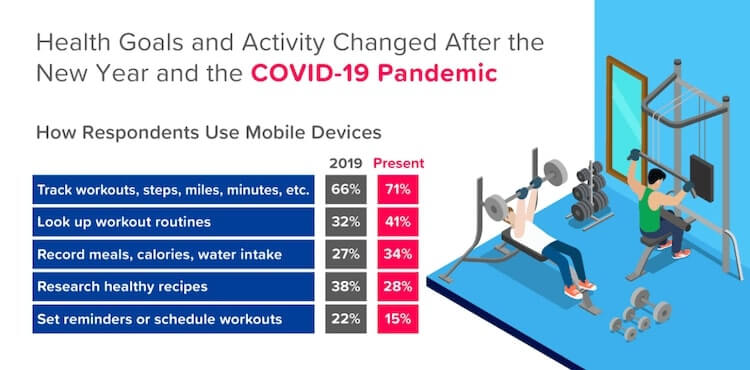
The business model of all these fitness apps have a same goal- ‘Conversions’. That is achievable by delivering the best user experience to the person using the fitness app in the minimum amount of clicks. To do that you have to create what people want. But the truth is, people don’t know what they want until you show them in a most simple way. Now that people have accessed and have had exposure to different ways a basic fitness app can help them in maintaining their health and fitness regime, they will always look to find more diverse app features to fulfill their specific needs. Like in the past few years, mobile fitness was only limited until tracking. But today the definition of tracking is expanded from steps to diet and meal, exercises and even sleep. The facet of fitness, health goals and activity of people have changed and sped up after the COVID-19 Pandemic. Today, 41% of people are looking up to workout routines against 32% in 2019. Around 71% of people are tracking workouts, steps, miles, etc. as opposed to 66% in 2019.

Pic Credits: Business of Apps People have got multi-tasky than ever and they want an assorted number of options in one fitness app to achieve their fitness goal. Let’s look at these foolproof features to create a market-leading fitness app solution that increases user engagement and retention.
Features to optimize user onboarding experience

Social Signup/Logins

Every user tends to reach the end goal faster. They want to get started ASAP. So, make the account creation process quick. Allow your users to log in through social accounts, mobile numbers and email id. Whatever they prefer simple and easy to access.

Interactive Tutorial

Users don’t seem to use your app regularly or at all. So, help your users get started with a very quick interactive tutorial. This will help them know how the core features of how your app work.

In-App Messaging

In-app messaging are the notifications or pop-up that appear when a user is active in the app. Do not confuse push notifications with in-app messaging. They are the native part of the app experience. They are intelligent and an immediate result of the user’s in-app behavior. This highly relevant in-app messages will help you gently nudge your user to take action. Say for example, if your user has just completed a workout- it may be the best time to propose your user with a complimentary offer. Like, do you want to take your fitness goal to the next level? Upgrade now. This type of personalized alerts increases app session time and encourages conversions.

Push Notifications

Push notifications are a good way to bring users back to your application and improve engagement by up to 88%. These personalized and timely notifications can remind them of the purpose for which they have installed the app. Some of the examples of encouraging notifications for your fitness app can be:

  • Motivating users to stick to their exercise regimen
  • Reminding users of the workout time
  • Congratulating clients on their progress
  • Sending them motivating quotes and inspiring to start again
  • Encouraging them to book online classes

Notifications at the right intervals can not only help your user stay on track and achieve their set goal but also help you strengthen your relationship with customer for a long time.

Blogging

Creating fitness-focused content and sharing them on multiple channels is a great way to engage existing clients, find new users, and establish a brand presence. Popular fitness apps like MyFitness Pal, Google Fit and many others have found many innovative topics to keep users informed and engaged.

Important functionalities that will help you reach your target market

Live Video Tutorial

Users who are not willing to visit the gym, are the ones who look up to you. Expect from your fitness app to help them resume their workout sessions or help them start from scratch. A great way to assist them is to post pre-recorded workout videos. To add greater visibility and convenience you can take LIVE virtual classes and train your users one-to-one.

Activity Monitoring Tool

Your app should be ergonomically designed such that it helps patients monitor and track their daily physical activities and motivate them to be more active.

Results and Progress Tracking

Seeing results after an exhaustive set of workout is no less than a miracle cure a fitness user have all been waiting for. The fitness app must allow your user to track their daily steps, no. of calories burnt, heart rates and all other physical efforts made by him/her. This encourages user to continue the next day with the same spirit.

Payment Gateway Integration

Your app should always support multiple modes of payment like the flexibility to pay through credit cards, debit cards, net banking, UPI or mWallets. Having all these options in place will never let go your user out of fuss.

Diet and Meal Planner

There are thousands of fitness apps registered on the app store and play store. But how many are well-known? Giving an added value proposition tailored for users will help you attract right traffic in abundance. A personal trainer and workout fitness app that combines a healthy meal planner to lose weight or gain weight can help you drive a massive amount of user traffic.

Marketing and Promotional Tools:

Besides in-app messaging and push notifications, other tools that help you in reaching a large user base and target market are:

  • Paid User Acquisition: This paid user acquisition technique through target advertising and app install campaigns will help you drive installs and engagement. You can also re-target your existing users to prompt them to upgrade their plans and take post-install actions like purchasing subscriptions.
  • Social Media Marketing: Tactical use of social platforms like Facebook, Instagram, Twitter can help you connect and engage with your huge base of audience. You can create an online fitness community and establish your brand presence, increase sales and drive app traffic.
  • Email Marketing: Email marketing strategy can do wonders for fitness member retention and new user acquisition. For every $1 spent you earn $38 to $44 in return. Furthermore, a customer’s first preference is email for looking up to marketing messages.

Different executive models to generate revenue

There are several different ways and marketing channels through which fitness app generates income. Like MyFitnessPal is a free app that earns money through premium memberships and ad revenue. Google Fit drives its major revenue from global advertising. Here are other different types of app revenue models you can utilize to maximize your income:

  • Ad-based model
  • In-app purchases
  • Freemium model
  • Sponsors and partnerships
  • Paid downloads
  • Subscription Model

You can’t ignore this!

Whether you run a gym, or are a personal trainer or offer specialized fitness classes like yoga, or meditation your business success rests on your ability to get clients, keep them engaged and coming back. No platform does this well than a fitness app. So, be wise when you hire a Fitness App Development Company. Check if all your development needs, customer engagement tools and functionalities are integrated to compliment the app and make it user-sticky.

How Retail Banks Can Innovate in the COVID Times

The COVID-19 pandemic is taking an awful toll on human lives and their livelihood; affecting millions of people all over the world. The lockdown imposed in many countries to contain the spread of the virus has ignited a serious economic disruption. Consequently, affecting almost every industry where Banking and Finance is no exception. Capital, profit-and-loss, and liquidity positions have been hit very hard. The flaws in banking models have started floating, leaving their reliability on doubt. To navigate in this crisis and ensure long-term sustainability, digital adoption in the mobile banking industry has a key role to play. In this post, we will discuss how retail banks can leverage digital technologies and innovate to respond to the coronavirus pandemic.

Meet the Low-Hanging Ways to Bring Innovation amid COVID Times

1. Build Omni Channel Experiences to Keep Your Customers Engaged

Are you still operating in an old school way? Only having a banking website will not help you survive especially in the market where customers are bombarded by multiple bank calls, messages and Ad traps to become their customers. You will have to grip mobile banking app development, banking website and other customer journey mapping tools like messaging apps to engage your customers beyond the traditional financial channels. “Mobile banking has become the new norm- says a PwC report”, be ready.

Image Source: Bank of America

2. Become Proactive On All Your Digital Channels

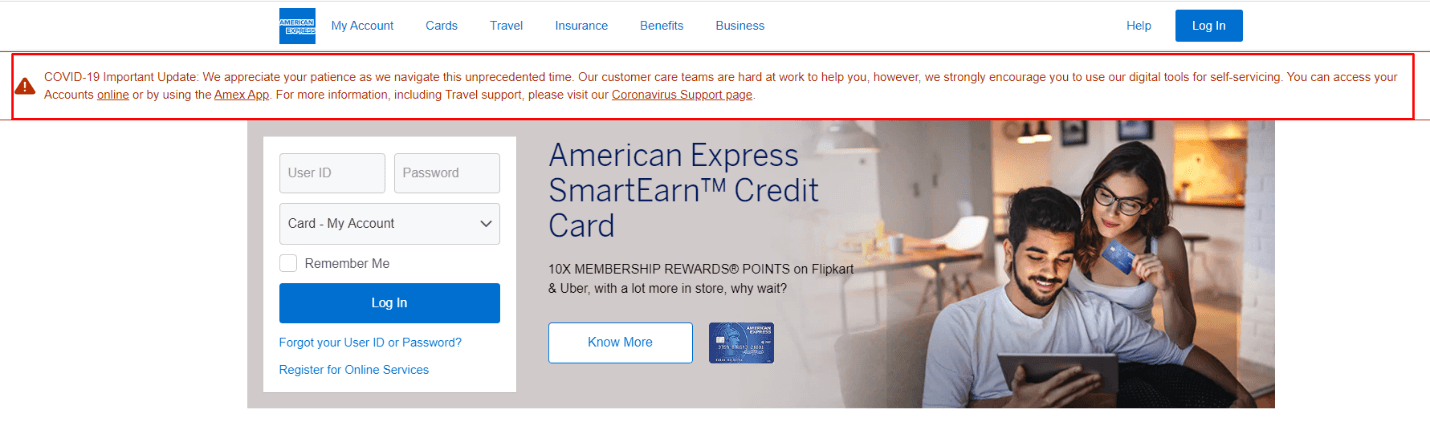
Yes, the customers are restraining to visit banks and want to stay in-house to maintain their banking operations. In these challenging times, those banks will win who keep their services a step ahead. The banks that proactively update their customers with any help they need through their digital channels (such as banking mobile app, banking websites, mobile banking) will be the market leader.

Image Source: American Express

3. Integrate Your Banking Mobile App With A Chatbot

The customer is God! And responding to customer queries in real-time should be your religion. Thankfully, we have got Chatbots to worship well. Chatbot solutions allow you to enhance the first response time and help you to provide online customer support seamlessly. Advanced technologies like Artificial Intelligence and Machine Learning trains bot as per your customer ethics and makes the conversation look natural like real humans. Thus, helping you in satisfying customers and nurturing leads- that directly improves your key productivity metrics.

Looking for Chatbot App Development? Meet Tetebot- AI Powered Chatbot to Superpower Your Virtual Assistance.

Click Here

4. Build Empathy by Offering Your Customers COVID Relief Services and Schemes

Until now, banks heavily built varied strategies into consideration with market trends, fluctuations, demands, etc. around different sectors. But in this time of crisis, banks need to curb the needs and agonies of customers by launching schemes and take steps like:

  • Offering emergency funds, credit facilities, loans to SMBs as well as SMEs at discounted rates to slowly recover from the loss.
  • Give some relaxations in EMIs, waive off minimum balance charges, and stay lenient in KYC norms.
  • Increase the limits for online transactions.
  • Launch products and schemes like health insurance, family/ group health insurance, easy personal loans, and subsidies on education loans and so on depending upon your customers and beneficiaries.

Image Source: Barclays

5. Educate And Engage Customers Through Banking Communities

Increase your community outreach by educating your audience about the project you undertook and the one that falls under the COVID crisis. This may include educating customers about government measures, helping people with personal credit support.

You Cannot Ignore…

Mobile banking app solutions or Digital banking is the bedrock for retail banks to navigate in this crisis and keep themselves as well as the customers safe and powerful. If you are looking for a banking and finance app development company or already have a digital platform and are looking to overhaul it with new features, contact our business development executives to get started quickly! We are available for you round the clock with personalized recommendations and a free project estimate.