How To Upgrade & Advance Your Grocery Business Using On-Demand Grocery App

Shoppers’ sensitivity towards buying groceries has increased. Nowadays, not only they are looking for convenience but aspects like transparency, product reviews, social shopping, and personalization are also taking the front seat in their lives.

This changing consumer behavior poses the biggest challenge for grocers operating their business in traditional brick n mortar stores.

To cut to the chase and to increase the customers’ trust and loyalty; grocers are compelled to upgrade their business with an advanced Grocery Delivery App Solution.

Hence, we have come down to this post to narrow down your search to upgrade your Grocery delivery business and power your grocery app with a smart feature counter.

But before we delve into the details, let’s understand what exactly a grocery delivery app is and why it is driving consumers at a large! Read on.

What Is On-Demand Grocery Delivery App?

The term in itself is self-explanatory! The on-demand grocery app is a real-time platform with a large variety of grocery listings to order 24/7 from the comfort of your couch & get delivered to the doorsteps. The grocery delivery app is helping businesses to reach a large number of people and offer them convenience by quick deliveries and instant discounts for the available products.

Types of Grocery Delivery Business Model

1. Brick & Mortar and Store Pick Model

In this type of model, the companies (app owner) either have a wholesale or retail grocery store like another store in the market, or else they have partnered with other grocery vendors just like the aggregator model.

The aggregator model explains that business owners will partner with multiple grocers in the market and then collect the delivery orders from the customers and deliver to the desired location.

This is a popular business model because there is a very low investment as an owner doesn’t need to invest in a warehouse facility or any other inventory management, they can take the goods directly from the grocers and confirm the availability of the same.

2. Pure-Play And Warehouse Pick Model

It is a different model where business owner does not own any personal store and neither they partner with any of the vendors rather, they directly buy products from producers/manufacturers and keep them safely in their warehouse for the further sales process. This model needs an investment in handling warehouses and goods especially the perishable ones.

3. Hybrid Model

As the name suggests, this model is the mixture of the aforesaid models in which the owner does not have their store but in some places, they can partner with the vendors for the product procurement and make the process convenient for them as well as the customers.

What Drives Consumers to Shop for Groceries Online?

Extra icing on the cake is cherished by all and the concept of an on-demand grocery app is just similar to that. The app gives you multiple ways to entice your customers like the app allows grocers to offer a wide product assortment and detailed product information, the app facilitates price and product comparisons, appealing discounts, easy payment gateways, quick customer feedback, speedy delivery, access to a large audience and many more. Also, there is not much extra spending in the up-gradation process of your grocery business rather you will be surprised with its ever-growing profits.

But success does not come overnight. Businesses have to follow the hallmarks and signs of winning customer experience maxed out by the right customer engagement strategy, user-centric design, and impeccable services.

To ensure that accuracy, you have to strategize your grocery delivery app in such a way that it is easy for the user to use & understand the features of the grocery app.

Let’s have a look at those simplified features that you need to include in your grocery delivery app to gain their trust & confidence and build an incredible brand image in the market.

Key Features of Grocery Delivery App

There are three main stakeholders of Grocery Delivery App that catapults the successful execution of the delivery economy.

  • Customer App
  • Delivery Boy App
  • Admin Panel

All these apps when power-packed with A-Z features and current trends that satiates the customer to the core helps grocers & aggregators thrive in the hyper-competitive market.

To make this brainstorming development journey a low-hanging fruit for you, here we come up with a brand-new list of trending grocery delivery app development features.

Customer App Features

  • User Login : Make the login process easy by offering login through social media credentials, phone no., or email. This saves the time & effort of the user.
  • Google Map : Users don’t need to put the address, every time they place an order rather the location will be automatically detected and there will be an option to save your permanent/office address.
  • Quick Search/browse Items : List down all the categories of the available items and also provide subcategories along with other additional product details. This feature offers an excellent experience to users help in taking quick actions.
  • Avail Offers : Before placing the order, users check out the available offers/discounts so that they can apply them in their order & cut down the cost. Thus, offering discounts, promo codes at this stage is a good way to reduce the chances of cart abandonment.
  • Live Location Tracking : This feature allow the user to track the on-process order.
  • Notifications : The user likes to stay updated and this feature will allow the user to get information via popup notifications like order acceptance, order packaging, order picked up by delivery partner, order on the way, and order delivered.
  • Schedule Order : The user can place an order and schedule a suitable delivery time from the available slots.
  • Payment Mode : Different modes of payment integration will allow the user to pay using an e-wallet, UPIs, Net-banking, debit/credit cards or cash on delivery.
  • Cancel Order : User will enjoy the freedom to send cancel order requests in a given time frame i.e., within 30 mins.
  • Feedback : After completion of the order delivery, the user will have an option to rate the app & share review/feedback about the services.
  • Delivery Tip : If the user enjoys excellent delivery services like speedy delivery, quick response, better communication then, they can add a tip for the delivery person.

Delivery Boy App Features

  • Delivery Person Registration/login : The delivery person will register himself by filling in all the required details like name, license, photo, contact details, etc. to ensure authenticity & security.
  • Order Detail/management : To view order details like order request, sending acceptance or rejection of the same.
  • GPS/ Live Tracking : This will support the delivery person to find the exact location where the order has to be delivered and also suggest the best-optimized route to reach the destination.
  • Delivery Status Update : Using this feature the delivery person can update the delivery status to the customers like order picked, on the way, in-progress, delay in delivery, and so on. The notifications will be sent to customers via text messages or email.
  • Delivery History : This feature will allow the delivery person to track the no. of deliveries he has made so far and the total amount of payment received.

Admin Panel Features

  • Profile Management : Admin will get access to manage all the accounts like product categories, subcategories, the account of retailers, drivers & customers.
  • Dashboard : This feature allows us to take a God view of all the activities like orders, deliveries and payment of the items.
  • Order Management : Admin can check the status of the order and assign orders to the available delivery person.
  • Report Management : Admin can manage daily/ monthly reports like how many total registrations are done including customers, retailers, deliverers.
  • Notification Management : Admin can send notifications like discount/offer, order updates, other related notifications based on customer order history.
  • Feedback Management : Admin will get full access to customer comments for deliverers, services, apps, retailers, etc.

Advanced Features

  • Order History & Repeat Orders

    The user should be able to check the order history bifurcated by active orders, scheduled orders, past orders, and reorder. The user should also be able to repeat their past orders.

  • Prebook & Schedule Order

    Give users the liberty to pre-book their orders ahead of the time like 2-3 days or 48 hours earlier and schedule a time for delivery. This feature will allow supermarkets to better predict the demands, which will eventually help them to improve efficiency in delivery. Further, it will also help them tap customers who might not end up ordering last-minute groceries due to long delivery times.

  • Special Offers

    Bombarding offers at the right occasion, right time, and place can surely elevate your sales, par excellence, to a record high. Make a list of occasions, events, even the trivial ones, and rebrand offers around it.

    For instance, if Christmas is around the corner, you can come up with promo codes related to SANTA and set a threshold of minimum buying in order to apply different promo codes for bulk discounts. This is just an example of shooting offers, it can oscillate from earning prime memberships through loyalty points, giveaways, and flash sales to competitions and free shipping.

  • Machine Learning-Empowered Ordering Solutions

    Improve customer experience and customer satisfaction by optimizing order fulfillment using machine-learning empowered app ordering solutions.

    Machine learning-based data makes use of real-time data, both to see and react quickly to problems that may arise.

  • Data-Driven Restaurant Management Solutions

    Data-driven decision-making can bear fruits for any grocery business in its infancy. With data-driven grocery delivery management solutions, supermarkets can optimize their decision-making at a more granular level.

food-cta

Marketing Tips To Cut The Competition and Race Ahead!

1. BOPIS

Tap shoppers’ affinity for buying online and picking up in-store. Shoppers today want choice as well as flexibility in how they want orders to be delivered. BOPIS allows shoppers to save the walk-in and searching time spent on aisle and item shelves in the supermarket. Through BOPIS, they can immediately purchase the items they are looking for through quick search functionality in the app.

Retailers nowadays are increasingly implementing BOPIS into their omnichannel retail strategy. You only need three things to execute it smoothly:

2. Curbside Pick Up

Also known as pick-up only spots, this idea allows shopper traffic to gain traction post-pandemic world. You can either create in-store pickup towers like Walmart did or create an outdoor pickup solution with temperature-controlled zones for hot and cold groceries. This can help people solve last-mile challenges.

By bringing this type of pickup capabilities, grocers can increasingly drive profitability.

  • A Grocery Delivery App or website for placing the order
  • One physical store where customers can walk in to collect the item
  • Real-time inventory capabilities to create analytics on order status, workflows, overall cycle time, and customer engagement

Codiant Opens A Pool Of Opportunities For The Grocery Business Owners And Supermarkets

Codiant in its fresh drive to support independently-owned supermarkets and grocers to drive profitability is creating a compelling mobile app ordering experience and E-commerce website.

Our deep industry experience in on-demand mobility solutions has led us to create an impressive roster of advanced technology offerings and functionalities that create immediate and long-term value for expanding the base of grocers and supermarket chain owners.

From independent supermarket owners to large multi-unit brands, Codiant now provides a holistic suite to cater to the the ever-changing needs of your customers in this digitally-maturing world.

How Healthcare Providers Benefit From Clinical Collaboration Platforms

Collaboration is key. A key to effective working. A key to improved efficiency. And a key to productivity. Irrespective of any industry. Benefits stand the same. But for the healthcare industry, it’s a matter of life and death. Clinical collaborations make it easier for healthcare providers and patients to effectively communicate and collaborate with the right tools and software. Allowing them to help patients receive a timely and broad spectrum of care—anytime, anywhere. Besides, clinical collaboration tools also help clinicians to instantly and securely share updates with patients about their own treatment and health. As a result, these platforms and tools deliver powerful benefits for both- doctors and patients.

How Doctors and Patients Benefit From Clinical Collaboration

  • Improved care delivery
  • Reduced hospital stays
  • Reduced costs and medical expenses
  • Fewer hospital readmissions
  • Effective patients and providers communication
  • Improved clinical productivity and efficiency
  • Streamlined clinical workflow with zero confusions

True to its name, clinical collaboration. To leverage it fully healthcare organizations must strategically identify, adopt, or deploy and manage healthcare tools and mobility devices that effectively support collaboration use cases in their ecosystem. Among all the solutions and platforms that contribute to enhanced providers and patient collaboration are mobile apps, telehealth solutions, device management, IoT sensors, and clinical collaboration and communication solutions. Let’s understand them separately.

Key Solutions That Improve Clinical Collaboration

Telehealth App Solution

Telehealth aims to enhance patient experience and provider’s convenience through its video collaboration, messaging, and voice tools. Care providers are adopting the use of telehealth app in the form of mobile devices, laptop to collaborate more effectively. Physicians can treat patients outside the clinical walls and other than normal business hours in case of emergency care. Telehealth platforms also allow physicians and clinicians to engage in training, observation, consults without having to commute long distances. Moreover, there are several other advantages of telehealth and telemedicine app solutions in shaping the future of healthcare:

  • Telemedicine apps facilitate rapid stroke diagnosis and treatment
  • Significantly reduce hospital readmission rates
  • Solves healthcare challenges in rural areas
  • Simplifies acute, chronic care, and dermatology consultations

How Physicians, Clinics, and Hospitals Are Benefitting From Telemedicine Platform

Get in Touch

The role and benefits of mobility in clinical settings are now more important than ever. Speed, accuracy, peace of mind are some of the direct outcomes that ease the workflow of hospitals, doctors, and patients. From patient’s medical record retrieval to ePrescription, remote monitoring to health status tracking, hassle-free checkups to performance improvement in clinical decision making, Mobility in Healthcare has tremendously helped Doctors to foster collaboration, make timely critical decisions and boost patient outcomes at a greater scale.

Mobile Device Management

Healthcare organizations are continuously coping with data and security breaches where patients’ data is the foremost target. “42% of healthcare organizations have reported that they had experienced a data loss or system downtime as a result of a breach involving mobile devices in the previous 12 months.” The concept of mobile device management evolved here and many hospitals adopted a unified endpoint management approach. MDM solution allows caregivers to access patient data history, treatment updates, and other important medications and reports through securely managed mobile devices. These secured devices help them to battle with challenges like improper data handling, real-time information sharing, record-keeping, and mobile report management.

Clinical Collaboration And Communication Solutions

Clinical collaboration and communication solutions have their own individual benefits for patients, clinicians, and healthcare organizations. Given, healthcare providers are unable to meet their holistic needs with traditional apps due to concerns like patient’s privacy and security; healthcare organizations seek app platforms and solutions particularly designed and developed to meet the needs of clinical collaboration to prevent such scenarios. These type of app platforms enable features like:

  • Secured messaging and data sharing
  • Video, voice, and text integration
  • EHR mobilization
  • Doctor-nurse communication
  • Nurse-nurse communication
  • Doctor-patient communication
  • Patient engagement solution

As a result, these technologies individually helps healthcare organization in facilitating enhanced care delivery to patients, reduce hospital stays, and readmissions. For clinicians, they can streamline the workflow through automation, help doctors to understand patient’s health better, and improve inter clinic collaboration. While for patients, these solutions can help them improve their quality of care, save time, cut costs, and reduce the dependency on in-person hospital/clinical visits.

Top 5 PHP Frameworks for Web Development in 2023

For developers, the introduction of the concept of frameworks is no less than a boon. These frameworks are equipped with actual programs based on which the software is built. The frameworks provide ready-made components and libraries to fasten the overall development process.

In this reference, PHP (Hypertext Preprocessor) is a web development programming language, which is stuffed with a great number of frameworks facilitating different dimensions. Now, PHP is a widely used web development programming language. It is responsible for almost 79% of the websites globally as a server-side programming language.

The popularization of PHP for web development is because of the availability of a wide range of high-quality web development frameworks. Despite that many consider PHP as a dead web development language, however, Google search trends narrate quite an opposite story. Well, this debate is unending, however, rest assured that PHP is not dying anytime soon.

Based on the ongoing trend, it is clear that many websites are preferring PHP, and using the PHP framework is undoubtedly a good decision. But the question is which could be the best PHP framework that can fulfill your business specifics.

To minimize your struggle, we have distilled down the top PHP frameworks that you can choose to optimize your business processes in the best possible manner!

Top 5 PHP Frameworks for Web Development in 2023

1. Laravel

Laravel is an open-source web development framework. It was developed by ‘Taylor Otwell’ and released in June 2011.

It can handle complex web apps with high security and comparatively faster than other PHP frameworks. Hence, with the Laravel framework, authentication, routing, session, caching, etc. operations can be handled easily. There are many Laravel web development companies that claim to provide all such operations and build a unique solution.

Key Features:

  • Laravel makes scalable web development and provides more high-security features than other PHP frameworks.
  • Websites developed on the Laravel framework are highly secure, easy, and resistant to numerous web attacks.
  • It includes namespace and interfaces, that support organizing and managing a variety of resources.
  • Laravel framework can reuse the existing components from the different frameworks that minimize the overall web development timeline.
  • It saves a lot of testing time and resources by supporting automation testing.
  • The Laravel framework uses its template engine i.e. ORM and Blade called Eloquent.

Companies Using Laravel Framework for their Web Development

  • Razorpay
  • Olx
  • Mastercard
  • TransferGo
  • 6GAG
  • Wattpad
  • Fox47
  • BBC
  • Pfizer, etc.

2. CodeIgniter

CodeIgniter is a web development framework with small footprints of merely 2MB of size (including the documentation). This makes it quicker than other PHP frameworks. It was developed by ‘EllisLab’ and is released in February 2006.

CodeIgniter is not entirely dependent on the MVC framework. Without a doubt, it is one of the oldest frameworks, which supports quicker and high-quality performance. This PHP framework is apt for dynamic website development. It is equipped with a wide range of prebuilt modules that support robust platform development and reusable components. It also offers quality error management and easy-to-read documentation.

Key Features:

  • It performs quick operations based on database processes as compared to other frameworks.
  • It is a great framework for beginners to work with because of its easy installation process and well documentation.
  • It offers built-in security tools.
  • CodeIgniter framework provides exceptional performance.
  • It offers valuable features that enable to provide a secured web application from external threats, such as remote code execution, SQL injection, and cross-site scripting attacks.

Companies Using CodeIgniter Framework for their Web Development

  • Udemy
  • Medical Guardian
  • Adobe
  • Ola
  • Accenture
  • Amplify
  • BigBazaar
  • Buffer
  • 3M
  • Grindr, etc.

3. Symfony

Symfony is a modular-based PHP framework and is most suitable for large-scale corporate applications. It was introduced by ‘Fabian Potencier’ in 2005. It is an open-source PHP framework sponsored by SensioLabs.

It is an extensive PHP MVC framework, it can easily integrate with PHP Unit and independent libraries. It is mostly the first preference of developers because of the availability of reusable components and libraries. By using these tools, authentication, object configuration, templating, and other varied tasks can be done easily. Symfony framework is used to build not only apps, but also web apps, microservices, and APIs too.

Key Features:

  • It uses open-source Doctrine ORM for database operations and is one of the most suitable alternatives to write repetitive SQL codes.
  • Symphony supports a variety of databases, including Oracle, MySql, SQL Server, SQLite, SAP Sybase, etc.
  • It is highly flexible and can integrate with big projects like Drupal.
  • It uses Twig templating engine, which is fast, secure, and easy to learn.
  • It is equipped with a robust and flexible debugging toolbar that displays all the required details to make debugging simple.
  • It’s quick to deploy Symphony, hence it doesn’t require any time or effort on manual deployment or developing an automated deployment.

Companies Using Symphony Framework for their Web Development

  • Spotify
  • BlaBlaCar
  • Practo
  • com
  • Statista
  • Magento
  • Sony VAIO UK website, etc.

4. CakePHP

CakePHP is a rapid-development PHP framework modelled after Ruby on Rails. It was released under the MIT license in April 2005. It is an open-source web development framework that follows ORM techniques and is based on MVC architecture.

It is an easy-to-learn web framework, as it is a CRUD framework, i.e. Create, Read, Update, and Delete. CakePHP framework follows CoC (Convention over Configuration) approach which defines the coding guidelines that developers need to follow. It is equipped with a huge number of libraries, which is considered one of the most diverse collections of useful components. The PHP developers can build scalable and secure web apps for different industries, such as eCommerce, social networks, and digital collaboration platforms.

Key Features:

  • CakePHP is simple to set up on a device. It requires simply a copy of the framework and a web server.
  • It supports different renowned design patterns like Front Controller, Associative Data Mapping, etc.
  • CakePHP leverage scaffolding and code generation feature of rapid prototype or MVP development. The scaffolding technique enables to access databases easily or generate codes using some high-level tools.
  • It supports numerous security features, including input validation, SQL injection prevention, cross-site scripting (XSS), and cross-site request forgery (CSRF) protection, which makes it an incredible option for business applications.
  • It also offers exceptional documentation, and a wide range of supporting sites, and extends premium assistance via Cake Development Corporation.

Companies Using CakePHP Framework for their Web Development

  • Glen Raven
  • Citizens
  • InSync Solutions
  • Hyundai
  • BMW
  • Edureka
  • MIT
  • Billabong
  • House Party
  • Blendtec, etc.

5. Yii

Yii is an open-source, high-performing PHP framework for developing web apps rapidly. It is simply pronounced as Yee or Ji – which means simple and evolutionary. It also stands for, ‘Yes it is’! Yii – The PHP framework was released in 2008.

It is a fast, flexible, and a secure PHP framework for web development, and specifically extends its brilliant support in building MVC architecture websites. Yii is a strict object-oriented PHP framework and requires an understanding of polymorphism, inheritance, etc. The documentation of the Yii framework is very well prepared and organized. This not only helps to learn about how to build an app, but the user can also learn about working with databases, MVC patterns, and other functionalities.

Top Features:

  • Yii has easy-to-follow guides for implementing different types of caching, such as data caching, page caching, query caching, HTTP caching, fragment caching, etc. All of this is suitable for server-side caching to client-side in-browser caching.
  • This framework also provides guidelines and framework for boosting security by implementing authorization, password handling, authentication, trusted proxies, cryptographic features, and headers.
  • It is quite a flexible PHP framework that allows developers to modify every line of code. Hence, it could take some time for beginners to have a grasp of it.
  • Yii is developed by specialists and a team of core developers. Even, one can submit the issues they are facing while developing on the Yii forums and receives assistance and support from the large community.
  • MVP and prototype can be developed rapidly on the GII2 code generator provided by the Yii framework to implement CRUD operations on the database.

Companies Using Yii Framework for their Web Development

  • Lenovo
  • Deloitte
  • Utrip
  • Discovery
  • Fujitsu
  • Lulo

Conclusion

PHP framework simplifies the web development process and supports reducing the workload. Each PHP framework is equipped with its strengths and weaknesses, which vary in the context of the database, documentation, and community they support.

We hope the blog is precisely providing all the vital details of the top 5 PHP frameworks for web development in the market. However, to get the most out of the PHP framework, and avoid errors, and frustration, ensure to have a decent knowledge of the PHP framework and its concept.

Apart from that, if you are having a hard time selecting the right PHP framework for web development or looking for an expert PHP web development company, then hire Codiant to answer all your business requirements and you can’t go wrong with this.

What is Digital Transformation & Three Steps to Get Started

Imagine a company ecosystem, “where products and marketing campaigns are launching at record speed, where data and insights are available in a click for rapid adjustments, where results are reflected in a fly, and where uncertainties are faced boldly”. – This is a digitally transformed organization.

Today, companies are looking for a nucleus giving a ripple effect on all companies’ touchpoints to deliver an unmatched customer experience, to seek a manual that dictates ahead strategy, and to create a prediction model that foresees market opportunities.While Covid-19 has been the accelerator of digital transformation, 79% of companies have admitted that the pandemic has increased the budget and if they do not adapt to digitally transform within a year, the organizations will start to lose the business.

What Is Digital Transformation?

Digital transformation means the integration of digital solutions into all areas of the business to fundamentally change organization’s business model and operating model to address and capture new market opportunities and improve customer experience.

While digital transformation looks different and works differently for every industry, but the DNA of its process and capabilities applies the same for every company.

Deloitte, explains this definition very well. Digital transformation means “Bringing the real-life experience of transformation as well as digital solutions to support our customers on their transformation journeys”.

In this process, we help companies to move away from the long-standing business process, resist getting comfortable with inefficiencies, workforce burnouts, and in turn, challenge the status quo and focus on a longer-term horizon. This outside-in transformation helps companies accommodate in uncertain markets of today and future, makes them market-ready, and agile enough to make winning moves.

Know Your Customers Better: Here‘s A Digital Transformation and Modernization Guide to Help Your Business Outshine.

Get in Touch

Defining the Scope of Digital Transformation

The scope of digital transformation is harnessing the ‘5D’s of Digital’ defined by Dave Chaffey in his book Digital Marketing: Strategy, Planning, and Implementation. The 5Ds outlines the opportunities for customers to interact with the companies and for businesses to reach and learn from their target audiences in different ways:

  • Digital Devices –Owing to this reason, visitors connect with brands and companies through their digital assets like websites, mobile apps, and official social media handles- all executing and running through digital devices. Thus, its role can be positioned through a combination of connected devices including smartphones, tablets, desktop computers, and TVs.
  • Digital Platforms – A consumer interacts with a brand through its most active digital platforms like mobile app and web and social media handles that’s Facebook and Instagram, Google and YouTube, Twitter, and LinkedIn.
  • Digital Media – Digital media includes different Paid, Owned, and Earned Media communication channels for increasing audience reach and engagement including advertising, email marketing, messaging, social media, and search engine optimization.

digital-transformation

  • Digital Data – The amount of insights businesses generate by collecting information about their visitors, customers, and their interactions with businesses, at a day-to-day level. This can be done by data analytics technologies and techniques. However, this now needs to be protected by law in most countries.
  • Digital Technology – The marketing technology or martech stack that businesses use to create interactive experiences from websites and mobile apps to in-store kiosks and email campaigns.

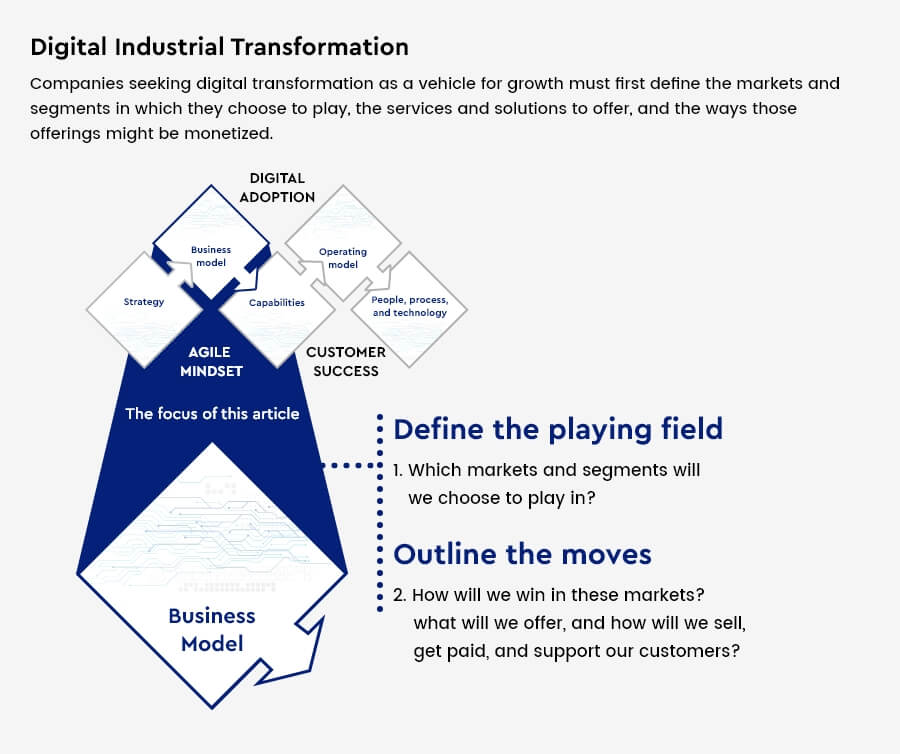
Digital Industrial Transformation: The Three-Step Approach

digital-industrial-transformation

Organizations and companies seeking digital transformation as a growth driver must start from the following three-step approach:

  • Defining the playing field: Markets and segments in which they choose to play
  • Services and Solutions to offer: Decisions around services, new products, and solutions
  • Monetization: Bundling those offerings and solutions to create pricing tiers and a monetization model.

1. Define The Playing Field

Intersection of industry verticals and use cases infused with the outcomes of the outside-in lens defines the play-field of enterprises.

Still, there are brands and enterprises, nascent to determine where to start and how to start; which market segments should they pick and take ownership of. In such cases, where choices are many but the bull’s eye is not clear- an outside-in lens that focuses on fencing those industry verticals and use cases having the greatest market potential calculated on behalf of projected market size, market growth rate and competitive intensity – come into play.

An outside-in lens, make strategic adjustments to see the future market shifts, risks and uncertainties, and challenges in productivity. It helps companies understand their own abilities in the realm of the current market segment. Their proximity to commercialization of innovation efforts and internal capabilities.

2. Determine the Services and Solutions to Offer

Define Where, What and How on the Land Of Uniqueness

Now once the company has its playing field defined in terms of where to operate, the market segments, it’s time to distill and narrow down its winning moves. It’s time to decide and introduce their services, new products and solutions with competitive differentiation on the land of uniqueness.

The questions that evolve during this phase are:

  • What will you sell? – Like what will be your solution archetype? Will you offer integrated solutions or will you offer services to help deliver and implement your solutions?Trade-off suggests, “Discrete products provide maximum flexibility with near-term revenue potential. Whereas, integrated solutions build a brand with long-term revenue potential.”Next implication, will you target and sell solutions to owners/operators? Or to manufacturers (OEMs)?Trade-off suggests, “Selling solutions to owner/operators to reduce costs may reap only short-term benefits but selling to OEMs may see long-term value-added benefits. “
  • How do you sell? What will be your market routes or channels mix? Will you rely on direct sellers or sell-with or sell-through?Trade-off suggests, “Selling direct to customers provides a higher degree of brand and price control, decreases time to market, provides you goldmine of customer data, but limits reach, thus, restricting your possibilities”.For selling direct to consumers, you’ll need a comprehensive digital strategy. For instance, if you belong to the eCommerce sector, you’ll have to pick a flexible eCommerce platform capable to support both B2C and B2B models.The other touchpoints you’ll have to consider would be order fulfillment and tracking, payment security, customer service management, sales and marketing activities with a special focus on B2B and B2C customer interactions.
  • How will you earn? What will be your monetization model? Will you offer a subscription model, a consumption-based model, or an outcome-based model? Or a hybrid of all these three?Trade-off suggests, “Subscription-based models lock the customers for annual or monthly basis, makes it easier to budget, foresee, and plan out revenue forecasting but the outcome-based service model increases collaboration between suppliers and customers that comes with challenges like adapting to a new mindset, working out a contract specific targets and minimum performance levels.

3. Identify Monetization Techniques Through The Business Model

Digital Transformation for Innovation vs. Growth Driven By Operational Goals

This is the stage where organizations hustle and act to yield significant returns based on the playfield (market segments) and monetization model created by them. This is the last step where brands must be practical, customer-driven, and acute in identifying stepping stones, internal capabilities, and strengths in accomplishing the desired future opportunities. And then packaging pricing models and pricing tiers to make a tactical yet informed move.

How Codiant Can Help Organizations In Digital Transformation?

The net global spending on digital transformation in 2018 was approximately $1 trillion and this number is expected to increase to more than $2 trillion by 2022. Between this acceleration, one thing is quite clear- it is the digital customer who’s is in the driving seat! And in order to drive right, the digital customer experience must be enhanced.

At Codiant, we start by defining your strategy first, then reimagine and reinvent your customer journey, create an agile, flexible and scalable IT environment then personalize the customer experience and create a seamless multi-channel experience on various digital interfaces such as mobile applications, websites, social platforms, etc. to offer a single, user-friendly customer experience.