The Pricing Strategy and the Virtual Differentiators
Americans are hungry for delivery. Yes, including us! Raising a toast to all the online food delivery apps out there making a statement amid their food delivery wars between the top giants.
With the food delivery sector grown 300% faster than dine-in traffic since 2014 and an epic surge in food delivery demand post-pandemic while having worldwide revenues expected to reach almost 97 billion U.S. dollars by 2024, we’re clearly not the only one turning to delivery apps even before the COVID crisis.
We have subscribed to convenience long back the pandemic hit. Though the spike in food delivery seen now is the result of restaurants and consumers self-isolating, a survey reveals there are only 14% of Americans who had yet not ordered food online.
That dramatic change in personal behavior occurred long before which compounded as a startup source for many technology-led startups funded by VCs. Although the services of these food delivery giants in the USA are virtually the same, the innovation however lies in their pricing strategy and marketing tactics.
Hence this post “Top Online Food Delivery Apps in The USA”- with the business model and pricing strategy outlined.
Top 5 Online Food Delivery Apps in the USA
- Doordash
- Uber Eats
- Postmates
- GrubHub -Seamless
- Caviar

1. Doordash

Doordash is a food delivery and takeout app for customers and a white-label fulfillment platform for restaurants giving affordable delivery options to both. DoorDash hires its own drivers who are called Dashers.
Available in over 4,000 cities, hosting over 300,000 local and national favorites in the U.S., Canada, and Australia, DoorDash is now bigger and bolder- in financial health, stronger communities, wider network, and happier people.
Business Model: Doordash works with a 4 step model- where users choose the order, make payments, track orders and get delivery.
Pricing Strategy for Restaurants: For Restaurants Partnership Plan, DoorDash offers four different delivery commission price points DoorDash Basic (15%), DoorDash Plus (25%) and DoorDash Premier (30%), and Pickup Pricing (6%)- all these plans are designed to help restaurants grow orders with in-app marketing plans.
2. Uber Eats

Uber Eats is an online and mobile food ordering and delivery platform that delivers local flavors, cuisines, and food from restaurants, patisseries, and bakeries right to your door.
With more than 320,000 restaurant partners in more than 500 cities globally, UberEats is best known for its fast delivery with its average delivery window of 30 minutes.
The app has easy to navigate menu that sorts restaurant choices based on users’ previous orders, most popular, price range, delivery time and fee, highest ratings, and dish names. Mega and mini menus with special offers, deals, and discounts, along with categories like “Popular near You” and National Brands also takes the front seat on the app’s home screen.
Business Model: Alike DoorDash, UberEats also works with a 4 step model-
- Browse hundreds of local restaurants
- Order from the restaurant’s menu
- Track the order in real-time in the app
- Rate your experience at the end of every delivery trip
Pricing Strategy For Restaurants: For Restaurants Partnership Plan, UberEats charges two fees- Activation fee and Marketplace fee. Activation Fee is a one-time fee of $350 where they install food ordering software in restaurant to streamline online deliveries. Whereas, second is a Marketplace fee where the fee is applied as part of every order fulfilled by the restaurant to the customer.
3. Postmates

Postmates a food delivery app that has so many things on its plate other than just delivering food is in demand for good reasons. Postmates pick-ups and delivers just anything- from food, drinks, groceries, and more across all your city.
Postmates registers more than 600,000 restaurants, retailers and grocers and enables delivery through an easy-to-use app platform that allows users to discover, order, and track food and get things delivered in a minimum window of 60 minutes.
The app partners with local merchants, grocers other than restaurants to deliver almost anything and everything.
Business Model
- Browse stores and products
- Make online payment
- Track, receive orders, and tips
Pricing Strategy For Restaurants and Merchants: Postmates and UberEats has partnered to serve a larger and efficient merchant and delivery network. They have different contracts with different merchant partners and they charge a commission between 15 and 30%.
4. Grubhub

Grubhub that is now acquired by Just Eat Takeaway.com on 15 June 2021, is a local food delivery and restaurant takeout app helping users to find and get fast food delivery from their favorite restaurants.
Grubhub is the most popular online food delivery marketplace app in the USA that hosts and features over 300,000 restaurants and is present in over 4,000 U.S cities.
With 33 million active diners and 745,000 daily orders, the app has positioned 4th rank in the most installed food delivery apps in the USA. It provides 24X7 services and fosters powerful AI and ML features that memorize users’ previous orders, preferences, and payment information and enables repeat orders.
Business Model: Here’s explaining in 4 simple steps how does GrubHub work:
- Sign-up and create an account
- Browse and explore nearby restaurants and place order
- Once the order is placed, the customer gets an ETA
- The food package will be out for delivery
Pricing Strategy For Restaurants: GrubHub merged with Seamless app (another popular food delivery company) in 2013 has a systematic and efficient payment model for restaurants. The amount of commission being charged ranges from 5% to 15%.
5. Caviar

Caviar is a premium local food delivery and takeout app (now being owned by Doordash) that has an extra use-case of pick-up and delivery other than delivering food.
Caviar has an interesting set of features that attracts user groups of all ages- right from millennials to baby boomers. Some of the attention-grabbing features making into the list are:
- In-house dietitians curating healthy meals for vegans, vegetarians, and more.
- A $0 delivery fees model with dash-pass eligible spots.
- Easy and breezy user interface that helps users to search results by a variety of filters.
- Customer can schedule orders in advance.
Caviar currently operates in Atlanta, Boston, Brooklyn, Chicago, Dallas, Los Angeles, Manhattan, Miami, Minneapolis, Philadelphia, Portland, Sacramento, San Francisco, Seattle, SF East Bay, SF South Bay, and Washington DC.
Business Model:
- Customers can order food via the web or apps (Android, iOS)
- An only app allowing users to get delivery from top rates restaurants from Yelp
- After payment is processed, the user can track the order status
- Get the order delivered right to the doorstep
Pricing Strategy For Restaurants: Doordash’s new partnership plans works on 3 tier model: Basic, Plus, and Premier. These plans have different interest rates for delivery commission, pickup commission, and services.
Doordash’s “Premier” plan charges a 30% commission on delivery and 6% for pickup commission. While the “Basic” and “Plus” plan has a 15% and 6% commission rate.

Pricing Strategy For Customers of Top 5 On-demand Food Delivery Apps
The pricing breakdown of the on-demand food delivery app for customers can be better understood by a pricing matrix that all these 5 food delivery giants in the U.S.- DoorDash, Uber Eats, Postmates, Grubhub and Caviar stick at.
Price Breakdown: How the Pricing Works?

Menu item List of all the food items ordered by the customer Service Fee A fee charged by the delivery app company for providing their services Taxes Sales tax as applicable under local tax laws Delivery Fee The price for having the food delivered Gratuity* An optional tip to be paid to the delivery driver The Process: Understanding the Total Cost Customers Have To Pay
Let’s understand how much premium fee customers have to pay over the actual price of the food item as listed by the restaurant to achieve convenience through delivery apps.
To help clarify the differences in pricing we have used two metrics to refer to the base price of the items by “Restaurant list price” and to refer the total cost charged by the delivery apps as “Total meal cost”.
Total Meal Cost (TMC) = the overall amount it costs to order a meal through a delivery app.
Restaurant List Price (RLP) = the overall cost when ordering directly from a restaurant
Below is the graph describing how much extra customers have to pay over Restaurant List Price (RLP) while ordering through 5 different on-demand delivery apps?
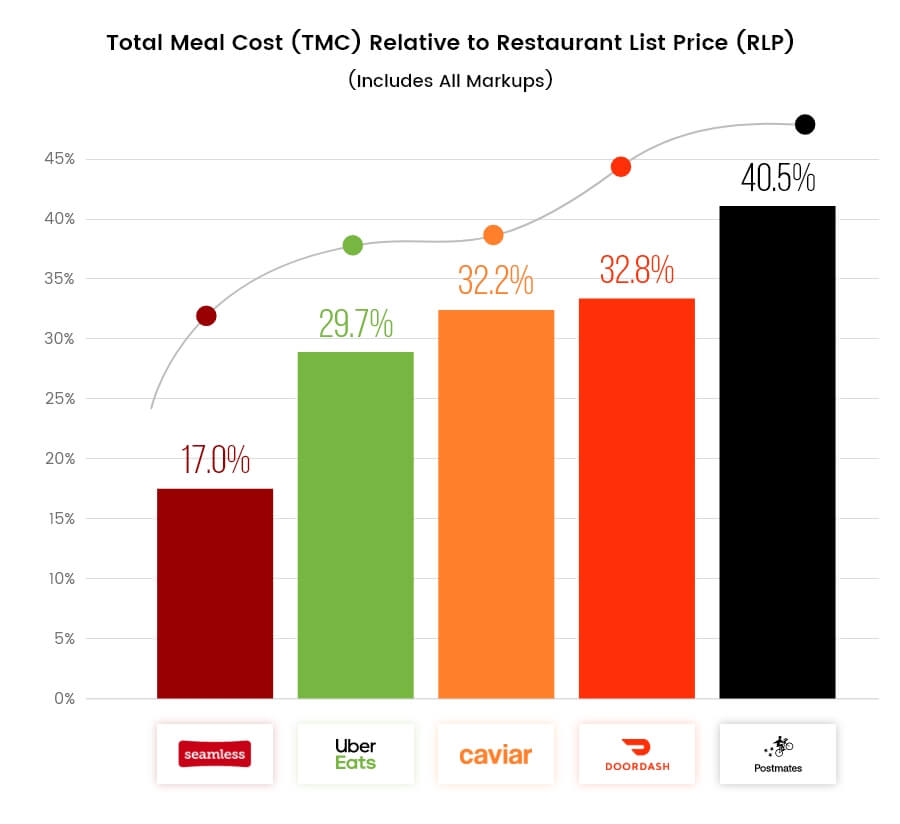
Image credits: Techcrunch
Meaning, when ordering through Seamless, customers have to pay extra 17% over RLP, while a customer would pay a whopping 40.5% extra over RLP when ordered through Postmates.
The Bottom line
After having studied the top food delivery giants in the U.S. with their pricing strategy and operational model, one thing is clear. Almost every food delivery app operates on the near-to-same business model. The only difference lies in their pricing strategy which nowhere defines the differentiation on the grounds of uniqueness.
Companies seeking to invest and foray into the delivery segment with an ambition of building a sustainable brand with high profitability should think of consumer-facing innovation from a different perspective. We couldn’t agree more, online food delivery app marketplace is still on a nascent stage and is ready for innovation.
Eventually, the Food Delivery Market leader would be the one who just not have its use cases limited to food delivery coupled with offers and discounts but the one who sells superior services, superior product with clear prices.
Related post: Online Food Delivery App Development Guide : Cost and Key Features Included
How Codiant Can Help?
Codiant is a leading on-demand food delivery app development company helping enterprises and restaurants develop a feature-rich on-demand food delivery app powered with advanced technologies like AI, ML to understand and deploy buying behavior of consumers and their motivations to purchase in the app functionalities.