A Simple Guide To Create A Calendar App In 2022

In today’s hurried and fast-paced world, where scheduled visits, events, and other back-to-back meetings are forcibly moving around, it has crunched the spaces users have created for their leisure time. And in fact, triggered the back-and-forth battle of coordinating schedules.

These time management issues have pulled off the demand for mobile applications that have an in-app calendar installed.

In-app calendars simplify all things scheduling. It avoids overlapping meeting times, keeps other hooked members notified in case of any plan changes and prevents the cross-wiring of meetings and schedules. While ensuring the plans of every other connected member fall on the same page.

Though the culture of calendar management is rising among app users, it is still becoming a tricky and strenuous tasks for many to successfully plan the integration of calendar apps to their niche-focused mobile applications.

To make that easier, we have created an all-inclusive post that will guide you with a power-pack of features, tools, technologies, and the uses cases of industries where the calendar app can be integrated.

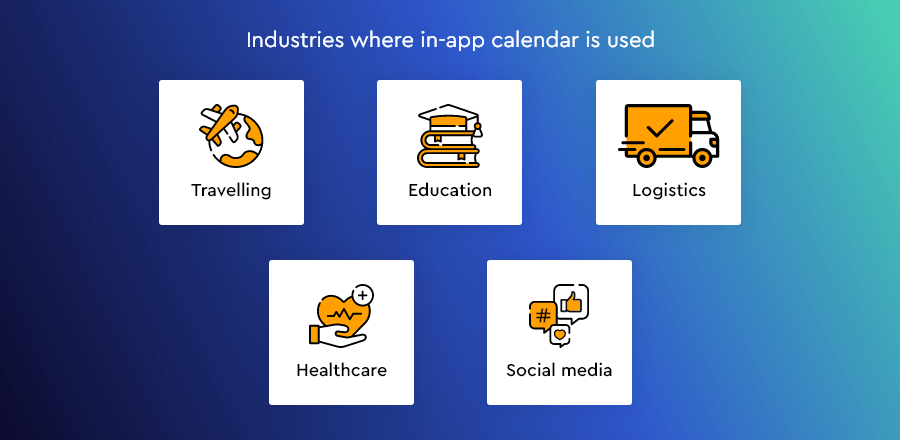
The Use Cases of Calendar App In Various Industries
calendar app development

Education

The education system has already taken a technological U-turn which is more or less not good for students as they may get distracted by the infinite content running on the internet. Therefore, it is now more important than ever, to find out ways that keep students’ elearning schedules on track without having them tangled in unproductive online activities.

Calendar apps are playing a lead role in powering up the student’s life by allowing them to schedule lectures, submissions, courses, exam dates, etc. The notification feature keeps reminding them about the pre-scheduled tasks and eventually helps them in enhancing their time management skills and bringing discipline in life.

Logistics

You succeed in logistics when you have clear statistics about how, when, and which consignment you are going to deliver. But there are limitations to everything and thus it becomes a problematic state to remember every freight.

Here the development of calendar apps brings ease for the users with its unique and innovative features. The carrier, receiver, and shipper, all of them can pre-schedule dates for the consignment delivery and can add convenience to their lives.

Tourism & Hospitality

Travel, time, and dates are interrelated with each other but keeping them all together on track is a troublesome task. Many tourism and hospitality platforms have in-built calendar apps in them. Using calendar apps the user and their loved ones can easily plan their trip by scheduling and organizing all the reservations and confirmation at a single place. They can add time and locations, specific reminders for most important events while keeping all the family members or friends in a loop.

Healthcare

The word hospital is enough to make anyone nervous. While booking/changing an appointment can only add more stress. Thankfully, the innovation of appointment booking and scheduling calendars in healthcare apps have come as the biggest rescue to this nerve-wracking task.

Real-time calendar sync with healthcare apps provides users with the features like fixing appointments with doctors, scheduling medicine intake time, setting a reminder for regular check-ups, etc. The user can also see if calendar invites have been accepted, declined, or moved. This straightforward appointment booking with reminders features also helps healthcare professionals in preventing no-shows and last-minute appointment cancellations.

Social Media Platforms

As we hear the word social media, the first thing that comes to mind is connections but these days social media is not just limited to that. The wings of social media are widespread everywhere. A lot of meetings, events, and occasions i.e. birthdays, anniversaries, and a lot of festivities are organized and celebrated over here, and for that one needs to schedule a date and time. And this evidences that the calendar is not just restricted to knowing date and time but it has become a part of us at every stage of life.

Now, you might be having a better understanding of the need for in-app calendars in the above industries but today you can experience a similar necessity in almost every sector of the market.

So, now the question is how are you going to deal with the situation?

Either you can create your own calendar app with customized features or you can go with the in-app integration using ready-made calendar apps available in the market.

In case, you are looking to create your own calendar app then consider following the technology stack that serves as a scalable solution for you. Have a quick glance at these points!

The Technology Stack to Develop a Calendar App

Use Of APIs

To integrate into the calendar apps Google and Apple offer lots of APIs that make the process simple and easy to use.

Apple Event Kit

There are many tools provided by Apple to create or integrate calendar apps. The EventKit makes it easy for the developers to create and edit the calendar app because the user can easily get access to calendar data. Also, EvenKitUI framework helps in displaying multiple interfaces that can be added to the calendar application to view, select, and edit calendar events and reminders.

Google Calendar API

Google API will give you detailed information about how to develop or integrate the calendar into your app in the documentation format. The use of Google calendars is also done to manage the programs and it can be integrated using both mobile and web apps. The functions performed using Google APIs are creating, viewing, and editing events along with the explanation of the use of libraries and RESTful calls for different programming languages like Java, JavaScript, PHP, Ruby, etc.

Apart from the above-mentioned APIs, there is also a list of APIs that can be used to create your calendar app exception among others.

  • SuperSaaS API
  • Calendarific API
  • Nylas Cloud Calendar API
  • FX Calendar API

Libraries

Explore the list of libraries used for both the Apple and Android calendar app development.

Users looking for an iOS-based calendar can use these libraries:

  • Calendar
  • Calendar Lib
  • JT Apple Calendar
  • MB Calendar Kit
  • FS Calendar
  • Calendar kit

Users looking for an Android-based calendar can use these libraries:

  • Cosmo Calendar
  • Event Calendar
  • Sky Calendar View
  • Agenda Calendar View
  • Customizable Calendar

The Key Feature List To Develop A Calendar App

  • Setting Reminder The feature is specially designed to prevent any omission or delays in meetings, events, and deadlines. It is obviously a benefit over the offline/paperback calendars.
  • Task Scheduling The user can easily keep a track of all the events by scheduling tasks in the calendar and marking them when done. It ultimately saves a lot of time because nobody has to move back and forth to check the status of events.
  • Time Block This feature allows users to block time in the calendar that is visible to others so that no one can disturb till the task gets completed. And this feature eventually boosts the work efficiency of the user.
  • Booking Slots This feature is specially designed for those who work online for a limited period of time. People can book a few specific slots and make them available for clients and other vendors. Also, the vendors or other clients can easily connect with the one-tap using a personal slot link.
  • Notifications Notifications are like information alerts, they inform users with the updated details like new member booking, cancellation, or any meeting. In other words, you get access to every activity detail of the user from the time they start using the app.
  • Recurring Events Recurring events are rare things that are usually omitted by the users. But this feature allows the user to schedule a recurring event with a specific date and time. Hence, users can be prepared for the meetings or events.
  • Resource Management All the essential resources can be added to the calendar so that the user can allocate and streamline them later to the required booking slots. This feature eliminates confusion and task repetition despite the number of employees or users enrolled in the app.
  • Contacts Availability It easily allows users to check the invitee’s availability. The decided date and time can immediately be shifted to the event as soon as the invitee accepts the invitation. Also, the feature helps save a lot of time by eliminating back and forth calls, emails, or texts!

The Essential Factors To Be Considered While Developing A Calendar App

Sync Capabilities

Now, the user activities are not just limited to mobile phones, today everyone has their online presence on laptops, iPads, tablets, etc. This feature allows users to integrate the app easily across all other robust gadgets in the market.

Hardware Access

Gain the competitive edge and boost the security of your calendar events and other scheduled tasks by using the 3D touch, dark theme, or face recognition. Moreover, using geo-location in events also improves overall work efficiency.

UI/UX

Design plays a crucial role and to fulfill the purpose, a team of experienced designers is needed who can flawlessly finish the designing part and provide the easy to navigate and simple interface.

The interface with minimal design and vivid features is the best for engaging users.

Speech Recognition

It is one of the exclusive features of calendar apps where users can use the native language to schedule events, reminders, and make changes in the calendar entries. Moreover, it also helps in saving time and eradicating text errors. You can even try to add customized features that will add more validation to your work.

Advanced Technology

An advanced version of anything always attracts a person and hence if you want more users to subscribe then you must upgrade your feature list.

Summing Up!

The process of developing or integrating the calendar app is not that complex but it does require a lot of pre-planning. The calendar app permits you to offer a wide variety of advanced functionalities to the users that enhance the level of work efficiency in different fields.

In case you are looking to add advanced features to your calendar app then you need to focus on the professional experienced team who can understand the requirements and can plan things accordingly. Also, choose the tools and technologies wisely that serve in the best way to create or integrate the calendar in any of your apps easily.

Looking For a Developer Team to Create A Calendar App?

Get in Touch

How to Successfully Launch a Fitness App in the Market?

If the most query your Google search engine is hitting these days is “how to launch a fitness app”, we get it. With massive competition operating behind closed doors in fear to get tumbled, finding the right set of guidelines for app launch has been even harder.

>Wouldn’t it get easy if you had an authentic, time-proven list of to-dos to build a highly personalized fitness app? Codiant’s industry-wide experience and vast portfolio in developing myriad types of fitness apps have made the launching easy for you.

How To Launch A Fitness App

Here’s a cheat sheet of how to gear up for fitness app development and launch it with a bang.

1. Perform a Detailed Market Research

The market size of fitness apps is expected to expand at an annual cumulative (CAGR) rate of about 21% to USD 4.4 billion during the period 2021 and 2028. This includes Android and iOS users both.

This size of market expansion depicts there already exists too many competitors and by the time you are ready with your fitness app, there will be more competitors in the market. Conducting thorough market research and having a futuristic approach will be crucial to introducing differentiation in your app.

Based on your budget, you perform primary research to understand the market and the target audience. However, before the deployment, secondary research can also give you good insights to launch a fitness app in the market.

2. Launch Time and Social Media Promotion is the Key

A lot of people make New Year resolutions to be healthy and fit, so the first quarter between January to April could be the best time to capitalize on changing user behavior.

This could be a peak time to get into the market but it would require accurate and rigorous promotion on multiple social media platforms to stand out. Along with social media promotions, the PR strategies work hand-in-hand and can increase the customer reach of your fitness app; if executed correctly.

Advertise and promote your fitness app’s unique features and services that you are providing to educate people about your presence. Before, you launch a fitness app; take your time and ensure to build trust among the people, which results in attracting new customers and an increase in app downloads.

3. Create Attractive and Informative Content

Try to create unique and appealing content that clearly explains how to use your fitness app and what news you are providing. Such content can be served through social media posts, press releases, email marketing, blog posts, and website copy.

You can pre-schedule the content for the launch day or share the post before the launch day to create the buzz. Through social media post shares you can also go with interactive posts to provide real-time updates to customer assistance, get reviews and feedback, and respond to the user recommendations. In addition to that, don’t forget to add an app download link to your fitness app on social media posts, blogs, emails, and other multiple sources.

4. Define Success Parameters For Your Fitness App Launch

To successfully launch a fitness app, it is an intelligent call to define what exactly success looks like for your business. Set some measurable goals and strategies during the launch. To make it possible you can use various tools to track the active install rate, the number of ratings and feedback you received, average app rating, and revenue generation, etc.

These statistics will support your fitness app business to implement and innovate your strategies as per the business performance against the competitors. With such tools, you can analyze market trends and demands to re-work them and implement new strategies and attract new customers too.

5. Follow a Detailed and Guided Approach For your Fitness App Development

To ensure a successful fitness app development it is recommended to follow a detailed and guided approach to make it possible. The whole development and deployment process is divided into different stages and is as follows;

  • Research your target users.
  • Select the most suitable type of fitness app for your target users.
  • Study and analyze the fitness app market.
  • Choose the right platform for your fitness app.
  • Study the competitors and perform a SWOT analysis.
  • Select your Fitness App Development Company.
  • Build an MVP of fitness app with selected features.
  • Get an estimated Cost of a Fitness App for an advanced featured app.
  • Define your budget.
  • Choose the type of monetization model you like to implement in your fitness app.
  • Monitor your fitness app development progress with regular communication.
  • Review the app after development by different modes of testing.
  • Deploy the app on the Play Store or App Store or both.
  • Accept the source code of your fitness application.
  • Track the app performance and define promotional strategies.
  • Update your app periodically to add new features and enhance the user experience.

6. Record your App Demo

To attract and educate users about your fitness app, you can create a demo video while displaying your major USP and presenting how easy it is to use the app. In your video, can easily explain what your app does and how it is useful in resolving your fitness-related concerns.

As you have learned above about the existence of a huge number of competitors in the market, so differentiating yours will definitely present a clear communication with your prospective customers. A short demo could be an easy and quick presentation of the worth of your fitness app.

7. Do App Store Optimization (ASO)

If you want your fitness app to be recognized or get discovered in the crowd of apps by users within the app store, then use the App Store Optimization (ASO) feature. You can optimize your app content and its search by using relevant keywords, which makes users find your app easily.

Apart from that, in App Store Optimization you can add specific screenshots of your app while depicting common use cases. Such screenshots also give an idea about the user interface, color combination, and other basic details to the viewer who searched for the app before downloading it.

8. Implement Paid Marketing/Advertising

Being a new business entrant you might get some organic traffic due to Google algorithms, but complementing it with some paid advertising during the launch week can comparatively give you a good number of customers.

You can also implement targeted ads on Facebook and other social media apps to drive users to your business’s social media pages. Where the user can learn about your business in a bit detail and encourage them to sign up for your mobile fitness app. Apart from that, you can redirect the user who clicks on your advertisement to download the app.

Wrapping Up

It can be a tedious task to develop a highly-competitive fitness app and launch it successfully. Marketing also requires a good amount of investment apart from fitness app development to ensure app success. Investing in the right marketing strategies will allow you to successfully launch the fitness app and gain a market response.

You can gain much assistance from your fitness app development company to successfully deploy and launch the app in the market. However, thorough market research will be crucial based on the demographics to attract users. So, overall it is crucial to hire the right expert Fitness App Development Companies to gain customer attention and trust.

Unveil the Most Crucial Features of Online Food Delivery App

Customer, Admin, Restaurant and Delivery App screen Panel Covered

Time is short. Users want quick service. App means convenience.

Quick service restaurants and food outlets just can’t run away with these consumer-facing technologies. In order to speed up the order process, online food ordering apps have become the go-to key that provides customers the ease and comfort in this daily grind of the traffic jam, time crunch, long queues and growing appetite.

See also : Compelling Reasons to Consider Online Food Ordering App for Your Restaurant

Restaurants and food business aggregators have started grabbing target potential diners with location-based push notifications, loyalty programs, and various other coupons/offers.

But before getting developed that client retention mobile ordering app, what are the crucial features every restaurant owner, or restaurant aggregator or a food outlet turning online should include compulsorily in the app in a gust to maximize sales, increase efficiency and make the app using process simpler for everyone?

Here is a deep study by Codiant:

Features Of Online Food Delivery App

ATTACHMENT DETAILS online-food-delivery-app-codiant

1. Customer App

  • Quick Signup : Simplify the access of users to experience your app. Make the on boarding process easy by allowing them to login through their existing social networks.
  • Search by Restaurants and Dishes : Give your customers a comfort to search for their favorite cuisines and restaurants by smart filters and sorting options.
  • Order Food : Give them the ease to order food from their nearby restaurants tracked from their current location.
  • Pick up & Drop : A feature where they can select the pickup and drop location of order within the app.
  • Track Orders : Give them the flexibility to track their orders and check their current order status. You can also use push notifications medium to keep them informing like the food is getting cooked in the kitchen, now out for delivery, about to reach etc. This increases the brands’ reliability and keep the customer’s informed and engaged.
  • Multiple Payment Options : Customers can pay smoothly with whatever option they like- cards, cash or wallet.
  • Prebook or Schedule Order : Allow your customers to place an order in advance for a scheduled date and time.
  • Ratings and Reviews : Give them the option to give feedback on the food ordering and delivery experience.
  • Promos & Offers : Customers can check the ongoing deals, promos and offers.
  • Order History & Repeat Orders : Let the customers check the past orders they made in the app and give them the flexibility to re-order with a few taps.

2. Restaurant App

  • Menu Management : Owners can add/update their menu listings, prices, items, minimum order amount, etc. and make them available for ordering.
  • Manage Orders : Check the order status (complete or processing), total amount earned on each order, and have the control on taking actions on them.
  • Order Alerts : Restaurants get real-time notifications for new orders and accept them on the go.
  • Push Notifications : Get notified to the assigned delivery guy and customer when the order is accepted and ready for delivery.
  • Track Payments : Add account details, view successful and pending payment settlements in one place.
  • Respond to Reviews : Restaurants get a direct line of communication with their customers to build trust.
  • Add and Manage Promos : Create and add new deals and offers to reward customers and gain new ones.
  • View Customer Details : Restaurant partners get useful information about their online customer base.
  • Order Reports : Partners get useful insights on their business performance and grow faster.

3. Delivery or Logistics

  • Easy Registration : Direct registration or easy onboarding from the mobile app.
  • Take Bookings : Approve/ disapprove new booking requests.
  • Check Distance : Check distance from the current location to the delivery point.
  • Manage Status : Updating status of order placed like accepted or rejected the booking, picked up order, delivered the order.
  • Booking History : Drivers can easily track the booking history.

4. Admin Panel

  • Manage Restaurants

Add and manage restaurants, Check their active status on your app, take actions like editing or deleting from your restaurant list.

food-delivery-app-admin-manage-stores

  • Manage Menu and Food Categories

Get menu from your restaurants or restaurant partners and put them online on your website/app arranged category wise (see below) and make them available for ordering. Manage them easily by the action button.

food-delivery-app-admin-manage-categories

  • Manage Orders

Check the order status (complete or processing), total amount earned on each order, and have the control on taking actions on them.

food-delivery-app-admin-manage-order

  • Manage Payments and Commissions

Track online payments you receive, set the commission rates with every restaurant partner.

  • Notifications

Get the notifications of the emails, SMS, order delivered, drivers accepting request. Easily set the notification settings for your customers and Restaurant Partners.

food-delivery-app-admin-notification

  • Feedback Management

View customers’ ratings and reviews, check their feedback. Take actions on customers tampering your brand’s image and so on.

  • Manage Customers

View complete information about your customers like their email id, phone no, zip codes, status and edit/manage them easily.

  • Reporting and Analytics

Catalyze actions, make strategies and be a good decision maker by our reporting and analytics tool inbuilt in the Admin Panel of Online Food Ordering App.

  • Driver Management

Check all your driver details, add and update their information and check their current status.

food-delivery-app-admin-manage-driver

See the Spot : Grocery Market Ropes In Mobile Apps Storefronts to Lead High Growth Prospects

How can Codiant be of your help?

Codiant is a premium online food delivery app development Company that also sells clone script of online food ordering apps and restaurant booking apps at unmatched prices. We help startups, restaurants/food outlets and food aggregators in improving their customers’ experience, operational efficiency and in maximizing sales by growing their business unprecedentedly.

Google’s New Flutter 3: All You Need to Know

Google’s Flutter, incepted a four years ago with the sole aim to build natively compiled applications! Recently, with the release of Flutter 3.0, the cross-platform technology has garnered all the needed attention for one winning reason—its stabilized support for building apps for Linux and macOS—apart from Android, iOS, and web apps already topping the list.Thus, charting the complete territory that will now allow Flutter Developers to build applications for all major platforms i.e. Android, iOS, Windows, Linux, macOS, and even the web all from the shared codebase.

At this year’s Google I/O developer conference, it was the major hit release to delivering the multiplatform UI development across phone, desktop and web. The team has also added its support for Apple Silicon, among many other new features (discussed below).

On macOS, the apps can run natively on Intel and Apple Silicon chips owing to its support for Universal Binaries. While for the Linux release as well, Flutter will come full circle in offering a highly integrated, best-of-breed option for application development, as a result of Google’s partnership with Ubuntu’s Canonical.

Google Flutter 3: Set to Cross All Targets

As Flutter is getting whopping cross-platform mobile applications (more than 500,000 apps) developed under its belt, the technology is proving its mettle in many niches. Being a feature-rich and comparatively new SDK, Flutter has helped developers build a range of modern apps belonging to several industries and businesses.

The usage niche scenarios range from eCommerce apps like Shein, eBay motors, Xianyu, and social networking and managing apps like WeChat, Hookle, PostMuse, and Lifestyle apps like My BMW, Fastic, Tabcorp, to name a few. The technology platform has also made its outstanding debut in creating official apps for government and public institutions such as the Brazilian government.

In a nutshell, Flutter was already radiating its brilliance across industries and with the release of Flutter 3.0, it has completed the loop by covering all the missing platforms out of the play.

Flutter app development, like earlier, will allow cross-platform developers to build beautiful app experiences for a total of six platforms with just one codebase. Here we enlist all the fresh features, updates, and development experience, Flutter 3.0 has in store for you.

Read Also: Top 10 Flutter App Development Tools for App Developers

Latest Features: What’s New in Flutter 3?

1. macOS and Linux Support 

Flutter is a most dynamic cross-platform development framework till now, which supports Android and iOS platforms. Now, with Flutter 3, its support has been extended at a great level and can now be officially used to build apps for Web, Windows, Mac, and embedded devices.

After the introduction of Flutter 3, the developers who have to put additional efforts into adding platforms or building their apps on other platforms, have now come to ease. Hence, as of now, the flutter developers can build applications for macOS and Linux devices in a hassle-free manner.

2. Firebase Support in Flutter

According to Google, 63% of Flutter Developers use and practice integrating Firebase in their apps. As a result, with Flutter 3 the integration of Firebase with Flutter has become now better than ever. The overall documentation, tooling, and widgets has been improved, for instance, FlutterFire UI- facilitates developers with reusable UI for profile screens and authentication.

Overall, Flutter 3 supports app development and maintenance, user analytics, storage, authentication, and cloud functionality, with detailed crash reporting. The services like AppWrite, Sentry, and AWS Amplify have played a vital role in improving the overall functionality.

3. Flutter’s Game Toolkit

It’s been going to be heart-warming news for game developers, as Flutter 3 has goodies for them as well in its basket. Google has provided a casual gaming toolkit that includes guidelines, tutorials, and templates for game developers who are planning or aiming to build a gaming app in Flutter.

This has widened the horizon for game developers to design more innovative, and engaging ideas for game enthusiasts. The game developers can have a tour of the Flame Game Engine to gain additional insights into how Flutter works with game app development.

4. Dart 2.17

Flutter 3 has also introduced updates for the Dart SDK, with the new language version 2.17. The developers can now access all the additional benefits of Dart, regardless of whether they use Flutter or not.

The Dart 2.17 version’s hallmark features provide the ability for developers to extend enums and override the default function as well. Hence, the enums can act similar to the custom written classes.

Mobile Updates in Flutter 3

1. iOS variable Refresh Rate Support

In iOS devices along with iPhone 13 Pro and iPad Pro, the latest version of Flutter i.e. Flutter 3 supports variable refresh rates with ProMotion displays. Flutter 3 version supports the increase in Hz rate i.e. from the earlier limit of 60 Hz to the latest limit of 120 Hz on devices. This speed increase supports a smooth user experience with animations.

2. Foldable Phone Support

By collaborating with Microsoft, Flutter 3 supports foldable mobile devices. This feature allows developers to infuse dynamic and productive experiences on foldable phone devices.

3. Streamlined iOS Releases

To streamline the release of iOS applications, the Flutter 3 version is available with a new option to build an IPA command (is an integrated security information management solution based on 389 Directory Server).

Web Updates in Flutter 3

1. Web App Lifecycle

With the updated version of Flutter 3, its latest lifecycle API for web applications, can allow developers to have the flexibility and gain control over the bootstrap process of Flutter app development from the hosting HTML page.

2. Image Decoding

The Flutter 3 version in web development can now automatically infer and use the imagecoder API in the browser. This API updation can decode images asynchronously off the core thread by using the browser’s built-in image codecs. With this feature, the speed of images gets increased by 2x without blocking the main thread. Additionally, it removes all the clutter which were earlier generated by images.

Additional Exciting Features in Flutter 3

1. Theme Extensions

By using the Theme Extensions in the Flutter 3 version, now the developers can add anything to the ThemeData of the material library. The developer simply needs to mention ‘ThemeData.extensions’ rather than writing for extending ThemeData and implementing copyWith, lerp, and other methods.

2. Advertisements

To build personalized advertisements and manage Apple’s App Tracking Transparency (ATT) requirements, the Flutter 3 app development version supports the publisher’s customized requirements. Google also provides a User Messaging Platform (UMP) SDK, which can efficiently replace the previous open-source Consent SDK.

Big Strengths Never Concludes

If the term “smooth experiences across the platforms” needs to be elaborated with a practical example, then the Flutter App Development and its significant releases would be the perfect one. Evidently, Flutter is the best framework for the Cross-platform app development, designed to give a tough battle to its counterparts with its high-end, rich, and naturally immersive user experiences.

Are you ready to burst all its spilling functionality power in your upcoming app? Move ahead with speed and stop crawling with old age technologies. Flutter is the offbeat cross-platform technology to develop and deliver natively-compiled applications.

What is IT Staff Augmentation? How it Works: Complete Guide

The soaring demand for business digitalization has exposed companies having dearth of skilled tech experts. According to Bloomberg, about 54% of companies all over the world experience shortage of proficient talent, and HR managers face difficulty in attracting and finding the skilled talent required to build their team.

Now, the IT Staff Augmentation process is completely transforming the workflow. As a result, web and app development is not just only confined to the team of in-house professionals, whereas it has widen its boundaries in all directions. To enhance the project quality and to explore the different market and tech trends, more and more companies are inclining towards outsourcing skilled personnel to fulfill their short-term project demand.

It is turning out to be a very effective and convenient model for companies, regardless of the industry domain to which it belongs. Overall, Staff Augmentation practice delivers multiple benefits for companies and skilled developers as well. In addition to that, the client can also demand a crisp deadline for the project delivery, and to make this possible the agencies can increase their staff instantly as per their requirements.

If you are the one exploring such an instant expansion solution for your business needs, then Staff Augmentation can be the most suitable tactic. Let’s understand this term in detail, its types, pros and cons, and the process of staff augmentation to fill the gaps in your business.

What is Staff Augmentation?

Staff Augmentation is a common practice in the IT industry that involves outsourcing specific staff for a definite time period to work on a definite web or app development at a time.

Recruiting the right talent for your project needs is quite a tricky and complicated task. For that, the HR managers have to explore the global market of developers and pick the right talent very precisely to deliver the project. These IT staff often work as an extension of an in-house developer’s team.

In general terms, Staff Augmentation is a type of outsourcing service from an external service provider on a contractual basis. These external staff should have to complement the skills and knowledge of the in-house team. It requires a strategized hiring module where the evaluation of existing staff capabilities is required to analyze the gap of tech-experts that a specific project requires.

The outsourced personnel is directly recruited by the vendor, as a result, the need and cost of hiring full-time employees are minimized. Let’s understand Staff Augmentation with a simple IT agency example.

Suppose, you want to develop an app which requires a team of 6 developers and 3 UI/UX designers. But currently, you are having only 4 developers and 2 designers. It might be possible that you can deliver the project with this limited resource, but meeting the project deadline won’t be possible. Therefore, you can turn towards practicing the Staff Augmentation model in your organization. As a matter of fact, hiring 2 in-house developers and a designer would require a month or two. It might lead to project delay or loss of client.

But while following the Staff Augmentation model, you can hire specific talent within a week or two for the specified period of time. It will help you to get your project developed and deployed within the assigned timeline. In addition to that, you don’t have to lay off the additional staff after the project completion due to shortage of work.

Types of Staff Augmentation

Before planning to implement an IT Staff Augmentation services, the agencies need to analyze their requirement first. The agencies can hire IT staff for a shorter or longer time duration as per the project demands. Analysis of time duration, expertise, and skills of the outsourced staff is very crucial to maintain the quality of the project.

After analyzing these details, you can consider any of the following types that suit your project’s needs. Generally, there are two methods that staff augmentation companies follow.

  1. Short-Term ServicesThe short-term staff augmentation service is used when a sudden demand for IT staff arises but for a definite or shorter time period. For example, when the in-house expert is on a long holiday or on sick leave.
  2. Long-Term ServicesThe long-term staff augmentation service is suitable for the entire project development or long-duration projects. Such experts are basically recruited when the project deadline is short and you need to fill the shortage of skill/resources gap, reduce operational cost.

Further, Staff Augmentation can be divided into three categories and are as follows:

  • CommodityThe commodity staff augmentation type does not demand any specific specializations. Under this model, the recruitment is done to fulfil the urgency gap rather than seeking specific skill expertise. It means an averagely skilled person can also fill the shoes when such urgent needs arise.
  • Skill-basedAs compared to the Commodity staff augmentation method, the skill-based staff augmentation requires a little bit more focus over skilled hiring. Still, the top quality skill is not required, yet basic skill and subject understanding are required. For instance, clerical work which can be taken care of by any educated or trained candidate.
  • Highly-SkilledAs the name suggests, the IT or software development companies consider highly-skilled staff augmentation type to fulfil the relevant expert gap in the team. Without a doubt, the highly-skilled staff augmentation method should be practiced to ensure the project quality. Hence, the recruitment manager needs to look for essential skills, training, and expertise of the candidate who can work efficiently in coordination with the in-house team.

Pros and Cons of IT Staff Augmentation

Pros of Staff Augmentation

  1. Recruit Global TalentThere are numerous global companies that follow staff augmentation model, hence the companies can explore the worldwide spread talent and need not be confined to a specific area. This enables companies to hire highly qualified and skilled employees to fulfil their project’s demand instantly.
  2. Cost-EfficientThe skilled manpower is spread all over the world but the charges significantly vary. So, from the outsourcing agencies the companies can recruit skilled candidate at a comparatively low budget. Overall, the development cost will reduce and clients can also feel good with a quality product but under the planned budget.
  3. Full Control on StaffAnother major benefit of preferring IT staff augmentation is the ability to have a firm grip on the existing staff. When you hire a part-time or a project-specific candidate for a definite time frame, then you have control over who leads the project and what to prioritize to ensure the product quality and timeline.
  4. Minimize Legal and Management IssuesWhile hiring staff, the companies have to provide employees everything necessary, including software, required devices, payrolls, insurance, etc. overall it is quite a lot to deal with. But with Staff Augmentation service providers or tech staffing agency, the company doesn’t have to take care of all such details. It is super convenient for such an IT business to find the right talent with minimum effort and post recruitment management activities.
  5. Resource SavingThe Staff Augmentation practices rely on business requirements and support to save hiring multiple resources as a full-time employee. The companies can hire relevant resources whenever required for a definite time period. Hence, it eliminates the presence of in-house ideal resources or employees when the company doesn’t have projects in the pipeline.
  6. Higher ProductivityUnder staff augmentation, the employees or developers can deliver 100% productivity as they are dedicated to a single project at a time. As a result, the client can experience top-quality dedicated work from the employee which leads to higher productivity.

Cons of Staff Augmentation

  1. Minimum Accessibility of Remote StaffIt is a bit tedious process to monitor remote staff, due to differences in time zone, instant accessibility, and reach as compared to the in-house inmates.
  2. Difference in Cultural BackgroundsDifferent cultural backgrounds can be a major hurdle in managing the team effectively. The teams might face language, time, and cultural differences that influences the person’s working style, habits, and mind-set.
  3. Potential MiscommunicationLanguage barrier can be the potential promoter of miscommunication in staff augmentation. Although English is the most common language spoken in many countries, but each country has a specific dialect that usually causes miscommunication.
  4. Higher Management CostsProject and staff management could be a tedious process to carry out remotely while adopting for staff augmentation. It may also result in higher staff and project management costs.

Staff Augmentation Process

The IT Staff Augmentation is applicable for companies that have in-house teams and require additional specialists to achieve their business goals. The process of staff augmentation used to vary depending on the outsourcing company or agency that is providing the employees. However, considering the standard practice, the staff augmentation process follows the following steps for ensuring the project’s success.

  1. Need IdentificationThe initial step of implementing staff augmentation services in your organization is to first analyze and define your outsourcing goals; with reference to a number of specialists/professionals, skills, and experience you require for your project’s on-time delivery while maintaining the budget.
  2. Choosing an Outsourcing PartnerExplore the IT Staff Augmentation market before hiring any specific outsourcing agency to fulfil your business requirements. Figure out the most suitable partner that can follow your business criteria among the available outsourcing partners list. But be cautious in terms of price tag while selecting the one, as neither the lowest price tag nor the highest price would be the guarantee of quality tech delivery. Therefore, choose the one after a thorough research.
  3. Interview and Negotiate with the Chosen PartnerBased on your project’s requirements, and the shortlisted outsourcing partners, interview every individual candidate to figure out the candidate’s expertise and their potential to manage the remote processes. After filtering a few numbers of the right talent, negotiate the budget and discuss the contract with every individual partner before making the final selection of tech-partner.
  4. Employee OnboardingAfter taking care of all the legal and monetary concerns, now you can remotely onboard your new team member. The first thing to be taken care of is to introduce these members to the team and define their roles and responsibilities in detail. Try to resolve all the queries of on-boarded expert, it will help him to smoothly associate with the team and be aware of the project’s requirements.
  5. Ongoing SupportThe staff augmented employees are assigned to communicate with HR managers and the team leads to ensure a productive and successful relationship during the ongoing partnership and futuristic requirements as well.

Conclusion

Recruiting new talents for your organization could be time taking and complex process. Despite such efforts, the results of hiring an employee could not be predicted. With evolving business requirements the demand for staff varies in terms of long-term or short-term commitment. For short-term staff requirements, the IT staff augmentation services works very effectively. It provides a competitive edge in the tech market and provides a firm grip over project progress.

The staff augmentation introduces a number of benefits, including transparency, cost-efficiency, and flexibility. However, before choosing the staff augmentation partner, ensure to perform extensive market research to find the most suitable tech partner.

Codiant has a team of skilled mobile app and web developers and collectively they hone more than a decade of expertise in staff augmentation. During this time span, we overcame all the hurdles that agencies usually face in outsourcing the staff, by providing them industry-wide domain experts under a single roof. Given that, we can effectively help you to build a brilliant business IT solution, no matter what. Get in touch with our experts, and we can support you efficiently in dealing with your web or app development needs.

Five Industries to Adopt Blockchain Development In Future

Blockchain is at an inflection point, with its momentum shifting towards practical business applications. Traditional industries had been in an effort to achieve greater efficiency, revenue resources and develop new business models through blockchain, as per the survey of Deloitte.

Since we are still early in blockchain’s development, the incessant maturation in the stage comes not as a surprise. Here we look at the perception of inflating blockchain trend in figures.

A Look At Some Global Blockchain Facts:

  • Over the last five years, venture capitalists (VCs) have invested more than $1 Bn in blockchain companies;
  • About 90% of the major North American and European banks are exploring blockchain solutions;
  • The global blockchain market is expected to be worth $20 Bn by 2024;
  • It is estimated that banks could save $8-12 Bn annually if they use blockchain technology;
  • In April 2018, a group of 22 European nations formed a new blockchain partnership aimed at exchanging information on the technology. The countries, including the UK, France, Germany, Norway, Spain, and the Netherlands, signed a declaration on April 10, 2018, establishing the new group, dubbed the European Blockchain Partnership, according to a release from the European Commission, which led the effort.

Stats: inc42.comWhile we have closely seen the forecasts of blockchain, now let’s track the trends ahead and see what this technology packs within it for the industries in the future:

1. Healthcare

The key problems in healthcare technical infrastructure existing today that impedes interoperability and thus patient-centered care are information security and privacy concerns, lack of trust between providers, and scalability concerns.

Now let’s see the potential use cases that demonstrate how Blockchain addresses these interoperability challenges:

Source: Deloitte

  • Sharing Cancer Data with Providers Using Patient-Authorized Access
  • Cancer Registry Sharing to Aggregate Observations in Cancer Cases
  • Patient Digital Identity Management for Better Patient Record Matching
  • Data Sharing to Incorporate Telemedicine with Traditional Care
  • Personal Health Records for Accessing and Controlling Complete Health History
  • Health Insurance Claim Adjudication Automation to Surface Error and Fraud
  • Prescription Tracking to Detect Opioid Overdose and Over-Prescription
  • Supply chain management that enhances healthcare contract management and reduces costs by allowing such features as real-time contract tracking and execution
  • Online patient access that enables patients to more easily, effectively and securely gain access to their own medical records

2. Banking and Finance

Blockchain is dramatically revolutionizing the global financial system backed by the much-hyped bitcoin ecosystem, lets’ go through the basic principles underlying blockchain that helps in driving down the cost, automate the execution of transactions with full trust, and ensuring top-notch security:

  • Decentralized Ledger: A digital ledger that allows participants to access identical information at the same time across the distribution chain.
  • Consensus Validation: Any transaction to be added to the blockchain, has to undergo an agreed upon validation process which allows participants to keep trust in their transactions whether or not the central authority is present.
  • Immutable and Tamper-proof: Every transaction recorded in the blockchain is irreversible and immutable making it impossible for anyone to tamper with data without leaving proof of the same.
  • User Authentication with Cryptographic Security: The cryptographic security, aka private and public keys of user access, makes it almost impossible for identities to be hacked and data to be compromised.
  • Smart Contracts: Time-consuming contractual transactions held can tailback the growth of a business. Smart contracts allow automatic validation of agreements signed and enforced through a blockchain construct which eliminates the need for mediators, hence saving the time and money.

3. Insurance

As per the latest report of Mckinsey, Blockchain addresses the competitive challenges of insurance industry including many incumbents face, including poor customer engagement, limited growth in mature markets, and the trends of digitization. In the following, we outline the most promising insurance-related use cases in three categories: enabling growth, increasing effectiveness, and reducing cost by automating key processes.

  • Innovate products and services for growth
  • Increase effectiveness in fraud detection and pricing
  • Reduce administrative cost

4. Cybersecurity

The tampering ransomware attacks, major breaches such as Equifax holds true that companies cannot safeguard their current identity system which eventually, calls for a crucial need of cryptocurrencies, blockchain and iOT. This futuristic immediacy underscores a strong outlook that the emergence of blockchain cybersecurity tools may be the next big thing in blockchain and it will set its own kind of definition in redefining Cybersecurity.

5. Automation and Privatization

As per the trusted resources, Blockchain will drive digital transformation of the enterprise specifically with automation, digitization of processes, tokenization of physical assets and activities and codification of complex contracts.

In addition to these, Asia and the Middle East are expected to aggressively push blockchain, the speed of ICOs will grow faster, and will overtake venture capital funding.

Angular.JS Vs. Vue.JS: Which Framework To Choose In 2022?

Till now, numerous JavaScript frameworks have been released, but the most in-demand frameworks are React, Angular, and Vue.js. Angular and Vue.js, both are front-end development JavaScript frameworks having similar syntax, intricate web pages, mobile apps, and software. Having so many similarities in both the frameworks turns out to be a complicated decision for developers to choose the most suitable one in their respective circumstances.We have already done a detailed comparison of React.JS and Vue.JS. Now, in this article, we will perform a detailed analysis of Angular.JS vs. Vue.JS and understand which could be a better framework to choose in 2022.Like React.JS and Angular.JS; Vue.JS is another popular framework that is worth debating to making the choice. Thus, to brush off this confusion, let’s analyze Angular.JS vs. Vue.JS to propose an easy-going decision. So, keep reading.

What is Angular.JS?

Angular.JS is an open-source JavaScript framework, introduced by Google. It is considered one of the most demanding web frameworks of modern days. Mostly, Angular.JS is used to build Single Page Applications and dynamic websites and apps. Angular is one of the tools that fall under the MEAN stack, and it supports a wide range of code editors. It supports multiple platform project development and deployment through its reusable codes. It has dynamic object UI bindings and two-way data binding which is essential to its architecture. Initially, Angular.JS development was based on the Model-View-Controller framework, however, after a period of time, it shifted to Model-View-ViewModel which is based on components.

Features of Angular.JS

  1. Data Model Binding- No, specific binding codes are needed to write to bind data to the HTML controls. Angular does this, just by adding a few code snippets.
  2. Less Code Writing- To carry out DOM manipulation in designing an application, requires less code writing with Angular.
  3. Unit Testing Ready- Along with the Angular framework, the Google developers also developed “Karma”- a testing framework that helps in Unit Testing for Angular.JS Applications.
  4. MVC- It is a modern-day’s design pattern used for the web application. It is based on the separation of the business logic layer, data layer, and presentation layer, to ease the management of each section/layer.

What is Vue.JS?

Vue.JS is a progressive JavaScript framework for developing User Interfaces (UIs) and Single-Page Applications (SPAs). Based on development requirements, it can work as a library and framework at a time. It is based on an MVVM (Model-View-ViewModel) architectural pattern which supports a business model or logic, differentiated from a graphical view or User Interface. Basically, Vue.JS is an amalgamation of Angular.JS and React.JS, where the best ingredients of both are presented together, such as two-way data binding. This turns into the Vue.JS development and introduces a better version of both the Angular and React frameworks.

Features of Vue.JS

  1. Adaptability: JS ensures stress-free migration and efficient structure.
  2. Components: JS framework can design custom elements that are reusable in HTML.
  3. Transition: Vue development follows multiple strategies to implement customization in HTML components whenever it is included or excluded from the DOM (Document Object Model).
  4. Detailed Documentation: It promotes easy and quick learning which represents an overall simple learning curve through the availability of a variety of learning documents.

Angular Vs. Vue: Key Differences To Focus On

1. Performance Comparison

Angular.JS: When you aim for web and mobile app development, the performance of Angular is directly influenced by DOM (Document Object Model). As a matter of fact, DOM influences the entire web page performance. Angular.JS uses real DOM in which the entire app/web page is rendered just by changing a single component or more. For rendering, it uses the ‘Ivy’ renderer to make the application compact and fast for an unmatchable performance and compiles components really quickly to minimize the Angular.JS Web Development time. The advanced update detection process and quick compilation minimize the count of DOM manipulation. It also pre-compiles the HTML and app components prior browser starting downloading and using it. This could be the major reason for Angular to gain much-needed popularity to develop high-performing apps.

Vue.JS: In contrast to Angular.JS, Vue.JS works on Virtual DOM but the updates are reflected on the actual DOM, and only on the modified components. It ultimately improves the loading time and accelerates the overall performance of the application. Lazy Loading is one of the elite features of Vue, which helps in improving the load time. In an asynchronous manner, Vue manages a third-party library that automatically handles the critical dependencies. This becomes possible by categorizing the libraries that are required to be integrated into the application bundle and are left from the core bundle.

2. Application Architecture

Angular.JS: Angular implements MVC (Model View Controller) and MVVM (Model-view-ViewModel) to develop dynamic web applications and websites. MVC pattern supports Angular to differentiate the HTML interface with the logic and helps to organize components with logic and codes both. Hence, the two-way data binding feature of Angular ensures straightforward development by following the MVC pattern. It allows Angular.JS developers to create a simple and clean design by including MVC patterns and two-way data binding at the same time.

Vue.JS: Vue primarily focuses on the ViewModel only and shows/releases limited data. ViewModel works as a link between the view and model through data binding. Thus, ViewModel shows the changes that are carried out in the model to the view. The MVVM architecture helps to develop robust and quality web applications while integrating them with relevant plugins and tools.

3. Learning Curve

Angular.JS: The Angular.JS web development curve is quite typical as compared to Vue. The Angular.JS developers need to gain expertise in concepts like MVC, and TypeScript to take the front-end development ahead. Angular is quite a typical technology for developers to gain expertise over it, after working with it for years. Thus, it has a limited developers and users community.

Vue.JS: Vue.JS framework offers inbuilt app templates and fierce customization ability, which makes Vue.JS more preferred framework than React.JS and Angular.JS. As we learned in the previous post on React.JS vs. Vue.JS, Vue.JS is a combination of Angular and React, which makes it easier to develop React or Angular-based app solutions on the Vue.JS framework.

4. Scalability

Angular.JS: Angular is been in the market for quite a long time, thus ultimately it has gained continuous support from many established organizations, including Google. Angular can arrange components as folders and modules based on the features. This depicts it had a well-formed framework that enables Angular.JS developers to build an enterprise-level application. It is a highly scalable framework because of its fierce command-line interface and feature designs.

Vue.JS: In contrast to Angular, Vue.JS uses a template-based syntax which reduces code reusability in the application development. This generates complications in developing a large size application on the Vue.JS framework. In contrast to this, it is a lightweight framework and is preferred to develop lightweight applications that are not highly scalable.

5. Ease of Testing

Angular.JS: Testing is an integral component of the Angular framework, likewise all the JavaScript codes had to go through a series of detailed testing. It comes with advanced debugging and refactoring options that support developers to carry out testing and maintenance. Angular extends the opportunity to test the complete project codes with a single testing tool, like Protractor, Jasmine, and Karma. All these tools are highly effective in minimizing the Angular.JS developers’ hustle to ensure efficient results. Such, a convenient testing process allows developers to build the projects from scratch and seamlessly test the components. The dependency injection in Angular effectively manages all the controllers and scopes.

Vue.JS: For ease of testing, Angular turns out to be a better performing framework than Vue. Its testing abilities are simple and ordinary, yet quite efficient. It is not equipped with quality tools, despite that does not compromise with the testing ability of it as well. Unit Testing in the Vue framework usually uses Mocha, Jest, or Chai testing tools. Apart from that, some of the official testing libraries of Vue are Vue Testing Library and Vue Test Utils. These libraries allow access to the app and the user-specific APIs and make code debugging and refactoring quite an easy task.

6.App Size & Loading Time

Angular.JS: Angular is a suitable framework to develop large enterprise-scale applications, so it is quite common for the app size to be slightly bigger than expected. As compared to other front-end frameworks, the small and medium-sized Angular.JS web applications usually range between 250 to 500 Kb. In contrast to that, the large and complex applications will be bigger than this range, however, it can be considerably handled by using a compiler to compress the bundle size. As the app or site loading time relies on its size, it requires comparatively more loading time than Vue.

Vue.JS: Vue.JS is a lightweight framework, which ultimately indicates that the app size will not be heavy as compared to the other frameworks. A simple Vue app usually has a size between 50 to 100 Kb, which is quite nominal. The Command Line Interface of Vue makes the app size appear heavier when the code loads for the first time. Even so, implementing lazy loading components allows the breaking of codes into smaller chunks which ultimately enhances the loading time performance. The Vue.JS developers can avoid writing codes from scratch by using tools like Vuex, Bit, Vue-router, and NuxJS, which allows effective state management by predicting codes, and unnecessary functions to eliminate them. As, the loading time majorly relies on the app size, and the small size of Vue.JS web app development ensures faster app loading.

7. User Experience

Angular.JS: Angular is a very effective front-end framework for designing interactive and straightforward user interfaces. It manages user interaction through templates which are divided into classes, components, and segments to build a clean coding architecture. The well-defined way of presenting data to the users ensures data updates instantly and the feature of SPA routing between pages without affecting the whole page. It makes Angular popular among developers with built-in libraries that ensure a hassle-free development experience.

Vue.JS: Vue.JS could be an ideal choice for designing an innovative and interactive web app user interface. Virtual DOM allows Vue.JS developers to carry out experiments while designing the user interface. As a result, the developers can create simple, interactive, and attractive applications. The data binding nature of the Vue.JS framework allows developers to build HTML values and attributes which can be easily modified without hampering the existing code by using the v-bind feature.

Angular Vs. Vue: Comparative Analysis

Criteria Angular.JS Vue.JS
Developer & Author Google Evan You
Known as Full-Featured JavaScript Framework Progressive JavaScript Framework
Size 563 KB (compressed & minified) 33.5 KB (gzipped & minified)
Source Language TypeScript JavaScript (also supports TypeScript)
Performance Fast Comparatively Faster
Learning Curve Steep Easier as compared to Angular
Browser Rendering Shadow DOM Virtual DOM
Error Handling Compile-Time Run-Time
Developers Community More Popular than Vue Comparatively Small
License MIT MIT

Web Apps Built with Angular and Vue

Angular and Vue are the widely used JavaScript frameworks that deliver high performance, robust features, and ready-to-use components. So, it could be very helpful to be aware of which companies use these tools for their customized web app development. Popular Platform Developed on Angular.JS are;

  • Google
  • Microsoft Xbox
  • Forbes
  • Paypal
  • Deutsche Bank
  • WikiWand
  • UpWork
  • The Guardian
  • com

Popular Platforms Developed on Vue.JS are;

  • Trivago
  • Apple
  • Nintendo
  • 9GAG
  • Statista
  • Gitlab
  • Trustpilot
  • Behance
  • Alibaba, etc.

Angular Vs. Vue: When to Choose?

When to choose the Angular framework?

Angular is a decades-old framework equipped with excessive libraries, mobile-friendly features, reusable templates, and easy-to-use. We suggest you can choose the Angular framework when:

  • You are planning to develop a real-time, dynamic, and large-scale web application.
  • If you like to work with Object-Oriented Programming concepts.
  • You are having a handsome size of well-versed Angular.JS developers, as it allows easy data flow and delivers a structural architecture.
  • You require a trustworthy and easy to scalable application.
  • If you can learn TypeScript before starting the app development.

Note: If your app is small in size and has multiple static pages then the Angular framework won’t be the best web app development framework.

When to choose the Vue framework?

Vue is fast, flexible, lightweight, sleek, and allows easy integration of external features, which is making Vue the leading choice among a lot of front-end developers. We suggest you can choose the Vue framework when:

  • You like to develop a dynamic high performing application.
  • You want to design lightweight and Single-Page Applications (SPAs).
  • You are aiming for high performance and speed.
  • You need a lightweight web development framework.
  • You prefer clear codes.

Note: If the application is heavy in size and has too much dynamic data, then prefer another front-end development framework that seems more suitable for your application.

Summing Up

It is quite a challenging task to consider any of the two frameworks as not good. Well, both the frameworks are good in their aspects as the front-end development framework. It is just about selecting the right framework that fits your business needs. In case, you still struggle to deduce which framework is suitable for your digital solution, they prefer connecting with a web development company. Codiant is a proficient web development company that has expertise in multiple domains and technologies including Angular.JS and Vue.JS web development services.

Low-fidelity vs. High-fidelity Design Prototypes

”The main difference between low-fidelity and high-fidelity prototypes comes in terms of user interaction. Low-fidelity prototypes are often paper-based and do-not allow user interactions. Whereas, High-fidelity prototypes are digital and allow clickable user interaction.”

To innovate anything, we build a firm foundation and create pillars that ensure safety and take good care of the entire product. Innovation in Software development works the same way.

To innovate software, first, you must build a Prototype that meets your business goals and solves the user pain points.

Prototype is the basic element that software companies research, work & create before jumping on the complex and time-consuming code development process.

Also known as Software Prototypes, there are two major categories viz. Low-fidelity prototypes and high-fidelity prototypes. Each of these prototypes takes abstract ideas and turns them into a tangible product. By investing all our time in ideating these prototypes too early in project development, we save ourselves from making costly mistakes.

In this post, we will cover what these prototypes are, when, and how they are used.

What Are Prototypes?

A prototype is an early model or release of a software product created to test the basic concept or process. Designers create prototypes to test their designs and validate their concepts among the real users and key stakeholders.

The feedback they receive from the real users helps them to improve the design and enhance the user experience, just before they pass this design to the development team. This eventually, helps them fail quickly and inexpensively and save all the development costs before investing too much time and money on it.

There are two major types of prototypes: low-fidelity prototypes and high-fidelity prototypes. Let’s understand them in detail. But before that it’s important to know what fidelity is!

What is Fidelity In UX Design?

Fidelity

Prototype is an expression of design intent. Through it, the designers can show their design and see how it works like. The fidelity of the prototype refers to:

  • The look-and-feel of the final product
  • It’s level of details and functionality
  • The real-time iteration and accessibility to users

The type of fidelity is defined through its interactivity, visuals, content, navigation, etc. Some prototypes can simply be created on papers/stickies that involve limited interactivity. But some prototypes are presented digitally with high-level intricate details of interaction and navigation. They are just close to the look and feel of the final product.

This scale of designing prototypes from paper to digital and every medium that falls in-between defines the category of the prototype. This category can be broadly classified into two types:

  • Low-Fidelity Prototype
  • High-Fidelity Prototype

While starting to design prototypes, you must know how much time and energy you can invest in. Depending on that you can choose between designing low-fidelity or high fidelity prototypes.

What Are Low-fidelity Prototypes?

low-fidelity

Low-fidelity prototypes (low-fi) are simple and low-tech. You only need paper and a pencil to start with. They are just used to turn your ideas into tangible artifacts that can down the line help you to test, analyze, and collect the feedback in the early stages of the final app build. Or say they are used to point out UX problems when brainstorming.

The Basic Features of Low-Fi Prototypes

  • Visual Design Low-fi doesn’t have polished designs. It covers only a few visual attributes such as the shape of elements, visual hierarchy, etc.
  • Content These paper prototypes cover only the main elements of content. Rest can be Lorem Ipsum.
  • Interactivity Low-fi prototypes are not clickable and interactive. Still, you can introduce little interactivity through connected wireframes which are usually linked to each other in the PPT/keynote using a prototyping tool.

At Codiant, our UX teams often ideate through low-fi prototypes. The reason is quite obvious- let’s realize it through the many benefits offered by low-fi prototypes.

Benefits of Low-fidelity Prototypes

  • Inexpensive :  Low-fi helps companies save the costs that go in designing as they can fail quickly and inexpensively early on the project, before investing too much time and energy on it.
  • Speed :  Clearly, the main benefit of low-fi is speed. You can create them in just a few minutes.
  • Easy : It doesn’t require any special skill to create a low-fidelity prototype, any non-designer can create it easily.
  • Collaborative : All the designers and developers involved, including the client, can remain on the same page by validating proposed functionalities and flow.

Limitations of Low-fidelity Prototypes

  • Highly Ambiguous : The assuming and imaginative state of a low-fi prototype makes it unpredictable for users to test, what will actually work and whatnot. This uncertain nature limits the exact result of the user testing.
  • Limited Interactivity : With low-fi prototypes. Only limited interactions can be presented. This limits the visualization of navigations, thus, making it less intuitive.

Most Used Techniques To Create Low-fidelity Prototypes

Generally, designers use paper prototyping and clickable wireframes to create low-fidelity prototypes. Here’s a quick definition of the same.

1. Paper Prototyping

Paper prototyping is the most simple low-fidelity prototype that you can ever experiment with. What you imagine can quickly be pictured on paper. Without grappling with graphics, tuning perfections on the monitor, just without using any digital software, this technique allows UX designers to sketch a digital product experience on paper.

Allows them to sketch different app/web screens that connect each other to present various stages of the product interface. Thus, helping in exploring ideas, making the imaginations tangible with the quick refinement of what works and whatnot.

The major benefits of having paper prototypes are: even a non-designer can sketch paper prototypes, it allows users to quickly experiment placements of simple to complex features and test their interactions. They’re also handy to carry, make notes, do revisions, and work off-system.

2. Clickable Wireframes

Clickable wireframes are interactive prototypes of user interfaces that give users a more realistic experience of the final product.

They are just a notch above paper prototypes, wherein, they give an interactive visual representation of the user interface of a web or mobile application.

With clickable wireframes, usability testing can be identified easily. The seamlessness of user experience navigation can be tested in the initial stage itself, which helps you save time and money.

What Are High-fidelity Prototypes?

high-fidelity

High-fidelity (high-fi) prototypes are highly functional, interactive, and detailed prototype models. They look nearly the same as the final software product. The user interface and user experience in hi-fi are well integrated and give the same immersive experience as the real product gives. Like, if you will tap an image/button, it will emulate the look-n-feel and the actual navigation a real product will do.

Hi-fi prototypes are often used in the final stage when the product is ready to be pushed for coding but before that has to undergo a final validation from real users and stakeholders to test its usability and identify issues in the product’s general workflow.

The Basic Features of High-Fi Prototypes

  • Visual Design High-fi has realistic, detailed, and intricate designs. It’s a complete pack of visual artifacts that covers all interface elements, graphics, color schemes, animations, etc. They look just like real app/web products.
  • Content Hi-fi prototypes contain almost all the content that appears in the real product. The content used in it looks the same as a real app or website.
  • Interactivity Hi-fi prototypes are highly functional and interactive.

Benefits of High-fidelity Prototypes

  • Real Feedback :  Unlike, low-fi prototypes, there is no uncertainty attached to high-fi. Since it looks like a real product, usability testing goes easy. Real users testing it can experience a more natural workflow as if they are using a real software product.
  • Testability of Specific UI Elements or Interactions : With high-fi prototypes, UI components like animated transitions, micro-interactions can be tested with high interactivity.
  • Good for Demos to Stakeholders : Hi-fi’s like-real product nature gives clients and stakeholders a real simulative environment where they can test, touch and feel how their real product would work like.

Limitations of High-fidelity Prototypes

  • Costly : Unlike low-fi prototypes, high-fi prototypes cost more as the designers have to devote their time to graphics, color schemes, and micro-interactions. UX writers have to work on content workflow, microcopies, and copywriting. These aspects increase the total cost of prototype building.
  • Time-Consuming :  Creating high-fi prototypes consumes more time as compared to low-fi, as digital software used to build high-fi demands more time and precision.

Most Used Techniques To Create High-fidelity Prototypes

1. Digital Prototypes

Digital prototypes are the most popular and commonly used technique to build a high-fi prototype. This technique employs the use of online prototyping software that allows designers to create visually appealing and highly interactive prototypes. The software allows designers to present simple to complex animations with real-time behavior. These prototypes can be previewed in the web browser, desktop, or any mobile device.

2. Coded Prototypes

Coded prototypes are just close to the final version of the real product. Not very widely used, these prototypes require designers to be proficient in coding skills. This prototyping technique is mostly used when the fully-functional app has to be presented.

List of the Best Prototyping Tools:

  1. Figma
  2. InVision Studio
  3. Adobe XD
  4. Webflow
  5. Axure RP 9
  6. Origami Studio
  7. Justinmind
  8. Sketch
  9. Fluid UI
  10. Framer
  11. Marvel
  12. Proto.io

Related reading: User Experience Design Process

The Final Word

Early prototyping of any software product prevents costly errors in advance. Gives a sense of ownership to all stakeholders. Improves time-to-market by reducing the possibilities of errors. Gains early feedback to test what will work and whatnot.

All this comes down to usability, accessibility, and pleasure.

A product that is user-centered, has a low learning curve, is memorable, and ‘easy-to-use’ will always be desirable and have a satisfying experience.

At Codiant, we lay the right foundation by designing a mobile app or web product that not only delivers satisfaction but gives users a compelling reason to come back.

How To Choose The Best iOS App Development Company in 2023?

The app development process goes through multiple phases and should be set on high priority, especially once you are confident with your idea. From those phases, the selection of an app development platform takes the first place on the list. Android and iOS are the two most popular app development platforms in the global market. Where a major market size is taken over by the Android operating system when smartphones are considered.

Arguably, when a wider market area is occupied by Android, then what is the need for developing an iOS application and hiring an iOS app development company to build the app?

As a matter of fact, the entire market has acknowledged the feature’s quality and technical competencies in iOS. The iOS app platform leads when it is compared on different parameters, such as quality, price, and performance level.

On the other end of the spectrum, iOS apps are more profitable as compared to Android, despite having less market share. iOS users are willing to spend almost 80% more than Android users – it is almost 1.8 times higher than Google Play Stores revenue.

Not only users but also developers too prefer iOS, not to mention due to various tech supports. It includes, simplicity, better accessibility, bug-free nature, easy monetization, high standards, development-friendly nature are the few. Thus, making iOS app development the preferred choice among businesses and app development companies, and developers.

Considering the acceptance and preference of iOS over Android in the market – to develop an iOS app, you require an expert team of iOS developers, who can develop an exceptional solution by leveraging the platform’s ability and can deliver a better solution than your expectations.

To hire the best iOS app development company or the right team of iOS developers, below we have prepared the checklist for your assistance with a detailed skill-set requirement.

Skills to Consider Before Hiring an iOS App Development Company or Developer

Multiple aspects should be considered to hire an iOS apps development company, such as experience, expertise, tech proficiency, market image, domain proficiency, previous works, client feedback, and user experience & feedback will help you to identify the right tech partner.

Before finalizing the company’s name for iOS app development, it is important to understand if the team fulfills all the aforementioned benchmarks.

a) Hard Skills

Over a period of time, an experienced iOS developer explores his skills in multiple domains. Thus, there is a great possibility that the developers have worked on numerous domains, like healthcare, banking, transportation& logistics, retail market, e-commerce, and many more. This demonstrates his versatility and will definitely be a positive point for you to work with such an expert and experienced developer.

Some of the mandatory hard skills that you must verify before hiring an iOS app development company are as follows;

  • Proficient with two crucial iOS programming languages i.e. Objective-C and Swift
  • Knowledge and working experience of Apple’s Integrated Development Environment i.e. XcodeIDE
  • Aware of Apple’s design guidelines and user interface rules
  • Standard knowledge of layout designing, UI/UX designing, and information hierarchy
  • Proficient in advanced code-writing tools
  • Knowledge of Metal and OpenGL
  • Working expertise with Realm or Core Data
  • Skilled in CSS, HTML, and JavaScript
  • Understands APIs and API Integration expertise
  • Expertise in using iOS SDK, APNS, Core Data, GCD
  • Basic knowledge of Object-Oriented Programming
  • Application testing and debugging

These are some basic yet necessary hard skills that one must possess before hiring an iOS app development company. Apart from that, the iOS developers also have a working knowledge of ARKit 3 and Reality Kit. All these skills in a developer will help to infuse next-gen experiences, like AR/VR user experience.

b) Soft Skills

Before finalizing an iOS, developer based on his hard skills; an efficient developer also possesses soft skills. This will make him culturally fit for your organization. Proper etiquette and a professional attitude are also responsible factors to influence the success or failure of the project.

Hence, when you are planning to hire an iOS app development company, consider the following soft skills that developers and the entire team must possess apart from their technical expertise and experience.

  • Critical thinker
  • Easily approachable
  • Actively participates and contributes to the group
  • To maintain efficiency, ensure to maintain the deadline
  • Self-presentable and negotiation skills
  • Good leadership skills

How to Judge the App Development Company Will Fulfil Your Requirements

The goals and targets of each app development company are different. Based on that, you have to find the right partner that can fulfill your requirements. Hence, check the following attributes of a company before hiring them as your app development partner.

1. Custom Development

According to Statista, it is predicted that the annual number of app downloads worldwide will be 299 billion, against 247 billion app downloads in 2020. It’s a huge figure, despite that the competition will remain very tough. Because not only a few or just you are the only ones who are aiming at their target audience.

The first and most important rule that any app development company follows is to offer something unique to their customers. But, creating an app as per the client’s expectation is not possible for every app development company. Therefore, choose the one name who has prior experience in fulfilling the client’s expectations by deploying tailor-made solutions. Customized iOS app development demands expert developers that possess’ hard skills and soft skills both in a balanced form.

2. Web-based Design

In this rapidly evolving and tech-reliant world, the differentiation between mobile and web apps is getting blurred. The expert web app development company’s development team has the skills to build a web-based design.

This means the app should be user-friendly and have a cross-platform design that allows users to seamlessly access the app and perform all the activities on a mobile app and web or desktop app as well. Such apps have multiple benefits as well to provide a much-needed smooth user experience, along with quick loading speed and less memory consumption.

3. UI/UX Design

Making an appealing app that gains users’ attention and selling the app, demands a well-defined and organized app design that can understand the user’s behavior. To gain all these things through your app, you need a highly creative and goal-oriented web and app designing company, that can easily understand your demands and study end users’ expectations simultaneously.

A poor UI/UX design leads to dissatisfied users, and negative market status, and also leads to app abandonment and loss of revenue. To avoid such situations, you require skillful and diligent mobile app developers having the ability to design an application that can provide an appealing design with a seamless user experience.

4. Mobile App Testing

Deploying software in the market without thorough testing is a huge risk and a severe blunder without a doubt. Therefore, it is vital to pick the right app development company that follows a rigorous testing process to ensure bug-free app deployment.

The proper testing process helps to find and correct any technical glitches, which may hamper the entire project if detected in the later stage or post-deployment. To avoid all the detectable issues, demand experience QAs, to find potential risks of app failure.

5. Mobile App Consultation

If you are not technically sound, then you need to pay extra precautions while looking for mobile app development services. Even if you know the tactics to succeed in the market, but wouldn’t be knowing what is required to make your application’s backend robust and everlasting.

So, to deal with such issues you need a web app development company, that can fill the gap between your idea and the working project. Only an expert and experienced team will figure out your specific needs and execute the idea in a guided manner.

Services You Will Get from an iOS App Development Company

1. Strategy Building

We offer iPhone app development services along with strategy building to streamline the entire process and implement effective business strategies.

2. iPhone App Development

For successful software, designing and exceptional user experience are the critical components. To achieve that, we ensure to maintain an outstanding and highly innovative team to offer our clients a high-quality design and streamlined user interface.

3. App Testing on the iPhone

We have a strong team of QA specialists that ensure to test the iPhone application and find any bugs or missing guidelines of the app. The testers maintain a proper structure to achieve the high performance of the application and offer the best solution to the end-user.

4. iPhone Game Development

We are one of the top iOS mobile app development companies, with an experienced team of game developers who provide high-performing, advanced tech-enabled mobile applications.

5. Business iOS App

Our expert team of iOS web and app developers possesses extensive experience in developing and deploying corporate solutions in the form of websites and mobile applications.

Tips to Choose the Best iOS App Development Company in 2023

1. Analyze your Business Requirements

To define your business requirements, you need to identify, store, interpret, and document all the specifics of your key stakeholders and their requirements that are most critical. For deducing all these details, you can carry out interview sessions with your stakeholders, build prototypes, use cases, and classify requirements under a specific label.

Analysis of a project on a superficial level won’t work, it also requires in-depth analysis to identify the requirements and involves some crucial steps;

  • Identify all key stakeholders
  • Extract all the requirements of each stakeholder
  • Categorize the stakeholder’s requirements
  • Analyze the feasibility of the requirement, and
  • Document and monitor those requirements

The in-depth analysis report in the form of business requirement documentation will work as a great foundation for the business’s success and land into the market with a right and proper introduction.

2. Analyze Technical Knowledge & Expertise

To develop an app, the technical expertise needs to be analyzed, which helps to perform a task. Basically, it is the practical knowledge that works as a foundation for iOS app development. Technical knowledge is very important to mark the project’s progress, for that, an iOS app developer must be fluent in two programming languages i.e., Swift and Objective-C.

You also need to look into multiple other factors to filter out the development company’s expertise, such as the quality of delivered products, delivery timeline, client feedback, and others. Additionally, interview the team leads of developers thoroughly before making any decision.

A detailed interview session will help you to understand their strength and weaknesses, and understand their knowledge and capabilities. Then make the final decision of hiring the iOS app development company or not.

3. Check Recognition and Recommendation

Go through the company’s portfolio and check what type and industry-related apps or websites they have deployed till now, along with the client’s feedback. This will help to learn about the quality of work the team is capable of delivering, and whom you are planning to hire.

Further, for more details, you can directly try to connect with the previous clients to seek their feedback and experience with that specific company. This practice will help to get transparent and unbiased feedback about the company. Moreover, you can also get to learn about their working methodologies and how they deliver their commitment.

Besides all this, you can also look into various business platforms, such as Clutch, Good Firms, Top Developers, Appfuture, etc. to check their ratings, awards, projects, companies, and accolades. Evidently, the years of industry work, experience, and recognition from past clients will endorse and make it easier to decisions making and hire the right iOS app development company.

4. Domain Expertise

Domain expertise is the skill in any specific activity, profession, or discipline in which the target system operates. Considering the domain expertise will help you transfer your views easily to the team and they can implement those things easily as they are already exposed to such things or industry-specific terminologies. This will make it extremely valuable and effective for the end-users.

The niche market experts can easily integrate advanced technologies without any delay or demanding any additional research, which ensures building a tailor-made solution for your end-users to make a difference against competitors. Also, these experts have the advantage of domain and testing experience with a detailed understanding of handling complex problems.

Undoubtedly, the niche market expertise will help the development team to deliver a quality project while maintaining the deadline, quality, and efficiency at the same time.

5. Adaptable to the Environment

In this staff outsourcing world, there is a great percentage of employees working remotely, from different regions and locations too. The market demands and updates with the latest trends and technology also slightly vary. Hence, the ability to rapidly adapt and learn new skills and behavior in evolving environment is crucial. So, while hiring an iOS app developer or the development team ensure that s/he is adaptable and socially fit with your working environment.

Despite being an expert professional, there might be scenarios when a developer fails to gel smoothly with your current project development team. There is no second thought that differences in the working environment can also cause confusion, miscommunication, or misunderstanding.

All these issues will definitely hinder the project’s progress and can lead to a goof-up with the project’s deadline. To avoid such situations and achieve your target on time, you need to hire a verified iOS app development company, that can seamlessly adapt to your company’s work process and deliver incredible output.

6. Effective Delivery Management

In terms of communication during project development, clients often experience or complain about poor coordination or untimely updates on the progress of the app development cycle. Such a communication barrier between both parties leads to poor project quality at the final delivery stage.

To get the desired product quality, it is necessary to maintain a regular and frequent communication channel to keep updated about the project’s progress. It also allows developers to take feedback from the client after each module rather than finishing the entire project and seeking updates – this maintains the project development pace, and quality and helps developers to maintain the delivery timeline as well.

It is suggested to prefer hiring a company that follows the Agile/Scrum Model. The scrum model allows a clear view of the project development progress and provides you a proper window to go through the small updates instantly and infuse any changes or updates.

7. Standard App Designing

The app design quality plays a vital role in the delivery of a successful tailor-made iOS application. An interactive and user-friendly UI design will ensure straightforward app navigation, which helps visitors/users to get their tasks done easily and in a hassle-free manner.

Hence, while hiring an iOS app development company ensure they understand your end-users context, and flow of tasks and fine-tune the most intuitive User Interface. To check out the developer’s and team’s sensibility and understanding of the design, you can go through their design portfolio. It will help you to learn about their skills and style, and analyze whether they follow the globally accepted design standards or not.

Cost of iOS App Development Services

The cost of the iOS app development service is often the crucial factor that determines the choice of a technical partner. Yet, it is understood that you will get what you pay for. So, don’t get the prey for the lowest price. As the project’s quality is the factor that can make or break you.

iOS app development is a tedious and a time taking process which only demands various experts from all the required fields and delivery of all the stages with perfection. However, the app development cost majorly depends on its features, functionalities, platform, technologies, design, and many other factors.

Moreover, define the pricing model you are fine with and the two common options are Fixed-price Model and Time & Resource Model. According to your requirements and preference for the project process, you can choose one of the models which suit you.

Some of the important factors that influence the cost of iOS app development services are;

  1. App Size: The size of the application can be small, medium, or large which directly influences the overall development charges. As the app size increase, its features also increase and resulting in an increase in development cost and time.
  2. Native or Cross-Platform: iOS app development follows two different approaches – native and cross-platform. Thus, the cost of the cross-platform app will be generally high because such apps are suitable for both Android and iOS platforms and can run effortlessly on both devices.
  3. Features Complexity: The complex features require more development time and experts’ hands to do so. It ultimately demands higher development charges to deliver the project quality as demanded by the client.
  4. UI/UX Cost: The app design also varies and is categorized as simple to complex, which leads to higher user interactivity and an appealing interface. All these micro-advancements demand utter precision, time, and subtle hands to do so. All these factors directly influence the iOS app development cost and hamper the overall budget.
  5. App Testing: Testing is another crucial aspect that defines the quality of the project and ensures the maintenance of an optimum performance level, security, and other factors. There are different types of iOS app testing methods, which influences the overall development cost.

To roughly estimate the development charges of an iOS app, the formula you can follow is;

App Platform + UI/UX Development Hours + (Development Time X Developers Hourly Rate) = iOS App Development Cost

Why Should You Hire iOS App Developers From Codiant?

Codiant specializes in developing mobile applications for various platforms, such as iOS, Android, Hybrid, and Cross-Platform app development.

For more than a decade Codiant is offering app development services and have successfully delivered diverse domain-based application. Till now, the expert and certified app developers of Codiant have successfully delivered 1000+ apps that are effectively running globally.

Till now, we have worked on a wide range of technologies to build a unique project with specific requirements that are catering varied industries. The industries we have served but not only confined to them are e-commerce, healthcare, on-demand delivery, real estate, finance, transportation, logistics, etc.

Profitable Taxi App Development Ideas to Follow in 2022

A comeback is more powerful than a setback.

We couldn’t agree more the pandemic has blanketed the entire planet with gloomy times and affected businesses financially across industries. Valuations got tumbled, startups swept, employees laid off, economy sunk—however, we still trust there are many ways businesses could see a silver lining. After all, Necessity is a mother of invention–and every problem comes with a solution.

Where COVID is no different. The novel virus became an accelerator to digital transformation; bringing almost every business online. Digitalization became a new norm. People now chase convenience and comfort more than anything else. Thus, opening gates to a sea of opportunities in the online ecosystem.

In this post, we will examine the range of possibilities emerging from the on-demand transport industry i.e. online taxi booking app business. Why have we chosen the “online taxi mobility” sector to give a new ray of hope to startups and investors have a different story to tell—that we will share later in this post! Without taking much of your time, let’s head towards the most modest, celebrated, and profitable taxi app development ideas that will surely change your red-inked balance sheet into black.

Online Taxi Booking App Development Ideas

  1. Carpooling App
  2. Online Car Rental App
  3. On-demand Bike Sharing App
  4. On-Demand Limousine App
  5. On-demand Delivery App
  6. Healthcare Taxi Service
  7. On-demand Chauffeurs Service
  8. An Employee Transportation App
  9. Online Bus Booking App
  10. Trucking & Logistics App

Let’s discuss them in detail.

1. A Carpooling App

An online car-pooling app or a ride-sharing app can prove to be a great venture in the online taxi-hailing industry. Reasons? The ride-sharing taxi service saves time and travel expenses of both taxi owner as well as the rider, it is cost-effective and cheaper, reduces the emissions coming from vehicle thus, playing a vital role in controlling the level of pollution. E.g. BlaBlaCar, UberPool, OlaShare, Quick Ride Benefits of Ride Sharing App

  1. Time Saving
  2. Convenient
  3. Budget-Friendly
  4. Energy Efficient
  5. Reduces Traffic Congestion
  6. Lower Transportation Cost

2. Online Car Rental App

  1. Select Your Favorite Car
  2. Book and Pay Online
  3. Receive the car on doorsteps
  4. Return to the preferred location

Also known as on-demand car hire, an online car rental service app allows users to book their favorite car at their suitable time and pay for it online. They receive the car on their doorsteps and then they can enjoy their drive for hours, days, or even months and return the car back to the preferred location. This type of business model works best for car fleet owners or single-car owners. By developing this online car rental app you can aggregate all such car lenders/owners who wish to get an extra source of income from their vehicles parked idle for months. E.g. Turo, Getaround, Kayak, Hertz, Virtuo, Revv, Zipcar

3. On-demand Bike Sharing App

Forget the big picture. A very fresh, cost-friendly yet profitable app idea for startups and entrepreneurs is on-demand bike-sharing app development. After carpooling services, bike sharing app became a new happy trend in cities globally. Customers looking to commute intercity or wishing to take a short trip around the city look for flexible transportation options. Renting a bike allows them to quickly get around with pocket-friendly prices and convenient experiences. E.g. Rapido, Mobike, Ofo, Ola bikes, Pedal, Limebike

4. On-Demand Limousine App

People craves for having a ride in style. People crave royal seating, comfortable transport, and luxurious interiors. On-demand limousine services tick it all. Whether it is a romantic date or an engagement evening, a business meeting or a corporate airport limo transfer, a birthday party, or a wedding night, limos are the classiest way to get around. You can always count on on-demand limo booking app as a new edge in conventional taxi-hailing app services. E.g. Limos, GroundLink, Carmel

5. An On-Demand Delivery App

A hyper-local pickup and delivery app is an excellent division of on-demand taxi mobility. People generally are stuck in work or prefer not to shell out their time in simple pick/drop errands. Having developed a feature-rich the on-demand delivery app like Postmates can enable customers to order and receive anything right at their doorsteps from their favorite store or maybe a home for a small fee. E.g. Postmates, Pickkup

6. Healthcare Taxi Service

No deny the on-demand healthcare taxi service apps have reaped immense benefits with it service in the COVID time. Less competition but cannot be downplayed—on-demand healthcare taxi booking apps can be a game-changer in 2021. Negate the prevalent proverb of “Pizza reaching home faster than the ambulance services”. Cash it out with an app service that equals to humanity and mankind. Start your own on-demand healthcare taxi booking app which also includes pre-equipped ambulances and hearse vans.

7. On-demand Chauffeurs Service

An on-demand chauffeur app service is a leading transportation choice for people looking to drive to major city attractions like theme parks/amusements parks or airport transfers and local transfers. Having a personal chauffeur not only offers flexibility to travel anywhere with frequent stops but also gives safety and peace of mind. E.g. DriveU, Wheely, Hopp

8. An Employee Transportation App

Many offices struggle for their team to get easy ground transportation for work travel where matching timings for offices is another level challenge. Developing a fully configurable and automated employee transportation app showing details like approved routes, timings, stops, arrival alerts, and more can prove to be a profitable idea. E.g. Uber for businesses, drive

9. Online Bus Booking App

An online bus booking app is indeed a good on-demand transportation app segment that targets travelers looking to book online reservations. By partnering with public transportation agencies you can plan of building an app that caters to travelers and tourists. Keep unique value propositions for bus owner partners with winning features like online reservation booking, online payments, geolocation tracking, customer support, and in-app ad services to gain and attract more customers. E.g. Redbus

10. On-demand Trucking & Logistics App

An idea that doesn’t talk small bucks- “Logistics and Transportation App Development”. Comprising of two different business models, this app connects movers and packers with customers looking to transfer their shipments in the least time of an hour. You can aggregate local truck drivers in your app who can safely move consignments from one place to another. The second model can be a trucking marketplace app solution that matches trucking companies with shippers looking to move freight. With stakeholders like carriers, shippers, drivers, and admin panel trucking and logistics app can help truckers eliminate empty truck miles and keep trucks fully loaded. E.g. Truck pulse, Rivigo, Convoy, GoShare, Bungii Related Reading: Reimagining the Transportation Industry for the Next Normal: Taxi App Market Post COVID-19

Why Taxi Booking App Is a Great Idea to Make A Fresh Start?

On-Demand Taxi Mobility Market Overview Ease of booking through mobile apps and online websites has meaningfully attracted customers to prefer online booking over offline taxi booking, owing to conditions like excessive comfort, convenience and usage of smartphones by people, across the world. Moreover features like tracking the driver’s location, pre-estimated ride fare, estimated time of arrival, driver contact, live customer support, and vehicle details available instantly within an app has inclined customers more toward the online booking option.

Source: Grandviewresearch

Some Key Accelerators:

  • The Market Value of on-demand taxi mobility is expected to cross $250 BN in 2025.
  • Increasing traffic problems and reliability issues have revolutionized the concept of on-demand ride-sharing with CAGR anticipated to reach 10%.

To leverage the rising trend, taxi operators should quickly adopt online taxi mobility.