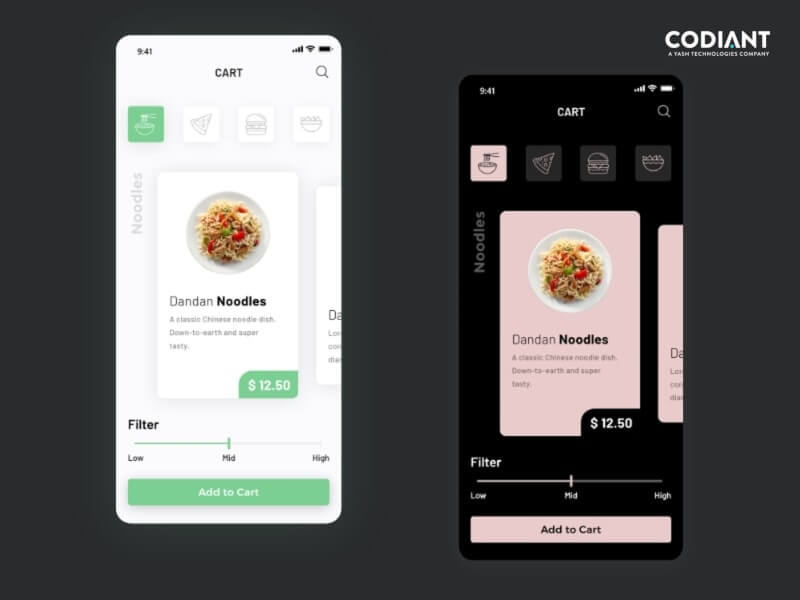
Online Food Ordering and Delivery Trends In 2020

food-delivery-app-design-codiant

Digital platforms -> On-demand Food delivery -> Measures to Convenience.

Online Food Ordering and Delivery businesses have been growing at a skyrocketing speed.

What posed as an innovation at a course of time quickly turns into a demand for incremental changes.

Of course, trends are supposed to bring change.

With the rising boom, we have seen food delivery players like Zomato, JustEat, Deliveroo, capturing a huge market share with their marketing tactics and strategic innovations to woo customers.

The online food delivery market that seems not to slowdown has recorded a revenue of US$23,991m in 2020 with an annual growth rate of 5.1% and is expected to grow to a market volume of US$29,222m by 2024, as per the report.

Underlying these rapid advancements, food delivery businesses continue to seek new ways to improve their delivery services as well as keep themselves up to date with the latest food ordering app development trends.

Here are the top game-changing food delivery app trends to hit the market in 2020:

Technological transformation

Personalized Catering: The rise in consumer preferences (e.g. demand for gluten-free food) will demand food delivery businesses to adopt Big Data Analytics into their existing digital platforms to better understand consumer needs, monitor trends and create meals that complement every dietary need.

Food & Ingredient Transparency: Transparent food labeling enabled by various health trackers will give a strong push to QSRs and businesses to mention more accurate information about food package labels.

Voice Assistance Tools: The AR and VR and voice assistance tools will play a huge role to help customers engage with QSRs and food businesses, even when they are not physically present in the restaurant.

Social Media & Small Businesses: The budding local food delivery startups will find their sweet spot in the webspace. They will access new markets, explore new opportunities by having their own website and food delivery app. Today, 89% of Australian small businesses have a website and some engagement with social media.

AI Bots: AI bots will progressively help in maximizing delivery efficiency, handling customer interactions, and driving recommendations.

New Ways to Delivery and Concierge Services

Delivery with Drones: Experimentations in delivering food will see new heights. Companies like Domino’s, Zomato and Uber Eats have already reduced the time by half by drone delivery. Businesses may use fully autonomous on-demand drone delivery services by hiring companies like Flytrx, Zipline to avoid traffic, congestion and reduce delivery time.

Delivery with Robots: Depending on the geographic location, businesses will soon come face-to-face with a food delivering robot.

Like the Starship delivery app is the first to start delivery with robots in the UK where the user simply opens the app, choose the items to be delivered and drop a pin by selecting the delivery location on the service map.

Users can even watch the robot’s journey to them through an interactive map. Once the autonomous food delivery robot arrives, the user will receive an alert, and they can meet the robot and unlock it through the app.

These little six-wheeled machines are well-equipped to protect themselves and their goods from being stolen. They walk around with 9 cameras and travel 4mph and can reach you only if you’re in the 3-mile radius from them.

Related posts: On-demand delivery by Robots

Delivery with Parachutes: If your restaurant is on the eighth floor and your customer on the ground, how will you deliver the food quickly and efficiently? Parachute delivery is the solution. Parachute-delivered food possibly may give a real benefit for restaurateurs, as pointed out by Pop-Up City. The spaces higher up in the buildings are less-expensive and give more options to businesses to test culinary concepts.

This innovative system was started by a group of friends in Melbourne where they delivered grilled sandwiches and used Paypal for payments.

Food Market Apps Segmentation

Delivery Only Business: The increasing internet penetration and smartphones have removed the limitations of having a food outlet to deliver food. Home kitchens can help businesses reduce the upfront cost for buying space and this way they can run their delivery business from home kitchens or collaborative kitchens.

A Virtual Kitchen also runs on the same concept where they run their businesses online by taking orders only by mobile apps.

Crypto Food orders: Purchasing food online with cryptocurrency is becoming increasingly popular. Pizzaforcoins a service based in California allows you to order from major chains such as Domino’s, Pizza Hut or Papa John’s in exchange for BTC.

Takeaway:

Convenience is king. And online food delivery app development has become a necessity and no more a choice. Restaurant-to-Consumer is by far the leading category but Platform-to-Consumer Delivery is growing faster. Improving the ordering experience and working on innovative delivery methods are the two major trends every food delivery business should vie for.

Related post: How to Create An On-demand Food Delivery App like Swiggy and UberEats?


How to Build an On-demand Delivery App? An Ultimate Guide

Generative AI stands out as a fascinating and innovative technology. But what exactly it is? How does it weave its magic?

Generative AI is like a smart artist on a computer. It creates new things, like pictures or text, by learning from examples.

  • This innovative technology employs intelligent algorithms to produce authentic-looking and sounding content, including images, text, and music.
  • Essentially, it’s analogous to having a computer that can exercise creativity and generate content independently.
  • The system is designed to function like a classy brain. It draws inspiration from the workings of human-like minds. It utilizes a neural network to analyze and process data.

A fascinating example of Generative AI is the Generative Adversarial Network (GAN), which operates as a pair consisting of a generator and a discriminator in AI technology. The generator produces new things, while the discriminator checks how good they are. They team up and get better at their jobs by challenging each other. It’s like a creative dance between two digital friends.

Types of Generative AI

Types of Generative AI

  • Generative Adversarial Networks (GANs)
    Imagine a creative duo – the Generator and the Discriminator. GANs bring these two together in a dance of creation. The Generator crafts new things, like images or text, while the Discriminator evaluates how good they are. This constant back-and-forth improves their skills, resulting in realistic and creative outputs.
  • Variational Autoencoders (VAEs)
    VAEs are like artists experimenting with different styles. They learn by trying to reconstruct input data in various ways. This type of Generative AI is great for generating diverse outputs and exploring different possibilities within a given set of data.
  • AutoRegressive Models
    AutoRegressive models are like storytellers predicting what comes next in a sequence. They focus on generating content one step at a time, making them effective for tasks like language generation. GPT (Generative Pre-trained Transformer) models fall into this category, creating coherent text passages by predicting the next word based on context.
  • Boltzmann Machines
    Think of Boltzmann Machines as brainstorming buddies. They consider the relationships between different data points to generate new ideas. This type of Generative AI is often used for collaborative filtering in recommendation systems, suggesting items based on similarities in user preferences.
  • Transformer Models
    Transformers are like multitasking magicians. They can handle different types of data and this quality makes them highly versatile. GPT models, a subset of transformer models, excel in generating human-like text, demonstrating the adaptability of this Generative AI type.
  • Deep Belief Networks (DBNs)
    DBNs are similar to detectives uncovering hidden patterns. They consist of layers that learn to represent complex relationships in data. This type of Generative AI is proficient in tasks like feature learning, making it valuable in uncovering meaningful patterns within large datasets.
  • Creative Text-to-Image Models
    Picture an artist turning words into pictures. Some Generative AI models specialize in transforming text descriptions into images. These models understand textual prompts and generate corresponding visual content, showcasing the intersection of language and image generation.
  • StyleGAN (Generative Adversarial Networks for Style Transfer)
    StyleGAN is like a digital stylist, allowing artists to control the style of generated content. Its ability to transfer artistic styles between images is unparalleled, offering users an unprecedented level of creative influence over the generated outputs.
  • Recurrent Neural Networks (RNNs)
    RNNs are like time-traveling storytellers. They consider previous information when generating new content, making them suitable for tasks involving sequences, such as predicting the next element in a series.
  • Conditional Generative Models
    Conditional Generative Models are like artists taking requests. They create outputs based on specific conditions or inputs. This type of Generative AI is valuable when you want the model to generate content tailored to particular requirements.

What is Generative NLP?

Generative NLP stands for Generative Natural Language Processing. It helps in mastering language with AI.

• Generative NLP is a subset of Generative AI that focuses specifically on language.
• Generative NLP is like a digital wordsmith, understanding and generating human-like text.
• GPT models falling under this category demonstrates the language mastery of Generative NLP.

The Power of Transformer Learning Models in Generative AI

At the heart of Generative AI lies the transformer learning model. Unlike traditional models that process data sequentially, transformers excel in parallel processing, making them highly efficient. This architecture allows the model to understand relationships between words and generate coherent and contextually relevant content.

  • Transformers operate on the principle of attention. It enables them to focus on specific parts of the input sequence while generating output.
  • This mechanism empowers the model to capture long-range dependencies in data, a key factor in producing high-quality and contextually rich outputs.
  • Generative AI, powered by transformer learning models, is transforming how computers generate content.
  • These models, like OpenAI’s GPT-3.5, are built on the Transformer architecture, excelling in language tasks and beyond. Transformers stand out for their efficiency and processing information simultaneously.
  • They break down data into tokens. It helps in understanding context and relationships within sequences. And, this is very important to grasp the tone of language.

Key Components of Transformers in Generative AI

  • Self-Attention Mechanism
    Central to Transformers is the self-attention mechanism, a mechanism allowing the model to weigh different words in a sequence differently based on their relevance. This attention to context enables the model to capture dependencies and relationships within the data, facilitating a more nuanced understanding of language.
  • Multi-Head Attention
    Multi-head Attention extends the self-attention concept by employing multiple attention heads, each focusing on different aspects of the input sequence. This parallelized attention mechanism enhances the model’s ability to capture diverse patterns and dependencies, contributing to its overall effectiveness in language-related tasks.
  • Positional Encoding
    While Transformers inherently lack sequential information, positional encoding is introduced to provide the model with an understanding of token positions in a sequence. This addition ensures that the model recognizes the order of words, addressing a limitation of the original Transformer architecture.

The Power of Language Models in Generative AI

Language models, a subset of Generative AI, specialize in understanding and generating human-like text. They are trained on vast datasets, learning the tones of language, grammar, and context. This training prepares them to respond intelligently to prompts, generate coherent text, and even complete sentences.

  • A prime example – GPT-3.5, boasts 175 billion parameters. This makes it one of the most potent language models.
  • This vast parameter count enables it to understand and generate text across a wide range of topics.
  • These models go beyond mere understanding. They produce coherent and contextually relevant text.
  • It’s like having a virtual writer who can compose articles, stories, or even poetry.

Autoregressive Models and Autoencoder Models are the two prominent types of language models.

• Autoregressive models generate output one step at a time.
• Autoencoders work by encoding input data into a compact representation and then decoding it to generate output.
Both approaches contribute to the diversity and richness of language generation.

The impact of language models extends to various sectors. In healthcare, these models assist in analyzing medical texts and improving communication. In customer service, they automate responses and so, enhance efficiency. In the education sector, educational tools benefit from language models that give personalized learning experiences.

Despite their benefits, language models raise ethical concerns. They may unintentionally spread biases present in the training data. Thus, ensuring fairness and accountability in their use becomes crucial.

Key Components of Language Models in Generative AI

  • Attention Mechanism
    At the core of language models is the attention mechanism. This mechanism allows the model to weigh different words in a sequence differently based on their relevance. By attending to specific parts of the input sequence, the model can capture dependencies and contextual nuances. It facilitates a more sophisticated understanding of language.
  • Contextual Embedding
    Contextual embeddings are used by language models to represent words by considering the context in which they appear. In contrast to traditional word embeddings that assign a static vector to each word, contextual embeddings adjust their representation based on the surrounding words in a specific context. This dynamic approach enhances the model’s capacity. After which, they capture the changing meaning of words in various contexts.
  • Recurrent Neural Networks (RNNs)
    Language models are typically developed using RNN or Transformers. RNN operates by processing sequences incrementally and retaining a hidden state that preserves information from previous steps. On the contrary, Transformers excel in parallel processing. It enables more efficient handling of sequential data. The selection of these architectures is reliant upon the certain demands of the given task.

Let’s decode the difference between transformer learning models and language models below.

Transformer Learning Models VS Language Models

  • While transformer learning models are the backbone of Generative AI, language models serve as its expressive voice.
  • With the parallel processing efficiency, Transformers lay the groundwork for quick learning. While language models are exemplified by GPT-3.5. They can take this efficiency to creative heights.
  • The key difference lies in their focus: transformers focus on data processing efficiency and context understanding, while language models focuses on language generation.
  • Transformers, with their attention mechanism, excel in capturing complex relationships within data. This makes them versatile for various AI applications beyond language generation. On the other hand, Language models specialize in understanding and generating human-like text. This makes them adept storytellers and conversationalists.

Final Takeaway

The possibilities of Generative AI seem endless. From reshaping design to revolutionizing how we communicate through language; Generative AI is such worthwhile technology for uncharted creative territories.

However, like any powerful tool, Generative AI comes with responsibilities. Addressing issues like bias and privacy ensures that the magic of Generative AI contributes positively to our digital world. Thus, it fosters a creative revolution that is beneficial for all.

Unleash the power of tomorrow with Generative AI technology – where innovation meets possibility. Join hands with leading Generative AI companies like Codiant to shape a future powered by limitless creativity.

Why Businesses Need Enterprise Resource Planning Software

Alcohol Delivery App Development : Cost, Key Features, and the Business Model