An Entrepreneurial Guide for Your Real Estate Mobile App Development

Look back and you’ll see a past episode where the process of buying/selling, or renting a property used to invite restlessness with burst of time. Gratefully, the times of all things digital with wide penetration of internet enabled smartphones has called an uptick in the demand for mobile apps which has incentivized the demand of real estate app development.

These real estate app solutions have proven their part as the best and quickest solution helping people find the most desirable property. With benefits like eliminating the needs of brokers and middlemen, these apps have become a go-to solution for instant information access for all things property.

In the wake of this ease provided by real estate apps for the home-buying experience, creating a guide for real estate mobile app development can bring advancement in an entrepreneur’s journey.

Let’s dig all the essential layers that goes in the development process.

Market Stats- Why Does a Real Estate Business Need a Mobile App?

Every now and then people used to leave their comfort places in the search of work, which is ultimately increasing the demand for such make-shift homes. These evolving needs surge the demand for real estate mobile apps in the marketplace. Let’s see some startling figures speculated to push the revenues with a boom in demand.

  • The global real estate mobile app development market is expected to reach a figure of $20.6 billion during the period from 2021 to 2026, with a CAGR of 5.7%.
  • Cloud-based real estate mobile app development demand is expected to grow at 8.7%, from 2021 to 2026.
  • The demand for real estate mobile apps in the residential sector is expected to rise at a CAGR of 7.5%, from 2021 to 2026.

Best Strategies for Real Estate Mobile App Development

1. Outstanding In-app Search & Filter

The real estate app development should provide a well-planned search and filter lists to help users to find the most relevant results. It will deliver a personalized in-app user experience with effective results.

2. Social Media Integration

Social Media Interaction provides a free hand to the user in sharing the best property option with their family, friend, or acquaintances. It also works as an indirect marketing for the app and property owner both.

3. Video & Image Sharing

The real estate mobile app should be multimedia supported to help users understand the property details and pick the right one that fits into their budget.

4. Strong Server Solution

The real estate apps used to be heavily loaded with a lot of details, images, video, and not to forget the users. So, to ensure instant data accessibility and quick loading time, it requires powerful server to manage all this at a time.

Benefits of Real Estate App Development

1. Increase Customer Engagement

An effective and SEO-optimized mobile application can generate a good number of leads regardless of geographical boundaries. It can increase customer engagement and generate good profits.

2. Higher Conversion Rate

Better Revenues as consumer’s behavior is changing. Users are no longer merely interested in searching for houses online, they are also buying houses which results into the higher conversion rates.

3. Multiple Options at a Time

The smart mobile apps provide multiple real estate options at a time. On the app, the user can find multiple brokers, property options, flexible budgets, and many more which ease the complete process.

4. Introduce Advanced Technologies

With the advancement and introduction of new technologies, real-estate app development companies can introduce new features and functionalities to ease user activities and finalize maximum deals.

5. Boost ROI

Smart mobile apps can exercise multiple means of generating revenues, such as brokerage charges, property listing commission, advertisement, broker listing commission, direct customer commission, and many more.

6. Accurate Customer Target

Based on the customer’s preference, the real estate app can instantly list down all the available options. Keeping the customer’s preference in mind the smart apps can even suggest the newly added property that fulfils the customer’s criteria.

7. Build a Strong Brand Market

The real estate app not only supports the businesses but also the app platform itself to build a strong market presence. It can provide a hands-on benefit and competitive edge in the market to come up as a strong brand name.

8. 24×7 In-app Communication

The in-app communication channel allows easy and quick query resolution, along with proper guidance which enhances user experience. The user can reach out to brokers or look for a suitable option at any time of the day and seek 24×7 assistance through the app.

9. Direct Marketing

A direct marketing channel allows businesses to list their properties on sale or rent. It minimizes a lot of human effort and saves time.

Must-have Features for Real Estate Mobile App

A Real Estate Mobile Application comprises three stakeholders, i.e., Buyer/Renter, Agent/Seller, and Admin Panel.

Features of Buyer/Renter

  1. User Onboarding: The buyer or renter can register or log in on the real estate app with an email id and password.
  2. Dashboard: User can manage profile details, agents profile, preferred location listing, reach out to agents directly, raise an issue, etc.
  3. Search & Filter: Users can search or filter properties under various search parameters like location, type of property, etc.
  4. Property List: View Property in form of List or Map View in the property listings.
  5. 3D View: 3D property view shows the entire property to the buyer on their smart devices at their comfort zone.
  6. Set Favourites: Users can add their desired properties under the ‘My Favorite’ tab.
  7. In-app Connection: Buyer or Seller can connect through the app on calls or messages.
  8. Set Calendar: Buyer can set property visits, broker calls, etc. reminders while syncing with the calendar.
  9. Integrated Map: Maps are integrated to track the property route and get a rough idea of the location.
  10. Push Notification: Inform users about deals, offers, property alerts, auctions, etc.
  11. Currency Converter: This in-app feature help with the rates in different currencies, so that international clients all over the world can access the app.

Features of Agent/Seller

  1. User Onboarding: The agent/seller can register or login on the real estate app with an email id and password.
  2. Dashboard: The agent can manage his profile, enlisted properties, customers contacted, and other details.
  3. Add Properties: Add new property, edit existing details, and delete the property or mark it as sold.
  4. Subscription: The agent can keep track of the active subscription package, validity, and the previously purchased package details as well.
  5. In-app Connection: The agent can connect with the buyer through in-app messages or calls to set appointments and share details.
  6. Push Notification: The agent can receive reminder or important updates notifications etc.

Features of Admin Panel

  1. Manage Customer List: Admin can view customer details, and their activities, or can activate/deactivate customers.
  2. Manage Broker List: Admin can add/edit/delete broker from the list, or can set active/inactive profile.
  3. Manage Property List: Admin can manage properties list, details, and can keep track of all the properties progress.
  4. Generate Customized Report: Admin can generate customized reports of customer, broker, property, and revenue to monitor progress.
  5. Revenue Management: Admin can monitor all transaction details and conclude revenue generation.
  6. Real-Time Analytics: This feature gives the admin enhanced access to the defined data patterns that help the admin derive the meaning to take decisive and strategic actions.
  7. Customer Support: Admin can resolve or respond accordingly to the customer’s and broker’s queries.

Advanced Features

  1. Geo-location Tagging: It allows the user to check the property nearby his/her current location.
  2. Mortgage Calculator: Through this calculator the user can easily calculate the monthly EMI s/he will have to pay if the user has purchased the house on loan.
  3. Interest Rate Calculator: The Interest Rate Calculator determines real interest rates on loans with fixed terms and monthly payments. It also helps users to figure out certain taxes and insurance associated with the property.
  4. Map View: Through this feature, the user can search properties in his area and location.
  5. Blog: The app owner can add informative blogs to educate its users about real estate. This makes the app engaging and increases the in-app time of the users.
  6. Testimonials: Feature to showcase the valuable testimonials of the client increases the reliability of the app and lets users check the genuine reviews.
  7. Social Sharing: Enabling the social sharing option allows the app owner to share the properties available on rent/sale on social media channels.
  8. Live Showing: Buyers can watch the live inspection of the property by the agent.

Required Technologies & Team Structure of a Real Estate Mobile App Development

Tech Stack

A state-of-the-art and cutting-edge development of a real estate app requires a strong backend. Some of the supportive technologies could be;

  • Database: MongoDB, HBase, Oracle, Cassandra, Microsoft SQL Server
  • Cloud Storage: AWS, Azure, Google Cloud
  • Query Tool: Apache Hive, Apache Pig, Flume, Sqoop
  • Platform: OpenStack, Windows, Google App Engine, Windows Azure, Force, Linux
  • Real-Time Analytics: Hadoop, Spark, Big Data, Apache Flink, Cisco, IBM
  • Payment: Braintree, PayPal, Stripe, Wallets, Credit Cards, Debit Cards, Net Banking
  • Push Notification: PushEngage, Urban Airship, Push Woop, Parse Push, Push.io, Accengage

Team Structure

Real Estate App Development is quite a complicated and time taking process, so it requires a dedicated team to develop an efficient and effective end product. Well, it is a combined team effort, so every individual should have to be at their best. Let’s get into the details of how a real estate app development team looks like.

  • Project/Requirement Manager
  • Business Analyst
  • UI/UX Designers
  • Front-End Developers (1-2)
  • Back-End Developers (1-2)
  • iOS App Developers
  • Android App Developers
  • QA Engineers

How does Real Estate Apps Make Money?

  1. Brokers Fees

    The real estate agents can pay the nominal charges for using the app. It can be on a monthly, quarterly, half-yearly, or annual basis. The platform can even advertise or promote brokers who avail the advertisement option. It will help brokers gain more visibility among customers, crack more deals, and earn more.

  2. Third-party Advertisement

    The real estate app owner can utilize the app’s white space by allocating the space to a different business advertisement that can support their business too. It includes interior designer, financer or lender, retailer, contractor, etc.

  3. Premium Features

    The app owner can categorize the features based on the quality and customer requirements. Then, can introduce the premium version of the real estate mobile app to monetize the platform by providing a limited time period access.

  4. Commissions

    The commission charges can be applied on a different course of action, as per the app owner’s requirement. However, one of the most suitable and appropriate commission charging strategies could be implemented whenever the deal is finalized between the customer and the broker or property owner.

  5. White Label Model

    The real estate app owner can get the code license to sell it to other people. You can also hire a developer to customize the app as per the new buyer’s requirement. Before getting into this, ensure your product had exceptional qualities that might interest entrepreneurs.

Related reading: Top 5 Real Estate Apps Features to Get Inspired From

The Total Time and Cost Required for Real Estate App Development

The time and cost of a real estate mobile app development could not be defined accurately, as there are many influential factors that affect the overall development time and cost. These factors include market analysis, project size, complexity, functionalities, UI/UX design, team size, team location, tech-stack, maintenance & support, and others.

The developer’s hourly charges vary as the zone changes. Such as, in the US the hourly charges range from $100 to $250; in Singapore, it is about $60 to $160, whereas it is comparatively quite low in India i.e., somewhere about $30 to $60 per hour.

Considering all the above influential factors, we can infer the average development charges range somewhere between $30,000 to $70,000, or more. Likewise, the development time also varies and takes around 2 to 6 months, which might be more in some cases.

Why Choose Codiant As Your Real Estate App Development Company?

The Real Estate Industry is booming, so is the demand for mobile applications. There are ‘n’ number of Real Estate App Development Companies, but considering the overall development nuances it is not as easy as its counterparts. Real Estate apps are quite complicated and feature-specific apps to develop, which require only expert hands to deliver perfection.

Codiant is one of the best real estate app development companies on which you can rely for your real estate app requirements. Our expert web and app developers have already delivered an array of successful apps in the market, enabled with advanced technologies. If you are also in search of such an expert development team, we are your right partner of choice. Reach out to our expert team to explain your project requirements and seek further assistance to take the business in the online competitive market.

Telemedicine App Development Cost & Key Features

“Provide virtual care to your patients anytime anywhere” this concept has delivered greater measurable value more than ever after the COVID-19 pandemic.Post the corona outbreak, Telemedicine app has become the lifeblood of many governments, hospitals, ePharmacies and even corporates.The surge in telemedicine app development amid the pandemic has given Doctors and healthcare organizations a well-suited platform in their employee wellness strategy.From the many benefits the telemedicine app provides, the remote consultation is the Holy Grail protecting the patients and doctors from the virus transmission, while not disrupting the lockdown measures.Telemedicine is a readily available solution bridging the gap between patients, physicians and health systems, enabling everyone especially symptomatic patients to stay at home and connect to the care providers virtually through online video calls, EMR/EHR, ePrescriptions, and medical data sharing.

readymade-telemedicine-app

The Urgent Need to Develop Telemedicine Apps

If at any point of time you think, consumer-friendly platforms like Skype, FaceTime and Whatsapp can help you take the video visits, then drop the idea now. These tools might be great for quick, one-off visits but they don’t integrate well with the health system’s telemedicine infrastructure and are bit cumbersome to provide remote care operationally.

Looking ahead, if the federal authorities passes any emergency with old rules and regulations, there likely won’t be any option remaining other than adopting it.

Furthermore, looking at the momentum at which telehealth is tackling the virus and chronic care management, other health and ancillary services are pushed aside.

What we as a telemedicine app development company are learning is the face of healthcare is changing permanently.

Study says, 72% of healthcare providers have adopted the use of telemedicine after the coronavirus hit and are now taking it as a new normal. There’s no going back.

Also, from a recent survey conducted of U.S patients, it was found that 84% of patients are more likely to select a provider that offers telemedicine over one that doesn’t.

‘WE … JUMPED FORWARD 10 YEARS ON THE ADOPTION CURVE’

It can be clearly concluded, healthcare practitioners have to deploy telemedicine quickly and see it as a long-term investment to provide urgent-care treatment and a better patient experience.

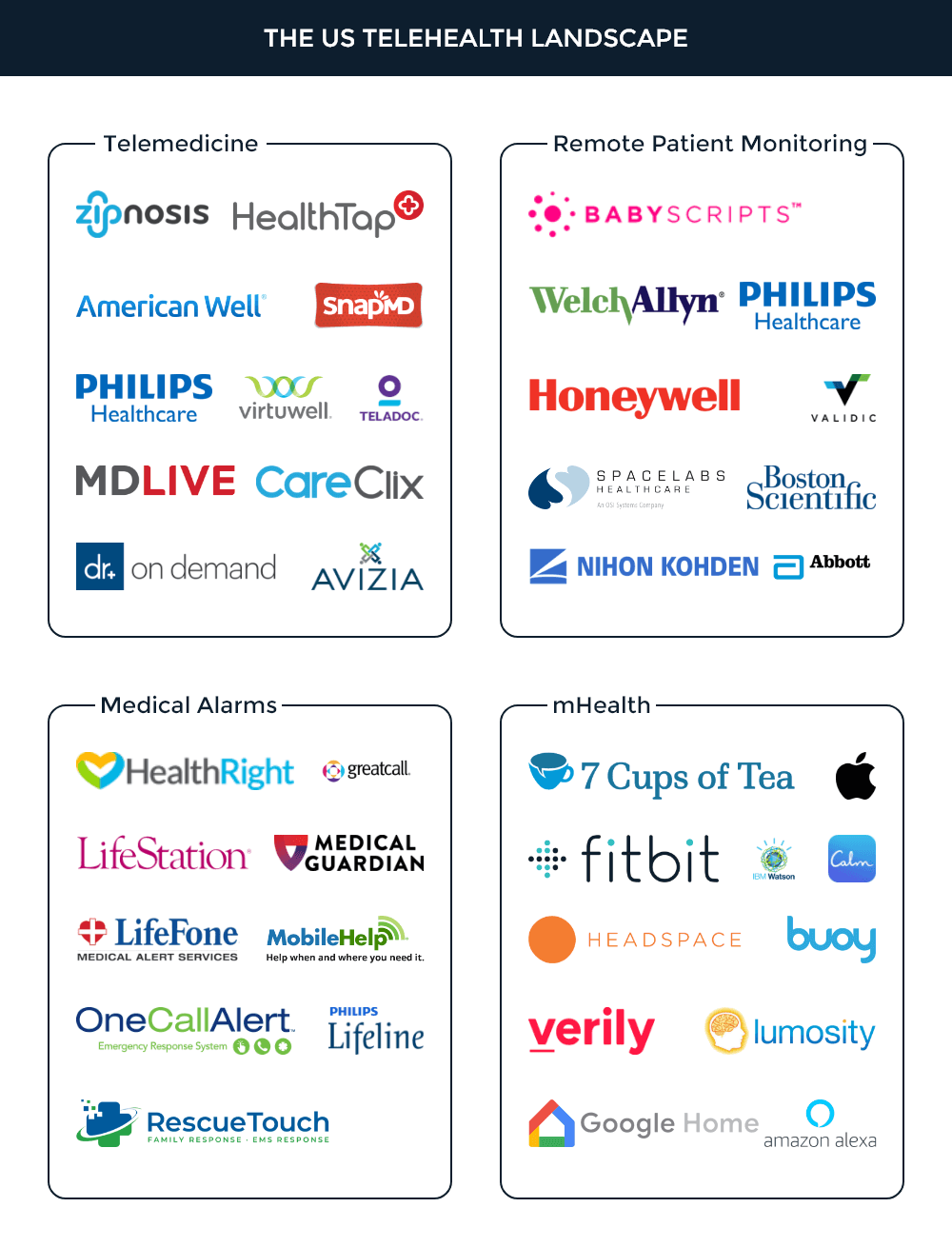
telehealth-landscape

Source: BI intelligence

The Capabilities of A Telemedicine App

Telemedicine has been a key pillar of technology-enabled care delivery that is helping healthcare organizations deliver quality care remotely and gain following efficiencies:

For Patients:

  • Lowered costs
  • Improved access to care
  • Convenient and time efficient
  • Slows down the spread of infection

For Healthcare Providers:

  • Reduced overhead expenses
  • Additional revenue streams
  • Improves the quality of care delivery
  • Less exposure to illness and infection
  • Improves patient engagement and satisfaction
  • Unified patient monitoring system

A recent study showed that with telemedicine, patients had:

  • 38% fewer hospital admissions
  • 31% fewer hospital re-admissions
  • 63% more likely to spend fewer days in the hospital

Want to Explore the Use Cases/Functionalities of a Telemedicine App? CLICK HERE

The Benefits Provided By Telemedicine Functionalities

  • Store and forward facility helps in pre-screening patients living remotely
  • Organize and collect patient data
  • Identifying and tracking public health issues
  • Some systems can improve data management through network databases and Electronic record keeping
  • Enables the transfer of images as attachments

How to Develop A Telemedicine App?

Key Features of Patient App

  • Registration A patient can sign up via mobile number, email and social media channel for quick login. However, we would recommend a two-factor authentication which requires SMS, voice or phone verification. Since, the app carries private and sensitive healthcare data records.
  • Profile Patients can create their profile by inserting information like name, age, gender, photo, past medical history, etc.
  • Search Doctors Patient can search doctors by filters like specializations, country and state, consultation fee, ratings, etc. They can also apply filters to sort doctors by fees i.e. (low to high and high to low).
  • View Doctors Profile Patients can view Doctors profile with details like photo, specialization, address, consultation fees, email, phone, available appointment slots.
  • Book Appointment Patients can book appointments as per Doctor’s availability. The appointment can be canceled or rescheduled. You can also ask your software vendor to segment the types of appointments on basis of priority like normal appointment for chronic care, instant appointment for urgent care.
  • Communication Mode The communication can be carried out via video or audio call, video conferencing, via chat or messaging and it can also be real-time or in-person consultation.
  • Upload Medical Record Patients can upload medical records like past medical history, prescriptions, lab tests, etc.
  • PaymentsPatients can make secured online payments through multiple payment gateway integrations like cards, mwallet, net banking, etc.
  • Leave Review Post treatment patients can leave review and rating of the doctor.
  • Patient Insurance This is an advanced feature that allow patients to take in-app insurance. At Codiant, we use PokitDot insurance as it readily gets approved and enable patients to get real time benefits.
  • Notifications The app can remind patients of their upcoming appointments, bills, etc. via notifications which can be email notification, SMS notification and push notifications.

Key Features of Doctor App

  • Easy Onboarding  Doctors can securely signup/login in the app through email, phone verification.
  • Create a Schedule Doctors can create a schedule by selecting a date range, days, start and end time, duration of the appointment. They can also manage the calendar as per availability.
  • Set Availability Doctors can set availability status to online/offline.
  • Appointment Management Doctor can receive appointment request, accept/reject an appointment and view upcoming appointments.
  • Communication Mode Doctor should be able to set type of consultation like video, audio and in-person for patient interaction. Doctor should also be enabled to take urgent type of appointment immediately.
  • View Patient’s Profile Doctors can view patients’ profile, manage their reason for visit, and view past appointments along with other details like appointment time & date, fees, reason for visit, status of appointment- completed/ not accepted.
  • ePrescription This feature allow doctors to send online prescription to patients which will be saved to either databases.
  • Notifications Doctors can receive notifications of their schedules or upcoming appointments with patients, payments received and more through email, SMS, and push notifications.
  • Profile Management Doctors can manage their profile by adding their professional details, uploading picture, and updating fees.
  • Dashboard and Analytics In this feature, Doctors should be able to view their dashboard where they can see their no. of patients, total earnings, prescriptions and more. This should be kept personalized as per your specific requirement.

Key Features of Admin Panel

  • Dashboard to view total no. of doctors and patients
  • Ability to manage doctors (add/update/delete)
  • Manage patients (view/edit/update/delete)
  • Ratings and review management
  • View reports and analytics

Technical Architecture of Telemedicine App Development

telemedicine-app-tech-stack

  • Programming languages: Kotlin, Java (Android), Swift (iOS)
  • Insurance verification: PokitDok
  • ePrescription: EazyScript
  • Video Conferencing: WebRTC
  • Chat: Twilio, Socket.io
  • Database: MySQL
  • APIs and frameworks: Stripe, EC2, S3

Advanced Technologies Used in Telemedicine

Health technologies integrated with novel uses of data are transforming virtual care to the next level. Let’s look how we can leverage it for improving outcomes and achieving quality goals.

emerging-telemedicine-technologies

1. Blockchain

The many potential use cases of blockchain in healthcare has only enhanced healthcare operations. Blockchain technology is helping in securing patient healthcare records, optimizing health supply chain for pharmaceutical products, clinical trial management and making claim process easier.

2. Artificial Intelligence

Data-driven technology AI and Machine Learning has broad applicability in the healthcare industry. The potential effects of AI in healthcare includes managing medical data, tracing patient history, remote patient monitoring through health trackers, medical imaging diagnosis and decision making through predictive analytics. Click here to explore in detail.

3. Big Data

Big data is helping healthcare organizations in collecting, analyzing and leveraging patient’s and clinical data. The data analytics helps to make strategic decisions and improve care personalization and efficiency at a greater extent.

4. Chatbots

Chatbots are assisting in physical patient care with medical queries, medication guidance, symptom checks, nutrition coaching, etc. The various healthcare apps using chatbots applications are Safedrugbot, Florence, Forksy, Izzy, Babylon Health and more.

5. Internet Of Things (IoT)

IoT enables healthcare professionals to be more watchful and connect with the patients proactively. It can track if patients are taking treatment plans properly and can also sense if they need urgent care or immediate medical attention.

How Do Telemedicine App Make Money?

Given the operational costs for healthcare in traditional settings rockets faster than its revenue, creating a telehealth app with sustainable business model is always a great idea. One time investment in the telemedicine app development and you take the advantage of revenue sources without going broke.

After discovering the revenue models of leading healthcare apps, we have funnel down 5 effective monetization strategies that can help hospitals, healthcare organizations and care providers generate money through the app.

how-to-make-money-with-telemedicine

  • Flat Fee Per Visit

Patients connecting to physicians using video visits can be charged a fee for a time period say 15-minute appointment. If the call goes over the allotted time, patients have to repay the same amount for another 15 minutes slot. App owners can earn money by fixing a commission of each visit from the care provider. Like Doctor on Demand takes 25% of the cost of each visit.

  • Per Employee Per Month (PEPM)

If you’re anyway thinking to charge employers through “Per Employee, Per Month” or say monthly subscription fee, you can earn a good figure annually. Like for example, a company of 100,000 employees, charges $1 from an employee per month, this rounds up to $1.2 million annual cost.80% of the revenue of legacy telemedicine providers is generated by PEPM revenue model only and the rest accounts from providing patient care.

  • Insurance Reimbursements

App owners can make money through insurance reimbursements and also giving flexibility to users to use the app platform without insurance by giving pocket money.

  • Providing Software To Health Systems (SaaS)

A newer line of business could be providing developed software to other health systems at a low per provider fee.

  • Selling Franchisee

This strategy can help you to popularize, scale and expand the platform to larger customer base in a short span of time. Speed of growth and early stage capitalization is yet another benefit you can avail.

Top Telemedicine Applications

6 Successful Telehealth Apps Known for Their Exclusive Business Models

The drive of innovative telehealth app development constructed over advanced technologies have powered thousands of hospitals and health plan partners with over millions of employers and care providers.

Let’s take a short trip to the success stories of some of the best telemedicine apps that have delivered a unified patient experience in normal as well as uncertain times like COVID-19 pandemic.

1. Doctor On Demand

iOS Android

doctor-on-demand

A simple, secured and safe telemedicine app for online doctor consultation is easy to use with its apps available on the app store and play store.

The app has 24/7 availability of licensed physicians, psychiatrists, psychologists, and master-level therapists. It covers the A-Z needs of patients ranging from urgent care to chronic care and behavioral health to preventive health.

The working is simple patient lists past medical records and symptoms before connecting with the doctor online through video conferencing and posts the virtual consultation gets an online prescription.

The consultation fee of the medical doctors’ ranges from $75 for a 15-minute consultation and for Psychology goes as high as $129 for a 25-minute consultation.

Looking to Create a Telehealth app like Doctor-On-Demand? TAKE A FREE DEMO

2.Teladoc

iOS Android

teladoc

Teladoc can also be called a digital powerhouse of healthcare and telemedicine apps prevalent in the USA. Known for providing “everyday care”, chronic care and cure to normal healthcare issues Teladoc relies on independent contractor physicians to provide telehealth services.

The app’s earnings can be attributed to the subscription access fees charged by the app to employers and insurers so employees and members can connect with doctors; right now in 2002 during COVID-19 times more than 70 million people in the U.S. have access to its platform.

Compared to other apps, TelaDoc’s affordable care plan that covers anyone without insurance helps the app sales soar year over year.

3. MDLIVE

iOS Android

mdlive

Fueled by the proposition of providing safe, timely access to care in normal days as well as during pandemic, MDLIVE app meets the growing need of virtual care through its expanded national provider network of board-certified psychiatrists and licensed therapists.

The online consultation app has won hearts of 35 million members with overall satisfaction rating as 92; by treating patients virtually with its comprehensive behavioral health offering.

The app connects patients with care providers within just minutes and simplifies and streamline the telehealth services by leveraging advanced technologies and artificial intelligence.

4. Amwell

iOS Android

amwell

Emerging as a frontrunner, Amwell is a leading telehealth platform in the USA that drives better healthcare outcomes by an amplified patient and provider digital experience. Led by innovation, the app provides an agile and swift virtual response to communities, COVID-19 pandemic, and screenings through its expanded virtual digital care delivery.

Amwell app is adaptable to the needs of the patient and provider, gives a dynamic environment; and optimized for different scenarios.

5. Practo

iOS Android

practo-like-app

Founded in the year 2007, Practo is one of the earliest dawn in the digital healthcare platform that currently offers comprehensive telemedicine app services and online medicine delivery services. Known for providing clinic like experience with video consultations, Practo telemedicine app has emerged as a key player in offering online consultation with doctors, medicine delivery, and pre-booked appointments to the lab or diagnostic centers.

For a quick and simple online consultation, the patient can enter their symptoms and get matched with a qualified doctor of their choice. Practo has recorded about 80 percent, first-time telemedicine users, along with a 67 percent drop in in-person visits during the peak pandemic time of March-May.

6. Teledocto

Web Android

teledocto

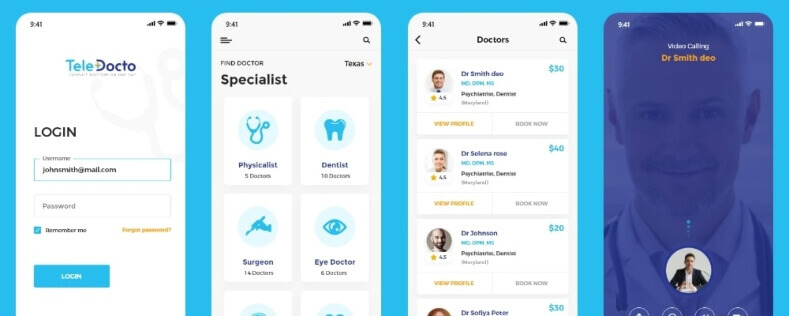
Teledocto is a ready-made white-label telemedicine app development solution for Doctors, Clinics and Hospital Organization. The solution enables physician groups, healthcare providers belonging to same or different groups run their own virtual clinic with well-rounded telemedicine capabilities.

The system utilizes cloud-based online video calling, video conferencing or group calling, audio calling, secured messaging, screen sharing, and whiteboards to provide its services. Online appointment booking and scheduling are also used to book consultations.

Crucial Stages in Telehealth Software or Telemedicine App Development

While you hire a telehealth app developers, you have to go through following stages of product development.

1. UI/UX Development

This is the design stage where the UI (User Interface) and UX (User Experience) design is conceived and iterated until there is a final prototype for the developers to be build.

At Codiant, we go through the subsequent steps to generate a final UI/UX design. Which goes in particular order as:

  • Wireframing (involves a few feedback cycles with client)
  • Visualizing app design concepts (the app screens are send off to client)
  • Upon confirmation on the screens we begin with collaborative design process.
  • The finalized visual design is combined with the UX flow to create a working prototype.

2. Back-end Development

The technology of the back end is a combination of servers, applications and databases. After the confirmed approval of finalized app or software design, the project rolls down to functionality development. There would be several third-party integration involved in this app that can be customized as per your requirements.

3. EHR Protection

Electronic health records enable you to give only authorized personnel access to patient data. As telemedicine apps contains patient-sensitive information, you have to make sure about the measures and encryption protocols your telehealth app development company follows to keep your confidential patient information secure.

4. Compliance With Healthcare Legislation

The development, distribution and implementation of healthcare and telemedicine apps requires to adhere to laws, regulations and guidelines specific to healthcare app processes. Safeguarding patient privacy and ensuring quality care is the responsibility of healthcare organization.

Telemedicine apps should be HIPAA compliant in the USA for the protection and confidential handling of patient health information.

Cost Estimation to Develop a Telemedicine App

To determine the cost to telemedicine app development, it is necessary to evaluate how the mobile app development company works for the software development process.

Like at Codiant, telemedicine app development is carried out in two different stages:

  1. Discovery phase
  2. Development phase

The elements of discovery phase include:

  • Software architecture planning
  • UI/UX design
  • Project Management

Learn in detail how we assess and cover discovery phase at Codiant? CLICK HERE

While the elements of development phase include:

  • Native app development (iOS, Android)
  • Quality assurance and testing
  • Project management
  • App deployment
  • App maintenance

These stages of app development are break down into features and functionalities depending on your organizations goals, needs and budget.

telemedicine

A Ballpark Figure

A telemedicine app generally takes around 1300-1500 hours of development time with hourly rates that vary company to company ranging from $20/hr – $50/hr.

Nonetheless, this price is approximate as it depends upon your requirements, no. of features, third party API integration and the degree of complexity involved in developing it.

So, we would rather recommend to contact the mobile app development company and take an accurate project estimation.

Starting an Online Food Delivery Business in 2022? Here’s Your Launching Tips and Trends

If you own a restaurant, you’ve probably tried every trick in the book to keep your business supplies rolling, in the highs and lows of pandemic. Online food delivery app development and restaurant technologies might be the farthest solution in your mind.

But if you see current scenario, all the longstanding concerns of restaurants & food industry striving to survive are only being solved by online food delivery apps. All other traditional measures that QSR industry relied upon went into smoke with an increasing dependency on on-demand delivery apps.

The food delivering technology is getting smarter, more user-friendly, and more intuitive. Right from searching the nearby restaurants or finding the favourite food to paying the bill can be done right at the table or from the home.

Do you know what all it needs to develop such a promising Food Delivery App in 2022 and ensure smooth operations while fighting daily challenges that affect your business?

Keep reading to learn how restaurants and QSR aggregators can enter into the on-demand landscape and leverage the power of online food delivery apps with assured returns and achievements.

Before that, take a sneak peak to the snowballing market of food delivery apps.

Market Overview for Modern Food Delivery App

Spot The Revenue Footprints Globally

  • The global online food delivery services market is expected to grow from $107.44 billion in 2019 to $154.34 billion in 2023 at a CAGR of 11.51%.
  • Global Revenue Generation of the online food delivery business in 2021 is $270,317 million and is expected to reach a point of $401,391 million by 2025 at a CAGR of 10.39%.
  • The global user’s number is expected to reach about 2,638.1 million by 2025, in the food delivery segment.
  • As per the business trends, the highest revenue-generating country is expected to be China in 2021, by $191,861 million.
  • This rapid growth is mainly due to the food delivery companies that are resuming their business while adapting to the new normal from the COVID-19 impact.

How does Food Delivery Apps Work?

An on-demand food delivery app is not a single app, rather the mighty nestles the entire food supply chain to streamline the delivery operations. The app is a hub to three different food ordering apps i.e., Customer, Delivery Driver, and Restaurant/Admin. All three apps possess different features and functionalities to ensure seamless food delivery services.

Customer App: As soon as the customer installs this app on their device, he/she will have to follow these steps:

  • To place the food order online, customers need to login or register on the app and provide genuine details, such as name, address, contact details, etc.
  • Customers can browse the restaurants or specific food item on the app to add to the food cart.
  • After adding all the required food items to the cart, the customer can place the order.
  • Now, the customer can make the online payment or select the cash on delivery mode and confirm the order.
  • Customers can track the order and delivery progress, then receive the order at the mentioned address.

Restaurant/Admin App: The restaurant that receives the order can control and manage the order progress with the Admin through the web-based food ordering app.

  • Restaurants update their menu list with the food item’s name, description, price, and images.
  • The restaurant can accept or reject the received order from the customer side.
  • The order is expedited to the restaurants’ kitchen, and based on the order size and queue, the expected order delivery time is assigned.
  • During the order preparation time, the order is assigned to the nearest delivery person to carry out the delivery process.
  • Based on the delivery distance and the delivery person’s performance the order delivery payment is done.

Delivery Driver App: The delivery driver receives the order request, picks the order from the restaurant, and delivers it to the assigned location or the customer’s doorsteps.

  • The delivery person can register or login through the delivery app with his accurate details.
  • The delivery person receives the notification from the restaurant for new order pickup and delivery address details.
  • Based on the convenience the delivery person can accept or reject the order.
  • Upon acceptance, the delivery person picks the order from the restaurant and delivers it to the destination address.
  • In case of rejection, the restaurant looks for another delivery person to complete the order delivery.
  • After delivering the order the cash payment is collected (only if COD was chosen by the customer) then the delivery person marks the ‘order complete’ on the app.

How to Attract Customers to your Online Food Delivery App?

Offer customer services that can help your business stand out among competitors and compels customers to prefer you over other food delivery services. These services could be like safe, hygienic and sustainable food packaging, swift delivery services, and instant response to queries and grieve, proactively addressing delivery issues, appreciating repeat customers, so on.

  1. Fill the Demand Gap“Invention is the mother of necessity”. There is no better time than now to spill this idea into your venture and make inroads in this competitive landscape.While launching your food delivery app, ensure that you study the market well, understand the customer’s pain points and develop an on-demand food delivery solution that hit the bulls-eye.
  2. Promote on Social Media PlatformsAdopt Social Media Platforms to bring your USPs into spotlight and effectively grab the viewer’s attention with reels, videos, marketing memes, influencer programs, etc. Use paid promotions as well to clinch customer attention and ensure enough repetitive views of advertisement to endorse viewers’ reaction. Overall, study and follow the latest social media promotional trends to turn out to be extraordinary.
  3. Connect One-On-One with your Prospects & CustomersReach out to your customers and interact with them on social platforms. Furthermore, be an active listener and respond positively to the customer’s reviews and feedbacks. One-on-one customer connect can help to introduce a personalized touch and can give a new dimension to your food business.
  4. Offer Finest Customer ServicesCustomer services is a support that you offer your customers, both before and after they buy your products and services. Arguably, it takes months to find a customer and seconds to lose a one. Do not miss a bit to go extra mile when satisfying your customers.
  5. Introduce a App Referral ProgramPeople trust recommendations from friends 7X more than traditional advertising. Acquiring new users through referral programs is a marketing idea that spreads like a wildfire and reaches far and wide. So, the let the word of mouth chanting your app echo in the online space. This is a surefireway to higher app installs and increase user engagement.
  6. Design an Appetising MenuA customer doesn’t like to spend too much time scanning the menu, so create a crisp, concise, and easy-to-read menu that conveys most of the item details and description. You can also entice customers’ with scrumptious pictures of well-presented dishes.
  7. Accurate Brand TaglineA tagline is the simple statement that conveys a lot about the business’s core idea. So, create an engaging and relatable brand tagline that makes your brand memorable.
  8. Collaborate with Food Bloggers & InfluencersOffer exclusive discounts to food influencers that like to award their followers with free products or hefty discounts. Their single story can make your app post reach thousands of people. You can also create an event relevant to food influencers, this can prove very effective in promoting your restaurant.
  9. Offer Deals to Employees From Local OfficesCapture the crowd. The crowd that is most likely to make repeat purchases from your app. They are none other than employees. To reach them make local offices as your target. Give these offices discounts on food items. This will lead to a rapid increase in your customers.
  10. App Store OptimizationIncrease your app visibility in the App Store or Play Store. Just by making your app rank higher in the App stores you can drive more traffic to your app and reach your target users in a flick.

Pain Points of an On-Demand Food Delivery Market

Experiencing a Hard Time in Engaging and Retaining Customers

Businesses always experience a hard time, regardless of the industry, in meeting up the customer’s expectations which ultimately affects the business in the long term. Likewise, the food delivery industry is not an exception. Therefore, while implementing new tactics, create strategies that attract new customers as well as retain the existing ones too.

The online food delivery apps are an avenue to increase customer engagement by introducing attractive offers and discounts, referral systems, cashback and many more. Besides, as an app owner you can also team up with UI/UX team and work on enhancing the app design with a compelling user experience that can offer seamless app navigation.

  1. Incompetency To Find the Right Food Delivery App PartnerHaving an online presence of your food delivery business can help to reach a wider customer base. While associating with the right food delivery partner can do wonders for your business, in terms of building a brand image and generating hefty revenue.Having a reliable food delivery partner can give you a free mind in strategizing and implementing business tactics to promote and grow your business in a guided manner. But, before sailing on the boat, ensure rigorous market research in identifying the right food delivery partner app platform.
  2. Facing Challenges in Order Deliveries and Logistics ManagementThe restaurant business owners always face a major challenge of managing home delivery of orders, as they could not conclude over the requirement of fleet size, instant or on-time delivery, maintaining the food quality, etc. Due to this, these individual service providers fail to cover a wide geographical area and the maximum number of order deliveries.Therefore, to overcome such challenges, restaurant business owners can associate with third-party delivery services to manage all the deliveries effectively and on-time. It will minimize the overall operating cost and time. The timely delivery services can also ensure to attract and retain customers for long, generate loyal customers, and ultimately boosts revenue.

Ways to Enter into On-Demand Food Delivery Market

The on-demand food delivery market is pretty versatile, highly competitive, and somewhat crowded too. To place your steps firmly in the market, it is highly recommended to make bold yet quite calculated steps to impress and invite new customers. So when you plan to enter into the online food delivery market, try to be unique and consider the following points;

  1. Start your Online Food Delivery Business LocallyHaving a humble beginning of your business can provide you with a wider scope of improvement and expansion. It is quite an easier and an intelligent call to set up and manage the online food delivery services in a small location or in a single city, rather than aiming for multiple locations initially.It will minimize the chances of business failure and losses. In contrast to that, it presents you a wider window to learn and improvise business strategies and expand your business to multiple locations. As a result, you can eliminate the scenario of experiencing heavy losses, in case of business failure.
  2. Market your Food Delivery Business with Utter CreativityStrategic marketing of an online food delivery app will help you to educate and spread awareness among your prospects about your business idea and unique offers. Implementing a robust marketing strategy will lead your business to perform well in the competitive market.Following effective social media marketing, branding promotions, billboard advertising, etc. will help your business to reach prospective customers and help people to know about your business’s existence. While highlighting your business process and selling points will also help to grab potential investors’ attention.
  3. Connect with Influencers and Food BloggersWhile advertising about your business existence, collaborating with some market influencers and leaders can help you to increase your customer reach. It reflects the impression of a trustable name entering the on-demand food delivery apps market.But to make it possible, it requires thorough research to find the professional influencers and bloggers who can best promote your business with a wider reach and at the same time fit into your budget. So while collaborating with them do make sure to check the numbers of their genuine followers, the performance of the previous posts in terms of reader’s engagement and their comments.

Top Reasons; Why Food Businesses Should Invest in On-Demand Food Delivery App Development?

  1. Real-time TrackingReal-time tracking is now the need of the hour for every business to ensure the best customer service. The customer and the restaurant owner can track the order flow in real-time through the food delivery app solution. This feature helps in building trust among customers and introduce a remarkable transparency level in the complete process of order and delivery.
  2. Enhanced Customer EngagementEach entrepreneur aims to attract and retain their customers. The on-demand food delivery apps can support profoundly building loyal and firm customer relationships. The apps allow business owners to dedicate some time to exploring and implementing business strategies to engage more customers and make them use their services more frequently.
  3. Ease of Doing BusinessThe on-demand food delivery market serves the purpose of facilitating services to all the digitally active users and letting them explore the wide variety of eateries at their fingertips. Such ease of reaching out to customers and doing virtual business is a much faster way to fulfil customers’ demands and increase business revenue.
  4. Seamless PaymentHaving a safe and reliable multiple payment mode is the major concern of any customer. The data breach used to be the severe issue in the traditional business model, whereas the on-demand delivery apps can ensure a seamless and secure payment platform. It contributes to enhancing the overall customer experience while manoeuvring the food delivery apps.
  5. Thriving Future DemandsThe advancement of technologies and the introduction of handy services are making customers impatient to wait for their order for longer. Therefore, these on-demand food ordering and delivery apps will undoubtedly oblige numerous customers at a time while ensuring much quicker order delivery. The online food delivery industry has a wider scope of growth and improvement, as more and more customers are going to indulge in exercising on-demand food services.

How to Minimize Your Online Food Delivery App Development Cost?

  1. Start with MVP of Food AppMVP- a Minimum Viable Product includes the basic features to deliver the main objective of your online food delivery app. Such products are highly scalable and easy to customize to introduce new functionalities without hampering the ongoing functionalities of the app. MVP will help you to minimize your app development time, expenses, and provide hands full of time to analyse the app’s performance in the market and what new you can introduce in the app.
  2. Simplified UI/UXThe customer always prefer to use or spend more time on apps that are easy to use and yet have an appealing interface. Such simple app designs with customized solutions will also help in minimizing your online food delivery app development cost. The complex or highly customized design will definitely cost more and is a time taking process, which ultimately influences the app development cost.
  3. Use Open-Source Libraries, Frameworks, & Third-Party ServicesTo minimize the food app development cost, prefer open-source libraries, frameworks, and third-party services & tools, rather than developing customized components and features. There are many free-to-use components that are brimming in the tech market, it just requires some directed digging to find the most appropriate free sources. Expert and experienced developers can do this effortlessly.
  4. Prefer Cross-Platform & Credible Technologies for Food App DevelopmentDeveloping a cross-platform could be a life saviour for any business, as the customers are very diverse and platform-independent. The cross-platforms can be less expensive, less time taking, and requires a single codebase for multiple platforms.To develop such apps ensure to adopt credible technologies that can influence the development cost, minimize development time, and resources. The budget-friendly and popular tools are; React Native, Flutter, Ionic, and Unity 3D.

Get Started With Your Own Online Food Delivery App With Codiant

At Codiant, we have an expert team of app and web developers who follow the stringent practices to develop a highly secured and robust app solution. Our developers are equipped with the latest technologies to maintain the product quality and meet the client’s expectations and dynamic market needs.

Apart from food app development, we have created numerous other on-demand delivery app solutions under various industries to streamline the business process. What you are waiting for, reach out to our experts to analyse your online food delivery app development cost, time, and other details as per your requirements.

Take Your Innovative Food Delivery App Idea on Next Level with our Experts

Request a Proposal

The Top 10 Most Popular Telemedicine Apps

In the healthcare industry, prevention is the pinnacle of quality care delivery. Flexibility to seek immediate care and catch anomalies early can not only improve patient outcomes but also reduce hospital readmission rates and cut healthcare costs.

Telemedicine and Telehealth app solutions can enable patients to consult doctors remotely for primary care as well as for acute or chronic care conditions and ensure the patient-doctor interaction remains uninterrupted.

In the wake of the pandemic COVID-19, telemedicine apps have seen an exponential surge in virtual care visits. From 11% of US consumers using telehealth in 2019 have massively accelerated to 46% of consumers now using telemedicine. As per McKinsey analysis, the telehealth market could surge up to $250 billion as opposed to $3 billion Pre-COVID.

These eye-opening developments in healthcare software programs have become the hotbed for healthcare organizations. With telemedicine increased accessibility to patients, even at a distance, and capabilities for preventive care, it has qualified as an exceptionally helpful standalone platform.

Telehealth apps’ simplified features supporting the Patients and Doctors App that includes online appointment booking, audio/video calling, real-time chats, medical file sharing, online payments, ratings and reviews, and more have supported the spine of the healthcare system.

The result is increased patient engagement and satisfaction with improved access to care and reduced overhead expenses.

Therefore, we have brought all the leading telemedicine apps in front that are effectively standardizing care for every patient and every doctor, in a single place.

The 10 Most Popular Telemedicine Apps

  1. Amwell
  2. MDLIVE
  3. Doctor On Demand
  4. LiveHealth
  5. PlushCare
  6. Lemonaid
  7. Talkspace
  8. Teladoc
  9. DocsApp
  10. mFine

1. Amwell

App Store | Google Play

Amwell

Amwell is renowned for offering 24/7 doctor visits to resolve primary conditions that are mild and curable, and non-urgent conditions that can be effectively treated without rushing to Doctor’s clinic. Some of the common patient concerns addressed by Amwell are therapy, psychiatry, nutrition, lactation, and a few urgent care consultation like cold/flu, respiratory infections, etc.

Patients can simply start by choosing the type of visit and provider based on their availability, schedule appointments, and make an online payment.

2. MDLive

App Store | Google Play

MDLive

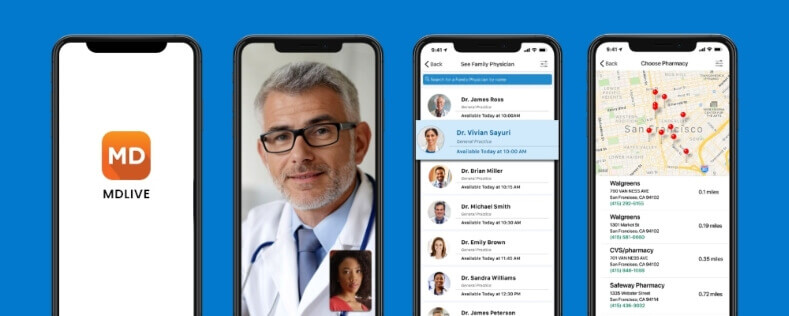
MDLive is a leading 24/7 virtual care delivery platform. Uniquely positioned to offer an end-to-end care experience, MDLIVE app aims to bring more connected patient care through its application. MDLive is among the largest telehealth vendors in the U.S., and delivers services including urgent care, dermatology, therapy, and psychiatry via its network of certified clinicians.

MDLive offers fast, easy, convenient access to a doctor with 3 simple steps. Patient can register in the app, schedule an appointment from virtually anywhere on a phone, laptop, or tablet and take a prescription.

3. Doctor On Demand

App Store | Google Play

Doctor-on-demand

Doctor On Demand is a San-Francisco based company that provides virtual care services to patients through its telehealth app and web platform. The app employs hundreds of licensed healthcare providers with an average of over 15 years of experience to deliver urgent, primary, chronic, preventive and behavioral care.

During COVID-19, the doctor on-demand app’s usage soared to 139% for COVID-19 screenings and other urgent and chronic care issues. In response to a public health emergency, the app has covered benefits for around 33 million beneficiaries across 50 states of America.

4. LiveHealth

App Store | Google Play

LiveHealth

Live Health is a fully-featured virtual care pioneer that brings qualified and certified doctors specialists for both video consults and virtual primary care. From appointment booking to receiving reports and making online payments through multiple payment modes like app, WhatsApp and SMS; Live Health offers an end-to-end digital patient experience.

Using the LiveHealth App patients can quickly connect with board-certified doctors, licensed therapists, lactation consultants, registered dieticians and more through their flexibility on the go!

5. PlushCare

App Store | Google Play

PlushCare

Hailed for Virtual Doctor Visits and Online Therapy, PlushCare is a fully realized telemedicine app platform that provides virtual doctor visits to patients in all 50 U.S. states primarily for primary care, urgent care, and mental health at anytime, anyplace.

Treating over 6,800 medical conditions, and steadily receiving over 90 promoter score, Plush Care accepts all major insurance plans. Patients can easily get diagnosed, consulted, and prescribed with medication and enjoy a stress-free experience.

6. Lemonaid

App Store | Google Play

Lemonaid

Lemonaid is a one-stop telehealth solution for receiving personalized healthcare and medicine delivery at affordable prices. Housing over top medical professionals in all 50 U.S. states, Lemonaid provide care for concerns like mental health, women’s health, skincare, and other general health issues.

The top reasons to choose lemonaid over others are low consultation fees, fast medicine delivery from lemonaid pharmacy, and immediate video consultation with Doctor.

7. Talkspace

App Store | Google Play

Talkspace

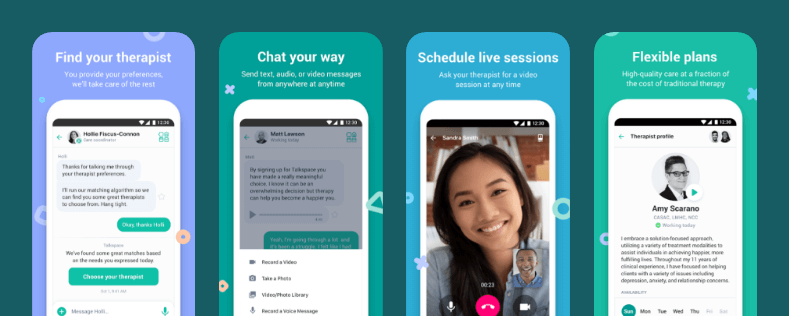
Talkspace is a leading virtual behavioral healthcare telemedicine app that specializes in online therapy and counseling. Available on a subscription basis, Talkspace is an easy-to-use and fully encrypted mobile app and web platform that enables patients to send video messages, text chats, and take live video sessions. The app platform is consistent with HIPAA and other state regulatory requirements.

When the pandemic took a toll on American’s mental health, nearly one-third of adults reported anxiety or depression. Talkspace helped psychiatry patients to combat mental health conditions and select for same-day delivery to their doorsteps.

8. TelaDoc

App Store | Google Play

TelaDoc

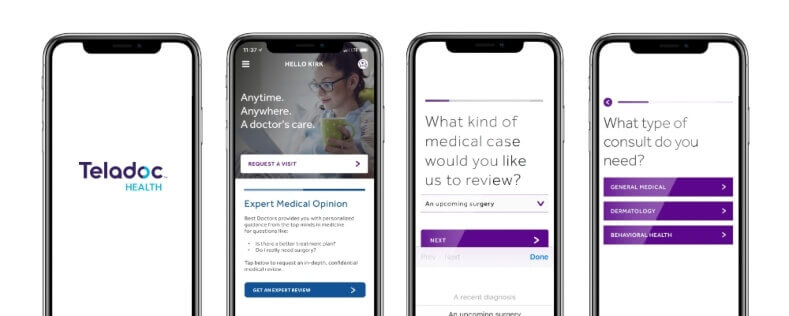
Teladoc is a full-featured telemedicine suite that uses data analytics and artificial intelligence to connect patients with physicians and provide expert medical opinions. Taking consultation with Teladoc is an easy feat. No matter the type of consultation a patient is seeking, just after a simple sign-up, patients can take virtual assistance with doctors via video call, real-time chats, or audio chats and have the prescription written.

9. DocsApp

App Store | Google Play

DocsApp

Docsapp is a simple, secure, and easy-to-use telemedicine app that collects only a few basic information about patient’s medical requirements and connects them with care providers immediately. Patients can even upload health reports and medical history. Get a second opinion on critical health concerns. Post consultation, patients can leave ratings and reviews to the doctor.

10. mFine

App Store | Google Play

mFine

Yet another telehealth app that centralizes around the full spectrum of health and well-being through its AI-powered consultancy in over 25 specializations. Alike others, mFine has partnered with licensed care providers and Doctors. Patients can make video/audio calls to the doctor after taking an online appointment. While the appointment in the app is paid, follow-up is free. ePrescriptions by Doctors can be received via the app itself.

Top Telehealth Apps Features

  • User-friendly doctor’s search
  • Appointment scheduling
  • Medical data sharing
  • Access to patients’ medical history
  • Secured video/voice calls
  • Real-time text messaging
  • Physician’s directories
  • ePrescriptions
  • Online Billing
  • Ranking system for healthcare specialists

The Bottom Line

With unprecedented adoption levels of telemedicine accelerated by COVID-19, Virtual healthcare delivery has reached its inflection point. Telemedicine app development has captured the well-sustained growth of the sprawling healthcare industry.

The population across the world has full realization of the effectiveness of telehealth apps. Implementing and leveraging telemedicine solutions at this crucial time can allow clinicians to improve patient satisfaction and increase work efficiency with minimum revenue leakages.

If you’re thrilled to shape and streamline the care delivery operations in your healthcare organization, developing a standardized and compliant telemedicine app that supports all the crucial features can elevate your practices to a whole new level.

How Industries Can Benefit From M-Wallet App Development

M-wallet app development has been among the most searched keywords among investors and entrepreneurs globally. Driven by the massive surge in mobile commerce, mobile wallets are all set to become the most popular online payment method by 2024.

The surge is certain! Everyone has shifted to the e-wallet system to carry forward all types of transactions. From big market leaders to those roadside small hawkers, everyone prefers to use e-wallets because of the convenience, security, and transparency it offers. In fact, U.S alone is predicted to overtake physical cards by mobile wallet as it will become the most popular online payment method in the next three years, predicts a report by fisglobal.

No sooner, the term ‘cashless world’ will prevail and normalize itself. The Statista reports 2021 shows that mobile wallet transactions will increase up to $9,419,619.76 million by 2025.

Considering its increasing usability and market demand, no true entrepreneur can escape the thought of investing in mobile wallet app development.

To keep you updated with this trend and the significant benefits it has to offer, here we have covered topics that shed light on different types of mobile wallets, top market leaders, key benefits, industries benefitted, and its significance in the e-commerce industry. Keep reading.

The Most Popular Wallet Apps

The popularity of mobile wallet apps is rising exponentially due to numerous reasons but COVID outspread is one of the major ones. The need of the hour and ease of usage has accelerated online transactions and now these mobile wallet apps have become a part of our daily lives.

Before we dig deep into the term, let’s underpin the topmost popular mobile wallet apps.

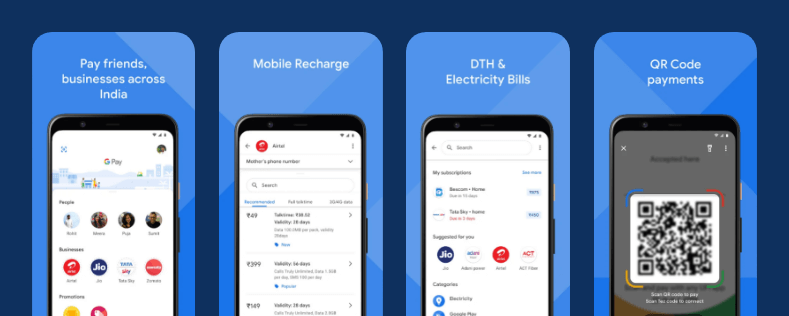
Google Pay

google-pay

Google Pay is currently the topmost application under this category and is effectively helping the common public to enjoy an effortless payment stack with a secure and simple procedure. Individuals can make payments online using this Google wallet by just adding existing bank account or debit/credit card details. It is widely used to send money to acquaintances, make multiple purchases, pay bills, recharge phones, order food online, etc. The app also surprises its users with a variety of rewards and scratch cards occasionally after making the transaction which obviously introduces additional value. The best part is that you don’t need to refill your wallets rather the amount is directly deducted from your personal bank account.

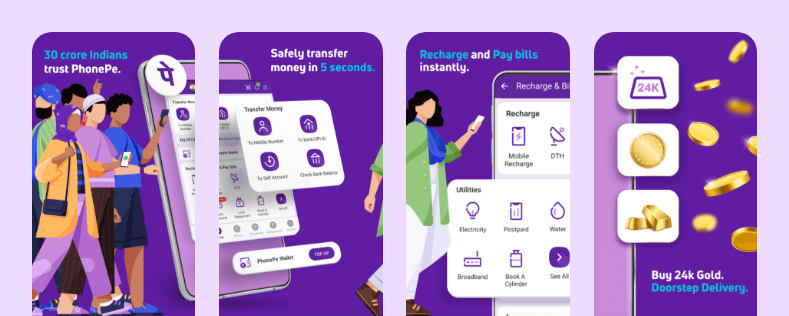
PhonePe

phonepe

It is the second most used mobile wallet app which was introduced in the market in 2015. The excellent user interface of PhonePe became the major reason for its success and gaining so much popularity. The users can easily perform transactions such as sending money to friends and family, paying bills, buying products and services, booking tickets, ordering online food, etc. Individuals can also reap other benefits like it is fast, convenient, secure, and a 24/7 available payment platform. To showcase the vast reach of the app, it is important to note that more than 100 million customers are demanding the same services and are already using them.

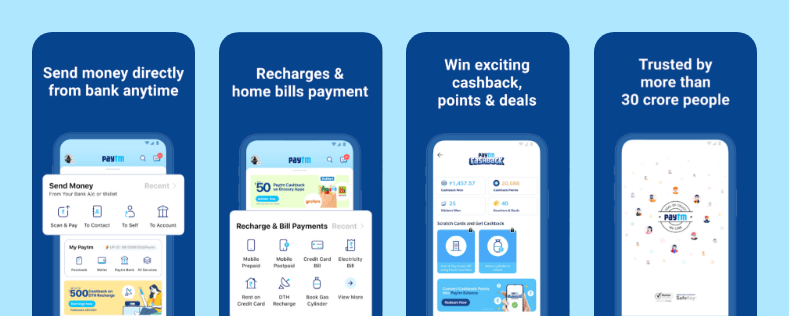
Paytm

paytm

Paytm is not just used as a payment wallet but it is also known as one of the largest e-commerce platforms where people can buy a range of items for their daily needs. The app was launched in 2010 and was the only secure and biggest mobile wallet platform before UPI was introduced in the market. The payments like entertainment, bills, money transfer, phone recharge, etc. can be carried out seamlessly. Paytm works on the semi-closed model therefore, it can easily take the advantage of mobile and other smartphone models. To use the app and enjoy its multiple benefits Paytm must have tie-ups with companies you are dealing with.

Related Reading: How Much Does It Cost To Develop A Mobile Wallet App Like Paytm?

Amazon Pay

amazon-pay

Amazon Pay has also attained success in adding its name among the top payment processing platforms. It was launched in 2007 and is owned by the eCommerce giant- Amazon. This platform allows users to pay for multiple platforms like BigBazaar, Flipkart, etc. and users can also shop on Amazon. To use this application, you just need to connect your bank source with an Amazon Pay account, and then it becomes seamless to operate. Also, every piece of your information is secure and safe as it is already stored in Amazon Pay. To continue your transactions with Amazon Pay, you need to directly access the Amazon Pay account because there is no such app that can support Amazon Pay to carry out transactions.

Apple Wallets

apple

To compete with the outside marketing world, Apple has introduced its wallet called Apple Wallet where users can add multiple cards like credit, debit cards, etc. This platform supports only Apple devices such as iOS, watchOS, macOS, and cannot be accessed with Android devices.

Related Reading: Key Strategies Adopted by Mobile Wallet App Companies for Driving Consumers

Key Benefits of Mobile Wallet Applications

1.Easy Accessibility & Convenience

It becomes easy for the user to perform day-to-day tasks as they don’t need to carry wallets or cards with them, rather every single piece of information is readily synced with mobile wallet apps. The user just needs to download the app and create an account with bank account details. Hence, it becomes as simple as operating like any other app on your mobile device.

2. High Security

E-wallets are highly secured as users need to unlock the phone using fingerprint, passcode, or face recognition. Other new techniques are ensuring high security of your data and money through technologies like blockchain, tokenization, etc. these methods makes the online payment process safer and secure.

The online transactions are more secure than the money a user keeps in a locker because the key to unlock user’s online transactions can only be accessed by the user himself.

3. Multiple Usages

No matter whether you are looking to buy groceries from a local Kirana shop or visiting a reputed departmental store, the usability of the mobile wallet apps is rising with each passing day. That being said, people can perform any payment-related activity such as online bill payment, shopping, buying groceries, booking tickets, ordering food, etc through m-wallet app solution. They do not have to wait for any kind of assistance or physical payment assets as everything can be done with a few taps on your smartphone wallet app.

Users also have the option of buying or gifting movie or travel tickets to your friends and family to surprise them with the best.

4. Instant Payment/Transfer

When we talk about instant payment, the transfer of the money can be done within a few seconds, earlier which was no less than a dream. Using e-wallets, many personal and professional challenges get minimized like, refilling the bank accounts, sending money to another person, sharing funds for business activities, and allowing payment 24/7.

It also helps in matching the latest trends of the society i.e., being part of a cashless society.

5. Incentives/Discounts/Promotions

Don’t worry about the special discounts, offers, and promotions because every e-wallet that you use comes with some discounts and promotional strategies. You will get different money-saving opportunities, cash-backs, discounts, free gifts, and offers. In case, you feel like you are missing out on something then you can choose to visit and see the discounts and wall section of that brand store.

Also, you need not worry about any discount/promotional part because it will be transferred to your online business account automatically.

Types of Mobile Wallets Apps

Here is the list of most-widely used mobile wallet apps with quick pointers. By following their business case successfully you can unlock new mobile wallet engagement opportunities.

i. Open Wallet

  • These services are associated with banks.
  • All types of transactions can be done using open wallets.
  • It offers higher flexibility i.e., easy transfer of funds.
  • Users can make both online and in-store payments effortlessly.
  • To use open wallet accounts the sender and receiver must have accounts in the same app.
  • An example of an open wallet app is PayPal.

ii. Semi-Open Wallet

  • Users can also send money to any mobile number along with the usual merchant payment.
  • An example of a semi-open wallet is Airtel Money.

iii. Closed Wallet

  • These services are associated with specific merchants.
  • Users can only pay for the transaction initiated by a specific merchant.
  • Closed wallets are generated by the companies that are selling special products or services.
  • If you cancel or reject the payment then the money gets stored in the wallet only.
  • User is not allowed to pay outside the restricted walls.

iv. Semi-Closed Wallet

  • Users can send transactions to several merchants only when they have any contractual relationship between them.
  • Funds can be withdrawn into bank accounts.
  • Users cannot withdraw funds in cash.

v. Crypto Wallet

  • Users can send or receive, and spend all types of cryptocurrencies like Bitcoin and Ethereum.
  • Users can store public and private keys in crypto wallets.
  • In case users want to operate these offline, they can use a USB stick to operate them.
  • To ensure the highest security level, it offers hardware wallets or cold wallets.

Industries Benefited From Mobile Wallet Development

Healthcare Industry

The healthcare industry is experiencing greater relief and witnessing better outcomes after the introduction of mobile wallets. It helps in streamlining the overall process and provides a convenient ending including all the medical slips and bills. A decrease in manual labor has facilitated the healthcare industry to provide excellent service to their patients.

Telecommunication Industry

The telecommunication sector can experience tremendous growth opportunities after encountering mobile wallets. According to Juniper’s research study, the number of people using mobile wallets will rise from 2.3 billion to 4 billion by 2024.

Apart from this, the telecom sector will benefit in these areas:

  • Loan Origination
  • Currency Exchange
  • Integrate Wallet with Messaging Platforms
  • Support In Creating A Closed-Loop

Agriculture Industry

With the integration of mobile wallets in the agriculture industry, farmers can experience a powerful force to bring the performance of this industry to the next level.

Narrowing down the list of benefits for farmers with the use of mobile wallets:

  • Farmers will be able to reap the quality line of credit.
  • Sufficient opportunities will be open to farmers for crop insurance.
  • Farmers will shift from financial off-grid to financial on-grid.

Construction Industry

One simple advantage of using mobile wallets in construction is that it will allow contractors to use everything in one go. From data basics to paying bills, using e-credit/debit cards can simplify the overall authorization process and can also help in reducing the processing fees.

Hospitality Industry

We are aware of the amazing response of mobile wallets in the hospitality industry. It has the power to complete transactions within a matter of seconds, but there is a lot more to encounter.

Have a look at these silver bullets:

  • Experience a high level of customer satisfaction.
  • Allow quick and secure payment actions.
  • Assist in maintaining hygiene especially during COVID times and simplify the check-in and check-out process.

How Ecommerce Industry Benefits From Mobile Wallet App?

The eCommerce industry is prospering to offer fabulous services to customers. A few remarkable changes that support the industry are its decrease in friction during the checkout process and also helps in increasing the conversion rates. Underpinning the few major takeaways for the eCommerce industry using mobile wallets:

Reduction In Transaction Fees

The role of the bank as a middle man gets eliminated i.e. the merchants provide their own payment option to use and eliminate the need for any digital card. So, once the bank is out of the picture to make any transaction, then the total transaction fees automatically get reduced or will be null.

Offering Increased Level Of Security

Mobile wallets provide the highest security level. Especially in current times when everyone is experiencing the threat of credit card fraud. The e-wallet successfully protects your amount and data because it is based on tokenization. It means, on every transaction a “Token” is given which is the replacement of credit card numbers and no one can use it any further.

A Chance To Increase The Overall Sales

To increase the overall sales, it is required that merchants must share personalized coupons that attract more people to buy. But recent data shows that almost 85% of the people do not even open such coupons and therefore they miss the chance of enjoying discounts.

Increasing the sales ratio is easy, but merchants must focus on updating coupons regularly and try to remain in contact with the customers which leads to an increase in overall sales.

Decline In Cart Abandonment

The major benefit provided to retailers through m-wallet is cart abandonment reduction. It is being observed that when people find it difficult to complete the initial process, they do not look for other better options. Contrarily, people tend to buy more when the purchase processing system is simplified and fast.

Here are a few ways that show how you can minimize Cart Abandonment:

  • Reminding customers occasionally about the items left in the cart.
  • Use good reminder subject lines with some emoticons.
  • Go for segmentation and personalization as it boosts conversions.

Must-Have Features of A M-Wallet App

To build a standout m-wallet app, the app should be equipped with unique and latest features. So, let’s check out the most common and widely customer-accepted features of the digital wallet.

  1. Log In/User Profile- Whenever the user downloads the m-wallet app, then the user have to register themselves by entering basic details. Additionally, the user can login through their social log in credentials.
  1. Sync More Than One Bank Account- The user can link more than one bank account and can operate multiple accounts at a time with ease from a single device and location.
  1. No Minimum Transaction Limit- Setting the transaction limit bounds the user to spend their own money, but providing an app with no minimum transaction limit will give a free hand to the user to make digital payments for any small to heavy products and purchase it instantly.
  1. Split Bills- Allowing the user to split the bills among people, such as friends or relatives to make every individual pay their part, rather than a single person paying and then collecting cash from others.
  1. E-Receipts- The user receives each transaction details and the receiver details along with other details in the form of e-receipts from the bank and the app as well. This promotes transparency and makes the digital payment method more secure, safe, and easy.
  1. GPS Tracking- The user can track the location and check payment history that where they made the payment, to whom, and at what time along with other details. In case of any confusion, the user can refer to all the details instantly from the app.
  1. Reward Points- Giving users some cashback, offers, or coupons on random transactions can attract more users to the app.
  1. Privacy and Security- Data privacy and security is the major concern when monetary transactions are concerned. In e-wallet apps, the money is directly involved, and the users share their bank account details on the app. Therefore, the user can instantly make the payment by authorizing biometric access and entering OTP or password to enable the transaction.
  1. QR Code Scanner- The user can scan the QR code from their camera and can directly initiate the money transfer request to the payee account without any hassle. It is a very easy, quick, and reliable mode of payment and is the latest introduction in the m-wallet apps.

Points to Consider While Developing A M-Wallet App

1. User Data Security

The online transactions are the major concern for any individual to take care of their personal data. Such data security maintenance builds trust among customers with the application. As the users are storing their credit and debit card details along with the password and for that data security becomes the mandatory factor. Therefore, to ensure user data security the mobile app development companies should follow and prefer the implementation of the latest technological advancements.

2. Fraud Risk

The platform should be secure and eliminate the risk of fraud when monetary transactions are in process. The money laundering or illegal transactions from anonymous accounts taking place are quite difficult to track, and for that the app owner is accountable. Therefore, to forbid all such risks and illegal activities the developers should make sure to design a risk-free platform.

3. Regulatory Compliance

The m-wallet app should abide by the rules and regulations proposed by the government and any other authorized regulatory body. The development of an app that follows all the rules and works under legalities can eliminate any fraud or data security risk. The app will only support fair and transparent transactions to generate trust and transparency between the user and the platform.

4. Digital Receipt Functionality

The m-wallet apps are equipped with a variety of functionalities and these can’t be hopped. After the successful payment through digital mode, the user requires a confirmation and intimation from the platform for the same. The app should follow the same process, in case of a failed transaction as well. Apart from that, the m-wallets should be integrated with emails and these payment receipts should be sent through emails too.

5. Integration of Features

In the competitive market, the quality of the app enables it to sustain the market and all this happens only by intelligently selecting the features and functionalities that can be infused into the app; same with the m-wallet app development. The selection and integration of features and functionalities can be carried out after a careful and detailed market study, latest trends, and customer expectations. The study will help to carve a roadmap for an m-wallet application.

6. Select The Right App Development Partner

While planning for m-wallet app development, having the right partner is the major criterion for developing a seamless and feature-rich mobile wallet app. Therefore, it becomes a very tedious process to find an expert development company from the pool of options. For that, you require to follow a proper detailed interview process to analyze the developer’s learnings and skills, then go for the suitable one.

Data Transfer Technologies Used In M-Wallet Apps Development

To build an application first and foremost is to understand the technologies and their applications that can be used in the app. Usually, the m-wallet apps use one or a combination of technologies to present data transfer, and are as follows;

1. Bluetooth and iBeacon

iBeacon technology facilitates the transfer of data by eliminating the necessity of having an internet connection. Evidently, almost each smartphone device is equipped with Bluetooth technology and is compatible with Beacon technology. The technology initiates the contactless transfer of data in a seamless environment.

The Bluetooth device establishes a connection with the payment device and enables to receiving of all the required data stored in the mobile wallet to POS, which allows the transfer of money.

2. QR Codes

QR Codes are very much in fashion after the wide acceptance of digital modes of payment. The QR codes are unique that can encrypt vital details, codes, sensitive information, and even images/pictures. To avail of the services, the user needs to scan the QR code image from their smartphone app to make the payment.

The scanned QR code enables to fetch the data and make payment by entering a secret code/password. After that payment, the sender and receiver both get the payment receipt, which makes the mobile wallet a secure platform.

3. NFC

NFC stands for Near Field Communication Protocol- the technology facilitates contactless money transfer services. The transfer can be made between only the specific types of devices, where the smartphone is the sender device that is equipped with an NFC chip and a transmitter in a POS device. The transmitter connects instantly with the NFC device, which is less than one-tenth of a second.

NFC can store card details in the digital form within the mobile wallet app, the process is termed a card emulation technique. To facilitate the payment, the NFC protocol transfers the data instantly to the POS terminal.

Summing Up!

There is enough information, facts, and figures available in the market to justify the rapid growth in the mobile wallet app industry and this trend is strengthening with time. But to beat the competitors and take hold of greater market share, you need to plan robust strategies. Invest your research time into adding functionalities and exclusive features that serve the customer demands