How Mobile Apps Are Benefiting the Oil and Gas Industry?

The oil and gas industry is a highly technical field that requires precision and agility in order to be able to make the right decisions when dealing with complex situations. The constant evolution of technology has completely changed our way of doing business, and it is now much easier than ever before for companies in this field to remain at the forefront of technological developments.

Mobile apps for the oil and gas industry are a great way to keep your collaboration processes on track. The potential of mobile apps in oil and gas is huge, and it is something companies cannot miss but only leverage.

To accelerate the business growth, streamline communication, and get real-time visibility across the business, the companies prefer to automate their operations and integrate customized oil and gas mobile app development solutions for their organization.

Why Mobile Apps for the Oil and Gas Industry?

It is evident to every individual how tedious it is to manage the varied processes and operations of oil and gas mining companies. Almost every day they have to face new problems and challenges but, having a tech-advanced intelligent solution-providing tool can be a great life savior to them.

A custom oil and gas app for the business owner can help to boost productivity, adopt safety procedures, take care of their employees and streamline almost every operation involved in the business.

To propose the most suitable IT solution for the Oil and Gas industry, app development companies usually prefer the latest technologies i.e. Artificial Intelligence (AI) and the Internet of Things (IoT). These technologies support businesses to mark their glorious presence in the global environment by automating, monitoring and securing oil and gas business processes.

The oil and gas digital solution apps can also help the stakeholders in formulating strategies to minimize expenses and generate more profits.

Different Sectors / Segmentation of Oil & Gas Companies

The process of the oil and gas company is divided into three segments. They are;

1. Upstream

Most companies either work in the upstream, midstream, or downstream sectors. However, large-scale companies integrate all three processes.

The main purpose of this sector in the oil and gas industry is to explore the existence of crude oil and gases available underground. Then the companies extract the available resources by digging wells and using the required machinery. For oil and gas companies, the search and extraction of reserves is the key to the company’s future earning and to ease the process, companies often prefer advanced devices and software.

2. Midstream

Midstream companies often deal with the processing, transportation and storage of oil and gas. The companies are also responsible for the distribution and maintenance of gas and fuel pipelines for transport to various storage stations.

Midstream companies have to deal with an enormous amount of data. Thus, to keep all data secure, the companies now used to prefer custom oil & gas app solutions. The apps enable easy management of field workers, fuel and other resources, maintain records, pipeline maintenance status details and many more.

3. Downstream

Downstream-based companies deal in refining, manufacturing and marketing of gas and petroleum products. The raw material extracted in the upstream process is filtered in this downstream stage. To manage such an enormous amount of data, retail distribution requires mobile apps to interact with their clients and customers.

The companies know that downstream processes can help them to make good profits or lose huge at the same time, as compared to the upstream process. Therefore, to avoid all these situations companies prefer to use mobile apps to remain on a safe site.

Types of Oil and Gas Mobile Applications
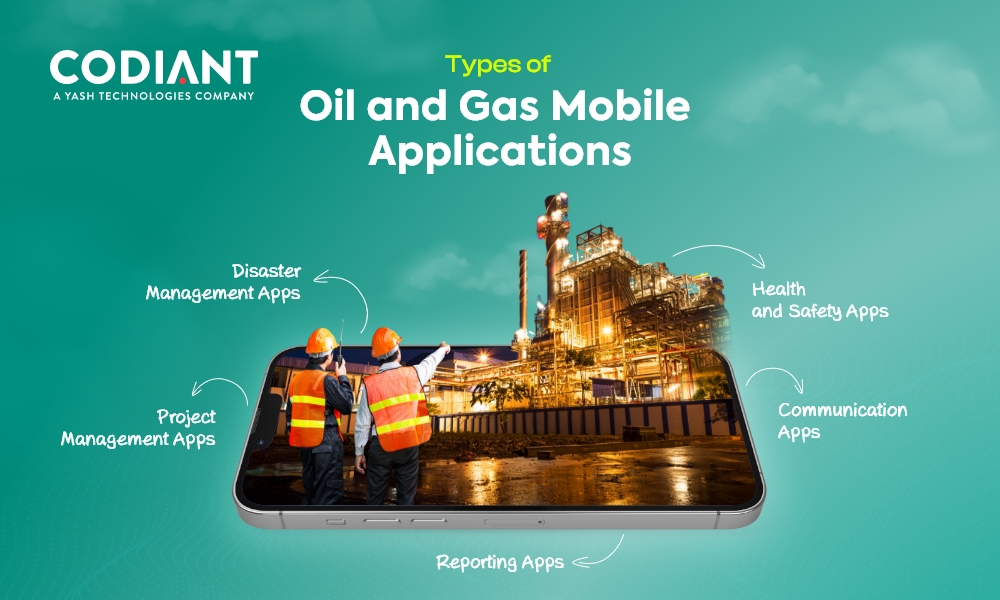

The companies can raise demand for custom oil and gas apps based on their requirement and specific processes they like to automate. Considering this, there can be multiple types of oil and gas apps that can be designed and developed, which are as follows;

1. Disaster Management Apps

Such apps equipped with advanced technologies and sensors can be developed by oil and gas app development companies – the apps will help companies to raise an advanced warning in case of any natural calamity or the inappropriate working of the system that can be hazardous in case of any further negligence. These apps are quite handy to use and get instant responses on issues.

2. Health and Safety Apps

The oil & gas companies are not only confined to indoor offices and employees but are employing numerous on-field manpower to find and extract raw materials for further processing. To find and connect with those employees is a challenging task.

In such cases, intelligently designed health and safety apps helps in making connection and communication easier with them. It includes sharing images or videos with their manager and providing regular updates on safety and health-related concerns.

3. Communication Apps

These types of apps in the oil and gas industry allow employees to stay connected with each other regardless of being on any easy or difficult terrain. Employees can share audio, video, images, files, and make group call instantly.

4. Reporting Apps

With oil and gas apps, employees can report all details and progress on time with the required details to inform their managers. These apps save a lot of time and transfer information to the right person within seconds and also help employees to organize and keep information’s on the app without any paper trail.

5. Project Management Apps

To manage complicated and long duration projects, such types of custom oil and gas app management solutions could be no less than a guarding angel to them. These apps simplify the business operations for employees by allowing them to organize the processes and keep a close tab on the processes, activities, expenses and data in real-time.

Benefits of Mobile Apps in the Oil and Gas Industry

1. Real-Time Data Collection & Validation

The oil and gas industry heavily rely on data and have to deal with data-intensive activities that demand a lot of fieldwork carried out by a skilled team. Traditionally, all these data were accessed and processed manually, which causes a delay in performing operations and other processes.

In contrast to this, the oil and gas systems use mobile devices and equipment for Supervisory Control and Data Acquisition (SCADA) systems integrated with a network of sensors to collect, share, process and analyze data.

During the process, the data which is collected through oil and mobile applications have to go through rigorous verification and validation process before transmitting it to other departments. As a result, the devices can also organize the data and remove irrelevant information and summarize it into easily understandable forms i.e. graphs, 3D models, etc.

2. Asset Tracking, Maintenance and Monitoring

The oil and gas companies own heavy machinery, tools and other equipment, which are no less than an asset for the organization. Using these assets companies perform drilling, exploring, refining and supplying the products. To do so, the company requires perfect and good quality equipment, as no error can be afforded while performing any process, therefore, proper inspection, tracking and maintenance are performed over those assets.

Thus, to easily check the status and history of any of the tools, it is assigned with unique barcodes, which makes it simpler and easier for custom oil and gas apps to track and identify the condition.

On the other hand, the field equipment’s are fitted with GPS (Global Positioning System), GIS (Geographic Information System) and RFID (Radio Frequency Identification) to accurately track their accurate status and whereabouts details.

3. Collaboration and Workforce Management

The on-field and off-field employees in the oil and gas organization face difficulty while communicating or sharing details with each other and maintaining the deadline as well. To rescue them from such issues, oil and gas software solutions are used to ease and fasten the entire data transmission process and maintain accuracy at the same time.

Apart from that, the work schedules, rotations, policy updates, production targets, etc. can be instantly monitored and updated.

These mobile apps in oil and gas companies are quite a handy solution for field employees. They can easily monitor, extract and share details or work records and reports in real-time. The mobile apps also help organizations maintain transparency by tracking the employee’s location and work efficiency.

4. Enhances Safety and Security

In the oil and gas industry the well-being of employees and following strict guidelines while maintaining the deadline is the success mantra of companies. To manage all these things and avoid the on-site kiosk and accidents – the oil and gas digital solutions are used.

On-field employees can share field data and instant updates on any progress or accident or potential hazards and can even file evidence of accidents too on the mobile app. Organizations can also create interactive maps to help employees in accessing the right location and find the correct route without wasting any time. The accurate and instant availability of data accelerates decision-making and raise productivity level to a great extent.

Wrapping Up!

The oil and gas industry are on the verge of automation to streamline and fasten the process and minimize the demand and availability gap in the market. Businesses can break down the barrier and rather than relying on the traditional approach can use machinery and advanced technologies to manage their day-to-day operations efficiently.

The on-demand apps for the oil and gas industry are helping businesses to eliminate flaws by advancing the operational processes and raising the bar of safety and work delivery.

If you are in the same industry business and looking for a custom oil and gas solution that caters to your specifications, then our app developers have all the expertise in the store for you.

At Codiant, our expert developers have a good command on custom oil and gas mobile app development which can support your business to become a high-performing unit.


How Top Augment Reality SDKs Benefitting Brands

Augmented Reality (AR) technology is showing an exceedingly great potential to excite things for the future. Business processes are transforming with the touch of AR technology.

However, with a few limitations, this technology has opened a new world of opportunity.

Such advancement in technology has triggered; the requirement for tech-advanced development tools that can promote AR technology-enabled apps and game development.

Software Development Kits are the main tools that work effectively in the development of various software.

There is a great range of SDKs for Android and iOS app development available in the market packed with unique features that developers require to build an AR application.

Let’s check out some best SDKs available in the market and discuss their functions. This will help you to understand their functional pros and cons and allow you to pick the most suitable one for your project.

Top 5 Augmented Reality SDKs in 2023

1. ARKit

ARKit was introduced by Apple during Apple’s Worldwide Developer’s Conference in 2017 (WWDC17).

This framework is exclusively developed by Apple i.e. iOS devices for developing AR-based applications. ARKit is an open-source tool for developers to access from anywhere and anytime.

This framework enables developers to avail the benefits of the latest integrated functions with their advanced devices and develop augmented reality software. The latest version of this Augment Reality DevKit available today is ARKit 3.0.

The key features of ARKit are object detection, light estimation, space recognition using SLAM, multi-player support, and a continuing AR experience through ongoing sessions.

The best iOS apps built with ARKit are, AirMeasure, WiTag, Solarscene, Dance Reality, etc.

2. ARCore

ARCore is a Google-supported open-source SDK for developing AR-based applications and was presented in the market for the final users in March 2018. The developers can effectively use this SDK for both Android and iOS app development.

To integrate with this Android SDK platform tool, the developers require at least an Android 7.0 operating system or above, as all previous versions of Android OS are very old and don’t support ARCore’s feature. On the other hand, for iOS app development, ARCore demands iOS 11 OS or above.

The key features of ARCore SDK are motion tracking, lighting estimation, flat surface recognition, and environmental understanding.

Some of the top examples of ARCore apps are, Just a Line, Molecatch, Measure App, AR Stickers, Beer Pong, Stack Tower, etc.

3. DeepAR

The DeepAR SDK was initially built for app developers who aim to build high-quality, fully-optimized, Snapchat and Facebook-style 3D lenses and masks. It also supports special effects via Android, iOS, HTML, and Unity platforms.

DeepAR is known for its simplicity to integrate with new projects and a wide range of lenses, masks, and filters to develop an AR-based application that can make real-time changes with human faces.

It is quite a fast, accurate and reliable DevKit, which can easily recognize more than 70 facial features in real-time, it includes anger, happiness, sadness, fear, and many more.

The key features of the DeepAR software development kit are face recognition, emotion detection, face tracking, and mobile-optimized AR images, and can work with existing software like Blender and Maya.

Some of the top brands that leverage the exceptional AR features of DeepAR SDK are Ray Ban, Armani, and Sephora.

4. Wikitude

Wikitude SDK was specially designed to develop AR apps and prototypes suitable for smartphones, smart glasses, and tablets. The SDK tools’ first version was released in 2008, and since then about 9 updated versions have been introduced in the market.

It supports Android, iOS, and Windows devices along with Vuzix and Epson Moverio smart glasses. Its’ trial version is available for free with a watermark for non-commercial uses, however, other versions are chargeable.

The key features of the latest version of Wikitude SDK are object and scene recognition using SLAM, the ability to identify about 1,000 images and can identify more than one image at a time, 3D model rendering, cloud recognition, location-based service and instant tracking that allows placement of a virtual object in the real space.

Wikitude SDK is compatible with multiple app development platforms i.e. Xamarin, Unity 3D, Appcelerator Titanium, and Cordova/Phonegap.

5. MaxST

MaxST an Augmented Reality SDK supports iOS, Android, Windows, Mac OS, and Unity, along with many HUDs and smart eyewear products like ODG R-7, and Epson MOVERIO BT-300, 350.

This AR SDK provides the following functionalities; visual SLAM, instant tracking, image tracking, object tracking, marker tracking, and QR/barcode scanning functionality. It is one of the most comprehensive AR SDKs that offers a great range of tools for objects and image recognition.

The key features of the MaxST AR SDK are a 2D image tracker that can track almost three flat images simultaneously, an instant tracker, cloud recognition and visual SLAM, and a 2D object tracker. Its version 4.1 allows the development of a 3D map by using a pin and bounding box.

Some of the successful apps built with MaxST SDK are AR Money, Canada AR, Volvo AR Stories, and many more.

Benefits of Mobile SDKs For Your Brand

1. Faster Integration

Quick performance is the soul of the mobile application, and integrating SDKs ensures that. These platform-specific SDKs allow developers to fasten the development process. Through SDK, developers can easily have all the features and resources that are required to be integrated into the app development, which ultimately influences the development process and time.

Moreover, the dedicated SDKs shorten the sales cycle and provide quick and easy integration with the existing tech stack. As a result, quick integration with mobile SDKs provides shortened sales cycles.

2. Efficient Development & Quick Deployment

With the rising demand for mobile applications in the market, custom app development is at its peak. Thus, it is not at all possible for developers to write codes for each module from scratch. From that, SDK toolkits came to their rescue, in which developers can find the code for the individual services that work accurately on the specific platform and devices.

These DevKits increase developers’ efficiency leading to quick development and also bridging the development gap – further saving money as the businesses only have to pay for the development or productive time of the developers. This maintains efficient development, which ultimately leads to quick development.

3. Minimizes Risks

The SDKs provide advanced control over the details of user interface elements.

These kits make it easier for the developers to manage the integration of the app with other apps and take care of the entire user interface i.e. how it looks.

Such control in app designing and development allows developers to eliminate the risk of delivering the best possible user experience. SDKs ensure efficient browser services and allow to deliver the much advanced and quality services.

4. Increased Business Reach

If you are integrating SDK into your application product and are allowing the smooth transfer of data or information, then you are on the journey of building the best combination for success. There is a great possibility that other tools will like to integrate with your product.

A great product with a great SDK builds an exceptional end-product, which formulates the path to increase your business reach.

Wrapping Up

AR technologies’ acceptance in the market is depicting a very promising future and potential to transform all industries and infuse a new height to the customer experience. So, if you are a brand or business and are likely to introduce AR technology in your business or develop AR-enabled software, then it couldn’t be a better time than now.

AR technology is increasingly becoming sophisticated and the SDKs are advancing and expanding rapidly.

Likewise, the number of AR-enabled commercial opportunities is also increasing exponentially. So, this is the best time to invest in AR technology and capitalize on the advanced possibilities the AR app development toolkits are offering.

If you are still unsure about the selection of the right and suitable DevKit for your development requirements, then we suggest having professional assistance.

At Codiant, we have a proven, expert team of developers who are well-versed in AR technology. For further assistance connect with us, and we will work with you to figure up your AR app development specifications and support you in finding the most optimized and cost-effective solution.

Top 6 Problems Artificial Intelligence Solves in Transportation and Logistics Industry

Transformational Artificial Intelligence technology has awarded a new height to the business world and demonstrated its impactful presence across many industries. Likewise, for the transportation and logistics industry, AI has changed the face of business operations.

According to McKinsey, AI will craft an entirely new paradigm for the transportation and logistics industry by 2030 and will outshine humans in performing repetitive yet result-oriented tasks.

Despite that, the rising demands among customers and unforeseen challenges in the entire process are demanding the usage of advanced transportation and logistics technologies to tackle issues in a much more proper and humane manner.

Here’s a look at how artificial intelligence in transportation is curbing the industry’s problem.

Solutions AI is Offering to Transportation & Logistics Industry

1. Warehouse Automation

Artificial Intelligence is transforming warehouse operations to a great extent, ranging from data collection to inventory process management. It is ultimately helping in improving efficiency and raising profit.

By studying the organization’s ongoing trend, AI technology is helping in predicting the upcoming market demand for the product. Based on such predictions, the companies can prepare their stocks and inventory to meet the requirements. This will help the transportation & logistics companies to save a huge amount of transportation costs and reduce goods wastage.

The companies having multiple warehouses, AI is helping to operate centrally and helping businesses to draft the best solution for transporting goods.

Ocado– a British supermarket has developed an automated warehouse. The robots and machines easily move, lift and soft the products and pack them properly to take them out for delivery. Their robot ‘hive-grid-machine’ used to easily manage and fulfill over 65,000 orders in a week.

2. Autonomous Vehicles

Autonomous vehicles are self-driving automobiles that help to minimize labor and fuel cost by boosting the supply chain. Without a doubt, self-driving cars will benefit the entire transportation and logistics industry. Some companies have already replaced their fuel-engine vehicles with autonomous vehicles, but still, it’s a long way to go to automate the entire industry.

The advanced tech-enabled vehicles are equipped with smart sensors and cameras to provide a 360-degree view of the surroundings. The authorized person can also track the whereabouts of the logistics and pick the most optimized route to minimize the distance, time, and expenses simultaneously.

Waymo– was the first company to integrate driverless technology into their taxi services in the year 2018 in selected cities. Now, they are planning to develop self-driving trucks to try their hand with Artificial Technology in transportation and logistics.

3. Better Cost Savings and Lower Carbon Footprints

Transportation and logistics companies have to deal with a considerable amount of cash on a daily basis, such as employee wages, system, and equipment maintenance, and more. However, these expenses could rise and might hamper accuracy and productivity during operations.

The usage of AI in transportation and logistics automates the company’s processes and helps to reduce operational costs. It will also minimize direct and indirect labor costs.

The technology also supports maintaining and analyzing a huge amount of data which could be a great asset for business data analysts to study and formulate strategies to enhance processes efficiency.

Automation in a traditional transportation and logistics business means inventory, warehouses, and transportation all the processes get smart and automated with sustainable equipment. Such operations and units save energy and reduce carbon emissions from warehouses and vehicles.

4. Improve Customer Experience with Predictive Analytics

Integration of AI in transportation and logistics companies is not only used to manage the data but also to study and predict upcoming requirements. Because if the demand is going to rise in the market and the company fails to figure out or lack in its preparations, then the company will have to experience some serious losses.

Artificial Intelligence and Business Intelligence Supply Chain tech solutions are majorly preferred to predict the latest market trends and are considered better than human experts. This technology can easily understand and track all the required concerns to improve the customer experience by analyzing demand prediction.

Smart and intelligent usage of AI can infuse positive changes to promote customer experiences. Dealing with customers’ specific concerns will promote personalization, and enhance their experience, which results in building customer loyalty.

5. Accurate Inventory Management

In inventory management, accuracy is very important, and smart technologies can do so easily as compared to manual management. The AI-integrated inventory management system will maintain the accuracy in the in and out flow of the products from a warehouse.

The inventories can be categorized into multiple sections, such as order processing, stocking, and packing and this requires a lot of time and manpower. However, with automation, all such processes can be eased and done in an error-free manner.

Additionally, with accurate inventory management, situations like overstocking, inadequate stock, and untimely stock-out can be avoided. But all these situations can be easily taken care of with AI-driven tools.

These AI-supported tools and software can handle and analyze a huge amount of data and predict the customer’s demand or market trends. Such operations will help to manage stocks and avoid situations of overstocking or stockout.

6. Reduces Operational Costs with Upgraded Security

AI is no less than a boon for the supply chain system. It can simplify all the operations ranging from customer assistance to warehouse management and work error-free in minimum time duration. The warehouse management robots can do the tasks quickly and with the required precision and accuracy.

All of this minimizes the requirement for manpower, save time, reduces expenses, and achieves a high level of productivity. On the other hand, the use of AI in logistics can provide smart tools and software as well to streamline operations, carry out smart planning and upgrade material security.

AI can also analyze workplace safety data and warn administrative staff about any possible risk. Such prior warnings will help to plan strategies and upgrade the security system accordingly.

Conclusion

As you see, there are a number of benefits and solutions that are being addressed with AI in transportation and logistics processes every day. If you are thinking about a transportation and logistics app development or integrating AI technology in your specific business operations, then it is the right time to do so.

At Codiant, we have a team of developers specialized in transportation and logistics app development and are experts in integrating AI technology to streamline your business operations. For details and assistance connect with our business analysts to take your idea into the market.

How Machine Learning & AI Technology Are Benefitting Small Businesses

Such a rapid expansion and reach of advanced technologies is letting the digital marketplace be fiercely competitive, regardless of business size. As a matter of fact, these days advanced tech i.e. Artificial Intelligence and Machine Learning are not just confined to leading corporations like Facebook and Amazon.

Small and medium-scale businesses are also getting benefitted from these technologies. With each passing day, AI integration in the core business functionalities and processes is becoming more accessible and affordable for all types and sizes of businesses.

AI technology is replacing human resources and filling their shoes very accurately. For small to medium-scale businesses, it is a fantastic technology to take the businesses ahead. Let’s learn some more ways – how AI can help small businesses and how your business can be benefitted from these advanced techs.

What is Artificial Intelligence (AI) Technology?

Artificial Intelligence technology refers to the recreation of human intelligence in machines. The machines are equipped with smart software programs that make machines think like humans and depict their actions.

The technology can also be applied to any machine that possesses some humanized characteristics, such as learning and problem-solving. The ideal characteristic of AI technology is its ability to understand the situation and take the most appropriate actions to achieve a specific goal with the required perfection.

What exactly is Machine Learning (ML) Technology?

Machine Learning technology is a subset of Artificial Intelligence that enables software programs to work and respond more accurately in different scenarios without being explicitly programmed to perform the task.

The ML algorithms use previous or existing historical data as input and deduce new output with that. Recommendation engines, spam filtering, fraud detection, predictive maintenance, and business process automation are some of the common use cases for Machine Learning technology.

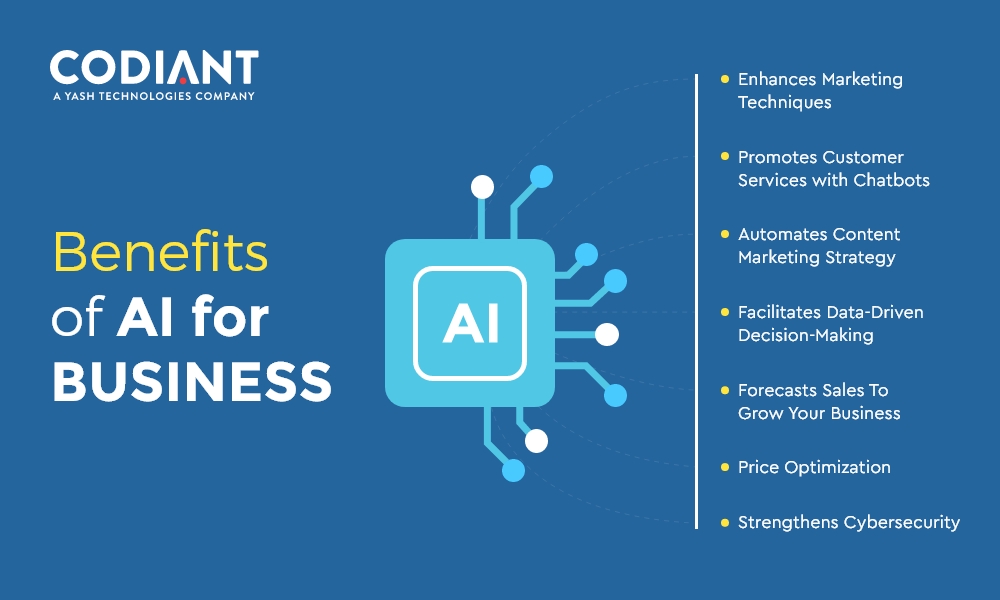
7 Ways ML and AI Technology Can Benefit Your Business

1. Enhances Marketing Techniques

One of the most significant benefits of AI in businesses is marketing automation processes that can also integrate Machine Learning to boost customer targeting, develop communication that is quite more accurate and deduce a conclusion as per their behavior.

AI can boost marketing campaigns, improves efficiency, and reduce costs – all these aspects ultimately result in an increased Return On Investment (ROI). Businesses can make more personalized offers by studying the target audiences’ preferences with the help of advanced AI technology.

It is a very powerful tool for studying and analyzing a huge amount of existing data that supports predicting future activities. Likewise, the benefit of AI in business can be about studying and learning about customer interest, global events, and other details that help to identify a certain product’s demand rise.

2. Promotes Customer Services with Chatbots

The intelligent and automated chat software supports small businesses to boost their customer engagement rate, user experience, and release of resources that are required for critical customer interactions. Chatbots are AI-powered digital assistants that design an interactive environment for people to communicate.

Chatbots offer quick, easy, and personalized customer services anytime and anywhere. These smart tools can also handle complicated issues or situations that require expert and qualified hands to deal with.

Moreover, Machine Learning for small businesses can also be used to predict the minimum and maximum time and duration of the call, which could help in defining the optimal usage of all the existing and available resources.

Some of the popular use of AI in business as chatbots are Pop Geo- National Geographic Channel, Wall Street Journal Chatbot, Whole Foods’ Facebook Messenger Bot, and many more.

3. Automate Content Marketing Strategy

A great number of consumers now and then used to search for products and services online that can fulfill their specific demands. To deliver customer requirements, businesses have to present their products and services accurately, such that it reaches a wider audience.

All this can be done by implementing a powerful content marketing strategy.

As the name depicts, it is a marketing tactic implemented for engaging, attracting, and delighting customers by introducing valuable content. In content marketing, an Artificial Intelligence company uses algorithms to analyze the existing data and formulate the best strategies to market the content.

AI also helps to decide what to write with relevant keywords, publishing frequency, and more. Overall, AI technology can help to write high-quality and high-ranking content.

4. Facilitates Data-Driven Decision-Making

Businesses can find the most suitable solution empowered with AI, ML, or Big Data very often. Such solutions can extract data from various departments of the company, such as marketing, accounts, finance, customer services, and more.

Expert professionals can study all these varied data to deduce the most suitable business strategies, streamline internal processes and enhance decision-making. Additionally, with cloud computing, AI for small business marketing facilitates problem-solving, strategic development, and business management.

Machine Learning for small businesses is often considered a great technology, which provides valid outcomes by forecasting future growth. Well, not only businesses but even varied departments in the businesses are implementing the benefits of ML technology under a limited area and data to promote data-driven decision-making.

5. Forecasts Sales To Grow Your Business

To remain competitive in the market, sales forecasting is very important for businesses. It helps organizations to identify and fix the issues in advance before they could hit the business growth to worse. Such, professional ideation can even help to make the right decisions in different aspects of the business.

The AI-powered sales forecasting software uses Machine Learning algorithms to study, forecast, and improve sales forecast accuracy. The AI services company can do it very effectively through software and study all the historical to latest data and predict the future trends of the business with much-needed accuracy than performing it manually. It helps organizations to make informed and improved business decisions.

AI in business facilitates accurate forecasting, which tends to improve the sales team’s efficiency and productivity. Not only this, but sales forecasting also minimizes the administrative burden on sales representatives and revenue operations by automatically updating sales activities.

6. Price Optimization

The price of any product or service is the key factor that influences a customer’s buying behavior from a company or a retailer. There are various responsible factors that influence the prices, it includes brand image, price history, quality, demand, competition, operating costs, etc.

AI for small business marketing uses mathematical and marketing analysis to understand how customers are going to take the change in prices across channels.

Evidently, every business exercises a pricing strategy to maximize its profit, but before that, it requires a detailed market study and a study of customers’ behavior – such that how customers are going to react to the price change strategy.

AI technology associated with ML algorithms can study and scan a huge amount of data, can deduce endless pricing scenarios, and suggest and select the most relevant price for your products or services.

7. Strengthens Cybersecurity

Maintaining digital transactional security against any fraud or monetary loss is not only a headache for financial institutions. But rather, cybersecurity is a concern for all types of businesses and industries, including retail, automobiles, telecom, consumer products, etc.

With the increasing adoption of business digitalization, the risk of data theft and cyberattack increases exponentially. There are a variety of threats a business can experience, such as bank account details, identity theft, vindictive ransomware, etc.

The AI software for small businesses can easily deal with cybersecurity issues in various ways i.e. phishing detection, network security, vulnerability management, behavioral analytics, etc. All these and various other strange behaviors can easily be detected with AI and machine learning technology.

Wrapping Up

The market is still in the early phase of integrating AI technology in organizations to automate processes. However, a wave of experiments harnessing technology can be witnessed in no time. The early movers can experience a significant upper hand against their competitors, especially those who cater the factors, like seasonality, customer behavior, and promotional activities.

So, to keep your customers happy and witness a ballooning effect on your revenue generation, then you must integrate AI technology into your automated business and propose the most feasible solution to your customers.

If you plan to develop a tech-advanced AI-powered mobile app solution, then we can be your best partner to cater to all your business requirements. Contact us to build the solution and find the best tools for your business.

How Cashier-less Checkout System Improving In-Store Shopping Experience?

Despite the inclining customer shopping interest in e-commerce, the physical channel in traditional brick-and-mortar stores is still playing a vital role in customer experience.

Traditional retail stores are implementing upgrades by leveraging technologies to stay afloat.

A cashier-less checkout tech system is one of the modern trends to hold customers with physical stores.

Integrating the cashier-less checkout system with the physical store supports a single shop assistant to run almost 6-10 stores at a time. According to Statista, in 2018, there were about 350 stores globally, and is anticipated to reach 10,000 stores by 2024.

Overall, cashier-less stores are a new and a very fascinating business tactic in the retail space that is rapidly gaining retailers’ and customers’ attention. So, let’s dive deeper to gain more details about the concept and how retailers can enhance the in-store shopping experience.

What is Cashier-less Technology?

The term, ‘cashier-less’ depicts the elimination or no need of the person sitting at the cash counter at any retail store. Any retail business owner can adopt this concept. However, it was initially introduced by Amazon Go.

The Amazon Go stores’ cashier-less technology allows the customer or buyer to enter the store by scanning the ‘Go app’ and the customer can exit without standing at the billing/checkout line.

On the other hand, there could be a possibility that the customer intentionally or by mistake forgets to scan any of the product(s) they acquired. But, it’s not a loophole anymore. This issue can be resolved with some advanced technologies. It includes pre-trained AI models, edge computing, biometric authentication, multi-angle cameras on product shelves & stores, and many more.

It will help retailers to deal with such issues and take care of revenue losses while minimizing the number of in-store staff at the same time.

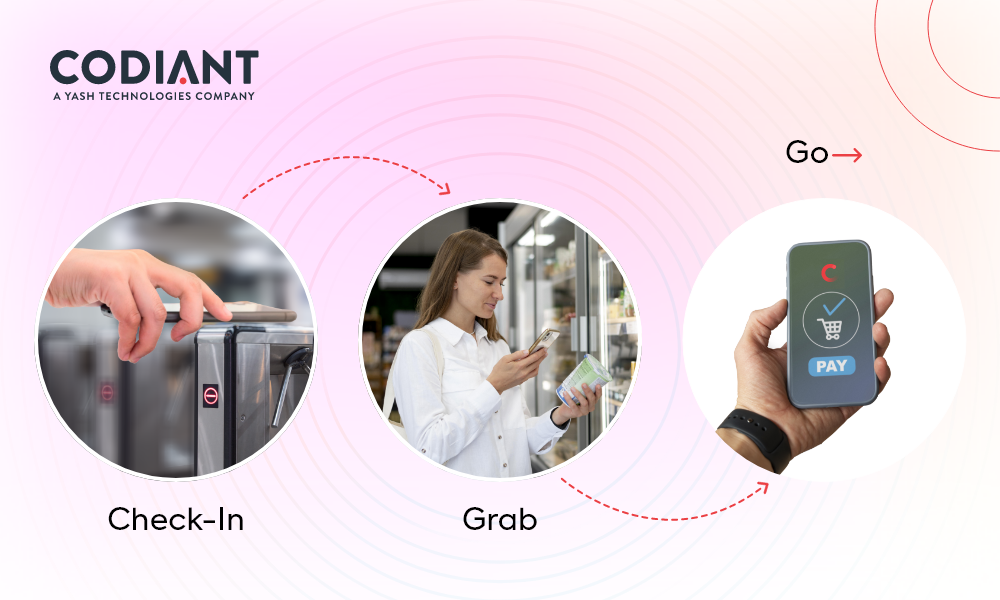
The cashier-less concept typically follows the three-step process i.e.; Check-In, Grab and Go.

Working in Cashier-less Checkout System

The cashier-less checkout system can be simply divided into three phases or say 3 activities where only the customer is involved in this process. The process follows; Check-In in (enter), Grab or Put products into the Cart, and Go (check out).

1. Check-In:

First and foremost, the customer had to enter the store which is equipped with a cashier-less checkout system. To do so, the customer needs to download the mobile application and scan the store’s QR code to link their device with the store’s billing system.The customer remains under the store’s monitoring system that tracks all their activities, right from entering to exiting the store.

2. Grab:

Customers take the smart device-equipped cart to put all the items they like to purchase. The device on the cart scans the product barcode, and the product shelf also tracks the in and out of the product along with the customer’s detail. The smart device parallelly maintains the bill of the customer.If the customer, later on, removes any product from the cart, the device deletes the product and manages the bill accordingly.

Once, the customer finalizes the cart and asks for checkout, then receives the final bill on the cart device and the linked mobile device as well.

3. Go (Check-Out):

When the customer receives the bill on the mobile device, s/he can make payment from their mobile app or by scanning the QR code from the smart cart device. After successful payment, the customer can exit the store with all the items s/he paid for.

Working of Amazon GO Cashier-less System

1. Check-In:

The Amazon Go stores are only accessible through mobile app services. The customer can install the app, sign in and choose the payment method.To enter the Amazon Go store, the customer has to scan the app’s QR code before entry. This will acknowledge the customer’s account and monitor their activities while being inside the store. The customer can even scan their companion too for check-in.

2. Cameras and Smart Sensors Track Activities:

Amazon Go store is equipped with advanced technologies and cameras that monitor the customer’s every activity. The devices are equipped with an AI system that automatically tracks every action of each customer in the store and manages their virtual cart with bills accordingly.Amazon’s cashier-less grocery store offers ‘Dash Carts’ that are fully automated and make the customer’s shopping experience even more efficient. The customer can instantly scan the QR code on the cart to activate it and map their activities.

The sensors on the cart track the products and manage the bill, based on the ins and outs of the products in the cart. This will help the customer to keep an eye on their expense.

3. Add Item To Your Actual & Digital Cart:

The smart cart is equipped with a weight sensor and PLU codes (defines product code, quality, and freshness) and defines product IDs as well. All these methods allow Amazon to track the product quickly and accurately.However, it is suggested to the user to only pick products from the shelf for themselves, and not for others. If they do so, then cameras will assign them as the payer, not the other.

For assistance, reporting a problem, returning the product, and other issues, customers can directly call the staff.

4. Check-Out After Shopping:

After shopping, when one is about to walk out of the store, a user has to visit the special lane to unload the items before leaving the store. Or can simply put the items in their shopping bag to walk out of the store.Either way, the customer doesn’t have to stop and pay. At the checkout lane, the amount automatically gets paid from the customer’s credit card, which is associated with the Amazon account.

The Technologies Supporting Cashier-less Checkout System

1. Computer Vision

Computer Vision is an AI-enabled technology that allows a computer system to present meaningful information from digital images, and videos by analyzing and processing the motion. It also uses object movement detection and recognition.

In general terms, computer vision technology is based on teaching computers to process images and understand them, pixel-by-pixel. In a cashier-less system, computer vision cameras can recognize products without relying on barcode scanning. All such easiness improves customer experience and fastens the entire checkout process.

2. Sensor Fusion

The sensor is a movement detection device that tracks all the movement in its environment and sends the details to the system. On the other hand, sensor fusion is software that integrates all the available sensor data for the study. Based on that data, the software improves the system’s performance by providing accurate results.

In simple words, the sensor fusion-enabled cameras in the retail store are placed in such a manner to track people’s activities and product movement as well. It also helps to avoid the situation of shoplifting or track the shoplifter, if needed.

3. Deep Learning

Deep Learning is a subset of Machine Learning that allows computers to study and understand images. Cashier-less retailers use machine vision to track customers in the store. However, to infuse perfection, facial recognition technology should be integrated to identify customers’ faces.

The system can store an immense amount of data to train and enhance the machine’s capability. It further helps the system and fastens the recognition when encountering the same data. As a result, machines become capable of recognizing and taking decisions.

Key Players To Watch On Cashier-less Projects

Cashier-less Checkout System Is Moving Into The Mainstream

The cashier-less checkout system for any traditional store can streamline the entire shopping process. With autonomous checkouts, the shopping experience will become quite faster and more convenient for the customer and the shopper.

Evidently, over the past couple of years, Amazon has single-handedly been the leading player in delivering a cashier-less experience through its physical retail stores. However, now many established brands are following such a trend to fascinate their customers. Considering the ongoing inclination of shoppers and customers to cashier-less technology, it is safe to say that indeed it is going to be the future of brick-and-mortar outlets.

To integrate this system, one requires a combination of advanced technologies. It includes Artificial Intelligence, IoT, and Machine Learning to introduce this revolutionary shopping format. But to deliver such a tech-advanced experience to your customer, you require an experienced tech partner. Only the right technology partner can help you to infuse these complex technologies and build an efficient and seamless retail shopping system.

Top 5 Educational Technology Trends In 2023

The abrupt adoption of technology is the result of all the recent struggles that the world has faced during the pandemic. It was not at all easy to find solutions dealing with the current problems but technology has encircled industries as a savior and the education sector is no exception.

It has aided education life with real tech visions and encapsulated simple learning with digital/online practices like interactive live sessions, online learning, virtual tours to ed-museums, laboratory simulations, and other significant collaborations using shared documents.

With all such brilliant benefits, the scope of increasing the digital citizen community is on the verge and accelerating mind-blowing growth opportunities.

Here are the popular EdTech trends and their addressing abilities in society.

What Is Edtech?

The term EdTech has a broad vision. It has arisen with a combination of two individual terms education and technology that helps in providing better learning experiences. The learners can enjoy distance learning with the use of apps and tech devices.

The EdTech creates more engaging, inclusive, and personalized learning experiences. These EdTech tools also foster a sense of inclusivity and boost the learning capacities of learners. Thus, enhancing the overall quality of education.

Top 5 EdTech Trends To Look Out for in 2023

1. Artificial Intelligence

AI has empowered the educational sector by turning knowledge into a comprehensive system where Augmented Reality tools and simulations are used. The automation of administrative work is one of the significant changes it has brought that allows trainers to enhance student engagement. Concerning other benefits, AI is helping the educational sector in many ways:

  • It promotes personalized learning by allowing where students can get custom learning approaches as per their requirements. AI makes learning interesting by providing features like customized learning programs, AI-embedded games, etc. to make learning effective.
  • It automates tasks like checking homework, organizing research papers, maintaining reports, creating effective notes, etc.
  • It maintains a positive classroom culture by upskilling the student’s abilities using AI & ML-powered software. It thoroughly understands the human learning process and then brings automation to the learning process automatically.

2. Virtual Reality

Virtual reality allows learners to enjoy the concepts and study them deeply by having an immersive experience through Virtual reality tools. It basically provides a virtual environment to the students where they can see the scenes and objects that appear so real to have an immersive feel of the surroundings.

Technology is uplifting overall learning as it provides better associations for learning subjects as compared to other teaching methods. Eventually, it creates learning more powerful through offering understanding, engaging and memorable lessons.

So, let’s head over to the benefits it offers for students and other individuals associated with learning.

  • It allows students to enhance their memory and knowledge retention power
  • It acts as a building block for improvising communication and collaboration skills
  • It lifts student’s excitement and engagement in the classroom
  • It shapes the emotional awareness and intelligence of students
  • It improves student’s learning outcomes

3. Gamification

Gamification in education aims at making it more engaging and appealing through the gaming elements added to the content. The game-based learning allows learners to introduce themselves with feedback, narrative, and fun-loving environments, enhanced interaction, problem-solving, competitiveness, and more.

  • It provides an addictive experience to the users and keeps them hooked on learning
  • It increases the student’s ability to retain knowledge by almost 40%
  • It allows students to connect learning concepts to the real world
  • It ensures getting real-time feedback and achieving meaningful and measurable targets
  • It makes the learning sessions more interactive and fun-loving

4. Blockchain

Blockchain technology deals majorly with sharing, storage, and security of educational data. It provides a huge cloud space where students, teachers, and educational institutions can manage their all-educational information, and data can be stored and shared securely among universities and students as well.

Some of the excellent benefits of blockchain that it has provided to the education industry include:

  • Both learners and educational institutions are able to enhance data security and efficiency
  • Enable easy centralization of information and data and reduces extra storage costs by giving a huge cloud space.
  • Allow easy and simple automation of the task, courses and lesson execution i.e., the tasks can be easily assigned by the teachers and they get notified and paid just after the task completion.
  • Makes the learning process self-acquired for the learners where they can fully own or control the information using access to course credentials, learned skills, and more.
  • Ensures data/content publishing on time and also protects and manages content against piracy.

5. Integrating Chatbots In Learning

Chatbots are the next big trend that the education sector is adopting and helping in enhancing overall efficiency. Chatbots support students by giving instant answers to all of their queries, providing them with course materials, evaluating students’ work, mapping progress reports of the students, and giving them required course materials and feedback. Understand the role of chatbots thoroughly with the significant benefits it provides.

  • Instant feedback from chatbots increases student interaction by making the conversation more healthy and interactive
  • Chatbots provide easy assistance to students by sending them tailored messages as per their needs
  • Students get the advantage of receiving instant and intelligent feedback that can be used to make better future predictions
  • Students can also enjoy the benefit of personal attention from the chatbots as the technology can monitor student’s activity, their learning patterns and can assist students in excelling in the learning concepts
  • Chatbots also play the role of being administrative assistants by providing easy access to all the administrative activities like campus guides, school fees, scholarships, course details, etc.

Summing Up!

The adoption of technology and tools in the education system has influenced society in many ways and technological learning is continuously moving towards the evolvement of unrestricted learning.

With the above explanation concerning the significance of EdTech trends, educational institutions and companies must rigorously start investing in it. Let’s not just look for the convenience but also the quality that technology will implant into the education sector.

Codiant is one of the top education app development company leaders with excellent forte in advance technologies fueling adaptive and simplified learning. Just think, discuss and invest in the educational tools and technologies to experience excellent results.

Top Fintech Trends to Follow In 2023

Alike every other industry, the fintech industry is also facing a bunch of challenges that could, however, be managed by tweaking current financial practices and processes with improved ones. And here is where the fintech trends come into play!

These trends are a set of new approaches adopted to meet global regulatory requirements and the rising demands of customers.

So, let’s closely understand the Fintech Trends for 2023 and their role in shaping businesses.

Embedded Finance

Consumers and investors have embraced the idea of embedded finance. Especially it has gained wide traction in the last 2 years.

The concept of embedded finance allows the integration of financial services into non-financial platforms with the use of APIs. In other words, digital customer-facing platforms can embed varied financial services in their applications so that customers need not leave the platform they are already on.

With the introduction of this term, businesses can directly offer financial services to their customers without making any separate investments for their own fintech wing.

Some of the most common embedded finance services include Embedded payments, Embedded credits, Embedded insurance, and Embedded investments. The 3 institutions play a major role in the embedded financial structures and these are Non-fintech companies/businesses having customer-facing platforms, Financial institutions like NBFCs/small finance banks, and embedded finance infrastructure companies.

Blockchain-Based Transfers

More people are choosing to forego traditional ways of managing financial data as Blockchain technology promises to offer distributed ledger which helps the fintech companies to allow their users to record, distribute, share and synchronize the financial data between the number of users.

This term is trending because it provides an open, secure, and inclusive network of businesses to perform customized tasks in a short period at a lower cost.

In the past few years, blockchain technology has got maturity by representing such benefits as transparency, security, trust, programmability, privacy, scalability, and high performance. Moreover, the technology also supports cryptocurrency which means customers and banks are becoming comfortable dealing with cryptocurrency. DeFi, Decentralized Finance is one of the significant fields of blockchain that removes the role of intermediaries and allows access to the customers for loans and other financial investments. Other fintech fields influenced by blockchain include settlements of real-time transactions, services for digital assets support, and zero-knowledge proof authentication.

MicroInsurance

Microinsurance is going to be a lifesaver, especially for low-income people who can pay proportionate payments to protect against the risks involved with specific areas. The trend will be further accelerated to eradicate the challenges like high transactional costs, excessive technical know-how usage, involvement of high investment to reduce risks, and the lack of insurers’ interest.

The financial institutions allow reducing the interest rates of microinsurance by acting as a partner whose financial and claim processing activities take away the overall portfolio risk and attract more people.

AI Technology & Chatbots

Process automation, increase in efficiency, cost reduction, and improvement in customer services are the major advancements of AI technology that are likely to revolutionize the whole picture of financial institutions.

Fraud detection, assessing loan risks and credit scoring, and maximizing predictive modeling through bank incomes will become faster, help in making more informed decisions, and allow frictionless payments through facial recognition.

Whereas, chatbots will ensure task automation by offering faster and more accurate banking services to the common people. In short, the emerging trend will allow banks to offer a personalized experience to individuals and promote cross-selling with 24/7 support services.

KYC (Know Your Customers) Guidelines

The increase in cashless transactions is likely to push the need for innovative regulations where the role of KYC comes. With the use of KYC guidelines, financial institutions can prevent financial fraud, identity fraud, embezzlement, and terrorism fraud. Other emerging regulations of 2023 will also include biometry and crypto.

Following KYC guidelines is one of the excellent ways of restricting customers from exploiting financial services. The steps included in the KYC process are done to verify the individual identity such as individual name, DOB, address, and other documentation which is issued by the government as identity proof. Also, the level of associated financial risk including the unusual behavior of the customer can be monitored closely.

On-Demand Pay

The trend of On-demand pay is expected to rise rapidly and people will embrace the pay-per-day system over the traditional one in 2023.

Almost 80% of the employees are willing to shift to companies where employers are ready to pay on-demand wages. This on-demand pay culture reduces the employer’s burden of borrowing money and saves the employee from the shadow of recession.

Moreover, the on-demand pay benefits the provider as well by ensuring quicker payments, easy access to financial tools, avoidance of overdraft fees and debt of credit cards, and other literacy materials that will help in reducing financial stress.

Personalized Payment Structure

Better convenience, higher security, and faster speed will be the metrics of practicing personalized payment structures.

The fintech industry will be able to access customers’ amounts easily. Given this fact, the overall payment frequency and efficiency will significantly boost. Further, managing financial risks and streamlining related financial operations will become easy.

The invention of voice recognition technology in fintech apps and services is offering the next level of liberty and contributing to enhanced fintech service efficiency.

Summing Up!

The impact of fintech trends in the coming years is difficult to predict but these trends are surely going to revolutionize the fintech industry.

Especially, excessive financial crimes, fraud, and frequent errors can be eradicated to a great extent.

People will be able to experience increased use of payment gateways for sharing credits and personal transactions. The strategy for easy account set-up, seamless financial transactions, and other easily accessible fintech services will also lift up the efficiency of eCommerce far and wide.

Now, the significance of the Fintech trend is clear, and how this is going to power up the overall fintech industry in the right direction.

On-Demand Babysitting App Development Cost & Features in 2023

Working parents often have a tough time maintaining a balance between their personal and professional life. As taking care of a baby is itself a full-time job and being in a job it becomes quite overwhelming to play both roles with ease. To cover up this gap and do their jobs without any stress, nowadays parents often seek a good babysitter or a nanny that can take care of their child in their absence.

However, manually finding such a good and affordable babysitter gives nightmares to parents, which generated the demand for an on-demand babysitting app platform that can connect parents and babysitters to fulfill their requirements.

If you are an entrepreneur, then you can avail the opportunity to resolve this pressing problem by introducing an on-demand babysitting mobile application in the market. For your assistance, in this blog, we are going to discuss in detail the on-demand babysitting app development cost and notable features that you must integrate into your app.

How Does an On-Demand Babysitting App Works?

It is quite an easy application to operate with a streamlined and user-friendly UI/UX. The working of the app for the parent and the babysitter is slightly different but is interlinked to each other to reach out and deliver the services.

Steps of Parents App

  1. Download the app and register yourself with all the relevant and genuine details
  2. After registration, the parent can access the list of enlisted babysitters on the app
  3. Parents can filter and reach out to the babysitters through the app by analyzing them on different parameters, such as status, reviews, hourly charges, and more
  4. Connect one-on-one with the right respondents and finalize the hiring
  5. Make payment through the app or cash
  6. After service completion, parents can leave their reviews and feedback based on their experience.

Steps of Babysitter/Nanny App

  1. Download the app and register yourself with valid and accurate details, and get the details verified from the admin end.
  2. After successful details and background verification, the nanny can update the status as ‘Available’ or ‘Not Available’.
  3. Set alerts to the new job or connection request from the parent.
  4. Provide services at the discussed price and for the time duration.
  5. On successful job completion, babysitters can track earnings, along with past jobs, earnings, reviews and ratings from parents, and more.

This is how the on-demand babysitter’s app works and makes it convenient for parents to find a reliable nanny and do their jobs without worrying about their children.

Vital Features to Integrate into Your On-Demand Babysitting App in 2023

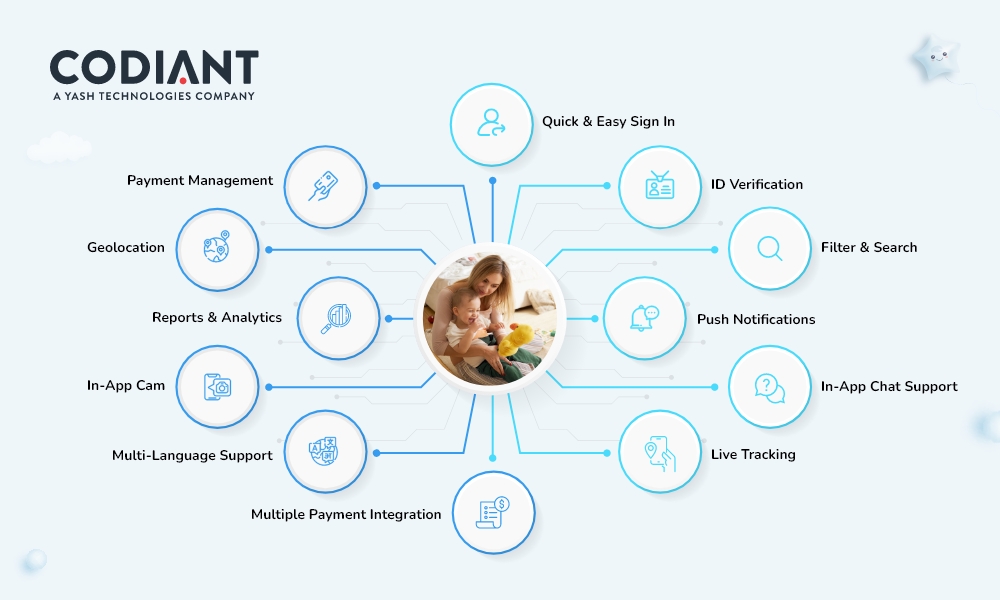
An on-demand app for babysitters comprises three stakeholders, namely the User/Parent App, Babysitter/Nanny App, and Admin Panel. All three stakeholders comprise many unique as well as similar features to maintain the app working smoothly.

1. Quick & Easy Sign In

Enable parents and babysitters to easily register on the platform with basic details and then let them fill in their details and requirements in detail.

Parents can find suitable nannies by filling their requirements accurately. Whereas, the babysitters can submit their details to get them verified and make the profile public for parents to find it easily.

2. ID Verification

ID verification is a crucial feature that you need to integrate into your babysitting app development. It builds trust between the platform and parents, such that they are leaving their child under the supervision of a safe and reliable nanny.

Being a reliable platform owner, you need to take the documents and ID of the babysitter and get all the details verified before allowing them to appear on the platform.

3. Filter & Search

Every parent looks for a desired babysitter that meets their particular needs like it can be age, timings, qualifications, experience, reviews, and ratings.

For such specific demands, the search & filter feature works accurately to reach the right resource. The parents can easily search the reliable and nearby babysitters and create a connection request to find the most suitable nanny for their child.

4. Push Notifications

Push Notifications is a great feature to integrate into your babysitting on-demand app development. It updates parents and nannies both on time for their duties and to explore new features or offers too.

Integrating this feature with your babysitting app development will keep parents as well as nannies engaged with the app and improve the app’s visibility.

5. In-App Chat Support

It is one of the most convenient and effective features of the on-demand babysitting mobile application. The in-app chat support provides a convenient platform for parents to communicate with their hired babysitter quickly.

Additionally, parents and babysitters both can look for professional support in case of any query or emergency. To make this possible, integrating an intelligent AI-enabled chatbot in the app can provide efficient support and a much-needed cordial experience to all users.

6. Live Tracking

The live tracking feature of a babysitter app generates a sense of relief and reliability in tracking the whereabouts of the hired nanny.

It will enable parents to remain calm and easy-going with their kids’ safety and the location at the same time.

7. Multiple Payment Integration

Every user seeks easy, secure, and convenient payment modes while availing of online services. The user can instantly book an appointment or avail of services online just by making the payments online while being in their comfort place.

Parents can avail of any of the available payment modes, which seems suitable for them to clear their babysitters’ dues in no time.

8. Multi-Language Support

We all live in a diverse society where different native language speakers can be found easily. And there are maximum chances that such people like to explore your app and services.

Thus, build an app that supports multiple languages and will bring more users without a doubt.

9. In-App Cam

In the babysitter finder app, an in-app cam is a very convenient feature for parents to connect with their babysitters directly through a video call in real-time, in case of any emergency or to enquire about ongoing situations.

10. Reports & Analytics

It is a great feature for the admin to collect and study all the data in an easily understandable form. The admin can analyze the trends on different metrics, such as new users, active/inactive users, user acquisition rate, babysitter with the highest rating, etc.

All these details and analytics help to understand the ongoing business trend and design strategies to improve business performance.

11. Geolocation

For safety concerns, it is a very helpful feature for parents through which they can locate their hired babysitter. Geolocation enables them to ensure that the nanny is at their home with the baby and hasn’t left the house.

Moreover, parents can even locate highly rated babysitters available near them without much struggle.

12. Payment Management

It is a very handy feature of the babysitting app development process for admin that enables them to track and monitor the service provider’s payments, revenue, and profit generated through the application.

All these handy payment details help admin to study their earnings and check out the success ratio of their services and implement suitable actions accordingly.

How Much Does An On-Demand Babysitting App Development Cost?

To develop any on-demand mobile application, there is no fixed cost for it. The price keeps on varying under multiple influential factors, which we’ll be discussing further.

However, the on-demand babysitting mobile app development cost will approximately range between USD $10,000 to $40,000 or more.

The following factors influence the development cost of the babysitter app:

  1. Features- The greater number of features included in the app will raise the development charges time and ultimately higher the charges.
  2. Complexity- The uncommon feature and functionality of the app define its complexity, which again adds more cost to the development process.
  3. Development Platform- Developing a single application suitable for multiple platforms demands platform-specialized developers and the team along with time, which again influences the development charges.
  4. App Size- The size of the app i.e. developing with basic features or an MVP or building an advanced or complex babysitting app, the size of such apps will vary and also increase. Similarly, the development time and development cost also increase without any doubt.
  5. Developer’s Location- Apart from the development process, the development team’s location plays an important role in defining the development charges. So, hiring the expert development team before analyzing the charges will be an intelligent call.

Let’s learn about the difference in the location-based charges, which will help you to pick the right market and hire the budget-friendly development team from the specific location.

Country iOS App Development Charges Per Hour Android App Development Charges Per Hour
Australia $80 to $120 $50 to $100
Western Europe $100 to $130 $50 to $110
North America $90 to $130 $30 to $90
Eastern Europe $110 to $150 $60 to $120
India $30 to $100 $20 to $80


These location-based per-hour development charges will help you to determine your selection for the babysitter app development within your budget. However, these charges may also be variable, so try to connect with a reputable company for a much more accurate budget definition.

Summing Up!

The market for such on-demand apps is growing each day. Likewise, with the inclining market trend, the demand for babysitting applications is becoming high. But to build such a mobile app, it is necessary to learn about the market demand, target audience, development process, cost, and other detailed research that could be helpful to take your app to the shop floor level.

To have a brief learning about the on-demand app development process and other details, you can also go through this on-demand marketplace app. Here you can get all the details about the development process, cost, and details of an on-demand application.

To build an on-demand babysitting application, Codiant is one of the top mobile app development companies to cater to all your custom requirements and help you stand out from the crowd.

With a vast portfolio in the on-demand industry, our apps have set the benchmark in the on-demand segment. So, why wait? Rely on our expert developer team to build custom solutions for any industry.

Angular JS Framework : Why and When Should You Use?

Angular JS is one of the most popular open-source JavaScript framework, developed by Google, and is used to build robust mobile and web applications. It can be freely used, modified and shared by everyone.

AngularJS provides an excellent framework for building interactive websites, single-phase applications and line of business applications.

Most standard groupings include:

Angular with Node.js, Angular with PHP, Angular with TypeScript, Angular with Django, Angular with firebase, Angular with Java, Angular with ASP.net MVC, Angular with .Net Core, Angular with Python.

The Angular mobile framework is simple and interactive, scalable, high-performance, and is used for developing applications across all platforms i.e. native mobile app, web, mobile web.

Benefits of Using AngularJS Over Other JavaScript Frameworks

Simplified MVC:

Unlike other JavaScript frameworks, in AngularJS development you do not have to write additional code to stitch your MVC i.e. model-view-controller components.

In AngularJS you just have to split your application code into MVC components and it automatically combines different MVC elements. Hence reducing your time to develop the code.

Two Way Data Binding:

Data binding in AngularJS is the synchronization between the model and the view. AngularJS uses two-way data binding for the synchronization of data automatically. In that way, changes in the application state will be automatically reflected in the view and vice-versa.

This saves time as Angular developers do not have to connect variables between the two layers.

Dependency Injection & Unit Testing:

Dependency Injection (DI) is a core concept of Angular 2+ and allows a class to receive dependencies from another class. The in-built dependency injection in AngularJS helps the developers to create, test, and understand the application easily. The framework divides the code into testing units so that the errors can be detected easily. Also, this simplifies the job of testers and saves their considerable time leading to reduced web development costs.

angular-unit-testing

Reusable Code:

AngularJS directives provide a good way to encapsulate and reuse functionality. The developers can reuse the same code developed before. This helps in saving extra time gone in developing the same code again, hence resulting in faster development time.

Filters:

The Filters in AngularJS framework simply filter out the data before it reaches the view or top layer of an application. They perform paginations, as well as filtering data arrays w.r.t existing parameters. The functions can be changed as per the ideal parameters in the system.

Turns Templates into Code:

AngularJS helps you build the perfect framework faster with ready-to-use, unique templates available with it.

The template is made of plain HTML, but you can extend to include instructions on how the model should look in the end view.

Businesses That Leverages Benefits of Angular Web Framework

  • Progressive Web Apps: Angular JS comes with inbuilt support for PWAs to make the process of building a progressive web app faster, with high performance, and less complicated.
  • Dynamic Applications: The platform can be used to build native dynamic mobile apps with strategies from Cordova, Ionic or NativeScript.
  • Enterprise Web Apps: The features like typescript, advanced refactoring, navigation auto-completion and more make AngularJS perfect for building large-scale applications.

Use Cases of Angular JS

  • On-Demand Video Streaming Apps like Youtube, Netflix, and Amazon Prime as they are high-performance web apps.
  • Travel and itinerary Apps since these apps include dynamic features. This helps in creating robust, easy to use travel apps.
  • Weather Apps AngularJS allows the developers to develop an interactive, real-time activity app with optimized quality.
  • User Review App or user feedback app requires faster review handling. With AngularJS app development it is easy to develop.
  • eCommerce Apps development for enhancing buying and selling experience.

The Definitive Guide To Understand Multi-Store E-commerce

Having a highly diversified e-commerce store comes with its own set of challenges for the owner. Handling and managing each customer, especially based on their personalized requirements is not at all a piece of cake.

However, such a hassle can be minimized to a great extent by introducing a dedicated shop for each of your audience. In simple words, you can develop a multi-store e-commerce platform.

Running a multi-store e-commerce platform allows you to sell specific products to a particular audience with personalize messages and marketing strategies, and serve relevant product suggestions to the chosen group.

It sounds to be a very effective solution but can give you a nightmare to manage each store individually and juggle multiple credentials to handle all the processes.

However, it’s not the case with multi-store e-commerce solutions where you can easily manage your multiple e-commerce stores from a single place.

Let’s delve deeper to understand the concept, benefits, features, cost, and platform that empower multi-store e-commerce solutions.

What is an E-commerce Multi-Store?

An E-commerce multi-store is a software solution that lets the owner control or views more than one store from a centralized place. The store owner can handle multiple business operations from a single account or software.

This method enables aiming at the specific target audience of the store, rather than reaching out to the interested and not-so-interested audience from one storefront.

For example, if your business is diverse and has different audiences/users for that, then you can create a different store view for each business suitable for the user’s experience. It will help you to promote products specifically to the right audience with a personalized message.

The categorization of businesses with individual stores allows for having their own niche, pricing, inventory, or offers. To streamline all the business operations, you can go with an e-commerce multi-store that can serve customers based on their preferences in different aspects.

With the multi-store e-commerce platform, you can easily customize everything to the store, without hampering any user’s experience or business operations.

Extraordinary Benefits of Multi-Store E-commerce Marketplace

The e-commerce marketplace in no time has become a vital tool for B2B and B2C marketing. This evolving trend has also evolved the purchasing or buying patterns of manufacturers, distributors, buyers’ committees, and customers. All these consumers prefer buying products from a trustable source, regardless of the original manufacturer.

The multi-store e-commerce platform offers various benefits to all of its multiple stakeholders.

Benefits for The Client

  1. For high-profile and important customers, the store can be client-branded.
  2. Authorized users can easily purchase available products over a specific dollar value.
  3. The automatically filtered catalogs allow the user to order only company-approved products.
  4. Ordering becomes quick and easy for all buyers through punch cards, reordering, bulk orders, and a quick ordering facility.

Benefits for Store Owners & Sellers

  1. The store owner can get a number of automated software solutions integrated into the platform to streamline operations, such as ERP, CRM, etc.
  2. Digital stores detailed SEO along with relevant keywords and meta descriptions can promote business in the competitive market.
  3. Supports multiple modes of digital payments and can even save and retrieve credit/debit card details securely while complying with government regulations.
  4. The store owner can have detailed access to the customer’s details, along with order history, wishlist, and order management.
  5. Store owners can access the customized RMA modules to carry out returns and exchanges with ease.

Benefits For The Administrative Staff

  1. ERP integration facilitates order and inventory from the client’s custom portal.
  2. An e-commerce platform can infuse a general or custom theme into each store.
  3. Cloud-based E-commerce marketplace offers unlimited platform scalability.
  4. The custom client portal offers easy-to-order and inventory management.
  5. Customer support can be centralized for all digital stores.

Benefits for The Distributor

  1. Distributors can identify and define which products they like to update, update prices and build branding strategies.
  2. The distributors can also control their set of operations within the website or marketplace platform.
  3. Bulk import and EDI integration support automated inventory management and product price handling.
  4. The operation managers can handle all the orders, inventory management, order and delivery monitoring, and customer assistance through the centralized distribution portal.

Benefits for Business Franchises

  1. The master franchise can keep a close tab on their franchisee’s order key products.
  2. The franchises can maintain their pricing, products, schedules, payment, and shipping methods.
  3. The robust marketplace platforms offer franchise-tiered management that can support both centralized and de-centralized management of franchises and franchise groups.
  4. Marketplaces can offer their clients some advanced services, such as updated catalog pictures, and compelling video and language translation facilities.

Significant Features of E-commerce Multi-Store

1. Stores Override Prices

With multi-stores, you can promote your profit earnings by availing of different pricing abilities for your advanced e-commerce store. The store owner can instantly override the product prices based on the store and list the same product at different amounts for different regions or the deal/offers provided at each store.

2. Store-Specific Discounts

By offering different and store-specific discounts on your multi-store e-commerce solution – you can easily attract more customers. The store-specific discount feature will allow you to offer unique and different discount rates for each store and track the accurate sales and discount details of each e-commerce store.

3. Store Specific Coupon Codes

Integrating coupon code generator features can influence visitor opinion and generate an ambiance of flash sales for an unsaid period of time. The user with coupon code can avail of varied offers which ultimately influence customer shopping behavior, double the sales, and builds a trustable relationship with the customer simultaneously.

4. Selection of Store

A multi-store presence of a business easily pushes it to reach a wider audience and this feature allows them to choose the store based on their preferences i.e. offers, location, language, needs, etc. The user can easily explore multiple stores and on their convenience and experience with the platform can easily place an order.

5. Store-Specific Categorization

Define product categorization based on the store type and the audience segmentation. Aim to provide an interactive environment that makes product search easier through the store-specific categorization feature. This feature allows you to assign different products to each e-commerce store simply by selecting and adding the product to the store inventory.

6. Performance and Analytics Tools

This feature offers a live dashboard to track the platforms and products’ performance and analytics. With this tool, you can analyze the detailed report of your sales, inventory, earnings, customer shopping behavior, and various other details. Apart from that, can get an auto-generated report on customers, sales, conversion rate, payment modes, and various other reports, and can perform report comparison as well against days/months/weeks/years.

7. Store-Specific Delivery Charges

To remain ahead of competitors, ensure the best delivery experience and the most convenient charges for the customer. The delivery charges can be optimized based on the area and the various offers implied in the order (if any) at different e-commerce stores. This feature allows to optimization of the e-commerce store specifically for the shipping charges.

Core Features of A Future-Ready Multi-Store E-commerce Solution

1. Products Management

With a custom-developed multi-store e-commerce marketplace, you can efficiently manage your products or inventory and can add ‘n’ a number of products with variants (size, color, style, etc.), categories, brands, and other details with a number of available stock and maximum order quantity filter with description and much more.

2. Logistics Management

Accurate logistics management with safe and timely logistics delivery boosts customer experience by multiple folds. It will ultimately elevate the customer reach and conversion rate. You can retain and engage the customer on your platform by letting them be informed with accurate information about their deliveries and frequent progress updates. This gives the admin and the customer assistants to have accurate information about the order and assists customers as needed.

3. Order Management

The multi-store e-commerce solution can offer your customers a highly convenient and customer-friendly experience with Single Page Checkout, Cart Abandonment Recovery, Order Product Update, Custom Checkout Options, Guest Checkout, and many more. Such streamlined processes promote user experience and support you build the best multi-store solution.

4. SEO Ready Solution

The E-commerce multi-store marketplaces are designed while considering the standard SEO guidelines and customized strategies. To build such projects, we ensure to integrate of automated features to simplify digital marketing and SEO-optimized themes for an appealing brand presence, and so on. An SEO-optimized platform promotes business presence, and ranking, and ultimately boosts the business revenue.

5. Marketing, Promotions & Discounts

Businesses adopt multi-store E-commerce solutions to simplify and empower their marketing strategy. To make this possible, we ascertain to integrate the best marketing tools, including Google Adwords, AI-enabled chat, email marketing tools, affiliate marketing, and others. All these tools drive easy and instant interaction with the customer in real-time and track their behavior on the platform to suggest the best solutions and formulate advanced marketing strategies.

Platforms That Empower Multi-Store E-commerce Marketplace

1. Adobe Commerce or Magento

Adobe Commerce is an enterprise-level e-commerce platform that caters to the needs and budgets of all company sizes through Starter ($1,999 a month) and Pro ($3,999 a month) plans. The platform offers in-built multi-store functionality to its users with a wide range of ready-made design templates.

Adobe Commerce makes it easier for its clients by offering a variety of hosting options, it includes AWS-hosted SaaS applications, on-premises deployment, or hosted on a public or private cloud. The platform had a wider presence in B2B and B2C markets.

2. Salesforce Commerce Cloud

Salesforce is a leader for Digital Commerce in the 2022 Gartner Magic Quadrant. The platform is specially designed to handle the demands and build the best possible solution for multi-stores by integrating apt capabilities. However, the platform doesn’t provide definite charges to its vendor, rather it provides exact prices on request based on the project size considering various other details.

Salesforce Commerce offers its clients an embedded AI-driven personalization with strong omnichannel features to provide the best personalized offline experience. The platform offers its services and solutions for both B2B and B2C markets.

3. BigCommerce

BigCommerce offers top-quality enterprise-level functionality and a well-designed app-based system. There are several apps available in the market that allow its clients to entirely customize their BigCommerce store. To make this possible, the client can even integrate the marketplace with other platforms too, such as WordPress, Drupal, Stripe, Amazon, Mailchimp, and more.

The platform is very cheap for businesses to avail – initially, it is available on a free one-month trial, whereas paid plans start at the nominal charge of $29.95 per month. The platform is designed to scale businesses and allow companies to grow at a pace they like. It can work effectively for both B2B and B2C sectors.

4. Shopify

Shopify is a widely used e-commerce software on the market today. Its variety of features and plug-ins help to build a highly customized and scalable marketplace. This platform encourages the integration of various systems with the e-commerce store, including ERP, CRM, CMS, and PIM. Apart from that, it also offers various apps for convenient services like Slack, Mailchimp, Google Sheets, Amazon, and more.

Shopify is initially available for a free trial with a regular subscription plan starting at $29 per month. The Shopify Plus SaaS enterprise-level service charges $2,000 per month. It is an effective platform for both back-end and front-end designing.

Summing It Up

There are different types and sizes of e-commerce owners that offer their services in the market. Likewise, their requirements and budget also vary to a great extent, and to cater to the wider customer market multi-store e-commerce solution is the suitable choice.

Taking the business to the multi-store listing software push businesses to grow at a rapid pace, improves profitability, and meets their needs. But it is not at all an easy task for a diverse business owner to switch their business from a single store to a multi-store concept. To make all this possible, only expert professionals are required, such that all the existing data doesn’t get compromised but rather gets organized in an advanced manner.

Well, in all this struggle, Codiant can be your right technology partner of choice. We are an expert web and app development company for decades and have exceptionally versed techies to build small to large-scale multi-store e-commerce platforms catering to all your business needs. Connect with us, for further consultation and assistance.