How DevOps and Agile Will Drive Greater Business Performance

Every small or big organization aims to enhance and accelerate their business processes while maintaining high customer value. To achieve that, the amalgamation of two techniques can be the most intelligent solution for an organization when a single method doesn’t turn out to be effective. In that reference, the organizations that are more likely to practice DevOps and Agile methodologies can enhance and streamline their entire business processes.

The DevOps Engineers by following Agile Software Development tactics can give a new dimension to the existing or proposed project development. Both the tactics are implemented in an organization to take care of the scalability, development, deployment, maintenance, and monitoring of software. It simply puts IT operations and Software Development processes together to maintain the timely delivery of the end-product/software.

A combination of these two techniques can help businesses to overcome the shortcoming and challenges they have been going through while experiencing a rise in customer satisfaction levels which yields a spike in profit and revenue generation.

What is Agile DevOps?

The concept ‘Agile DevOps’ is a combination of two different technologies that are put together to smoothen the entire project/software development process. Basically, both are modern software development practices that are considered to build a product, launch, and iterate.

To understand the Agile DevOps concept, it would be better to learn about both the terms individually. Ultimately, it will help to analyze how well both the technologies/methods can work together and can be implemented to fasten and align all the software development phases.

Let’s take a look and compare approaches to analyze how both practices can help businesses to drive greater performance.

What is DevOps?

DevOps is derived from the combination of two words i.e. ‘Development’ and ‘Operations’. It is a software development methodology that aims to put IT operatives and Software Development together on a common platform to gain the business objectives more effectively and effortlessly.

The DevOps Engineers follow a common practice to remove the barriers between the IT operations, Development, Quality Engineering, and Security Teams. Thus, under the DevOps model, the engineers ensure to keep both operations and development teams closely knit across the entire software development life cycle, from research and development to testing and operations.

The combination of two completely different teams and processes promotes Continuous Integration, Continuous Deployment, Transparency, and Automated Testing in the code repository. The DevOps practice is often defined as an alignment of development and IT operations to speed up the organization’s application delivery and services.

What is Agile?

Agile is a software development method, which is categorized into multiple phases to improve the process of app development and release. It requires continuous collaboration with stakeholders and improvement at every development phase. It promotes flexible responses to implement the relevant and acceptable changes.

The agile method generally boosts a disciplined project management process that initiates regular inspection and adaptation, a guided leadership to encourage teamwork, self-management, and accountability, following best practices to allow high-quality software delivery in a minimum time period, and typical business aspects to align development process with customer requirements and company goals.

To facilitate software development, the agile method follows varied frameworks, like Scrum, Kanban, or Extreme Programming (XP). These frameworks form the basis for familiar software development processes like DevOps and Continuous Integration/Continuous Deployment (CI/CD).

Difference Between DevOps and Agile

  1. Basic PhilosophyDevOps- It follows a practice of integrating the development and operations team together to upgrade productivity and team collaboration.Agile- It follows a culture of continuous delivery of small manageable project updates through iterative development and testing.
  1. UsesDevOps- It is implemented in the end-to-end project development process.Agile- It can be implemented in any department to enable easy management of the complex project.
  1. Team SizeDevOps- It has a huge team size, as it includes all the departments involved in the business process.Agile- It has a small team size which enables easy management and quick delivery.
  1. Focus AreaDevOps- Put the development and operations team on the same platform to practice continuous development and testing.Agile- Promotes the environment that supports mid-way changes to enhance project quality.
  1. DeliveryDevOps- Aims to provide continuous delivery on the daily or hourly basis.Agile- Updates incremental deployment after achieving each task/sprint i.e. on a weekly or biweekly period.
  1. DocumentationDevOps- Automation eases the documentation process to ensure team collaboration. It emphasizes communication through official documentation only.Agile- Minimum and only crucial documentation is followed to enhance flexibility in the development process.
  1. ToolsDevOps- AWS, TeamCity, Puppet, Chef, Docker, Jenkins, Ansible, GitLab, OpenStack, Kubernetes.Agile- JIRA, Trello, Slack, Kanboard, Active Collab, Bugzilla.
  1. FeedbackDevOps- Promotes internal team’s feedback to enhance processes and speed up delivery.Agile- Follows customer feedback and market requirements to update or design the product accordingly.

Benefits of Integrating DevOps and Agile For Greater Business Performance

Integration of DevOps and Agile methodology in an organization can lead to great business performance. The organizations that are practicing Agile and DevOps methods parallely can witness almost 50% to 60% growth in their revenue. Additionally, they can experience quick project delivery, a rise in user satisfaction, and cordial & effective team collaboration.

Integrating the practices of DevOps with the Agile culture requires changes in existing attitudes and strategies. The organizations experience a number of benefits by integrating DevOps and Agile methodologies to boost business performance, which is as follows.

  1. The product release process get simplified and product offering gets improved by integrating DevOps and Agile methods in the organization.
  2. The team members can understand each other’s tasks and roles in the development phase. The mutual understanding gets increased and is especially important for Project Managers, Scrum Masters, and Product Owners. Hence, to manage the project successfully, these entities should be aware of every step to deliver the product in complete coordination.
  3. Minimizes the risk associated with the project delivery or project failure, as the teams are working in coordination to deliver the result. Additionally, it also infuses perfection in the project and delivers more value.
  4. Integrating DevOps with the Agile development method can support managing sprints and milestones effectively. It includes the entire DevOps team, ranging from developers to testers in planning tactics, daily stand-ups, and retrospections.
  5. DevOps focus on business automation and likewise includes agile workflow and project planning to streamline the business operations and process. The emerging fields that integrate both the techniques together are, AIOps- uses Artificial Intelligence to automate manual workflow in the IT environment.
  6. The amalgamation of DevOps and Agile in the organization involves the assessment and measurement of key DevOps metrics and KPIs with end-to-end development.

Ways To Use DevOps and Agile Services Together

1. Smart Assessment

Assessment is the major and primary step that enables to build a roadmap for further steps. It includes cultural readiness, past implementation process and strategies, leadership responsibility, and IT service management processes.

2. Improve Teamwork

The team working by forming a team of DevOps Agile must have a better knowledge of multiple products. They should be well-versed in the development. These skills will improve teamwork while infusing business values. The practical knowledge of DevOps and Agile can support to give a new shape to the work.

3. Build Small and Straightforward Strategies

Apply agility in the project and organization process through rapid processes and assisting suitable technologies. For that, you can firstly create an MVP (Minimum Viable Product) that can provide value to customers, employees, and the organization.

4. Discover and Evaluate Challenges Individually

Usually, an organization goes through four types of problems: Simple, Complex, Complicated, and Chaotic. The specific problem can be dealt by implementing the most suitable practices and principles. Process automation can be applied quickly to questions and result in minimum errors, enhanced efficiency, and employee satisfaction.

5. Analyzing Quality after Every Milestone

The analysis of project quality is a vital aspect of the entire development lifecycle. This is another vital factor that can be used after the integration of Agile and DevOps. Furthermore, Testing plays a crucial role in adjoining the two methodologies. Functional Testing is applied in the Agile method. However, to check the quality of the software DevOps requires load testing and performance testing. Hence, for continuous development regular testing of software becomes important.

6. Analysis and Progress Measurement

After integrating DevOps and Agile methodology, the project managers need to track the progress. As well as, allow successful releases of multiple versions and rapid production. Apart from that, the user needs to implement specific measures to track its effectiveness.

Factors To Be Considered While Integrating DevOps and Agile

1. Seamless Teamwork Flow

Implementing the DevOps and Agile method in a team ensures that team members have a broader understanding of all aspects related to development and management. These team members are aware of DevOps business value and the practicality of Agile at the same time. The entire team is equipped with skills and ability to release, service and change management, automation tools, environment provisioning, and application deployment. The build-and-run product-centric team without a doubt can solve the business problem of Agile development-to-operations.

2. Defining Software Lifecycle

Defining a software lifecycle while integrating DevOps and Agile method can increase consistency, minimizes cost by reducing waste, and speed up the time to market. It means fewer instant changes and minimum errors. Both DevOps and Agile work together to maintain consistency and pace up the marketing of products or services.

3. Quality Assurance in Each Phase

It is another crucial factor to include QA in the development cycle while integrating DevOps and Agile. Testing handles a vital position when combining these two. The functional testing is applied in the Agile method, whereas DevOps requires load and performance testing of the software. Hence, continuous testing is equally crucial as continuous development.

4. Using Right Tools

Using suitable tools is the primary key to ensuring the successful integration of DevOps and Agile in software development. It also helps in creating and replicating the framework using Infrastructure as a Code (IaaC). The developers find it easier to deploy the application on different platforms without putting in any reworking effort and dedicating any additional time.

5. Automation and Documentation

Automation of the code scanning process eliminates the occurrence of any potential error. On the other hand, the DevOps team documents the entire process of the software release. It is suggested to document all the details to store for future reference. This automation and documentation enhances the overall productivity and minimizes the scope of errors as well.

Conclusion

Considering all these details and comparisons, it’s quite evident to understand that both DevOps and Agile methods deliver the end-user value in quite an efficient way but by following different paths. The agile method makes developers and the development process more efficient, whereas the DevOps method enables the operation team to maintain continuous integration and continuous delivery.

Codiant is the leading Agile and DevOps consulting company known for delivering quality app development solutions. We support our clients with measurable changes by adopting multiple methodologies, including DevOps and Agile app development integration.
Recruitment App Development: Cost, Benefits & Key Features

Flashback-5 years back! Job aspirants went to great lengths to find their dream jobs. The cut-throat job competition quite literally brought them down on the knees to find the suitable opportunity they’ve been vying for. Creating a long-page resume stapled in the traditional file along with their curriculum certificates was an inevitable thing.

Sigh! We’re in 2022. Where the foray of technology in every sector has made inroads to almost every problem. Recruitment app development is the result of one such innovation.

Though getting a job online still might not be a cakewalk today but about 65% of job seekers find recruitment apps as the most reliable and quicker job search tool to hunt for jobs, through their smartphones round the clock.

The struggle for searching for a job does not fall only on the shoulders of job seekers. In fact it’s a twin stress for recruitment professionals as well; looking for a suitable candidate to match their requirements. Almost 68% of the recruiters consider Recruitment Apps as the most efficient tool to find qualified candidates from the pool of talents.

Recruitment Job Portal App Development is transforming the recruitment experience of companies and job seekers completely. This positive construct and ease-to-search are thereby resulting in high demand for job portal apps, such as Indeed, Monster, LinkedIn, etc.

Given the scenario, this could be a brilliant niche market to invest in the job search mobile app solutions. In this post, we have tried to envelope the complete package that best describes the how-to, why-to, how much, and how many of the buzzing topic Recruitment App Development Space. Keep reading.

Top Benefits To Develop a Recruitment App

1. Quick & Cost-effective

Candidates can quickly filter the suitable job opportunity and apply for them in a few seconds. They don’t have to burn their pocket to make their physical presence count.

2. Job Alerts

A good recruitment app learns about the candidates’ preferences and regularly updates them about the relevant job openings so that the candidate never misses any great opportunity.

3. Easy Job & Candidate Filtering

The candidate can effectively filter the job options based on their experiences, skills, and other preferences. Similarly, the recruitment professional can also filter the suitable applicant based on their experience, skills, and qualification.

4. Painless Resume Sorting

The recruitment mobile applications offer an easy resume filtering feature to find the desired resume. By checking the right filters, the hiring personnel can easily and quickly sort out the applicant’s lists whose resumes are suitable for the organization’s ongoing requirements.

5. Promotes Organization as a Brand

The recruitment software supports employers to promote their online business presence. It helps them to generate awareness among people about the vacancy and attract highly-qualified candidates to their brands through such job search portals.

6. Perfect for Bulk Hiring at a Time

The hiring professional can recruit a variety of talent at a time to fulfill the organization’s advancing requirements. Such apps help in organizing the shortlisted and hired candidate’s database to access the candidate’s details quite easily and instantly at any point of the time.

7. Increases Productivity Rates

Such recruitment app development enhances the recruiter’s productivity, where the recruiter can create new vacancies, monitor new and existing applicants, and communicate with the right candidate to ensure a swift onboarding process.

8. Enhances Engagement

With recruitment apps, the candidate and the company both parties can receive relevant and on-time reminder notifications. Both the parties can connect through the chat feature to take forward the recruitment process or resolve any query when required.

9. Minimizes Humanized Errors

Humanly it becomes difficult to juggle between loads of tasks which might lead to some error or miscommunication between the candidates. Therefore, performing such a recruitment process through smart recruitment mobile applications can minimize the workload and reduce the chances of errors.

10. Excellent Experience

It helps the candidate to access the platform quite easily and find a suitable organization. Similarly, for organizations, such smart job search apps ensure a hassle-free end-to-end process.

Key Features of a Recruitment App Development

A Recruitment App Development is a combination of three different applications that work collectively to turn out to be a recruitment app or software. Based on that, each app have its own unique features and are distilled down to ease your app development research;

Key Features of Customer App

  1. SignUp/Login: It’s the first screen candidate interacts with. Users can register or log in with their email address, and other relevant details, or can prefer social media credentials.
  1. Edit Profile: Users can add and update their details based on changes in job requirements to get the relevant job feeds.
  1. Search/Filter Jobs: The user can manually search for specific jobs with relevant keywords or can also filter the job opportunities list based on their specifications.
  1. Upload & Mail Resume: The qualifications and learnings of a person upgrade regularly, so they need to update and upload the latest resume. The user can also individually mail the resume on the required job post through the job search app directly.
  1. Alert Notification: User receives alert notifications based on their activities, latest job updates, the response from any recruiter, and so on.
  1. Bookmark Jobs & Employers: Candidates can bookmark the job and the employer/organization they are interested in to apply later on.
  1. Multilingual: To ease the user experience, providing the app in multiple languages helps the customer to easily understand the job post and make the decision.
  1. Payment Gateway Integration: Candidates can make online payments whenever they purchase any package.

Essential Features of Recruiter App

  1. SignUp/Login: The recruiter also first goes through this screen to register or log in to the recruitment software. Use email id and organizations details to get into the app or software.
  1. Manage Profile: Add/Edit/Update details about organizations, such as owner, team size, location, industry, etc.
  1. Job Creation/Posting/Editing: The recruitment manager can post relevant job details when required and the admin can grant the access after details verification.
  1. Accept/Reject Applicant: The recruiter can accept or reject the applicant’s job application at any time during the entire recruitment process.
  1. Resume Filtering: The hiring manager can filter the list of resumes based on its organizations’ requirements and then can go through the resume details manually.
  1. Resume Downloading: The recruiter can download the resume of candidates they like to approach for further processes.
  1. Email Prospects: Recruiter can connect with candidates through email with detailed job descriptions and communication details.
  1. Track Applications: The recruiter can keep track of the received job request and the actions taken over them.
  1. Payment for Plan Subscription: The recruiter can make payments to upgrade the membership plan.

Essential Features of Admin Panel

  1. Dashboard: It provides a quick view of almost everything, such as managing users, candidates, recruiters, and other things instantly.
  1. CMS: The admin can manage recruitment apps or website content with the help of a CMS.
  1. Job Post Management: Admin can keep track of all the job posts done by the recruiters.
  1. Real-Time Analytics: Admin can generate real-time reports of recruiters, candidates, job posts, job search, and many other activities.
  1. User Profile: Admin verifies candidate’s details and updates about relevant new job posts.
  1. Recruiter Profile: Admin verifies the details of recruiters to maintain job post genuinity and eliminates fake job situations.
  1. Schedule Interview: The interview is the most crucial phase of the recruitment process, which finalizes the decision of selection or rejection. So, interview scheduling through the app could be a beneficial feature for the recruitment app.
  1. Ads Management: Admin can monetize the platform by implementing an interface to manage the advertisements easily.
  1. Membership/Subscription Management: Admin can keep track of candidates and recruiter’s active and inactive subscription packages.

Additional Features

  1. Review & Feedback: Any recruitment app user can submit their reviews and feedback based on their experiences.
  1. In-app Call and Messages: The recruiter and candidate can directly connect to each other in case of any query through the job search application.
  1. Resume Creation: The app itself creates the candidate’s resume within no time, based on the provided details on the job search portal.
  1. Cloud Environment: This feature makes data access easier and enhances the user’s experience. Cloud environment makes recruitment mobile applications more robust and scalable.
  1. Document Scanning: The user can add relevant documents to their profile with an in-app document scanning feature to maintain the user’s data accuracy.
  1. Job Questionnaires: The customized questionnaire for an individual company will help them to analyze the candidate’s skills and learnings to choose the most suitable candidate for the job.

Top 10 Market Players of Recruitment Apps

  1. LinkedIn
  2. Indeed
  3. Yello
  4. Glassdoor
  5. JobAware
  6. ZipRecruiter
  7. TalentBin
  8. Workable
  9. Monster
  10. Shapr

Team Structure of Recruitment App Development

Eventually, it all comes down to the best Recruitment App Development Company when measuring success. You require the best resources and talent. Apart from that, expert individuals are also prioritized to develop the recruitment mobile app. Usually, app development requires a team of Developers, Designers, Testers, with Project Managers.

The team size and structure depend on the size, complexity, and deadline of the mobile application. So, while you search, look for a recruitment app development company that follows an agile method of development. This scrum model allows you to work in a rigorous environment where you can come up with the changes at any stage of development.

The team members required for developing the robust job search portal apps are:

Business Analyst- A R&D expert that analyzes the business’s requirements and extracts the client’s ideas to present a well-formatted business plan for the further development phases.

Project Manager- A smart leader to manage the tasks and deduce the most appropriate solutions.

Developers- Front-end and back-end web and app developers.

Designers- Graphic Designer, UI architects and UX designers.

Tester- A quality analyst to ensure the app is free of defects and meets all the quality standards.

How Much Does it Cost to Develop a Job Search Portal?

A Recruitment Mobile App Development Cost relies on multiple variables, which could be a daunting task. As it is quite difficult to figure out all the factors and apps features in the initial development phase. The complexity of the application requires more development time and the time duration also influences the overall Recruitment Job Portal App Development Cost.

The variety of influential factors that contributes to the app development cost is the applications size, complexity, features, functionalities, third-party tools, development team, team size, experience, tech-stacks, app platforms, team location, etc.

The charges also vary on the hourly-based charges and the project-based charges. The hourly charges vary from zone-to-zone and country-to-country as well. Like for instance, the hourly development charges of US-based Developers can cost from $100 to $250; European Developers charge $80 to $200, and the Asia-based Developers charges around $25 to $100.

Considering all these factors, we will analyze the generalized average cost of recruitment app development. The average cost of a Job Search & Recruitment Mobile App Development ranges from around $12,000 to $100,000 and more.

Conclusion

The demand for recruitment apps is increasing due to rising dependence on technology and the pressing need of job aspirants and companies to streamline and fasten the entire recruitment process. This never-ending cult has attracted a huge volume of job seekers and providers to rely on job search applications.

Thus, to build a unique and attractive recruitment app that outshines the competitive market, you need to hire an expert recruitment app development company. Considering the market trends, we have described the details of a Recruitment Mobile Application to guide you properly.

If you’re chasing one such app development company, Codiant can be your apt choice! We use best development practices to provide our clients with market-leading software. We build highly versatile and secured online job software & mobile app portal on modern frameworks and design patterns.

Top 10 Reasons Why FinTech Startups Fail

Financial Technology (FinTech) is one of the most trending industries that is accelerating automation and using modern innovative technologies to influence customer behavior.

As the adoption of automation in the field of finance is increasing, it is witnessing a great number of technological innovations in the form of products and services. Concerning this, it is predicted that by the year 2028, the FinTech market will hit the approximate figure of $332 billion.

But since Finance is a very sensitive industry, most often in terms of security, legalities, privacy and interest rate changes, it becomes quite a challenging task for a startup to gain success in the FinTech industry.

Even though Fintech projects are heavily influenced by the funds and investments (which are prone to higher business risks), an extensive number of startups are still foraying in the hyped market and are unfortunately crashing down.

This brings into question, What could be the possible reasons for the failure of so many top-funded startups?

In this review of failure, we’ve analyzed top reasons to find why companies had an undesirable exit. And how being a FinTech entrepreneur you can avoid falling into a trap that may tumble down your company.

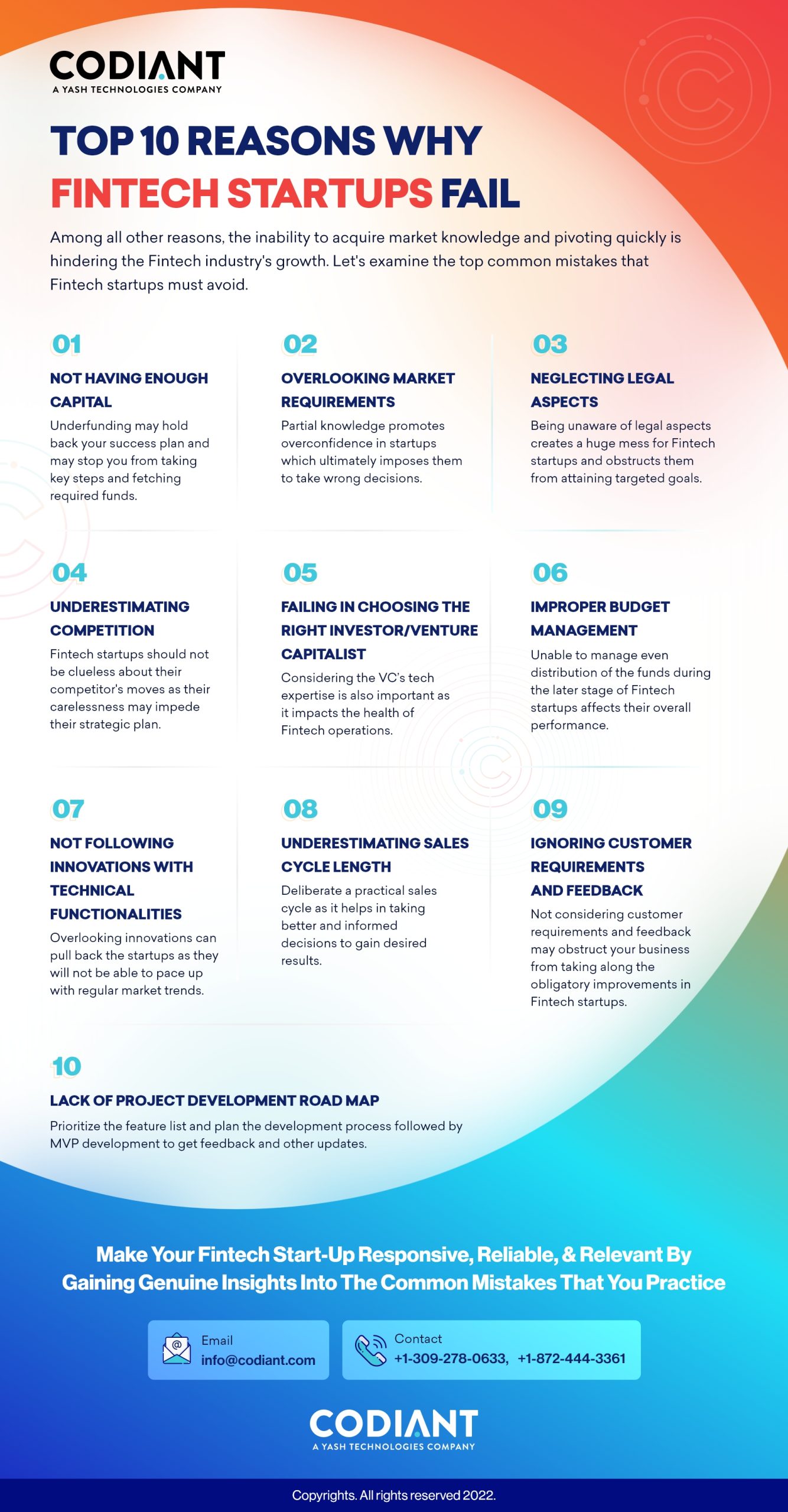
Top 10 Common Mistakes That Lead To FinTech Startups Failure

1. Not Having Enough Capital

For any business to make its successful entry, money and time are the two crucial factors that determine its effectiveness and sustainability. Usually, a FinTech app development requires a heavy budget, which includes category-specific tools, top talented developers, and other vital resources. So, having funds flowing continuously is significant for fintech startups to gear up.

To make all this possible, the app company has to be gripped by a huge budget or be backed up by investors or venture capital. This helps FinTech startups to raise timely investment for the project and save themselves from shuttering.

2. Overlooking Market Requirements

The basic aim each app follows is to come up with a feasible solution for a problem that the user faces. However, if the entrepreneur fails to analyze the right problem and accurate solution for the same, then, no money or tech experts, or any fintech app development company can save the startup from shutting down.

Hence, before finalizing any problem and solution for that; it is necessary to carry out detailed market research to analyze the feasibility and intensity of the problem a user faces in the fintech industry.

Eventually, customer experience is the basic building block of any holistic app development. Thus overlooking market requirements and just chasing capital gains will ultimately obscure real damage.

3. Overlooking Legal Aspects

When funds and finances along with crucial and personal details are involved, then taking care of all the legal and security measures becomes mandatory for any business. Therefore, a fintech company must comply with all the financial laws and legal aspects along with genuine license certification to operate smoothly and gain customer trust as well.

Many fintech entrepreneurs fail to research varied legal aspects of the industry, which raise the risk of product failure. However, going with a solid and well-planned legal strategy and the right documentation can prevent a startup from facing failure.

4. Underestimating Competition

Automation in businesses has widespread reach therefore, before entering the crowded market, it is a must to first analyze the competitors and the services/solutions they are offering.

You can’t turn a blind eye and assume that being a newbie with cutting-edge proposition in the industry you are going to be successful and nobody can surpass you.

There is intense competition in the market, and so are the chances of business failure. Before you catapult your business concept, get into the depths of competitor research and analyze all the required details.

Check out who is in the market space, what and how they are doing, and ensure to come up with something valuable and unique to offer to your customers after monitoring its risk. If you failed to do so then you may get into trouble.

5. Failed in Choosing the Right Investor or Venture Capitalist

Funds are vital for any business’s survival but finding the right and highly skilled investor is very important. Contrary to popular belief, the Venture Capitalist you are associating with should not only be the source for offering their money. Some VCs are even lifelong financial advisors and technical business experts. Many of them have previous finance industry experience.

That said, you may always count on them to offer their brand name to increase the popularity of your business and acquire market expertise like infrastructure, technology centric operations, human resource planning, performance evaluation, etc. to improve the efficacy of your budding company with a high uptick.

Failing to associate with the right experts or financial partners, could cause trouble for your business and may lead to early business failure. Therefore, before tying knots with the venture capitalist, ensure they have sufficient industry expertise, the type of reporting they expect from you, and the governance you require from them.

infographic

6. Improper Budget Management

Shortage of finances often leads to the failure of a business, hence a business must abide by proper budget management and restrain from making wrong and untimely investments.

For instance, a new Fintech company initially doesn’t need to have top-quality and expensive software for its system. Apart from that, being a new entrant in the business, it is not mandatory to furnish and automate your workplace with new and latest gadgets.

All these updates can be done in multiple phases, as the business progresses and opens its wings in the market. Hence, it is necessary to focus on customer satisfaction and quality services instead of providing all the luxuries to employees in one go. So, plan your budget intelligently and make the right investments to save your Fintech startup from facing the failure phase.

7. Not Following Innovations with Technical Functionalities

Low-tech product weapons may die an embarrassing death. Integrating new technologies in your Fintech app product may save your startups to fall into the graveyard.

Cutting-edge products backed with modern and innovative technologies enhance their working functionalities, which ultimately improves user experience and raises its market demand as well.

Technologies like Artificial Intelligence and Machine Learning help to forecast and make accurate financial decisions rather than having guesswork. Such automation reduces trivial investments and promotes intelligent investment decisions.

For example, with smarter chatbots, the staffing cost can be trimmed down to a great extent. Chatbots are equipped with AI technology that constructs a conversational experience, identifies fraudulent activities, and are responsive to the conducive environment. Hence, implanting innovations can make your startup less nightmarish.

8. Underestimating Sales Cycle Length

Often, every business considers itself a well-organized and planned business making into the market, and Fintech startups are no exceptions. Eventually, the startups consider their product or services as the best and consider them worthy to beat all the sales deadlines.

But little do they know, customers who are already swayed on the existing market products and services cannot be instantly lured to a new market entrant, only unless it provides a compelling value proposition.

That said, when the ball is in the customer’s court, the FinTech companies require to maintain patience and tenacity. And craft strategies that gradually attracts customers with their progressive services.

Additionally, always be in the real world by defining a longer sales cycle for your startup business plan, rather than expecting everything to happen instantly.

Keeping such unrealistic expectations may make you reckless and push you to take untimely decisions, which ultimately leads to fintech startup failure.

9. Ignoring Customer Requirements & Feedback

No business can survive in the market, which fails to deal with customers’ requirements and does not take action on their feedback. As a matter of fact, a product that doesn’t deal with the pain points of the customers is destined to die soon.

The Fintech business and services should follow the customer-centric approach. It should provide in-depth insights to take action on implementing any changes.

If a Fintech startup fails to fulfill customer expectations and requirements, then sooner or later the failure comes knocking at your doorstep. Hence, to avoid such a scenario with your business, consider acquiring customer feedback and act accordingly. This will help you reduce inefficiency and incapability of the product, and provide valuable and accurate solutions to customers’ problems.

10. Lack of Project Development Road Map

Introduced a top-quality unique product but having a tough time gaining buyers? This situation can be faced by any business as customers are unpredictable which apparently leads to business failure.

Well, such situations can be avoided by creating an organized roadmap to develop the project in multiple phases. Each phase is having features based on its priority i.e. higher priority in first phase development, lesser priority in the second phase, and so on.

However, making a basic version of a properly working project i.e. MVP development with enough features is preferred to validate the project idea and gain customers’ attention and feedback. Such development planning helps businesses to understand the project’s effectiveness in the market, then follow the next development phase or introduce changes, if required. This will support a business to sustain longer while saving themselves from standing on the verge of failure.

Conclusion

Success and failures are the two sides of the same coin, where a startup either succeeds or fails while investing in the Fintech industry.

All the above-mentioned points can be seen as virtues that can still save you from falling into the cracks. However, it doesn’t give the surety that the product will be a success shortly. It requires a hell lot of effort and precautions to build a successful business.

In reference to this, Fintech project development is one of the crucial aspects. And in the process of building the tech infrastructure, it requires an expert FinTech Web and App Development Company.

In order to influence, Fintech app developers at Codiant can extensively be your greatest strength. Our host of teams -from project managers to UX designers and strategists to developers- is arguably the iconic arm of any startup looking to head into the crowded market and battle on the front.

How to Hire Mobile App Developers (Android, iOS & Cross Platform)

Every recruiter goes through the tidal wave of complexities while hiring a developer. There are uncertainties on judging their coding expertise or maybe justifying their experience. One of the major abilities required to hire a developer is to check higher proficiency but considering the current multifaceted scenario, it is not the only deciding factor. To ensure the success of the organization in terms of achieving its mission, vision, and objectives, companies need to broaden their evaluating horizons when hunting for the right resource.

This article will take you to the accurate roadmap of landing on the potential developer you can hire for your organization. But before you jump on discovering hiring essentials, know that recruitment should be done smartly because it is a pricey affair. It takes a lot of the recruiter’s time to conduct interviews, onboard employees, and provide them the essential training. Remember that a single mistake while hiring a developer may cost a huge amount.

Moreover, another significant aspect before beginning your hunt for developers is considering the development platform i.e. iOS/Android, Web, etc. for which you need to hire a developer. This will simplify and filter down your research and will give you the right candidates’ options while saving your time and budget.

For instance, if your team needs to develop an:

iOS application

In this case, you will have to hire an iOS app developer with skills and expertise in Objective-C, Swift, and Cocoa Touch. The developer must have extensive experience with iOS frameworks such as Core Data and Core Animation. He/she must have good knowledge of Apple’s design principles and application interface guidelines and so on.

Android Application

For Android app development, you will have to hire an Android developer with working proficiency and experience in Android SDK, familiarity with RESTful APIs to connect Android applications to back-end services, knowledge of Android UI design principles, patterns, and best practices, and a solid understanding of Google’s Android design principles and interface guidelines, etc.

Cross-Platform

If your client doesn’t want to develop a native app on the iOS/Android platform but is looking to develop an app that runs very well on both OS then you’ll have to hunt for cross-platform app developers. The cross-platform frameworks that the developer works on are Flutter, React Native, PhoneGap, Xamarin, Ionic, among others. The cross-platform app developers must also be well-versed in developing single-page applications using techniques including front-end routing, client-side templating, consuming JSON-based RESTful APIs.

Web Development

For website development, you need to hire web developers having proven working experience in programming languages like PHP, ASP.NET, Javascript, or Ruby on Rails.

Now that you know the exact hiring requirements, let’s quickly drill down the most popular ways of finding developers online.

Where and How To Hire Developers Online?

1. Freelance Websites

  • Upwork This is a huge marketplace that makes your task much easier by just bifurcating the list of essential features i.e. skillset, experience, and other related areas you are looking for in a developer. The platform allows you to explore the top-class talents from corners of the world who are ready to work on an hourly basis at lower prices as well.Here is the list of points that you need to check to be more precise during your hiring process:
    • Draft and share a significant job description with the required details that you are looking for in a candidate
    • Check out the shortlisted candidates suggested by Upwork based on your requirements
    • Select and schedule their interview/discussion to carry forward the further process.
  • Freelancer It is one of the leading marketplaces which is known for finding developers, UI/UX designers, and other top freelancers. Recruiters find it easy to search for the top specialist and the process of finding them is very easy. They can just upload the project for which they are looking a specialist and the concerned person will respond to your query.Explore how freelancers make your task easy:
    • Users can find the potential candidate based on these categories i.e. skills, contests, languages, hourly project rate, fixed project rates
    • Now every category will display the number of specialists trying to collaborate with your project and you can easily find the one you are looking for.
  • Toptal Toptal is another well-known platform known to recruit the best suitable candidates without actually investing much time in the initial selection process from all over the world. The recruiter can look out for potential developers, designers, product/project managers, etc. The unique feature that attracts recruiters for the recruitment process is the excellent screening which measures a candidate on these parameters like professionalism, expertise, and communication skills.Have a look at the screening process used in this platform:
    • Initially, a soft skill interview is conducted
    • This followed by the technical interview and project test
    • Only 3% of the candidates can pass the exam test which makes it easier for the recruiters to continue their recruiting process

2. Design Associations

  • Dribbble It is a huge platform focused on experts in the field of animation, mobile/web design, and illustrations. The platform offers opportunities to recruiters to find the right set of skills, talent, and creativity in the form of the latest alluring designs. The design specialist uses this platform to showcase their creative work to escalate their career growth.Key steps to finding the potential experts in your niche:
    • Know the requirements of your team and the type of designer they are looking for
    • Prepare a detailed and striking Job description that creates curiosity among designers to join your team
    • Wait for the designers to apply or send them an invite to join you
    • Carry out the screening process to select qualified, experienced, and creative candidate
    • Conduct interviews and design test to check their talent and abilities
  • Behance Behance is a kind of social networking platform specially created for designers to display their design creativity and get more exposure in the outer professional world. Using Behance, recruiters can easily explore the top specialists and their connections. The kind that is featured on the platform includes animation, mobile app development designs, illustrations, web designs, and more. There is a special job section where recruiters can find the quality leads and skip the chaos of endless scrolling to find the potential candidate.Steps to find a great designer on Behance:
    • Behance has a range of discovery tools that can be used to search for the right set of skills and creative professionals that you are looking for.
    • Follow top designers or creative experts on Behance as you can explore their comments, likes, and other activities along with their top designs.
    • You can also share your required query on the job list and can yield the best potential candidates.

3. Stack Overflow

Stack Overflow is an online community, specially designed for programmers who can learn, share and connect with other experts to enhance their career growth opportunities. Majorly programmers post their questions or queries on the portal expecting that they will get the related answers. The recruiters get access to explore a large number of professionals with direct search or they can post position opportunities on the job board and continue the screening process.

You can simplify your search using available features on the platform:

  • Stack Overflow offers multiple badges and you can use them to sort your search
  • To find out professional expertise and the opportunities they are looking for, recruiters can explore the careers section
  • Also, there is an option to use tag search to get the list of relevant candidates

4. Github

Github is an online platform used by programmers to host their best projects, so that other users can get access to your past portfolio and tasks. The platform is specially used by other developers to make more informed decisions on any project; he/she will be able to cross-check their accuracy with other codes uploaded or they can either post their query on the job board section to land on the relevant result.

This platform also promotes teamwork and allows the team members to work collectively on the same project in one place. Thus, the members can update, edit, and replace the codes when needed and build a centralized channel. Eventually, these features help recruiters to find out detailed information about the potential candidate and it helps in their recruitment process.

5. LinkedIn

LinkedIn is the most popular platform to recruit candidates from all over the world. This is generally used because of the advantage of getting access to the candidate’s resume and other detailed information from their profiles and connections.

Other compelling reasons for recruiters to use LinkedIn are:

  • It allows recruiters to share job opportunities where people can comment, like, and connect easily with the hiring person or company.
  • Recruiters can easily get all the latest updates and plan their recruiter’s strategies based on the current industry scenario.
  • This platform reduces the number of spam by letting the recruiter conduct reference checks immediately.
  • Referral recruiting is another excellent feature that allows recruiters to find the best-fitted resource from their professional candidates along with the required feedback.

 6. Staffing Agencies

Staffing agencies are the organizations that help recruiters to find out the potential local candidates who can join their professional team. The candidate selection process includes checking references, shortlisting candidates based on resume screening, and then conducting interviews with the concerned organizations to select them for the required position.

How staffing agencies can benefit recruiters while hiring developers:

  • It saves a lot of recruiter’s time, training resources, and other related risks
  • It reduces the cost of payroll and on-boarding employees
  • Recruiters get the quick response to their queries and find the best suitable candidate
  • A need for the short term can be resolved quickly
  • The overall hiring process becomes much more cost-effective and efficient

7. Hiring Marketplaces

There are thousands of hiring marketplaces all around which makes the recruiter’s task easy and worthwhile. These marketplaces allow recruiters to gather a lot of information and simplify the waiting process so that you do need not look out on different sources. Using this platform, recruiters can reach out to the suitable candidate quickly which ultimately helps in making quick decisions. To search in a more precise manner, there is an option to share a recruitment announcement where you can check candidates’ responses and decide the candidate you need to work with.

8. Job Boards

Job boards are the best search engines used by recruiters to upload their job openings and search the suitable candidate to gather resumes for the screening process. It offers recruiters useful, unique, and valuable opportunities and tools to find the best fit.

There are a few tech-specific job boards that can hasten the process by directly displaying the candidates for which they are looking.

Reasons how Job Boards can help you to hire developers easily:

  • Get easy access to the wide variety and quality tech candidates
  • Get the best results out of the recruitment campaigns and minimize recruiting time
  • It is a cost-effective way of finding a suitable candidate as you can get immediate access to the experts as per your chosen area.

9. Social Media Channels

  • Twitter Twitter is a platform where candidates are not looking for jobs but recruiters can find the candidates with the right set of skills.Recruiters just need to follow these simple strategies:
    • Relevant tags are the master key to selecting the deserving candidates for your industry
    • Use the power of Twitter advanced search
    • Keep following different latest topics on Twitter to get the potential leads
  • Reddit This platform doesn’t work exactly like social media but here is a huge community where you can increase your audience reach. It engages with other social media platforms and offers an opportunity to connect with skilled aspirants. This platform is also loved by tech-rich communities because they can easily share their ideas and put up a conversation over them.Follow these steps to find relevant candidates:
    • Search candidates using Reddit Boolean strings
    • Reach out to the relevant Reddit communities to connect with potential candidates
  • Quora Quora is a great platform where you can connect with a huge audience by putting down your queries or resolving any common issues that other developers are facing.The best way to recruit candidates on quora is to:
    • Let your conversation move in a stable flow
    • Answer other’s queries with authority
    • Check out the stats of the uploaded conten
  • Facebook Facebook is the widely used social media platform where recruiters can easily find a potential candidate. It is gaining a lot of popularity these days because people are already spending a lot of time and therefore they can easily respond to the queries that you post.Tactics to use while hiring a developer on Facebook:
    • Get data and insights using the Facebook Graph Search
    • Join multiple IT groups where you can get the latest updates and find potential candidates
    • Keep an eye on Facebook events and use relevant hashtags in your job posts
  • Instagram It is the most trending platform where most of the youth population resides. Instagram is populated with visuals and therefore it is quite difficult to find developers here.So, recruiters can make use of these tactics to get relevant candidates:
    • Post your job requirements in your Instagram stories
    • Reach to the relevant candidates using the right set of hashtags

10. Paid Ads

Paid ads are the traditional ways to get leads in any kind of industry and recruiters can also use them to get potential candidates. It benefits recruiters with these many strategies like:

  • It increases the ability of recruiters to target passive aspirants
  • It facilitates you to increase your reach
  • It assists in developing a long term strategy
  • It allows recruiters to use the smart targeting features

Steps To Hire A Developer

  • Create a well-written job description

To deliver the right set of expectations to the candidate, it is required to write a well-written job description. You must include areas like experience, skillset, cognitive capabilities, and other responsibilities that you are looking for.

  • Choose the developer that understands your business

Impart some knowledge about the business idea that you are taking ahead in your journey. Candidates need to know the kind of work they are going to perform while choosing them for your project.

  • Check their portfolio

Always sticking to the resume is not the right approach to choosing candidates, rather you should check out their portfolio and find out the ability to perform tasks as per your expectations.

  • Test them by giving assignment

It is very essential to test their skills based on your thoughts, ideas, and expectations, and giving them a test is the best way to check it.

  • Ask related questions

Sometimes, asking a few practical questions related to your requirements will help you in making a clear decision about selecting the right candidate. Ask questions like:

  • Give a detailed description of your current project
  • Explain your interaction with your clients
  • How will you tackle the project after its development phase? etc.

The Cost of Hiring A Developer

Estimating the cost factor is one of the most crucial parts while hiring the developer for your company. Cost estimation is not an easy task as you need to consider many factors and figure out a relatable cost.

Let’s discuss the factors in detail:

  • Check out the type of candidate you are looking for i.e. Full time, freelance, or outsourcing
  • Discuss complexities of the project
  • Check out the location and the local pricing strategy of that area
  • Consider the experience level of the candidate

This is not the final list but you can consider other factors depending on your project requirements and other related capacities.

Summing Up!

Recruiting the right candidates for your organization or project requires a lot of research. The recruiting starts with understanding your organizational needs and building strong relations and communications with the right communities, all around. Also, you must pay attention to the value you are expecting from your developer.

We have already discussed essential platforms and features to consider and we are sure that it will help you to land at your desired destination.

Fitness App Development: Types, Key Features, and Cost

“Use it or lose it!” The much-overrated mantra to stay fit is increasingly gaining prominence as we inch closer to a society rushing to get fit overnight. In this run to stay fit, most people tend to lose patience as they fail to measure visible progress. Fortunately, the launch of many different types of fitness apps bundling mind, body, and soul workshops that also monitors and tracks progress in real-time has brought laurels for fitness freaks of all ages with different goals.

Scoring high on app store meter, fitness apps have leased the phone space from almost every person looking to shed weight, gain muscles, or simply attain wellness. As a result, the app market has got flooded with health, fitness, and wellness apps. Thus, demanding much more investment in the sector with niche-based functionalities.

Taking into consideration, the high search volumes on fitness app development, its key features, app types, and more, we’ve created this article that will hopefully address all your queries and trending market demands in the fitness app market. Keep scrolling.

Fitness App Market Overview- USA

Fitness apps are in rage as the people are paying more attention towards their health and fitness, such apps have become prominent for almost every smartphone user. The COVID-19 impact has accelerated the online fitness app trend to the extent that people are preferring to work out at their homes rather than visiting gyms or fitness centres.

In the wake of COVID-19 pandemic, the health concerns and fitness issues burgeoning among people have encouraged millions to indulge into some kind of health activity or exercise. This ultimately, increased the demand for feature-packed on-demand fitness app development and resulted in the introduction of a spectrum of fitness apps in a short period of time.

This could easily be experienced with the advancement of global fitness app market boomed in 2020, with a market size of about $3.5 billion in the US itself. As this soaring online fitness market drives massive installations, the figures are even expected to reach around $14 billion by 2026. Likewise, the number of fitness app users in the USA was around 62 million in 2018 and is expected to reach more than 86 million users by 2022.

As per the market trends, it is expected that fitness app that analyses workout regime, such as miles run or weight lifted is going to be more popular. Overall, the fitness market will witness significant growth in the next few years. Projecting it as the right time for investors to look into the opportunity in fitness app development to foray in the industry.

Statista blog1659357604

Image: https://www.statista.com/statistics/1154994/number-us-fitness-health-app-users/

If you are already planning to venture into the fitness business industry, then this post can help you understand the types of fitness app development options you can implement; and the key features for such applications.

Types of Fitness Apps

Generally, there are three basic types of fitness apps, and the major difference between them is the way they work and store details. Find out in detail, what you need to about such fitness apps before getting into development phase.

  1. Diet Planning Apps
  2. Workout and Exercise Apps
  3. Activity Tracking Apps
  4. Yoga and Meditation Apps

1. Diet Planning Apps

The diet planning apps help users to control weight and follow a healthy diet by counting the number of calories intake. Apart from that, the user can also keep track of the number of burned calories, maintain a water balance, and adopt healthy eating habits.

To adopt a healthy lifestyle, it is necessary to monitor the intake of calories along with exercise to get appropriate results. As, both aspects are tightly connected, so you can include both in your fitness app development to serve your customers the best possible manner. It could work as a USP for your business and give you an edge over your competitors.

Some of the known nutrition tracking apps available in the market are, MyFitnessPal, Nutrition Facts, Calorie Counter & Diet Tracker, MyPlate Calorie Counter, and many more.

2. Workout and Exercise Apps

The workout and exercise apps cover a broad range of features that serves fitness goal of collecting data about the user’s activities. The main purpose of such workout apps is to demonstrate to users what exercises to do and explain how to do them. Apart from that, such apps are enabled with multiple sensors that monitor heart rate, oxygen level, number of steps taken, etc.

While such apps don’t have their own hardware, it requires a smartphone to make these sensors work properly. These workout apps can be categorized into three groups;

  • Logbook Apps: These apps are like your mobile health trainers, where you can simply define or assign your workout sessions and make your personalized workout and exercise plan. The Logbook apps are quite simple and small in size that works like a to-do list to store your workout information and progress in graphs and stats. Some of the best fitness apps under this category are StrongHeavySet, Fitbod, and many more.
  • Personal Trainer Apps: Personal Trainers are in great demand among people as they can explain and guide how to perform a specific set of exercise or yoga poses along with what purpose it will serve. Likewise, with an online personal training program, the trainer can even demonstrate the complex level of exercises based on the user’s requirements.

It is safer to learn any set of exercises visually otherwise, the exercise could cause a negative impact on body or won’t yield desired results. For such personalized experiences and assistance, people prefer personal training apps. This is providing a good market scope for business seekers to aim for highly interactive and easy-to-use fitness app development to serve the needs of users.

  • Fitness Apps Paired with Device: These are the tracking apps paired with wearable. Such apps are in great demand among sports persons/athletes who like to track their every activity during the day on any kind of wearable device. Such devices could be smart watches, activity tracking bands, or any other kind of wearable device.

Some of the best examples of such fitness apps are Google Fit, Apple Health, Samsung Health, Polar Beat, etc.

3. Activity Tracking Apps

The activity tracking apps collect user data based on their activities. The activities could be walking, running, stair climbing, cycling, quality of sleep, or any other physical activity. Such apps can also monitor heart rate, oxygen level, calories burnt, skin temperature, etc. In general, the app requires the use of smartphone sensors to track all these activities properly.

Activity tracking apps help users to reach the desired goal and monitor their performance. For instance, those who are training for any competition can monitor their performance narrowly. Now, activity tracking apps became quite common in the market, so it could be quite tricky to come up with a unique idea to introduce your app in the market.

Some of the best fitness apps available in the market are Map My Run, Runkeeper, MyFitnessPal, 10K Runner, Fitness Buddy, etc.

4. Yoga & Meditation App

Yoga and Meditation apps are tailored to improve health, de-stress, and work on flexibility—like stretching out sore muscles. Great for users who wish to harmonize their body, mind, and soul rather than build big muscles.

There are many types of yoga asanas for specific body parts that are also designed to generate inner peace through special meditation. Such apps are quite like workout apps that provide different courses and various trainers based on the user’s requirements.

The Yoga & Meditation App allows users to monitor their progress and share it with their trainers. In addition to that, the user can also learn new asanas through videos and personalized trainer classes as per their package selection.

Some of the top yoga & meditation apps available in the market are Yoga Workout, Yoga Studio, Daily Yoga, and Fitbit.

Must-Have Features in Fitness App Development

It’s totally up to you to integrate the features you want to include in your fitness app, in addition to the app design and monetization model. To assist you, we have outlined below some of the must-have fitness app features to secure high user acquisition and engagement rates.

1. Personalized User Experience

Adding personal details, such as age, weight, gender, height, and other physical parameters helps to personalize the complete user experience. With such details, one can provide customized diet plans, training classes, and other customized support to achieve fitness goals.

2. Reminders and Push Notifications

Reminder and Push Notification feature is one of the important features of fitness apps. Through this feature, you can remind your customers about diet plans, training sessions, mealtime, etc. It also enhances the personalized experience of your fitness app users.

3. Activity Summary on Regular Intervals

This feature provides an overview of the user’s fitness regime at regular intervals, such as daily, weekly, monthly, or any customized time duration. It helps the user to evaluate their progress and set a goal as well to achieve a fit and healthy daily regime.

4. Geolocation & Tracking

The geolocation feature in a fitness app allows users to track their routes, directions, and pathways while jogging, running, or cycling. This will also help them to analyze their performance or progress in a period of time.

5. Wearable Device Integration

People use multiple devices for tracking and improving their daily fitness activities. That’s why it is the demand of the tech world to build such an app that facilitates synchronization with a fitness app and mobile device. The device integration feature allows users to see notifications on time and interacts with the app during inconvenient situations.

6. Social Sharing

In this social media era, people are obsessed with sharing and showing their accomplishments to a wide group of people at a time. Creating a fitness app integrated with social media feature can help you entice a huge customer base. As sharing and interacting about the fitness app the customer is using will works as free promotion for your business.

7. Gamification

The Gamification feature in your fitness app will make it interactive and interesting for users to stay motivated and enjoy their fitness activities. In this gaming feature, the user will compete with other users, it will ultimately make the whole session quite exciting and interactive. Apart from that, you can add badges, rewards, and other exciting offers to retain users and entice them to work out daily to earn rewards.

8. Video Tutorials or Live Video Streaming

Video Tutorials or live streaming facilitate users to learn exercises through videos rather than hiring any personal trainer. The fitness training video will provide vital tips and methods to perform specific exercises along with what impacts it will have on the various parts of your body. These video tutorials will provide your fitness app business an added benefit among the wide range of fitness apps.

9. In-App Purchases and Safe Payment System

In-app purchases will look like an online store, where customers can buy equipment, proteins, supplements, and health drinks through an online payment mode. Apart from that, the customer can also purchase a premium membership or any periodic subscription through the secure payment system.

10. Nutrition and Recipe Database

For fitness app development, a nutrition and recipe database could be a unique feature where customers can look for health diet recipes from numerous easy-to-cook meals. The variety of available meals will help a person to plan their diets easily along with detailed preparation instruction and nutritional values.

11. Online Consultations

A lot of people prefer personalized assistance and consultation while starting a fitness regime. Instead of training with wrong posture and incorrect usage of gym equipment, it is safer to hire a personal trainer or opt for personalize online consultation. Hence, in your fitness app development, you can add this feature based on customer demand.

Related Reading: How to Create a Workout and Personal Fitness Trainer App?

12. Barcode Scanner

Barcode Scanner can make the database navigation and search easier when a user filter any meal from a pool of item list. The barcode scanner can also add the product by using a smartphone camera and even identifies the manufacturer. In this way, user can get detailed information about their meal in a few seconds.

13. Building A Community

A competitive approach in fitness training can yield good results in maintaining fitness and health. So, providing such an experience for users to engage and interact with like-minded people, which motivates them to do well. Apart from that, from the business point of view, it can be a good feature to retain users for longer.

14. Sleep & Water Tracker

Proper sleep and adequate water intake are important for every individual’s good health. This app feature tracks the no. of hours you slept. While Water Tracking features send timely reminders via push notification feature to drink water after a period of time to keep you hydrated and energized during the day regardless of your busy schedule.

15. Customized Diet Plans

Customized diet plans are prepared for each user specifically based on their health condition and the amount of energy they need. So, if you are allergic or have any specific requirements, then such diet plans are made while taking your concerns into consideration. Customized diet plans save your time in deciding what healthy food to eat; you can simply purchase the food staples based on the diet plan and you are sorted.

The inclusion of such features in the relevant fitness app will definitely outshine your app in the competitive market and optimize the fitness app development cost. The market of fitness apps is expanding and depicting a bright future ahead, so one can plan to get into the fitness industry. Though it is not an easier task to develop a fitness app, but launching a feature-loaded app will pay off. Such apps will definitely improve the overall user experience which drives them to recommend the app to others and get good reviews and feedbacks from them.

The Total Cost To Develop a Fitness App

Now as we narrow down to the fitness app project price estimation, it’s essential to know in prior the major cost drivers of app development. As the cost to develop an app depends on multiple factors like:

  • of app platforms
  • Complexity of features
  • UI/UX design
  • Post maintenance features
  • Discovery and research process
  • Location of app development company

Since the dependency is on the above factors, it becomes hard to give an exact quote for your project’s price. But still we can share a ballpark figure! The average cost to develop a fitness app varies from USD 30,000 to USD 50,000.

How Codiant Can Help You?

Codiant has more than a decade of experience in developing and delivering on-demand apps for a range of industries, where Fitness app development is the niche that our developers hone a special expertise. We have a team of subject matter experts and UX architects that helps our clients in fitness industry do the market research, competitor, and SWOT analysis to understand the key market trends and discover unearthed features that could help their app stand out among the fitness freaks and yet be the inspiration for many.

Our ever-growing fitness portfolio is brimming with its key clients that covers new editions in fitness app categories like subscription-based fitness app, breathing and meditation, fitness marketplace and online gym workout and exercise app.

We also have a white-label market-ready fitness app solution known as GymFitApp that can help you gain quick market access with least possible investment. Alternatively, if you want to customize this mobile app with few changes then we can even invest our time and resources to replace few of its existing features, branding elements, and scale it as per your business model.