How to Develop an E-Commerce Mobile App?

It wasn’t earlier super common to find retailers or vendors having brick and mortar commerce area as well as e-Commerce apps for selling their services. But as soon as consumers inflected more towards mobile devices, phones and tablets, to acquire goods and services, the choice of having e-Commerce apps turned into an inevitable necessity.

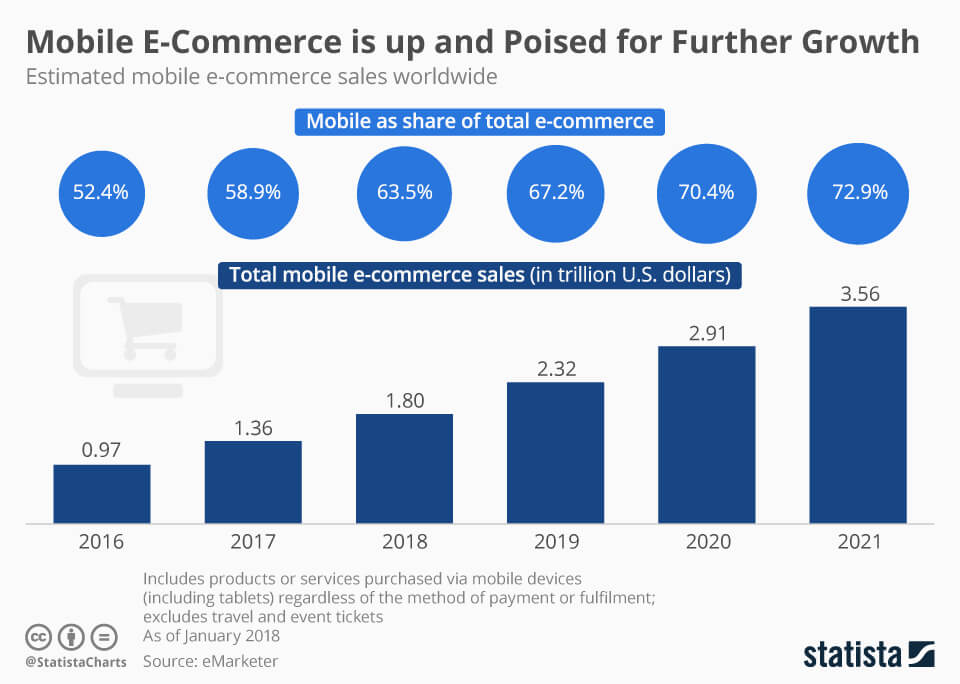
According to eMarketer estimates, retail e-Commerce sales reached $2.3 trillion in 2017, a 23.2 percent increase over the previous year. The mobile share of this stood at 58.9 percent, or $1.4 trillion. In 2021, mobile e-Commerce could rake in some $3.5 trillion and then make up almost three quarters (72.9 percent) of e-Commerce sales.
statista-facts-ecommerce

The Need

In order to democratize the on-door delivery services and to bring convenience at the doorstep of the consumers, every retailer out here looks for an extended superpower that can help them in simplifying the supply chain management, automating operations and managing deliveries.

In such exigencies, e-Commerce apps come as the biggest rescue.

E-commerce apps lure shoppers with a variety of deals, offers and a wide range of products and services to choose from, speeds up the buying and selling of goods while saving a big chunk of time. Furthermore, it minimizes the recurring cost by hiring virtual support resources and provide the customers’ flexibility to buy product 24/7 anytime anywhere.

The Business Model

1. Key Partners

  • Logistics Partner
  • Distribution Partner

2. Key Activities

  • Supply chain optimization
  • Marketing

3. Key Resources

  • Delivery Staff
  • Technology
  • Warehousing
  • IT Infrastructure

4. Value Proposition

  • Convenience
  • High-quality customer service
  • Flexible Payment Options
  • Customization and innovation

5. Revenue Streams

  • Retail Sales
  • Commission on third-party sales
  • Advertisement revenue

6. Customer Segments

  • Consumers of all ages

7. Cost Structure

  • Technology
  • Logistics
  • Marketing

key_competitors

Choose the Type of Model

1. Aggregator Model : Aggregate retailers, vendors in a mobile app/website.

2. Retail E-commerce App : Build an app/website for your own retail chain.

Key Features of an e-Commerce Mobile App

  • Customer App
  • Vendor App
  • Admin Panel

Customer App

  • Sign up/login : User can create an account with details like name, email id, mobile no., password, confirm the password.
  • Social Login : Makes the signup process convenient by enabling users to log in through their social accounts like Facebook, Instagram.
  • Profile Creation : Users can create their profile by entering all the vital information like name, email, DOB, state, country, phone number and address.
  • Find Stores : Users can find all the listed stores and search the products.
  • View Product List With Images : User can view product list with image, price and brand.
  • Search by Products, Brands and other Filters : Users can search product items, filter products (with price, brand type, ratings, & reviews), view product details.
  • Product Comparison : Users can compare product features, price, ratings, delivery time and find the best product at best rates.
  • Add to Cart : Once the product is finalized, users can add products to the cart.
  • Add Product to Wishlist : If the users want to save the product for later buy they can add them in the wishlist.
  • Coupons, Offers : Users can check and apply coupons, check offers, loyalty programs and discounts.
  • Multiple Payment Options : Users can make payment through credit/debit cards, online banking, and wallet payments.
  • Track Shipment : Users can track shipment status- if packaged, dispatched, or on the way.
  • Push Notifications : Users will get push notifications for product offers and delivery status.
  • Voice Search and Image Search : Users can also search the products through voice and image. This comes under advanced functionality.

Vendor App

  • Register/Login : Vendor/seller can register his/her business.
  • Set Up an Online Storefront : Vendor can upload his/her varied product collection online.
  • Check Active Subscription Plan : Vendor can check his/her subscription plan (active/expiry/renewal date)
  • Manage Orders and Catalog : Vendor can manage orders (receive order request, check availability, send the invoice to admin) and the catalog (add products).
  • User Review : Vendor can check user’s ratings and reviews.
  • Reporting & Analytics : Vendor can check the reports (like the number of products sold, product viewed, the frequency of visits, users’ bounce ratio etc.) and extract meaningful insights to better understand and improve business performance through strategic decisions.
  • Push Notification and Alerts : Push notifications can help buyers and sellers both by alerting users about new deals, product launch, discounts, offers and more.

Admin Panel

  • Login : Admin can log in by entering the set username and password and keep the account secured.
  • Admin Dashboard : Dashboard helps admin in checking no. of active users, no. of active sellers listed in the app, no. of active orders, products dispatched and manage them on the go.
  • Manage Products : Admin can manage products (no. of products dispatched, delivered, returned etc.)
  • Manage Buyers/sellers : Admin can activate/deactivate users registered on the app, message them personally and broadcast the messages.
  • Manage Promotions, Reward Points : Admin can manage customer reward points generation and in-app promotions.
  • Manage Payment : Admin can check the total earnings and set commission rates to be taken by the vendors.
  • Manage Referral/Invites : Admin can set up and manage programs to incentivize customers.
  • Reports and Analytics : Through reports and analytics tool, admin can drive strategic actions by extracting meaningful information from the reports generated and take necessary business action for better performances.
  • Ratings and Reviews : Admin can manage customer ratings and reviews by enabling/disabling them for certain products.

Advanced Features

  • Product search with QR codes
  • Live chat support
  • Real-time order tracking
  • Payment Gateway
  • CRM integration

tech-stack-ecommerce

The Total Cost to Develop an E-Commerce App

The cost to develop an e-Commerce app generally depends on the number of features required, the complexities involved and total hours employed in developing those features which further depends upon the per hour cost the mobile app development company charges.

Nevertheless, the tentative cost to develop an e-Commerce app costs around $27000 – $34000! Given, the app development charges are $20/hr-$50/hr.

How to Make Online Corporate Food Ordering App?

Yes! Restaurants are now turning more towards online corporate food catering services.
online-food-delivery-app-codiant
As e-commerce and on-demand delivery get easy, businesses are now bisecting their services at a more granular level. Restaurant owners, Hotel Chains, and food startups are way confident in taking online food delivery app services to prosper day by day, as people are getting more dependent on instant services.Following the same fad, the online corporate food delivery also calls out a need for creating a niche for them. This kind of specialized app platform simplifies the way companies feed their employees with healthy meals and lunch.

Types Of Meal Delivery

  • Tailored office meal programs: Tailored office meal program allows employees to customize their food by picking different dishes from the restaurant to complete their platter.
  • Order meal by choice: In this type of food delivery, employees can choose their favorite food from the long list of delicious cuisines served by the nearby restaurants and order their favorite food.
  • Daily ON-TIME delivery: If the office staff wants to have meal packages delivered at their workspace daily on their lunch/dinner time, they can choose on-time delivery. In this case, the restaurants cater food of their own menu decided by themselves with variety of different options every day. This way employee can eliminate their time to think of what to order and what not. EAT Club promptly delivers the individually packed lunches all at once to each office, 99.7% on time.
  • Dietician meal program (optional): If the employees want to follow a strict diet, he/she can consult a dietician registered on the app platform and order nutritional food as recommended by the dietician.

types-of-food-delivery

 Business Model

1. Key Partners

  • Restaurants
  • Local food joints
  • Bakery & Beverage points
  • Technology Partner (to build app & website)
  • Payment processors
  • Drivers with vehicles
  • Investors

2. Key Activities

  • Product development and maintenance
  • Hiring Drivers and managing their payouts
  • Product Marketing and customer acquisition
  • Partnering with Restaurant partners
  • Procuring food from Restaurant & local food joints
  • Receiving orders and processing food deliveries

3. Key Resources

  • Technological platform
  • Skilled drivers and logistics team

4. Value Proposition

  • Fresh and delicious meals delivered to office employees
  • A healthy meal with daily new choices to eat
  • Monthly meal packages reduce the time to think what to order
  • Gives restaurant partners fixed daily customers

5. Customer Segments

  • Office employees
  • Corporate trainees
  • Busy Professionals
  • Office Celebrations
  • Professionals wishing to give treat in-office

6. Cost Structure

  • Technological cost
  • Salary of employees
  • Advertisement and marketing cost
  • Miscellaneous

7. Revenue Streams

  • Commission from restaurants
  • Advertisements

food-cta

 How Does It Works?

  • User signs up and creates a profile or log in to the food ordering app.
  • Chooses the type of meal program. (Daily on-time delivery/Customized order)

OR

  • Chooses the type of meal delivery (breakfast/lunch/brunch/dinner).
  • User places the order.
  • Selects the payment mode. (COD/Wallet/ Credit/debit card)
  • The restaurant delivers the meal at the office.
popular-food-delivery-apps

How It Makes Money?

  • Commissions earned from restaurants: Restaurants pays the charges as per its positioning on the app platform to promote it amidst the customers. As well as the commission earned on every order is yet another major source of income.
  • Online and Offline Advertisements: Placing ads on your app platform for promoting restaurants, offers & discounts can help you earn extra money.
  • Strategic alliances with startup restaurants: Breaking a lucrative deal with startup restaurants for launching them on the app platform by charging a small fee can help restaurants gain recognition amongst the localites and help you earn a significant amount.
  • Convenience Charges: Earnings from convenience or delivery charges earned through the customers for delivering the food.

Corporate catering and business lunches are part and parcel of every industry. This new corporate food ordering portal is going to create a big room in the food industry on the grounds of profitability and opening new avenues of business generation. Seize the opportunity now and get an online corporate catering and online food delivery app developed now.

Retail Battlefield : How to Win the New Age Customers?

Failing retail companies, whether it be brick n mortar store or an online storefront, are usually over-managed and under-led, warns American scholar and leadership guru Warren Bennis. In today’s time, where exemplary customer care remains the nucleus of any business’s success, a majority of new entrants have failed to craft a stronger online proposition. To be able to plan a right strategic move and to prepare a marketing mix, the brand has to understand the core buying behavior of the customer as well as their pain points.

The Four C’s that today Customers Vie For:

Convenience: Ease and comfort of buying

Cost: Costs to satisfy

Customizability: To match their specific needs

Credibility: To put their trust upon

Studies say, 66% consumers switched brand or business due to poor customer service.

82% consumers who switched said the brand could have done something to stop them.

The Solution: Omnichannel Marketing

Hubspot defines omnichannel marketing as “a multi-channel sales approach that provides the customer with an integrated shopping experience” irrespective of the device or channel they use to interact with the brand.

Examples of Omni-Channel Brands

  • Disney
  • Virgin Atlantic
  • Bank of America
  • Oasis
  • REI
  • Starbucks
  • Chipotle

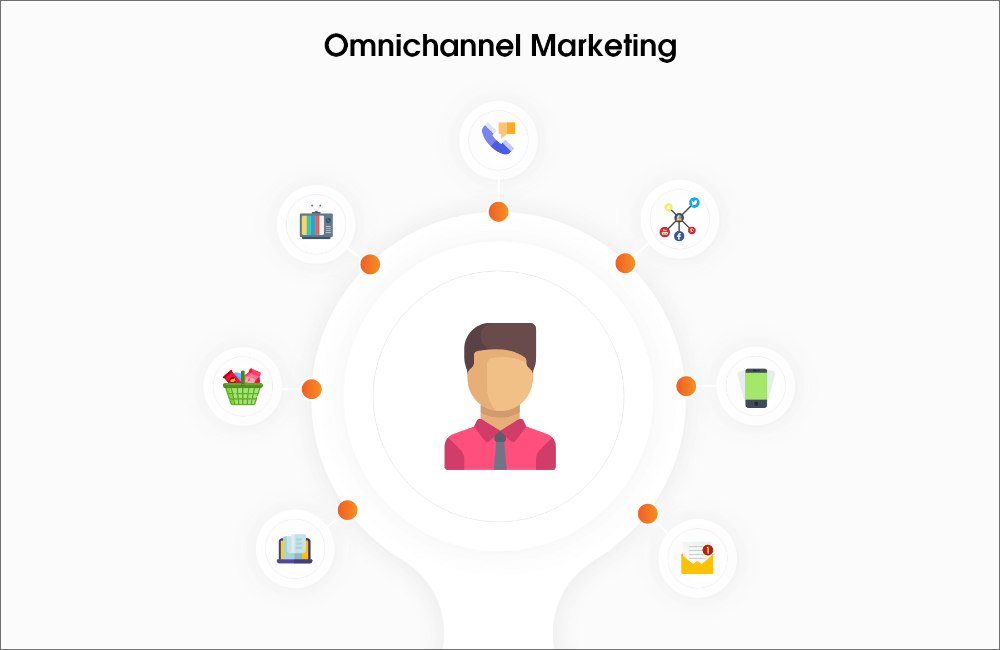
As opposed to a multi-channel platform, a successful Omni-channel initiative should be coherent across all the channels, as shown in the above graphic and should be aligned with all the multiple platforms involved in the customer journey. To achieve the synchronization between them and to execute it smoothly, the brand requires incessant coordination, empathy towards customer pain points, investment in technology and manpower, and most importantly, time.

Unlocking the Potential – Results of Using Omnichannel Strategy

How to Harmonize Omnichannel Marketing for Retail Growth?

  • Understand Your Customers Needs

As said by Laurent Simonin, CEO of Smart Traffik, explained in an email interview with Retail Customer Experience, it’s all about reducing the gap between online and offline. “A seamless customer journey comes under the influence of social media, mobility, geolocalization and the fact of being constantly connected, and provides a frictionless experience that will harmonize the customer journey, whatever the point of contact is between him and the brand/retailer,” said Simonin. Today’s customer wants to face only a single entity regardless of the channel used- app, web, store, via email or online chat. And Omnichannel makes the cut. It interlinks all the multiple channels without any breakage.

  • Understand Your Customers Needs With Data

Data and Content is the king when it comes to Digital Marketing. So in order to understand your customers gather data about them from different channels such as their in-store experience, email, social media, web, and geographical location. Extract their digital behavior, understand their channel preferences, and trace out a graph to standardize the data. After studying it, draw a customer retention strategy and figure out how you can provide personalized experiences to your customers.

  • Customer Feedback Matters

Pull out all customer feedback, analyze them thoroughly, and draw insights. This will help you to catalyze action and take the next step in crafting strategies to increase your brand engagement. If these strategies are put in a right place, it will help you in boosting engagement, increasing conversion rates, and decreasing shopping cart abandonment.

  • Create Brand Advocates

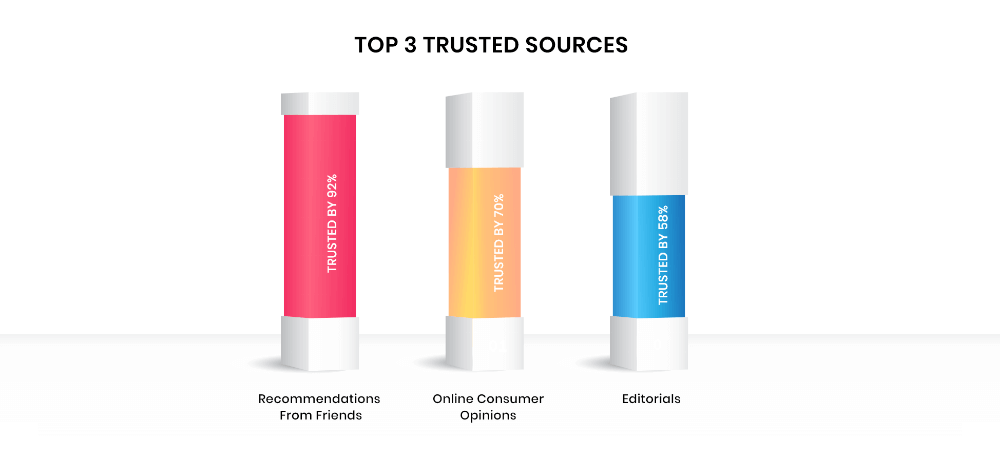
“Word of mouth” in consumer decision making is an influential source of information that plays the highest role in making purchasing decisions. According to the Nielsen Global Trust In Advertising Survey, 92% of people trust recommendations from friends. Look at the data:

MCKINSEY: While word-of-mouth has different degrees of influence on consumers at each stage of the consumer journey (Initial Consideration, Active Evaluation, Moment of Purchase), it’s the only factor that ranks among the three biggest consumer influencers at every step. Therefore, creating brand advocates that talk about products, services and experiences can help in increasing conversions as well as in improvising customer experiences.

  • Avoid Common Pitfalls

Before placing any of your strategies in place, just personally experience how people will visit your app/web/store; how they will shop, in other words, just become a customer and validate their experience and then figure out, what problems have you faced and how can you enhance the shopping experience. By gradually mastering these new touch points’ retail marketers can increasingly achieve exemplary customer satisfaction as well as stronger sales incentives.