The Ultimate Guide to Fantasy Sports App Development

The rise and rise of the Fantasy sports app is for the right reason. In a short span of time, the virtual gaming app has made people go frenzy with its spine-tingling features.

Hitting a $22.31 billion market in 2021 at a CAGR of 9.5%, the fun-tastic and thrilling online fantasy sports gaming has managed to fuel the requirement of Fantasy Sports App Development Company. Further, the market is expected to reach $38.60 billion in 2025 at a CAGR of 14.7%.

The secret glory behind such a massive adoption rate goes to a big pie of the population that follows sports religiously.

More than ever before, the surge in demand for fantasy sports apps has opened up new avenues for venture capitalists and entrepreneurs looking to stack money exponentially in a short time. Consequently, leading to an unprecedented spike in fantasy sports app development across the world.

According to a Statista survey, about 85% of gamers prefer to play games via fantasy sports app, whereas only 7% and 8% prefer to play on desktop and website respectively.

The fantasy sports app hooks rewards, cash prizes, and a rollercoaster experience that users from different age groups vie for. Witnessing this addictive behaviour, wild popularity, and massive demand, We were compelled to prepare a detailed guide that can be prove to be a treasure trove for entrepreneurs or investors planning for a fantasy sports app platform.

What is a Fantasy Sports App?

Fantasy Sports app is a fun, inexpensive, and low-energy online prediction game played on the mobile app where the fantasy gamers (person that plays the game) create a virtual team of real sports players. They earn points based on the players’ performances in real-life sports that are converted into fantasy points.

There are two types of fantasy sports widely popular i.e. season-long draft system and daily fantasy leagues (DFL). The fantasy sports platform hosts multiple sports for engagement, including Football, Cricket, Basketball, Golf, Soccer, Hockey, etc. majorly from the Indian Premier League (IPL), English Premier League (EPL) the National Basketball Association (NBA), among others. The app makes the real-time game going on the field interesting for viewers by allowing them to play and be a participant in the app.

How Do the Fantasy Sports App Function?

The app user/participant simply has to create a virtual team of real sports players with a selected budget who they think will score the most points for the selected match. Once the game begins, the individual player’s performance gets converted into points (as decided by the app manager) which in the end gets summed up to declare the result. The team with the highest points is declared as the winner of the contest. Here is a step-by-step process to start with.

  1. Join a Match: After registering or logging in to the app, the user can select the match from the available options.
  2. Build a Team: Based on the game’s requirement, user can pick the team members.
  3. Choose the Leader: After finalizing the team, the user can select the team captain.
  4. Team Division: Based on the sport’s guidelines and rules, users can divide the team where virtual players are allowed to join.
  5. Team Management: As per the game’s rule, the user can change their team members.
  6. Earning Points: Based on the match performance, the players are assigned points, and these highest total points help to announce the winner.

Why Fantasy Sports Apps are Quickly Gaining Popularity?

Since, the inception of the virtual gaming concept, Fantasy sports apps are making rapid strides and going mainstream in many countries. The increasing growth of daily fantasy sports is subjected to reasons like;

  • Let’s users participate in quick and easy real money games.
  • It offers near to real experience for sports enthusiasts.
  • Users can also participate in polls and earn bonus cash through referrals.
  • It enhances skills and interest and chucks off monotonous life.
  • It helps to build a connection with globally like-minded people.
  • It gives an opportunity to sport lovers or fans to change the result of the actual game on a fantasy sports app.
  • It also works as a brilliant community building for the fans to empathize with each other.
  • According to Statista, there were 45.9 million fantasy sports players in United States in 2019.

fantasy-app-statistics1640855778

What are the Must-have Features of A Fantasy Sports App Development?

A fantasy sports app comprises of two stakeholders, i.e., User/Participant and Admin Panel. We have narrowed down some vital features that both stakeholders’ apps require in efficient functioning of Fantasy Sports App Development.

Participants/Users App Features

  1. SignUp/LogIn Option: It is one of the primary and mandatory features of a fantasy sports app. Users can signup with an email id or phone number and password or can use social logins as well.
  2. Home Screen: It’s the first page that the user gets after signup/login. The page contains a variety of information about sports, profiles, settings, tournaments, offers, etc.
  3. Build Profile: User can manage their complete profile and perform modifications like add, edit, or delete the details.
  4. Live Score: It allows users to get the live match scores and feeds.
  5. Select Team: The user can build his team by choosing the favorite and well performing team players. To make such decisions right, users can view the statistics based on the real-time performances of each player.
  6. Join Game: This feature allows users to join the ongoing or be a part of any scheduled match.
  7. Match Result: Here users can track all of their played matches or tournaments along with their results, awards, and rewards.
  8. Match Analytics: Through this feature, the user can predict team players’ real-time performance and team’s historical data.
  9. Mail Reminders: User should be able to receive a reminder mail and notifications for events such as upcoming matches, match invites, payments, renewals, new updates, etc.
  10. Payment Mode: To make in-app purchases or retain earnings, users can exercise multiple modes of payments.
  11. In-app Chat: With this feature users can chat with their fellow teammates and other app users globally.
  12. Social Media Sharing: The user can share his match performance or updates on his social media account and can invite others to join.
  13. Invite & Earn: User can invite their friends to join the application, and on each successful joining the user earns reward.

Admin Panel Features

  1. Signup/Login: Admin can signup/login to his account through email id/contact number and password.
  2. Organize Leagues/Tournaments: Admin can organize the sporting event to attract global users to connect and play, rather than playing with their known community.
  3. Manage Results: Through this feature, the admin can keep track of the results of all the matches played and every individual earned points.
  4. Track Payment: Admin can take care of all the payment details and the user details as well.
  5. Rewards Management: Admin can maintain track of all the rewards and prizes earned by each player in all sporting events.
  6. Manage Players, Team, Matches, and Tournaments: Admin can manage all the details of players, team, matches, tournaments, etc.
  7. Notifications: The notification feature informs users about the latest updates, player performance, proposed events, daily offers, etc.
  8. Merchandise Sales: Admin can handle merchandise sales of collaborated brands and teams to generate revenue.

How To Get Started? Steps To Develop A Fantasy Sports App

Here are a few simple steps to start with a promising Fantasy sports app development.

Step 1- Define Your Fantasy Sports App Objective

To develop an app, first, you need to define your business objective and niche market, i.e., which type of fantasy sports app you are planning to build.

Step 2- Conduct a Market Research

To ensure the success of your business, it is important to perform a detailed market research. It is a crucial component of any fantasy sports app to develop an updated product with the latest features and trends.

Step 3- Select an Online Platform

There are multiple app development platforms available in the market i.e. iOS, Android, and Cross Platform. As per your target audience, earning goals, deadline and budget, you can easily decide on what all platforms your fantasy app idea will deliver the best result.

Step 4- App’s UX Design

The design of the app is the crucial step of fantasy app development. The UI/UX is the basic building block that attracts users and retains them for longer. But, the app should be simple in design, so that user doesn’t have to experience a hard time while interacting with the app.

Step 5- Coding and Database Designing

Front-end is how an app looks but the back-end development is responsible for that front-end smooth functionality. The developers will develop the user app and admin panel of the fantasy app based on the wireframes. These back-end developers sync the visual elements, features, and functionality to work smoothly. Apart from that, an app also requires a well-curated database to store all the data in a proper format that keeps it safe and secure.

Step 6- App Deployment

After finalizing and developing the app accurately, now it’s time to deploy the app on a suitable platform. When the app is deployed on the right platform, the user can find, download, and access it easily.

Step 7- Optimize Mobile App

Also known as App Store Optimization (ASO), this is the process to higher your app rank in the App Store or Play Store’s search results. Higher rankings makes your app more visible to its potential customers. So, ensure you optimize your app for the app store.

Step 8- Monetize the App

The main purpose of any app or business is to make money out of it. To make this happen, you need to monetize the app through multiple modes, such as in-app advertisements, brand promotion, in-app purchases, commission, different packages or premium subscriptions, etc.

fantasy-sports-app-development1654006862

5 Strategic Ways to Monetize Your Fantasy Sports App

  1. Participation FeesThe fantasy sports app can be monetized by enforcing the minimum participation fee. The user had to pay nominal charges to enter into any league or tournament. It can be the most prominent yet effective way of monetizing the fantasy sports app. Part of these fees can be used in defining the cash prize of the tournament.
  2. AdvertisementsAdvertisements are a brilliant mode of generating revenues, especially when the app is performing well among competitors. The companies tend to prefer such demanding and well-performing apps to market their products and are willing to pay a hefty amount to use the fantasy sports apps for the advertisement of their products.
  3. MerchandisingThe fantasy sports app can monetize their business by introducing customized merchandise, accessories, and apparel. It can also be a good marketing strategy to reach more audiences along with generating revenues. There could be a variety of merchandise related to sports, popular events, etc.
  4. Organizing Leagues or TournamentsOrganizing frequent leagues or tournaments can increase the customer base and make them pay registration or participation fees. It can also boost revenue generation along with attracting and retaining customers. These leagues or tournaments are highly engaging for sports enthusiasts, and sometimes it works like an ethical gamble to make a safe bet.
  5. Daily EventsAlmost every participant in a fantasy sports app seek instant or daily rewards. Such strategies can motivate curious players to participate and play more frequently. These daily events, award of fantasy sports app attract these types of players on the app which compels them to register on the app and pay the minimum on-boarding charges.

Major Players In Fantasy Sports Market Making Headlines

popular-apps1640855748

Cost Estimation of Fantasy Sports App Development

After analysing the features of an app and its development process, now it is important to figure out the approximate budget of the app development. The cost can be influenced by multiple factors, such as the location of the Development Company, size of the development team, the complexity level of the app, experience level of developers, quality of UX design, size of the project, project timeline, and many more.

All these factors greatly affect the overall budget of any app. So, while considering all these factors, along with the features of the app, the estimated development cost of a fantasy sports app will somewhere range around US $30,000 to $40,000.

Related post: How to Develop a Fantasy Sports Mobile App like Dream11?

Striking the Right Chord!

The fantasy sports app has a worldwide fan base and is one of the potential market segments that predicts huge growth in the upcoming times. As of now, there are many fantasy sports app available in the market, such as DraftKings, SuperDraft, FanDuel, LineStar, etc. that have covered a huge market, received good reviews, and attained credibility amidst the users.

Put simply, no time can be greater than now to invest in fantasy sports app development. Those who are interested or are planning to get into the e-gaming industry with a fantasy sports app, should not waste a second and quickly touch base with the best Fantasy Sports App Development Company that religiously develops apps that tend to go viral with its infectious UX. Not to forget, Codiant can be your best bet to develop an offbeat fantasy sports app that evokes interest on every tap.

Top 10 Benefits of On-Demand Delivery Apps Offering Better Business Outcomes

When COVID-19 hit the markets by shutting them down for almost a year-round, it was only the on-demand delivery app that kept the head above water to save both lives and livelihoods.

Right from supplying daily necessities by running errands to buy grocery, food, dairy, medicines to providing on-demand pick-up and delivery services- On-demand delivery app development was no less than a technology boon for society as a whole.

In 2020, the revenue of U.S. food delivery apps reached $26.5 billion — a whopping 204% increase since 2015. This swiftly developing sector is now projected to reach between 55% and 66% of U.S. consumers by the end of 2024, depending on how long the pandemic lasts.

The on-demand delivery industry is going through a revolutionary phase with the market showing huge prospects and attracting heavy investments.

These extremely useful apps help to match the soaring demands and supply with full ease and convenience to the customers looking for instant door-to-door services. Beyond instant service delivery, the app also helps businesses increase their online recognition, build a huge customer base with increased customer retention, and boost their ROI significantly.

If you’re an entrepreneur or a service aggregator looking to learn about the direct benefits an on-demand delivery mobile app can provide to businesses and direct consumers, then this article has got you covered.

What Is An On-Demand Delivery App?

An on-demand mobile app gets consumers what they want, when they want. An on-demand mobile app product integrates a set of features that allows consumers to make instant requests for any kind of delivery service. The app consists of majorly three user roles: Customer, Delivery Boy and Service Provider.

How Does It Work?

  • Customer browses and selects the desired product
  • Books the order
  • Track the delivery through geo-location map
  • Receives the order at doorsteps
  • Makes online payment or pays cash on delivery

Top 10 Benefits Of On-Demand Delivery Apps

  1. Makes Business Processes Easy
  2. Meets Financial Targets & Increases ROI
  3. Suitable For All Business Type and Size
  4. Help You Reach the Right Audience
  5. Collects Valuable Customer Data
  6. Gathers Customers’ Feedback
  7. Enhances Cost-Effectiveness Of The Business
  8. Offers Uninterrupted Mode Of Payment
  9. Takes The Competitive Advantage Of The Market
  10. Supports In Acquiring VCs and Investors Easily

1. Helps You In Making Business Processes Easy

Seamless customer interaction acts as a catalyst to any B2C business. On-demand delivery apps provide a perfect online platform to quickly connect with the customers looking for instant services at their doorsteps. Features like searching nearby services, online booking, calling the servicemen, multiple payment options ensure customers get full convenience in just a few taps.

On-demand delivery apps also benefit businesses to showcase their offers, discounts, and new arrivals. Thus, enabling businesses to carry out all laborious tasks online with full ease in less time and resources.

2. Helps You In Meeting Financial Targets & Increasing ROI

Mitigating the current issues & modifying everything as per the customer’s requirements is what a business needs to be successful these days. Mobile apps have become a crucial tool to satiate the ever-demanding customers. So, it’s always a worthy investment to invest in on-demand delivery apps as the app gives you full flexibility to offer custom services, make an informed decision, and tune strategy and pricing as per the current market scenario.

That said, there lies a great opportunity for all those who are running businesses like Grocery selling, food/restaurant business, service delivery, taxi services, etc. An on-demand delivery app will not only provide better ROI but also help to scale up your daily business activities remarkably.

3. Suitable For All Business Type and Size

No matter what is the scope, scale, or sector of your business, you can still choose to have an on-demand delivery app & modify it according to your niche. The customizable nature is the basic reason why this app is getting so much popularity these days.

Apart from this, multiple features can be added with the altering trends which are user-friendly to the audience.

The most popular types of delivery apps flourishing in the market are:

4. Increases Visibility & Help You Reach the Right Audience

The major part of the business revenue is invested in promotions & advertisements to reach a wider audience & spread awareness about the business which is too heavy to pocket. The on-demand delivery removes this obstacle by providing an edge to reach the right audience and a wide range of people.

So, if you are looking to invest in digital to scale your existing business operations with increased visibility, there is no better choice than an on-demand delivery app.

5. Helps To Collect Valuable Customer Data

People using the on-demand delivery apps have to onboard on the app via account login/sign up in order to avail benefits offered by service providers. This helps app owners to capture important customer details like name, mobile number, email id, address, etc.

Information like these can help businesses categorize their customers in divisions of age, location, lifestyle, behavior, and preferences. Eventually, helping them to connect their customers better by targeting them with their specific demands and preferences. Like for instance, this data can help in email marketing, providing the right offer at right time, adding customer-centric features to the app, etc.

6. Gathers Customers’ Feedback And Helps To Act On It

“If we don’t know how our customers feel, what makes them tick, or where they are frustrated …we will fail.” And it all starts with gathering customer feedback and knowing if your customers are happy with your services or where do they face problems!

On-demand delivery apps offer an in-built system of gathering customer feedback which makes the process smooth. Now, as a business owner, you will be able to find out loopholes in your services, functions which need attention. Eventually, helping you to focus on improving your products & services. In short, getting customer feedback is an amazing way to ensure quality services without investing much time & effort.

7. Enhances Cost-Effectiveness Of The Business

One of the excellent benefits of using the delivery app is to reduce the operational cost & human dependency which was not possible without digital automation. The whole process from accepting orders, resolving queries to delivery or payment can be done easily and therefore on-demand apps are termed as cost-effective to run business in this advanced technology world.

In addition to this, the on-demand delivery app also helps in cutting promotion or advertisement costs as businesses can promote offers/discounts/updates in the app itself.

8. Offers Uninterrupted Mode Of Payment

Online payment has become a popular trend, especially after the pandemic. The multiple safe and secured modes of payment offered to the customers like UPI payment, net banking, credit/debit cards, wallet balance, etc. adds convenience to make an impulsive buy.

Thus, leading to increased customer satisfaction, a better flow of transactions, increased sales and outreach to the national market, and a full stop to any kind of fraudulent activities during the purchase or sale.

9. Helps To Take The Competitive Advantage Of The Market

Carrying modifications to the app according to customers’ needs and wants becomes easy with on-demand delivery app development. Businesses lose popularity because they lack in fulfilling the customer’s demand which is essential to scale up the business.

The on-demand delivery app will help in understanding customer preferences, the demand for new products, new trends which can be easily developed in the app. Hence, investing in on-demand mobility is beneficial to take a competitive advantage, as you will be way ahead of competitors who do not have an on-demand delivery app till now.

10. Support In Acquiring Venture Capitalists and Investors Easily

Many startups or businesses fail to scale up because they do not have enough budget to spend on their trade. The on-demand delivery app is poised to attract investors progressively as the idea is market validated with high growth potential.

There are many brands that have historically lured funders showing exponential growth and raised funds to expand their operations and go global from local. Ultimately, helping app owners lead with high business growth, streamlined businesses processes, and speedy flow of other trade activities.

The Final Words:

By now you must have understood that an on-demand delivery app is a lifesaver for businesses even during the pandemic time. Businesses managed to survive even in the darkest phase of life and all that was possible, because of on-demand delivery mobile apps.

It is now your responsibility as a business to leverage the multiple benefits that come along and make a positive impact on your bottom line.

So, why wait? Take your business to greater heights of success with on-demand delivery app development.

Armed with cutting-edge technologies, Codiant has a special knack for developing apps for diverse industries like grocery and food delivery, healthcare & telemedicine, medicine and cannabis, on-demand service marketplace, fitness, and more.

How Logistics Management Software Will Transform Business in 2022

The logistics sector awaits disruption. The history of inefficiencies witnessed in the pandemic needs to be transported. Flexibility and productivity should be the heart of supply chain organizations.

Put it all together, as we write the new chapter of 2022, unlocking automation in the transport and logistics industry has become the only answer.

The logistics sector has always been a key player in connecting different national economies and cementing the way for the cyclic flow of goods exchanged globally. It is the nucleus of economic affluence and worldwide interconnection.

As the E-commerce volumes soar, automating freight flows, digitalizing every touchpoint of the supply chain to efficiently handle a gamut of operations in a cost-effective and agile way should be the first agenda of logistics CEOs.

If reports are to be believed, by the year 2024, global freight volume will surge to 92.1 billion tons owing to external factors such as cost pressure, demand fluctuation, sustainability, complex and dynamic market, and changing consumer behavior.

In such a fast-paced environment with growing transport volumes, Logistics and transport management software play a key interface for the managers in the supply chain. Giving them an efficient medium to monitor their shipments, optimize delivery routes, communicate with partners, and oversee distribution with full transparency.

With this article, Codiant- a leading logistics management software development company offers an overview of the market for transport management systems and talks on the upcoming technology trends that will reshape logistics management. Hope it helps you to gain new insights and inspires you to make technical advances.

Major Hurdles and Challenges In Logistics Industry

Lack of Coordination

The major challenge the logistics industry goes through is inconsistency and fragmentation. In the logistics and trucking sector, multiple parties are involved —right from manufacturers and storekeepers to carriers, shippers, and end-users— which makes the coordination quite a tedious process. Certainly, monitoring each activity at every touchpoint without any central control is a time-consuming process that also misses the guarantee of accuracy. This open-ended fragmentation often causes inefficiency in establishing a synchronization among multiple parties.

Blunders In Warehouse Management

Warehouse management is another concern for the logistics industry to track and manage a huge number of goods and cargo. Feasibly it is quite complicated to manage a bulk of cargo. A single stock error results into misplaced or lost goods, thus, making product stacking in the warehouse a critical process than ever.

Given the chances of errors, companies prefer adopting warehouse management mobile applications powered with barcode scanners and voice technologies to automate the products’ stacking & loading process and identify goods digitally.

Absence of Internal Communication

Maintaining smooth internal communication and building organizational trust is the major challenge for any business to sustain in the competitive market. The culture of facilitating work processes directly bears on employee’s productivity level.

Apparently, companies lack the innovation to interact with employees or train them to adopt new tools or technologies to introduce changes in the work environment. This, as a result, decrease efficiency as well as divides the strategic vision organizations look to achieve.

To overcome this prevailing issue, companies must look for logistics app development that integrates management training functions.

Not Keeping Customers Well-Informed

Honest interactions with customers increase loyalty and build long-lasting relationships. This is where typically the logistics industry fails. Customers like to have flexibility—in placing orders online or offline, door-to-door package delivery or pick up from the store, tracking the shipment anytime—in addition to the urge to have a quicker and safer delivery.

To make all this possible and provide transparency to the customer at each step, while keeping them well informed remains a major challenge for the industry. Thanks to digital technologies, logistics apps powered with CRM solutions are acting as a forerunner to keep customers up-to-date about the delivery steps.

Fleet Inspection & Maintenance

To ensure smooth cargo shipment and eliminate downtime, companies require well-maintained vehicles. But to track the condition of all the vehicles on the daily basis is very complicated to do manually. Therefore, having a centralized system to inspect, take an update and status of each vehicle from any location will make it handy.

With Fleet management solutions, companies can adhere to routine vehicle check-ups, set service schedules, and receive automatic updates in real-time.

Influence of Technology In Logistic Software Development

Meeting Customer Expectations

As we inch closer towards digitalization, customers’ expectations are rising quickly. They expect quick and flexible delivery of goods with easy tracking. In fact, they seek order delivery flexibility by changing the shipment location just after the product left the warehouse.

How to Design and Develop a Healthcare App?

The hallmark of a robust, resilient, and possessive healthcare app is its ability to become a collective solution for its most vulnerable users. Few taps, simple navigation, and no rocket science – and you are the winner!

The root of the ‘healthcare app development’ lies in better connectivity between patients and doctors. Design-thinking led strategic user experience supported with advanced technologies and third-party integrations makes this demanding task a school play.

We’re excited to share the growth formula of starting a new healthcare app development project with full ease.

10 Steps to Design and Develop a Healthcare App

As tech trends are gaining new heights with dynamic market demands, doctors and patients are relentlessly pinning their hopes on new tech-oriented features that could bridge their gap to connect with each other. In this chase for seamless connectivity, telehealth mobile apps are capturing the biggest market pie with an unprecedented revolution.

To be distinct from the competition, introducing a unique idea or developing a healthcare app is not an easy process, so let’s understand in detail how to lay down the stepping stone.

1. Identify the Problem You Want Your App To Solve

There are numerous competitive healthcare apps existing in the market, so it is crucial to analyze the market requirement and your niche expertise and then develop the app. Based on the analysis, gear up to propose the right solution to the customers through healthcare app development.

If in case, you fail to culminate the right issues, then try to answer the following questions-

  • What problem your app is addressing and how the user’s life will become easier?
  • Does your healthcare app fill the existing market gap?
  • Will your app idea beat the competition?

The mobile app industry is heavily crowded, so it is crucial to pick the right business idea to attract users. If your app fails to deliver the proper solution to the user’s problem efficiently, then you are also going to be part of the cluster, rather than being one of the market leaders.

Bonus: Some of the pressing issues of the healthcare apps that you could solve through advanced technologies like artificial intelligence, virtual reality, symptoms trackers, and training programs are:

  • Mobile healthcare apps have serious ongoing problems with “Privacy”. Confusing privacy disclosure makes it tricky for users to know the implications.
  • “Misdiagnosis” is another concern that is affecting patient-doctor relationship trust. Healthcare apps powered by AI and symptom trackers can help Doctors diagnose more accurately.
  • “Limited access to advanced clinical training” is also a matter of distress that directly impacts seamless delivery of healthcare services. This issue can be solved through online training programs.

2. Analyze Your Target Audience

“One Size Does Not Fit All”. Market Segmentation is the key. Since you are delivering the mobile app solution to the users, so it is recommended to design your products and services by studying your prospective users in the early stage only. It will help you to understand the users, the demographics, and their heterogeneous needs to define your specific target audience. A useful construct is to look at:

  • What is the location of your prospect users?
  • What preferences do they have with healthcare app solutions?
  • What demographic segment do they belong to?
  • What type of devices does your target market possess?
  • Does your target audience suffer from some chronic diseases?
  • What do they demand or expect from the healthcare app solutions?
  • What are their priorities, values, and attitudes when they go to consult a care provider?

This can also be carried out well through the segmentation of health-care consumers on the determinants of psychological, socio-demographic, and socio-economic variables. The survey will help you to align supply and demand and facilitate the selection of target groups through the right solution.

The other benefits of healthcare market segmentation are better engagement with patients and a clear approach to delivering tailored healthcare services with strategized healthcare marketing.

healthcare-market-segmentation1639043841

3. Define the Type of Healthcare App Solution You’d Like to Build

“List out, define, and scrutinize”- should be your go-to strategy! Clearly, if you are looking for the types of healthcare app solutions that seem more appropriate for your business idea to introduce in the market, then you will witness a plethora of app ideas while considering three different users i.e., Patients, Medical Practitioners, and the Administrator. To make your search easier, here we dropped down the list of such healthcare app ideas.

Healthcare App Ideas for Medical Practitioners and Administrator

  • Telemedicine/TeleHealth App
  • Remote Patient Monitoring App (RPM)
  • Doctor Appointment & Clinical Assistance Apps
  • Medication Prescription or Dosage App
  • Medical Record App
  • Professional Networking Apps
  • Medical Training Apps

Healthcare App Ideas for Patients

  • Health Tracking App
  • Medication Tracking App
  • Ambulance Booking App
  • Mental Health App
  • Medical Education App
  • Diet and Fitness Apps
  • Women’s Health Apps

4. Choose Your App Features & Advanced Technologies

Once you decide on the type of healthcare app solution, you can proceed to the development phase. But, before development, you need to jot down the functionalities and relevant advanced technologies you like to introduce in your mobile application.

Key Features of Healthcare App Development

Apart from basic features, here are the popular key features that every telemedicine mobile app requires.

  • Schedule Appointments- Based on the doctor’s slot availability, users should be able to book an online appointment and visit with the specialist from your healthcare app.
  • Real-Time Video/Audio Chat- The real-time video and audio calling feature in the healthcare app design helps patients to connect directly with the doctor on an appointed time schedule to get online consultation, discuss health issues, get treatment, and receive e-prescription.
  • Chat and Messaging- This feature enables communication through chat & messages when call interaction is not required.
  • Secure Payment Integration- Providing multiple modes of secure online payment is a good option for global patients to reach out the specialist for consultation.
  • Geolocation- This feature enables patients to find doctors, clinics, pharmacies, and medical facilities based on the location search.
  • Progress Tracking- This means storing the current and previous data to do a comparative study and track the progress. This feature is useful in monitoring heart rate, calories burn, blood pressure, sugar level, etc.
  • Third-Party Integration- The healthcare application enables to connect HealthKit, Samsung Health, and Google Fit with measuring devices, such as smart scales, smartwatches, etc.
  • Analytics, Reporting, & Charting- It is intelligent to present patients or doctors data through visual reports and charts.
  • Cross-Platform Access- Develop a healthcare app that works properly on multiple platforms and devices i.e., smartphones, tablets, and laptops.
  • Offline Mode- In offline mode users can access frequently visited pages, such as user profile, chat, medical history, prescription, etc.
  • Push Notifications- The App sends notifications to the users to remind something, or educate them about something unique such as a new feature or functionality added, A new doctor joining the panel, and many more.
  • Real-Time Update- Providing updates in applications is important for healthcare applications that regularly refresh the data to ensure better analytics.
  • Security and Privacy- Telemedicine mobile apps take users’ sensitive and confidential data very seriously, therefore such apps should have quality privacy and security features.

Advanced Technologies Included In Healthcare App Development

The advanced technologies promote innovation by maintaining the trends and status quo in today’s healthcare app development. Such advanced features significantly upgrade the user experience. Let’s find out what such advanced technologies are.

  • AI & ML- AI is a smart technology that learns from the previous activities the software performs. Hence, AI-powered apps can easily track & identify health trends, ease diagnoses, and analyze a pool of data at a time. AI & ML work side-by-side; after data analysis, the ML technology can help medical personnel improve their ability to diagnose, by suggesting the right prescription, preventive measures, along with behavioral monitoring.
  • Blockchain- Blockchain-based healthcare apps provide a secure and tamper-proof environment to store and access data. Likewise, the healthcare apps possess a lot of personal details about patients and doctors as well, which requires good quality security to prevent any type of fraud or data theft. Blockchain can perfectly match the increasing need for the security of medical sensitive data.
  • IoT- Tracking physical activities using wearable devices has become a popular method to help people better monitor their health status both at an activity/fitness level. The IoT-enabled devices are wearable health devices, smartwatches, and fitness trackers. These devices track patient’s health data and send it to the doctor, which helps the doctor to monitor the progress and suggest prescriptions without their physical presence.
  • AR and VR- AR & VR technology work simultaneously to yield the best results and are very effective technologies in the healthcare industry. Both the technologies can be used to carry out physical therapy sessions remotely, whereas doctors can also educate and train their students safely to perform a surgery. Moreover, VR is also useful for biomedical education and medical training and also assists patients in understanding their diseases through a simulated environment.

5. Choose a Right Tech-Stack

Technologies are your app’s engine. Thus, choose the tech-stack very precociously. As it can influence the features you are looking to add to your healthcare app. You can develop a native or an Android or iOS-specific application.

This decision depends on your target audience’s device usage. So, keep in mind your users while developing the healthcare app and support different screen sizes as well, such as smartphones, tablets, and laptops/computers. These devices ensure quick and instant access to the app.

For Healthcare App Development, the following technologies are recommended:

  • Programming Languages- Kotlin, Swift, PHP, Node.JS.
  • IDE- Xcode, Android Studio.
  • Application Framework- Ruby on Rails
  • JavaScript Framework- React Native
  • Automation Framework- RSpec, Capybara
  • Cloud Storage- Amazon S3
  • Database- PostgreSQL, Mongo DB, Redis, MySQL
  • Utilities- Google Analytics, Visual Website Optimizer, Mixpanel
  • Payment Gateway- Stripe, Paypal, Braintree
  • Deployment Platforms- Cloud, iOS Native, SaaS, Android Native

6. Research Privacy & Compliance Issues

The patient pool is continuously rising. So, is the sensitive medical data! Therefore, it is extremely crucial to address this alarming issue of privacy leakage in your app. While developing a healthcare app, make sure you comply with data privacy and medical regulations.

And In order to ensure the patient’s data always move to and fro in the app in a secured format and through a secure connection path, comply with the country/regional industry’s privacy regulations.

Like if you are developing an app in the US, then the personal health information should be protected by HIPAA. In European Union, the app needs to be compliant with General Data Protection Regulations (GDPR) and In Canada, you must adhere to regulations of PIPEDA (the Personal Information Protection and Electronic Documents Act) Likewise, The UAE Ministry of Health (MoHAP) for UAE.

Related Reading: What is HIPPA Compliance and Why is it Important for Healthcare Organizations?

7. Design UI/UX of Healthcare App Considering Users Requirements

Introducing a striking UI (User Interface) and effortless UX (User Experience) design is important for telemedicine apps’ success. A great UI/UX keeps users involved, attracts more users, and promotes trust in your product and services.

Such apps are frequently used by doctors and patients and they tend to invest a good amount of time along with providing sensitive and personal details. So, make sure to create a simple and easy-to-use app that does not take a cognitive toll on the user’s mind.

Consequently, avoid implementing complex designs that need high mental efforts, instead, promote a simple app. As, in vulnerable states, patients might struggle to use the app or in the worst case could stop the app usage and adopt a traditional mode of treatment.

To avoid such scenarios, it is suggested to implement a smart and user-friendly interface that drives patients to exercise all the services the healthcare app is offering in a hassle-free way.

8. Hire the Right Healthcare App Development Company

After analyzing all the aspects of healthcare app development, now it’s time to hire an experienced healthcare app development company with an expansive portfolio. Not every development team can accurately take your business idea on-floor. So, look for the right technical skills, expertise, and most importantly the experience in this domain.

To develop a detailed and quality product, a team of professionals is required who have already developed a series of successful healthcare mobile apps including telemedicine/telehealth, online appointment booking, doctor on-demand, remote patient monitoring apps, etc. Aim to hire the best healthcare app development companies, because they are experts on their craft and can help you to formulate strategies in a guided manner and can also suggest the latest trends and technologies whose demands are going to escalate in the near future.

9. Perform Testing and Quality Assurance

Before deploying the healthcare app in the market, it is essential to test the developed product and ensure the quality of the finished app. The Quality Assurance (QA) are specialists, who are responsible for maintaining the app quality while keeping the end-user in mind.

Apart from that, QA check also ensures that the app complies with the data security and follows the healthcare norms and regulations. Thus, to maintain the quality multiple types of testing can be performed by QA, such as A/B Testing, Black Box Testing, Alpha Testing, Beta Testing, Unit Testing, Acceptance Testing, and many more. Quality Assurance is crucial for an app because it identifies all the issues that must be resolved before app release.

10. Product Release and Continuous Support

After testing and debugging the healthcare app, now it’s time to deploy it on the relevant platforms i.e., App Store, or Play Store, or on both. Deploying an app is also a critical step because these platforms have norms that an app must follow. However, an expert healthcare app development company is aware of all that and can carry out product releases smoothly.

Once the app is deployed on respective platforms, you are not yet done with the development companies. Your app still requires continuous support to maintain the quality of the app and sort out any real-time technical issue, if arises. This phase also includes the introduction of app updates, which depicts that regularly your app has something new to offer to its users.

Develop A Healthcare App That Works for Your Target Market

The healthcare mobile app has a bright promising future due to its escalating market demands and increasing dependency post COVID. Therefore, to build a successful healthcare mobile app, the patient’s best interest should be the top priority.

If you are looking for a customized healthcare app development but experiencing a hard time finding the healthcare app development company, then don’t worry, now you have landed at the right place. Codiant has a team of experienced healthcare app developers and is ready to execute your idea and take it on a competitive level.

How to Develop a Bike Taxi App

On-demand bike taxi apps- the fresh addition to urban commutes is increasingly gaining popularity in the hustle and bustle of highly-populated cities like Vietnam, India, Cambodia, etc.

Hailed as a cheaper and faster alternative to taxi booking apps; the Bike taxi app development solution has emerged as a lucrative business investment idea.

Ease of riding bikes in the congested traffic, low incomes of a rising middle-class family, and the reduced riding rates are the key drivers of success in the Asia Pacific Taxi Market.

As per Statista, the estimated revenue of the ride-hailing market is expected to show an annual growth rate of 11.02% that means the projected market volume will grow to US$ 392,580m by 2025; with 48% of total revenue to be generated alone by online sales.

This soaring market of bike taxi software definitely calls for a post that dives in-depth into the tried, tested, and successful way to develop a market-leading bike-taxi app.

Let’s quickly get started!

How Does A Bike Taxi App Works?

After successfully registering on the app, the bike taxi app works in 3 simple steps:

  1. Passenger enters a pickup and drop off location(Views estimated trip fare with the time of arrival)
  2. Taps on ‘Book a Ride’(Passenger receives the driver’s detail, estimated trip fare with time of arrival)

    (The biker accepts the ride request and reaches the pick-up location)

  3. As soon as the trip ends, passenger pays the bike rider via m-wallet, card, or cash.(The passenger can rate and review the overall ride experience)

Top Market Players of Bike Taxi App

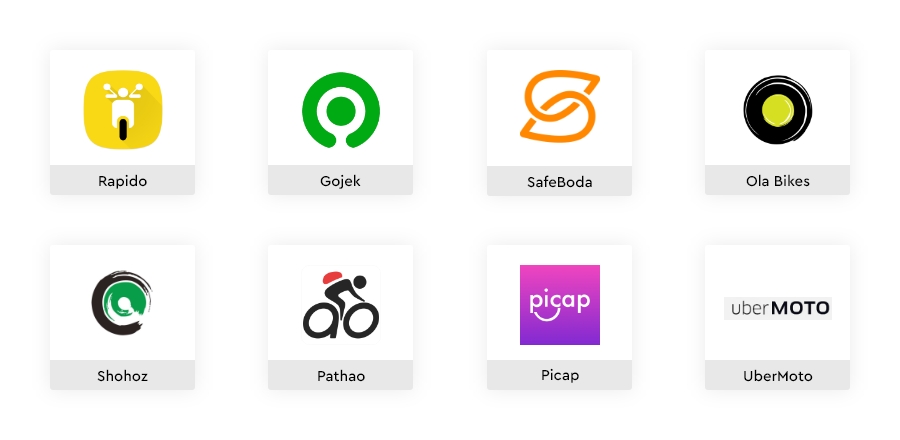
bike-apps1638445309

  • Gojek An on-demand bike and taxi booking app platform offering ride-hailing and hyperlocal delivery services for consumers and businesses. Founded in Jakarta (Indonesia), Gojek is also hailed for offering on-demand delivery services of food, groceries, and packages.

    Note: This can be your 2nd USP if you look to add value to your bike taxi app development solution.

  • Rapido Rapido is India’s leading bike taxi app available for both Android and iOS app platforms. Power-packed with features like GPS, insured rides, real-time tracking, multiple payments, and more, Rapido has established a dominating presence on the streets of India. Rapido is founded in Bangalore (India) and is currently running in more than 100 cities with 25 Million+ app downloads.
  • Ola Bikes Ola Bikes app is the most popular ride-hailing service in India that offers a well-protected ride with top-of-the-line features like multiple payment options including Ola money, real-time tracking, secure OTP for every ride, Ride scheduling, corporate rides, and more.
  • UberMoto UberMoto is a unique personalized bike service launched by Uber. The app allows users to book bikes and scooters and match shorter distances from point A to point B; which also includes last-mile connectivity.
  • SafeBoda Safeboda is an Africa-based on-demand moto-taxi booking app that works on the ethics and social mission of safety, reliability, and trust amidst the driver and passenger. With Android and iOS app platforms, the SafeBoda app provides a safe, more convenient, and mobile-first alternative to urban transportation for Africa’s flourishing population.

The Must-Have Features in a Bike Taxi Software

There are 3 major stakeholders in the bike taxi app development solution that makes the ride-booking process seamless and easier for both rider and driver.

  1. Rider/Passenger App
  2. Driver App
  3. Admin Panel

Rider/Passenger App

  1. Easy Onboarding The rider should be able to quickly register in the app through mobile number, social accounts, and email id.
  2. Request a Ride Riders should be able to book a ride with a few taps i.e. simply by entering the pick-up and drop-off location.
  3. Maps Integrate maps for live route tracking, location visibility, and matching pick up and drop-off locations.
  4. Multiple Payments Mode Riders should get multiple payment options such as cash, card, digital wallets, and UPI payments.
  5. Push Notifications Riders should be able to get real-time alerts for updates like driver arriving, reached, offers, promotions, etc.
  6. Trip History Allow riders to check the previous booking history made through the app.
  7. Contact Driver Riders should be able to contact the driver for pick-up coordination.
  8. Rate and Review By enabling user feedback on the app you can increase the positive evaluation rate and increase engagement.
  9. Offers and Promos Offers and promo codes lure users to book rides. It’s a good way to increase your app installs and ride bookings.

Driver App Features

  1. Easy Registration Drivers’ registration should include a collection of all necessary documents like scanned copies of driving license, photo, vehicle insurance, etc.
  2. Set Active Status Give drivers the flexibility to operate part-time or full-time, go for a break when they want. All this can be done by allowing them to set their active status through toggles of online/offline.
  3. GPS Navigation A great pick up and drop off happens only when the driver reaches on time. Thankfully by integrating GPS navigation, you can enable drivers to track the optimized pickup and drop off route of customers on live- maps.
  4. Track Earnings Drivers are motivated by an income target for sure. Allowing drivers to track their daily/weekly earnings helps them to set their monetary goals and maximize productivity to reach goals.
  5. View Ratings Ratings are always seen as a performance report for Admin as well as the Driver. After each trip, as the rider rates the driver based on their trip experience, drivers should have the opportunity to view the individual ratings sent by the particular trip or person.

Admin App Features

  1. Interactive Dashboard Admin should have a bird’s-eye view of all the ongoing rides, total earnings, total active riders and drivers through an interactive dashboard.
  2. Manage Drivers Admin can add/remove drivers, see their personal details, message them personally, or broadcast messages to all drivers.
  3. Manage Customers Admin can activate/deactivate customers, access their contact details, book a ride on behalf of them and send them messages.
  4. Manage Notifications Admin should be able to manage the notifications to be sent to drivers and passengers.
  5. Manage Offers Admin can set offers, promo codes and discounts and incentives to referral rides.
  6. Manage Reviews Admin can manage reviews submitted by riders and take action on them like reading, replying, and removing.
  7. Manage Earnings Admin can check total daily earnings, manage the mode of payments and check earnings made by individual drivers.

taxi-cta

Total Cost To Develop A Bike Taxi App Development Solution

The total cost to developing and maintaining a Bike taxi management software ranges somewhere between USD 20, 000- USD 40,000.

However, there are several factors that decides the cost of creating an app product. Since serious mobile apps require a strong conceptual foundation, there goes an excellent ecosystem involving top talents in-app project planning, designing, and engineering. Therefore, the true cost to bike taxi app development bifurcates into different phases performed by the taxi app development company.

The activities that include major cost breakup are:

  • Project planning and management
  • UI/UX prototype development and designing
  • iOS and Android app development
  • Quality assurance and testing

Perhaps, the most important foundation to gearing up for all these points and creating a great taxi app is doing your research. Take the time to make sure how your app will play out in both long-term and short term. As per the research, draft your app-building strategies.

Bonus!

Need help in-app research and planning? Competitor assessment and strategy building? Don’t fret. You’re at the right place. Codiant is your end-to-end mobile app development partner having strong expertise in building bike taxi app software and other leading on-demand mobility solutions. Connect with us for a quick app demo that exactly matches your requirement. Let’s together build a great story of your brand.