How to Make An App Like Swiggy and UberEats?

Millennial and Middle age people have settled into the reality that only food delivery apps connecting an extensive range of restaurants, hundreds of cuisines and the flexibility of secured online payment system can delightfully make the way to their stomach.

On the same fervor for Food Delivery App Development, the industry is blooming digitally and made it almost mandatory for every restaurant to get registered in the app those lacking online presence. Apps like Swiggy, UberEats, JustEat and Grubhub seems to have captured the market and set themselves as a statement of a quintessential food delivery app.

If you are a business scrambling to find how food delivery app like Swiggy is created and operated here is your go-to guide.

swiggy-uber-blog

Types of Food Delivery Business Model

A. Aggregator Business Model

In this type of model the Middlemen or third party handle the customers and restaurants, make the restaurants their partners, and sell their services under their own brand. The app in this model allows user to log in into the app, view menu items, pricing restaurant details, reviews and feedback. The user can order the item and the delivery is handled by the delivery boy of restaurant.

B. Food Delivery System With Logistics Delivery Service

This model provides complete logistics support to restaurant partners thus, helping small startup restaurants, food joints and store fronts to manage their operations seamlessly. Also, it becomes a great help to restaurants who can’t initially afford the expenses of logistics operations.

Apps like Swiggy and Ubereats runs on the same food delivery model.

Swiggy Business Model

The Swiggy operates its business on hyperlocal business model. That means the food delivery company aggregates restaurants as well as delivery fleet which collects the food from restaurants and deliver it in less than 30 minutes.

The business model works in four steps:

  1. The app allows users to search nearby restaurants or cuisines.
  2. Place an order by opting mode of payment (online or COD).
  3. Restaurants receive the order from Swiggy and they make the order ready to deliver.
  4. Swiggy’s Delivery boy collects the order from the restaurant and deliver it to the customer.

Swiggy generates revenue from the following sources:

  1. Commission from Restaurants : Swiggy earns its major part of revenue from Restaurant Commission for serving as their delivery partner and featuring them on their app that helps them in gaining popularity, get more orders, and make new customers.
  2. Delivery Charges : Swiggy also earns from customers by charging them delivery fees on orders below a certain threshold and certain other conditions such as distance, high order demand, and extreme weather condition.
  3. In-App Advertisements : Other secondary but major sources of income of Swiggy comes from Advertisements. The company earns from promotional banner ads and priority listing on Swiggy app featured by restaurants to earn greater visibility and more orders.
  4. Affiliate Income : Nowadays, apps like UberEats and Swiggy also earn from affiliates like banks and financial institutions by luring customers to use their credit cards in exchange of offers. This way banks can easily sell their credit cards to customers.

Swiggy Competitors

Swiggy is in direct competition with major on-demand food aggregators like Zomato and UberEats. Whereas, other small food-delivery startups like FreshMenu, Foodpanda, and Licious also make in the list.

On-demand Food Delivery App Features

A. Customer App

  1. Easy Registration : Customers should be able to easily register in the app through email id, or mobile no. verification and password.
  2. Customer Profile Management : Customers should be able to manage their profile by entering important details like name, address, phone no, email id, etc.
  3. Search By Area And Current Location : This user-friendly feature will allow customers to search restaurants located nearby their current location and saved addresses.
  4. Choose Your Cuisine : Customers can discover nearby restaurants as per their favorite cuisine.
  5. List Of Restaurant Based On The Area Search : In this feature, based on the areas entered by the customer a list of restaurant is displayed. Clicking upon it, customers will be redirected to restaurants website or individual page.
  6. Place Order : Customers can easily place order by adding the selected cuisines or dishes into the cart.
  7. Apply Coupon : Customers can check the offers, coupon codes, discounts given by the restaurants and redeem them at the time of making payment.
  8. Review : Customers can check the reviews and ratings given by the customers to the restaurants for their services, quality of food, and hospitality.
  9. Select Delivery Choice : Customers should be able to select takeaway or delivery option based on their choices while ordering food.
  10. Secured Payment Integration : Customers should be able make their payments using secured payment gateways like credit/debit card, UPI, mWallet or COD.
  11. Push Notifications : Keep customers informed by sending them the status of delivery like when the order is prepared, packed, out for delivery, and on the door.
  12. Track Delivery Boy : Geolocation integration to track the real-time location of Delivery boy from the restaurant to delivery address.

Read also: Unveil the Most Crucial Features of Online Food Delivery App

B. Restaurant Owner App

  1. Instant order notification : As soon as the customer places order restaurants will receive instant notifications so that they can process the orders quickly.
  2. Assign order to driver : Restaurant owners can assign single or multiple delivery orders to drivers.
  3. Check Order list : Restaurant owners should get order reports to analyze the sales including total customers, total orders and total revenue generated.
    • New Order list: An overview of new customers placing orders can be fetched.
    • Accepted Order list: Orders accepted by the restaurants can be extracted.
    • Delivered Order list: All the orders delivered to the customers are displayed.
  4. Set Order Status : Restaurants can accept/cancel order received by the customer.
  5. Order History : Restaurant owners can track and analyze their business performance by checking the order history and reports of daily sales.
  6. Restaurant Profile Management : Restaurants can create profile, manage addresses, change password, and logout.

C. Delivery Boy App

  1. Registration : Delivery boy can register by entering the email id, personal details and password.
  2. Accept Bookings : Delivery boy has the controls to accept/reject new booking requests.
  3. Route Optimization : While assigning delivery, the app picks the nearest delivery boy and assigns the shortest & fastest routes for on-time delivery.
  4. Manage Status : Delivery boy can update the status of an order placed like order picked up, on the way and order delivered.
  5. Booking History : Delivery boy can easily check the completed bookings.

D. Admin Panel

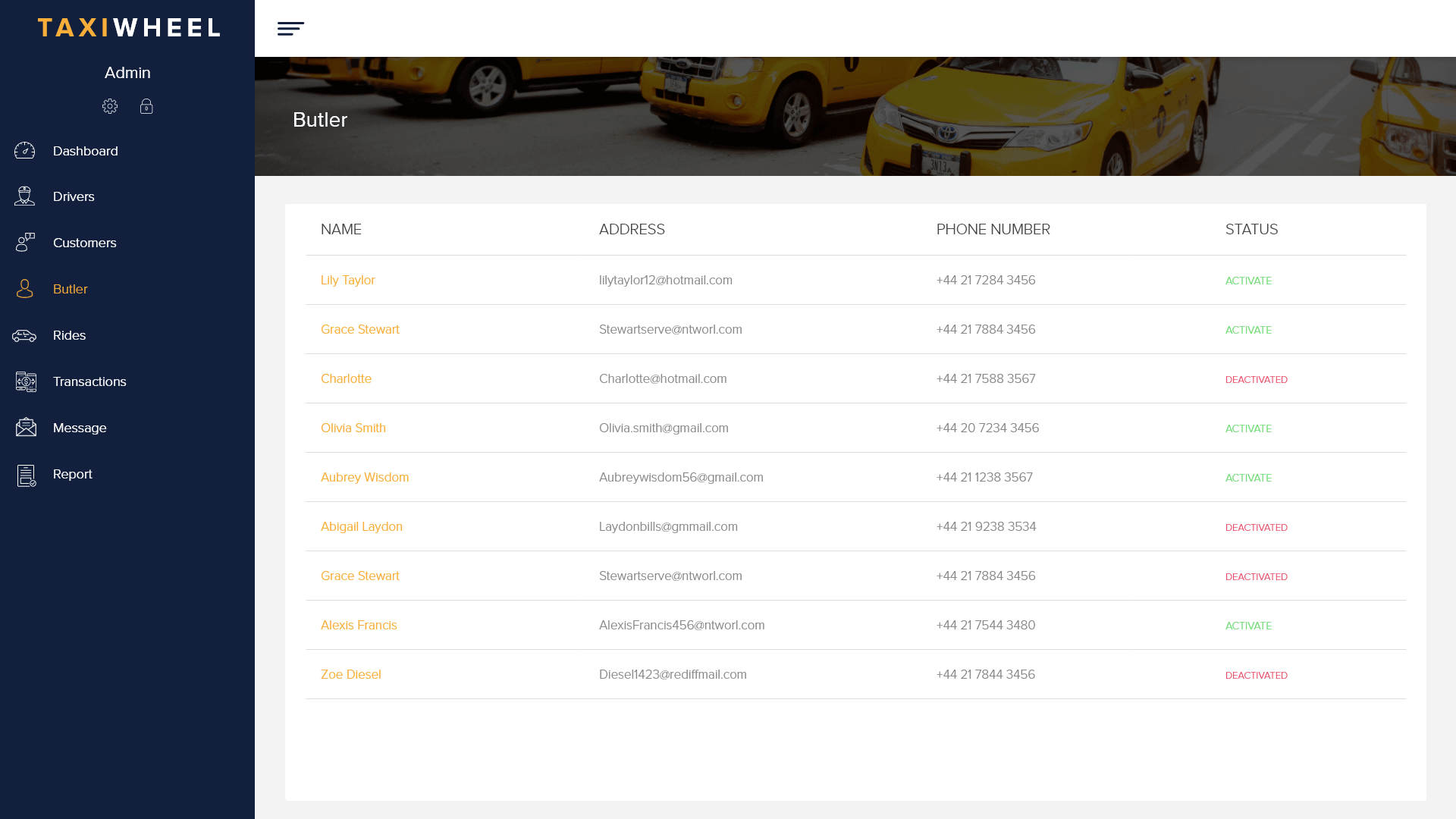
  1. Admin Dashboard : Through dashboard admin can view total orders, commission earned, total sales and daily turnover.
  2. Category Management : Category management allows admin to search based on the categories like keywords, status (active/inactive), item description etc. Admin can also update them by adding and editing new categories.
  3. Manage Restaurants, Customers and Drivers : Admin can manage and add new restaurants, menu, offers, and reviews. Likewise, Admin can also manage customers’ information with an option to activate/inactivate customers.The admin can add, manage and reassign Drivers.
  4. Manage Location : Admin can manage countries, state, city, area/zip code.
  5. Reports Management : Report on sales per month/per week and orders per month/per week can be extracted by Admin.

Challenges Faced While Entering In The Food Delivery Market

1. Fierce Competition

The food delivery industry is already a crowded space where new entrants have to face stiff competition from the giants like Swiggy, UberEats, Zomato, and other local competitors. These giants are in the market for a long time and have acquired a huge customer base, hence leaving a tiny room of scope for the new players. It is one of the greatest challenges for new businesses to build a good business, gain market traction, and customer response.

2. Finding Partnering Restaurants

Identifying and partnering with the right restaurant partner requires a lot of effort, time, and local market study. Associating with renowned and quality restaurants and listing them on the platform will support to design a good brand image. But, the challenge is to find and filter the right food outlet from the plethora of options. In addition to that, introducing a straightforward restaurant onboarding process can also give a push to restaurants to get associated with the food delivery app platform and diversify their business presence.

3. Deciding the MVP Features

The analysis of existing competitors and the prospect of restaurant businesses that can be associated with the platform can help to decide which MVP features can be added or excluded in the final version of the app. The MVPs of any product can heavily influence to deduce the cost of food delivery app development. Apart from that, the food delivery app development company or agency can support precisely in defining the features and cost of the app, which would help to raise a highly effective business.

4. Finding a Reputed App Development Partner

Finding the right tech partner that can convert your business idea to a fully-functional live app is quite difficult. A detailed interview and a number of industry and project related questions needed to be asked before hiring a food delivery app development company. So, despite getting into a rush, take the time and find a suitable partner to take your dream into reality.

Things To Consider To Create An App Like Swiggy and UberEats

1. >Easy and Attractive User Interface

A food delivery app should be easy to navigate for users, as the partnering businesses are taking their processes and the entire hotel/restaurant on the app. Likewise, the app should be attractive and easy for users to move from one page to other. Such convenience will make user to return back and enable restaurants to earn loyal customers and build a competitive business.

2. Multiple Device Support

An app should be adaptable to a great variety of devices, in terms of screen sizes and platforms. It is an easy way to grab a wide range of users, as they like to place an order through mobile apps and websites. Such convenience will make user return back on the same platform to place their new order or explore the platform for other options.

3. Quick Data Accessibility

Quick and easy accessibility of all the available data on the platform is the major deciding factor to ensure the users stay and return back. Thus, make sure the data is well-organized and easy to access different restaurants, dishes, menus, and delivery details. These facilities enable the user to place orders effortlessly and engage users in the right manner.

4. Secure and Multiple Payment Methods

In a food delivery app, payment is one of the tedious processes for one, but it can be eased by providing a digital mode of payment. As a requirement, the platform can integrate multiple methods of payment to facilitate a wide range of users instantly. The multiple payment methods provide a sense of security and confidence in the user, which supports building a long-term relationship.

5. Provide Rewards and Offers

Every user appreciates saving a few bucks on their order, this makes their food tastier and turn up a happier user. So, providing offers and rewards is one of the secret ingredients to building a successful and competitive food delivery services platform. These pocket-friendly deals and offers can engage more users with time.

6. Push Notification

Push Notifications are the widely accepted and diversely practiced feature for any online business to engage more users and build a competitive market. This feature makes people aware of the latest introduced offers and services by boosting a personalized experience.

Technologies and Development Team Required To Shape An Online Food Ordering App

As per our experience and industry expertise, we’ve singled down the requirement of technologies and development team required to build a food delivery app like Swiggy and UberEats.

Technologies Required

  • Programming Language- Kotlin (Android) and Swift (iOS)
  • Back-End Development- JS
  • Payment Gateway- PayPal, Braintree
  • Push Notification- Amazon SNS, Firebase Cloud Messaging
  • Mailing Service- Amazon SES
  • Navigation- Google Maps, Google Places API
  • Social Media Integration- Facebook SDK
  • SMS Services- Twilio
  • Restaurant Listing- Grubhub API, FourSquare API
  • Cloud Storage- Amazon S3
  • Database- MongoDB, Redis
  • Analytics- Google Analytics, Mixpanel

Development Team or Required Resources

  • Project Manager
  • UI/UX Designer
  • Business Analyst
  • Android Developer (2)
  • iOS Developer (2)
  • Front-End Developer
  • Back-End Developer
  • QA Engineer

Swiggy Marketing Strategies

Majorly, Swiggy uses online marketing campaigns for its promotion on various social media platforms like Facebook, Twitter, Youtube, Instagram and Pinterest.

Some of its campaigns include:

  • #Secondtomom
  • #DiwaliGharAayi
  • #SingwithSwiggy

Swiggy’s regular update on Facebook is another marketing effort that opens the gate to customer engagements through promotional offers, giveaways, and for handling customer grievances.

Swiggy and Zomato Marketing Efforts During COVID-19

swiggy-zomato

In the wake of increasing demands for daily essentials being unmet by disrupted supply chains, food delivery apps like Swiggy, Zomato, Grofers, Dunzo are capitalizing by moving from multinational to hyperlocal. These market players are scheduling pickups from local stores, running same day delivery model, offering contactless and cashless delivery. Thus, providing convenience and safety to consumers.

Some of the ways that are helping these unicorns gain tighter grip on consumers are:

  • Doorstep delivery of Alcohol or Liquor
  • Partnering with FMCG firms for delivery of Grocery and other essentials
  • Tie-up with wholesale establishments that don’t often supply walk-in customers
  • Leveraging the under-utilized labor for smoother product deliveries
  • Enters the cloud-kitchen concept or plug-and-play kitchen space

Having said that, these unicorns are competing fiercely even in these challenging times and hitting all the right notes by foraying into the hyperlocal market.

Cost to Create an App like Swiggy and UberEats

App Development for the Customer

The customer-based app mainly comprises a dish catalog or services to grab the user’s attention. The user interface of the app design should be straightforward and easy for the customers.

The basic and must-have features of the customer app, includes user registration, placing order, different payment methods, order tracking, delivery time estimation, review, and simple yet attractive design. Such food delivery apps are usually average in complexity and the development costs for these types of apps could be $20,000 to $30,000 or more.

App Development for the Restaurant

The restaurant app development is for managing orders and authenticating the user. It is a simple app with the functionality to approve the order, meet the special demands of the customer, and deliver the order. Apart from that, the restaurant app user can modify their menu, access complete delivery details of the customer, track all the upcoming orders and ensure timely delivery.

To develop such an app with a user-friendly design and easy navigation, the average development cost could be about $6,000 to $10,000 or more.

3. App for Delivery Only

The delivery app development is for tracking the order status and ensuring the right and timely delivery. The functionality includes agent registration, order status, and order management- all such features that can be helpful to carry out the order successfully.

To develop such a feature-rich app that facilitates timely and accurate order delivery, its average development cost could be about $8,000 to $12,000 or more.

Overall Development Cost of A Food Delivery App

After analyzing the average cost of all the stakeholder’s app development, the estimated cost of food delivery app development could be around $35,000 to $50,000. This variation in the cost occurs under the influence of various factors and most importantly is due to the addition of features and custom features, as per the requirement of the client.

If you are into restaurant business or any food delivery business, or just an aggregator thinking of on-demand food delivery app development, Codiant can be of your great help for value-added technological solutions and cutting-edge marketing strategies.

How to Make an App like Musical.ly/Tiktok

Music and videos making apps are apparently slaying youth and millennial so far, being specific it has become the ticket to glory for 20’s kids.

To retrospect, the time where more than three-fourths of youth binged on TV shows and Spotify to groove to an endless mix of music, have now taken a leap to bring themselves to light via popular social video networking app TikTok (previously Musical.ly).

Musical.ly is a video network app, where users (aka musers in app) can create 15-seconds videos single/duet by lip synching and dancing along to the musical clips embedded in the app or uploaded by themselves and share with the musical.ly community. It gives you the option to create the videos with your BFFs or people you follow and who follow you back.

What defines Musical.ly+TikTok?

Musical.ly which was launched in 2014 by Alex Zhu on Play store and App store had more than 100 million active monthly users, which is now taken over by Chinese video platform TikTok. In China, the app is known as Douyin and has over 300 million monthly active users, much bigger than Musical.ly’s reach.

Whilst TikTok is based around users uploading short videos of themselves, like good old Vine used to do, it doesn’t have the emphasis on music and songs like Musical.ly did.

Since both of the apps shared a common mission of capturing the world’s creativity and talent and give them a platform where they can create, share and treasure their precious creations, talent and act. They decided to combine musical.ly and TikTok and gave it an umbrella term “TikTok”.

Competitive Analysis

Upcoming Competitors

Facebook is developing a singing contest feature to rival musical.ly

If thenextweb reports are to be believed, Researcher and code-breaker Jane Manchun Wong found a code which indicates that Facebook may introduce a ‘Talent Show’ feature where users would make use of Facebook’s recently added music partnerships by recording themselves singing and submitting their audition for review amongst other users on the platform.

tiktok-competitors

How to Use The Tiktok App?

  • Open Tiktok app
  • Tik Tok opens up to a stream of uploaded, popular videos.
  • Tap the white + icon at the bottom. This button will allow you to create and post a video on your profile.
  • Select a soundtrack for your video. Start shooting.
  • Post the video.

Features of Tiktok

  • Simple and non-penalizing UI
  • Create and edit profile
  • Likes are given in the form of Hearts
  • Live-Ops – Hashtags, Challenges and Search feature
  • Tools for Expression- contains filters and AI effects
  • Social Feature- Duets
  • Discovering the “Original Sound” posted by user
  • Follow and unfollow People
  • Explore by hashtags, discover featured stuff
  • Watch an endless stream of recommended videos

How to Earn Money Through Music/video Apps?

  • In-app purchase : By facilitating the sale of products or services, by allowing users to unlock the premium versions, advanced features in the app you can earn good amount of money. Tiktok uses in-app purchases for raising money.
  • Fundraising : You can find angel investors for injecting capital for your startups in exchange for ownership equity or convertible debt. Beijing Bytedance Technology (Tiktok developers) is angling for a $3bn round that could value it at $75bn.
  • Advertising : Ads are an effective and easy way to earn revenue from your apps. You can maximize your revenue from in-app advertising like cost per click; cost per install.
  • Selling it : By making your app popular, gaining an apparently large number of followers you can make a good worth of your app.

The Cost to Create an App like TikTok

The total cost of developing a music streaming app depends upon the functionality and features you incorporate and the number of complexities involved in the development. Furthermore, the cost also depends on the following factors:

Or You Can Be Charged for The Following Criterions:

Related reading : How to Develop Best Alternatives of Banned Chinese Apps?

Create an App like Tiktok from Codiant

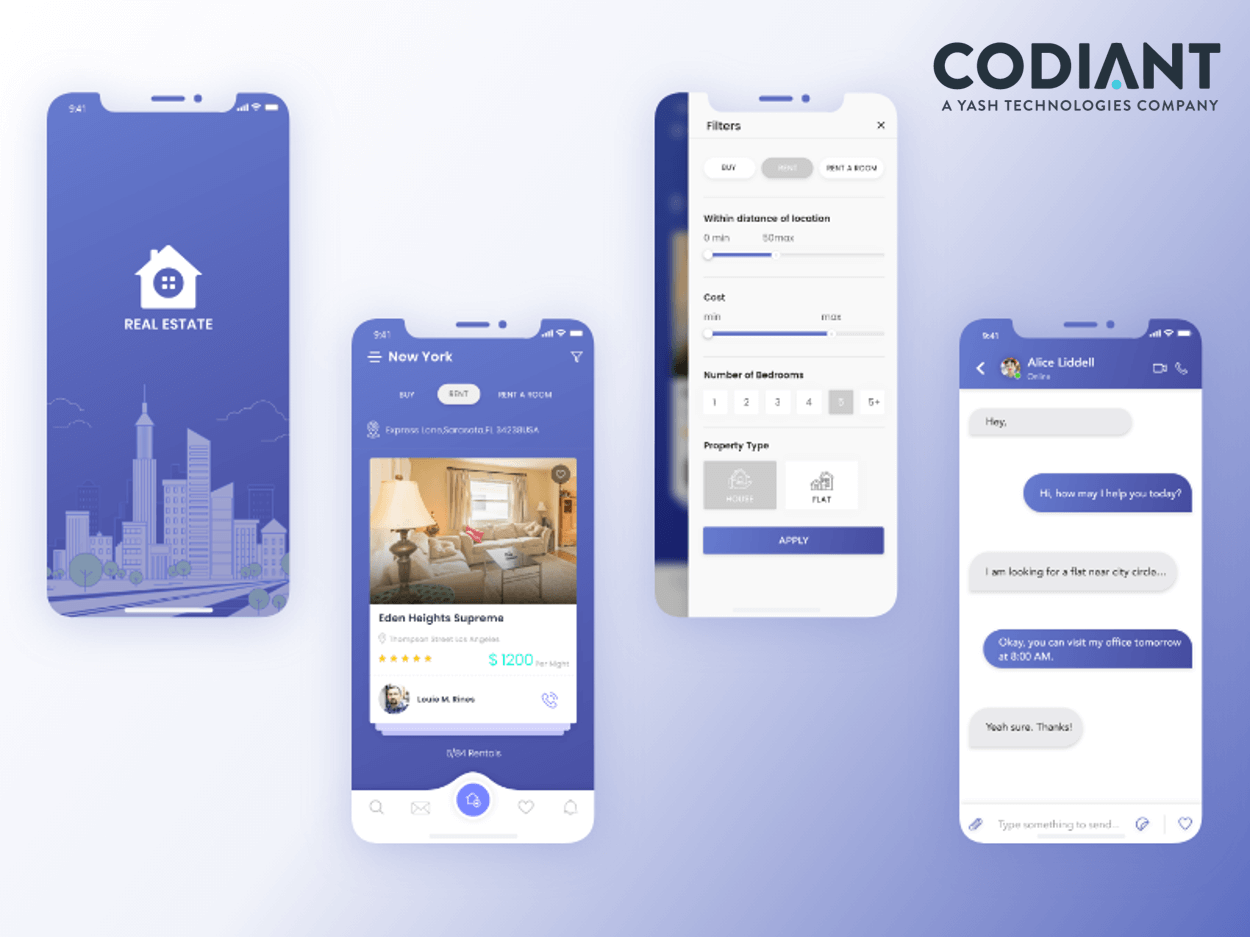
Cost and Key Features to build a Real Estate Mobile App

real-estate-app-codiant

Real estate business, as a matter of course, has typically been a game dependent upon the bit of luck, hard-work, changing trends and shifting times.

It’s not much of time sifted out, however, “Real Estate Mobile App” is changing the way real estate agents or brokers, buyers, sellers think about property transactions.

The advanced technology trends like Big Data and Artificial Intelligence might not be the hottest product type, but thanks to the relentless rapid growth of Mobile apps and the changing habits and lifestyle of consumers, which are driving demand for tech space and further innovations.

Looking for a property is now as simple as tapping once or twice on the mobile app. The increasing proliferation of buying and selling properties on the internet (web and app) has cut into brick and mortar transactions. As a result, the offline and traditional medium is getting dwindled.

Here’s a closer look, depicting how buyers today found the home they purchased, based on the survey of National Association of Realtors.

real-estate-piechart

Benefits of Real Estate App

Online real estate segment shows a two-fold increase. How will it benefit your business?

  • Better Revenues as consumer’s behavior is changing. Users are no longer merely interested in searching for houses online; they are also buying houses which promise higher conversion rates.
  • Increased Interactions between brokers and buyers and sellers or property owners.
  • Increased reach to a wider audience base and a platform to stay connected with customers 24/7.
  • A direct marketing channel which allows users to list their properties on sale or rent.
  • Geolocation Integration allows customers to track the property location with ease.

Related: Top 5 Real Estate Apps Features to Get Inspired From

real_estateFeatures of Real Estate App

Customer App/ brokers App

  • User registration via email id or social media channels like Facebook, Twitter.
  • Create and edit profile includes personal details like name, contact number, email id etc.
  • Search property; on the basis of various search parameters like location, type of property etc.
  • Filter and sort property on various search parameters like prices high-to-low, low-to-high, no. of rooms, size etc.
  • Property view can be seen in List View and Map View in the property listings.
  • 3D property view to show the entire property to the buyer in the comfort of his home.
  • Get brokers details for contacting for the desired property the user is interested in.
  • Buyers can contact seller through email or inquiry messages.
  • Users can add their desired properties under the My favorite tab.
  • Calendar to keep the searches in sync.
  • Built-in maps to track the property route and get the rough idea of the location.
  • Add property for sell, rent or lease.
  • Push notifications to inform users about deals, offers, property alerts, auctions etc.
  • In-built currency converter can help with the rates in different currencies so that international clients all over the world can access the app.

Admin Panel

  • Add/Remove Property : The admin has all the control to add or delete the property.
  • Manage Property Listing : The admin can add or remove new property lists.
  • Manage Users and brokers : This feature allows admin to manage, edit, add, and update users and brokers.
  • Real-time Analytics : This feature gives the admin an enhanced access to the defined data patterns that helps admin derive the meaning to take decisive and strategic actions.
  • Manage Subscription Packages : The admin can add, edit, delete, and update the subscription packages.
  • View Reports : Admin can view reports or requests, requests like adding properties, to purchase, or sell requests.
  • Check Earnings : The admin can review the total revenue earned through property deals.

Additional Features

  • Geo-location Tagging : It allows the user to check the property nearby his/her current location.
  • Mortgage Calculator : Through this calculator the user can easily calculate the monthly EMI he will have to pay, if the user has purchased the house on loan.
  • Interest Rate Calculator : The Interest Rate Calculator determines real interest rates on loans with fixed terms and monthly payments.   It also helps users to figure out certain taxes and insurance associated with the property.
  • Map View : Through this feature, user can search properties at his area and location.
  • Blog : The app owner can add informative blogs to educate his users about real estate. This makes the app engaging and increases the in-app time of the users.
  • Testimonials : Feature to showcase the valuable testimonials of the client increases the reliability of the app and let users check the real reviews.
  • Social Sharing : Enabling social sharing option allows the app owner to share the properties on rent/sell on social media channels.
  • Live Showing : Buyers can watch the live inspection of the property by the agent.

real-estate-app-cta

Technology Stack of Real Estate App

  • Cloud : AWS, Azure, Google Cloud
  • Push Notifications : PushEngage, Push.io, Urban Airship, Parse push
  • SMS : Twilio, Sinch, Nexmo, Plivo
  • Payments : Paypal, Braintree, Stripe, Credit/Debit Cards, Netbanking
  • Real-time Analytics : Hadoop, BigData, Spark, Cisco
  • Database : MySQL, MongoDB, Cassandra, HBase, Oracle

How Much Does It Cost to Develop a Real Estate Mobile Application?

While a real estate app’s cost depends upon the number of features and complexities involved but considering the above features, a real estate app development company breaks down the cost of a real-estate app based on the following components:

Summing up all the components above, an average real estate app costs around 20k-30k USD for iOS and Android platform.

Why Should You Develop A Telemedicine Mobile App?

Primary Needs, Use Cases and Challenges CoveredTelemedicine is one of the best rollouts of digital advancements in the healthcare sector. The flexible healthcare and telemedicine solutions for patients and people suffering from chronic disease and challenged by traveling to visits, follow-ups, etc. are helping them save time and money by facilitating 24/7 on-demand access to Doctors and Physicians anytime, anywhere.Pragmatically, telemedicine apps are creating a new avenue for patients to connect and collaborate. They are also serving as a huge opportunity to alleviate the burden of office visits and go beyond the clinical walls. For urgent care and primary care, virtual visits or remote care are improving the patient experience while still providing quality care.

What’s The Primary Need to Develop a Telemedicine App?

A. Let’s talk on the basis of statistics:

  • A 2017 survey obtained by C2 solutions claimed that almost 75% of hospital visits, doctors, urgent care and emergency room visits in the US are very basic and can be easily handled via a phone or a video call.
  • A Solution reach survey of patients last year showed that 73% of patients now want to text their doctor’s offices and 79% would like to receive text messages from their doctors.
  • Fifty-eight percent of baby boomers, who consume the largest portion of healthcare services in the country, are spending three times more for personal healthcare than the average working-age person, according to the Centers for Medicare & Medicaid Services. And their wish list that stands true for ideal doctor is:

B. On basis of functionalities

Use Cases/Functionalities of a Telemedicine App and Related Benefits

  • Real Time Consultation Saves Time and Money

A healthcare or telemedicine app allows a patient to book an e-visit, where he needs to answer a questionnaire regarding the symptoms and then search through a list of doctors available who have a specialism in curing that disease. Then after selecting one, the patient can book an appointment and take a real-time consultation from the Doctor without any hassles of location and time and all this with full peace of mind. This helps patients in saving an enormous amounts of travel time, waiting time and costs.

  • Photo and Video Based Virtual Online Consultations

Photo-based store and forward consultations allow Doctors to treat a patient remotely by simply getting a small questionnaire filled and an image attached, which is thereafter analyzed by the Doctor and helps him in establishing a diagnosis and messaging the patient with a treatment plan. While video-based consultation allows doctors to schedule a real-time call with their patient and send the diagnosis via an app. Telemedicine app development solutions by Codiant allow doctors and patients to make secured video calls while allowing them to transfer files or e-prescriptions in the ongoing call. Benefits:

  1. Limits travel for patients
  2. Extends care to rural areas
  3. Reduces healthcare costs
  4. Minimize infrastructural requirements
  5. Limits the volume of phone calls, text messages, and emails
  6. Allows to view health reports in real-time
  • Specialist Referral Services Allows Remote Patient Diagnosis Specialist referral services typically involve a specialist assisting a general practitioner or healthcare physician in rendering a diagnosis. This may involve a patient seeing a specialist over a live, remote consult or the transmission of diagnostic images and/or video along with patient data to a specialist for viewing later. This practice helps practitioners in receiving remote help on an efficient and timely basis and gives an enhanced ability to provide more comprehensive care while breaking the geographical barriers.Related: Integration Of Wearable Technologies Into Patients’ Electronic Medical Records EMR
  • Improved Patient Safety Through E-Prescriptions A custom telemedicine app allows you to transmit eRX (e-prescription) to a pharmacy that helps in reducing manual errors and misinterpretations while improving patient safety. Further e-prescribing increases prescription legibility, decreases the time required to prescribe medications and dispense them to patients, and decreases medication errors and ADEs.
  • Simple Medication Advice Through App Saves A Trip To Doctor There are times when a patient has some medication questions regarding the prescription. Like whether or not to continue the medication if the symptoms are fled away or if there are some negative repercussions or side effects from the medicines prescribed or a request to prescribe some other brand of medicine due to unavailability of the given brand in their local area. Simply giving a thought to make a hospital visit, standing in a long waiting queue for a two minutes question can be a reason of resentment for any person and eventually, may persuade the patient to make a self decision. In such cases, a quick consultation or advice on telemedicine app can come as a big respite. This way, a person can attach an image of the prescription; ask a question to doctor by text or if necessary, book a call and make a face-to-face conversation.Related: Unveil the Doctor on Demand or Telemedicine App Development Cost and Features

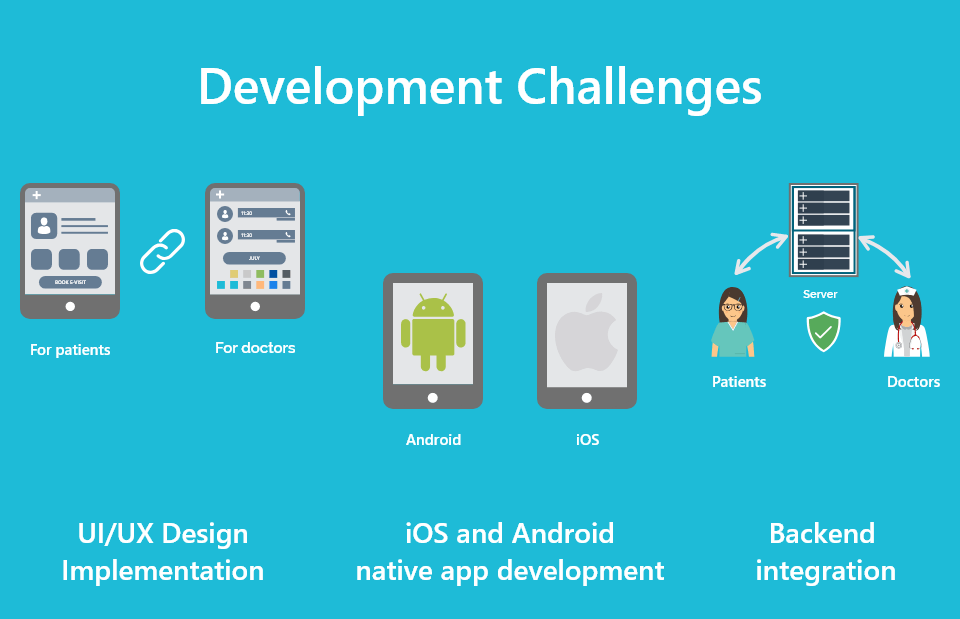
Telemedicine App Development Challenges

  • UI/UX Design Implementation A telemedicine app requires two separate apps, one for Doctors and other for Patients. While designing a user interface and user experience for a telemedicine app it is very much important to ensure smooth interaction between the Patient and Doctor. Since a single UX pitfall will fail to get the much needed attention. So make sure the UX is great and glitch free because a distressed patient cannot afford any cognitive load. And eventually will be provoked to uninstall the app and leave negative reviews.
  • iOS & Android Native App Development You will be required to build mobile apps for two user roles i.e. Patient and Doctor on two major platforms i.e. iOS and Android. Additionally, an Admin panel to manage patients, doctors and reports!
  • Backend Integration For a seamless communication both the apps with be integrated to a separately developed server (backend server) that holds all of the patients sensitive data and it will act as a mediator to exchange data between patient and doctor apps. Since the healthcare app contains data-sensitive information, therefore upon integration, both of the apps address encrypted requests while sending and receiving information from the server. Revolutionize the Patient and Provider Relationship with Codiant’s Telemedicine App Solutions.Because… we know what patients want.. What providers demand.. And we create a holistic and customized solution that makes interaction with patients seamless and fluent. An interaction that not only focuses on healthy outcomes but also impacts the bottom line.

5 Ways a Grocery Delivery App will Disrupt Supermarket Chains

Supermarket chains and traditional grocery stores no more hold an entitlement of being a bandwagon ruling in the grocery industry. Although, the retail giants have deep roots in brick and mortar but has adopted the incessant growth of digital commerce capabilities. The frenetic pace of people using on-demand apps beefed up with mobile payment options, tap-and-collect facilities and same day on-door deliveries have almost made the brick-n-mortars a refugee in their own land.

Grocery Delivery App

To disrupt supermarket chains Grocery Delivery App have made their own ways. Here are the tech fronts this app is surpassing retail tech giants:

Enhanced Grocery Shopping Experience

The instantly gratifying features like fast-delivery services of FMCG products, instant mobile payments, no standing in queues and running on aisles for searching products have come as a bigger respite for daily grocery shoppers. After all, delivering a better customer experience on multiple fronts is a key to outsmart competitors.

Offers That Lures Consumers’ Hearts

When you think of competing with retail giants and breaking the ruling fishes of the market, you are actually challenging the convenience and quality. To surpass the traditional retailers you’ve to build an emotional connection with your customers and earn their loyalty. In order to ramp-up your in-app store experience you have to strategically create a personal connection. The ways to do it, howsoever, can be giving coupons, loyalty points, cash back, gifts, exciting offers, daily deals, discounts, free home deliveries and many more.

Always Runs Like A Startup

The grocery delivery apps are like those jellies on the cakes that have the dynamism to tempt any unwilling customer deterring to shop. Yes, this digital powered apps run like a startup, not an X-year-old mainstream company. We hope the point is clear!

The App Becomes The “Everything” Store

Grocery delivery app development is not just limited to grocery shopping; think of it as an all-inclusive store that focuses on grocery, fresh farms and vegetables and other FMCG products.

Stores Consumer Preferences and Act on them

The Admin panel of the grocery app helps app owners to understand their consumer preferences, monitor products they frequently purchase, and serve them as per their choices making their shopping experience seamless.

So, the barriers to entry in the market have now vanished! Undercut your competitors, take advantage of new Grocery delivery app platform, web apps and analytic tools and get ready to disrupt your competitors operating on traditional methods by this superficial online business model of grocery app that talks conversions and bring your prospective customers’ closer.

How Much Does It Cost to Develop a Logistics and Transportation Mobile App?

There are many logistics and transportation companies which still lag behind in automation. The reason being technology has always been seen as an added expense, not an enabler. In a point of fact, technology allows for automation, which reduces cost and enables visibility for every process.

logistics-transport-app

In order to revolutionize the trucking business, getting developed a logistics and transportation app can help companies maximize delivery volumes in minimum time. Through an automated promise-management system, it will become way simpler to track fleet, routes, shipments, drivers, and everything that will help standardized and organize the operations better.

An on-demand logistics app when fortified with fully-functional and planned features and robust technology backing it can help attribute in delivering quality services. That’s why we’ve thought to unfold this topic which will take you towards nitty-gritty required in a full-fledged on-demand trucking app.

Types of Logistics & Transportation App Solutions

1. Fleet management Apps

Fleet management app helps you to organize, manage and coordinate work vehicles from a central information system to keep the overall fleet operation running smoothly. Fleet management apps help in improving performance, reduce costs, and provide compliance with government regulations.

2. Logistics Apps

Just imagine Uber- A taxi app solution where riders book a taxi, enter the drop off location, travel and then bill. Similarly, on-demand logistics apps allow users to choose & book a trucking vehicle, ship their logistics and make bills or payments. On-demand logistics apps help you to connect with your users and provide them instant services on fewer taps.

3. Inventory and Warehouse App Solutions

Warehouse App solutions aim to increase visibility with suppliers, ensure received assets are in the right location, know the current status and location of all assets, streamline the picking process, and eliminate manual loading verification processes etc.

Do not find what you want? Discuss your requirements in Logistics App Development

Get in Touch

The Features of On-demand Logistics App

1. Customer App or User Panel Modules

  • User Authentication: The user can easily sign-up, register and login via social media channels, email id.
  • Profile Creation and Profile Management: The user can create a profile, enter personal details like name, address, phone no.
  • Book a vehicle(s): Users can select from a range of vehicle and make the bookings.
  • Schedule bookings: Under this feature, users can pre-book for a scheduled time and manage the bookings for set date and time.
  • Get fare estimation: Get a rough estimation of the fare that will be charged for the distance you want to travel.
  • Billings and payments: Select Payment Option (Card, Cash or Wallet)
  • Track shipments: Track drivers’ current location on the map this way you can track the shipments.
  • Contact Driver: Call driver to coordinate shipments pickup locations.
  • Cancel Booking: Cancel the booking anytime in a single tap.
  • Push notifications: Get notification alerts (Arrival time, Late Arrival, Coupons etc.)
  • Rate driver: Give ratings and reviews to the driver for their performance.

2. Driver App Modules

  • Driver Authentication: Just like the user panel, the drivers can also register with their email ids or social account. Here you can also add driver’s authentication feature where he needs to add his license status, details of qualifications and disqualifications (if any), an account number for funds transfer (can be tailored as per the requirements).
  • Manage requests: View and manage (accept/reject) the incoming requests for pickup and delivery of shipment or carriage.
  • Check shippers details: Driver can check the details of the exporter, consignor or shipper who is responsible for initiating a shipment. Details include name, address, phone no, drop-off address, invoice etc.
  • Check freight details: Drivers can reckon the costs of the weight of the goods, fuel, toll charges as per the distance covered.
  • GPS route tracking: Drivers can determine the optimized route to travel to the destination with the help of GPS.
  • Payments: The user payments via any mode enabled in the app can be recorded by the driver and he can smoothly accept the payments whether it is COD or by card.

3. Admin Panel

  • Secure login: Admin can securely login with the email id and password from any web browser.
  • Admin dashboard: Admin can view summary on Dashboard, no. of active drivers, their LIVE location, shipments completed, all customers etc.
  • Manage drivers: Admin can add new drivers, update driver details, Activate/Deactivate drivers.
  • Manage shippers: Admin can view all registered customers, message them personally, broadcast message and block customers.
  • Manage fleet & vehicles: Admin has the ability to add types of trucks and fleet info.
  • Manage dispatchers: Under this section, admin can view, add, delete and update dispatcher’s information.
  • Billing and invoice: Admin can see payments each driver has earned and can manage the cash in/out.
  • Evaluate trip reports: An admin can further note the trip history of every driver and take the next step.
  • Referral Rewards: Admin can add/edit promo codes and referral points for customer retention.

Note: There are even higher levels of functionalities and features that can be added as per the requirement and specifications. The list of these features does not indicate our limitation to offerings.

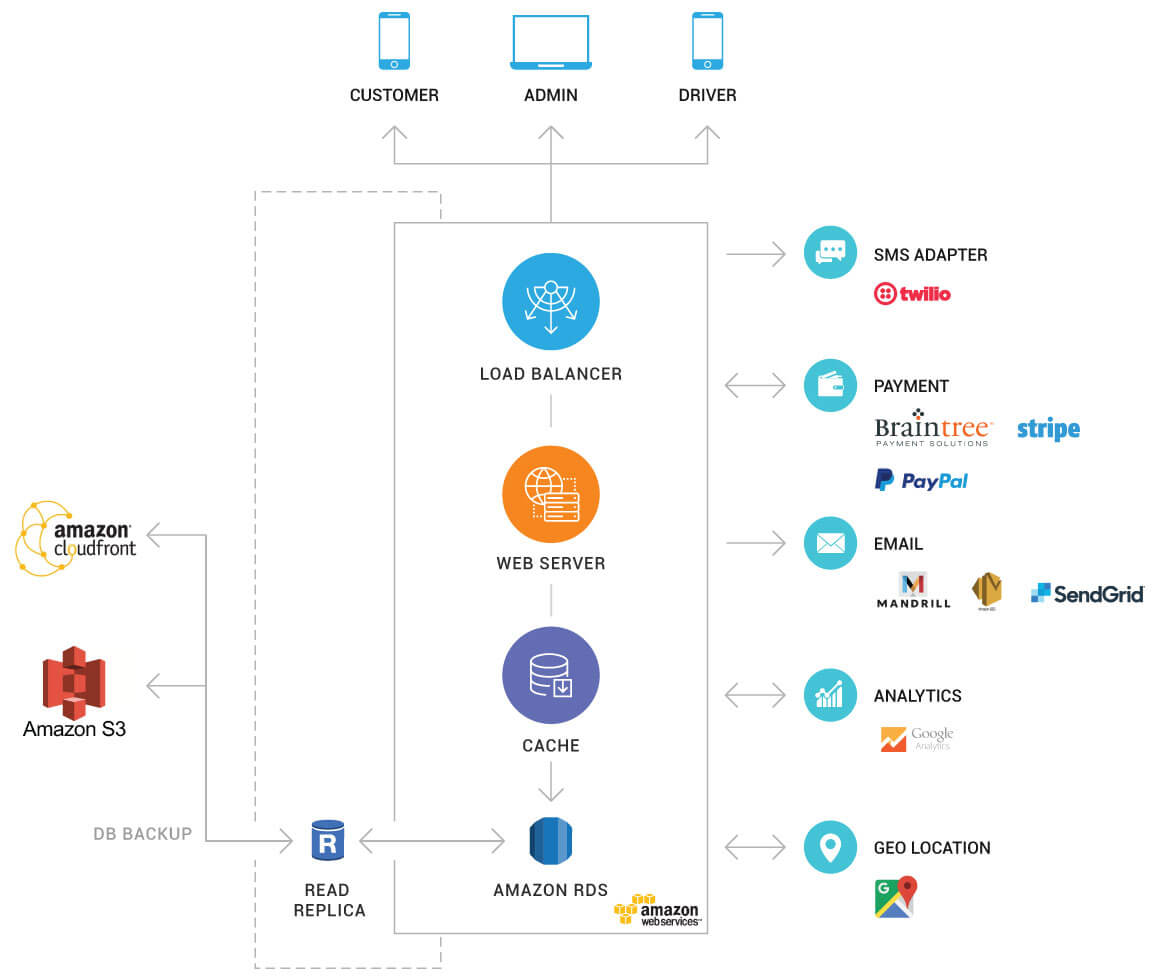
The Technology Stack behind On-demand Logistics and Transportation App

Tech-Stack

Cost to Develop An On-demand Logistics & Transportation App

According to our estimation and developing similar kind of logistics apps with customized features for different clients, the costs heavily depends upon the number of features and complexities involved in the app.

You would need to pay for following services when going for similar kind of app development:

  • Design
  • iOS and Android native app development
  • Backend development
  • Web development
  • Project management
  • Quality assurance

A total of cost for a simple logistics and transportation app development may land to $25,000-$40,000 and can go as high as $100,000-$150,000.

How much does fitness app development cost in 2022?

Exercise anywhere with an app that knows plenty about you, and takes up way more energy than coming up with an excuse why can’t you make it today.Workouts with fitness apps have become a whole lot easier; it imbues punctuality and infuses an obligation. Like, maybe this is the reason fitness and healthcare apps turns out to be mobile gym and insists personal trainers, gym owners, and fitness athletes to build an app that proves its profitability every single day.Instead of investing capital in buildings, tools and machinery, money is pouring where the software are. And the holy truth in this relentless digital world stands stiff- ‘’ the key to capture customer’s mobile wallet is only an engaging mobile app that stands out from your competition”.As simple, if you’re planning to make a fitness app that makes a heady growth, you need a strong conceptual foundation, a thorough research, a clear vision and an excellent app development company. Believe it or not, stitching these variables will increase the velocity of your growth and trimming any of these variables will risk the ROI of your end product.Here we mention the most crucial steps that will define the stages of fitness app development with the cost involved.fitness app development cost

1. Do Your Research On The App Concept

Do you know there are many different types of fitness apps which have its own set of features, degree of impulsion, and the framework! Let’s have a brief about them:

Activity Tracking Apps

Activity tracking apps give users a complete report about day-to-day physical activity like stairs climbed, hours slept, no. of steps, distance and speed run and calories burned. The app includes features like:

Planning the personalized exercise routines, setting goals, comparing progress and saving the statistics.

Geolocation Integration to track the walking routes, calories burnt, duration of exercise, heartbeat rate, tracking the fitness progression etc.

Altimeter, Sleep tracker and Food tracker.

Diet And Nutrition Apps

Diet and nutrition apps help users to monitor food habits, calories burned/ taken, control water balance, body weight and so on. It also allows users to set personal goals, maintain a diet chart, and create lists to do.

Workout Or Exercise Apps

Want to get fit but don’t know where to begin? Workout apps provide you with sets of exercises and a range of workout routines based on your own fitness level and targets specific areas of the body. It helps you in trimming down weight in the body parts where you need more focus.

Personal Trainers App

Personal trainers’ app exactly correlates with your trainers and the way they train you. You will see a perfect mélange of pre-arranged exercise routines that come in different formats such as video, illustrations, text or 3D models.

Decide The Right Platform For Your App

Before you approach IT Solutions Company just do your homework, by choosing a right platform on which you want to get the app build: iOS, Android, or Cross platform devices all have their own operating systems. Choosing the right platform for your app doubles the ratio of revenue generation and user engagement.

Select Your App Development Company

After rounding out the right platform hire an app development team or choose an exclusive app development company which has a sound portfolio in developing similar kind of apps you require. This approach will help you gauge the real potential of the company.

4. Start Sketching Out Key Functional Flows

As a next step, start listing down the number of features and key functional flows your app should possess. This will help the designers to make detailed wireframes and then the visual design. Remember, this is a very vital and time consuming stage as it may require frequent revisions. And a good exercise in this phase will help you simplify and smoothen the end result. Of course, it’s better to cut the frills early than paying hefty amounts for changes later.

5. Get Build a Working Prototype

Get build a working prototype of your app for the usability testing. This way you’ll get the real-time feedback and a window for further improvisations.

Read Also : A quick go-to guide to understand Mobile App Development process

6. Kickstart The Development

After the design and a running prototype are ready, your strategy works get completed. It is now the time to build an app. At the development stage, you’ll be updated on every move. Since mistakes or changes at this stage of the app creation process can be costly as well as tedious for developers too. So, it’s important for you to be in regular touch with the project manager and the developer team. After the app completion, user testing is done.

fitness-cta

Top Features You Must Include in a Fitness App

User App

  • User Registration via email id or social media channels like Facebook, Twitter.
  • A Personal Profile includes height, weight, age, gender, allergies and so on.
  • Wearable Devices Integration to connect the app with example fitbit to track their activities.
  • Workout Tracker that gauges distance traveled by walking, running, cycling and so on.
  • A Meal Planner that will help user to prepare a meal plan in accordance with the body requirements.
  • Geolocation integration to monitor the directions and routes while walking and cycling.
  • Live Video Tutorials to guide the workout process and correct postures.
  • Payment Gateway Integration to make payments through cards, wallets or online banking.
  • Ecommerce option to purchase fitness related products.
  • Push notifications that alerts about daily, weekly and monthly goals.

Admin Panel

  • A dashboard to keep track of all live sessions, chats, managing the order placed and so on.
  • Accounts section to view past deliveries, customer reviews and account balance.
  • Payments section to make payments to Gym owners, trainers etc.
  • Marketing and Promotional Tools to add coupons loyalty programs, cashbacks and referral programs.

Choose A Cloud Services Provider

Before the app release, you need a cloud services provider who will not only host it, but also power and maintain the back end systems. You can choose the provider who can scale as quickly as needed. Few well-known cloud service providers are Amazon, Microsoft Azure, Google Cloud platform, Rackspace, Verizon Cloud and hundred others.

App Maintenance

Generally, App maintenance is provided by the same company you’ve hired for app development. Just ensure the team is available for bug fixes, updates and so on.

The True Cost Of Building A Fitness Mobile App

While a fitness app’s cost depends upon the number of features and complexities involved but considering the above factors, a fitness app development company breakdown the cost of a fitness app based on the following components:

  • UI/UX Design
  • iOS and Android native app development
  • Backend development
  • Web development
  • MVP testing
  • Quality assurance (Polishing and bug fixing)

Adding all the components above, an average health & fitness app costs around 20k-30k USD for iOS and Android platform

Cost and Features Involved In Developing an App like Airbnb

Airbnb is more than an amazing business website that lets any entrepreneur pull his or her interests towards building up a similar kind of platform with new tiers of their own. As Airbnb is now spreading its legs across the hospitality industry and offering a variety of experience, the bandwagon is quickly setting a new metaphor for an entrepreneurial mindset. Every tom, dick and harry has a pick to tap same concept within their own geographical boundaries. To serve your curious senses, seeking to get down to every nitty-gritty of this swelling app, here is a condensed blog for you that will cover the following highlights in a brief:

  • Business Model of Airbnb
  • Features to include in Guest, host and Admin app panel
  • Technology Stack used in the app
  • Cost to develop those features

Let’s delve in the points:

The Business Model of Airbnb

1. Key Partners

  • Hosts (People who rent their space)
  • Guests (People who book spaces)
  • Freelance Photographers
  • Investors and Payment Processors

2. Key Activities

  • Building host network and managing hosts
  • Building travelers network and managing guests
  • Product development, management and maintenance

3. Customer Segments

Guests

  • People going for vacation and bleisure (business leisure)
  • Travelers who want to stay comfortably at economical prices

Hosts

  • People who own a house or property and want to lease/rent them.
  • People who want to know and meet new people.

4. Revenue Streams

  • Commission from hosts upon every booking
  • Commission from guests upon every booking

5. Cost Structure

  • Technology set up and running costs
  • Payments to photographers
  • Employee salary

List of Features Included in an App like Airbnb

Guests App

  • Log-in / Sign-up via email or social channels like Facebook.
  • Manage user’s settings like change email/password, notification settings, etc.
  • Edit and update personal profile information.
  • Chat and push notifications.
  • Manage personal profile information like birth date, email id, mobile number, residence address and other details.
  • Filter and search accommodation on factors like Dates, room type, price range etc.
  • View details about different variants of the room like location, direction, terms and condition, ratings and reviews, etc.
  • Contact host, send order requests and communicate about these requests via messages.
  • Accept/decline offers, create new requests and send to other hosts.
  • View upcoming/past bookings and check reservations details.
  • View the location of the property through maps.
  • Rate and review hosts.
  • Select payment methods and view transactions history.
  • Access receipts and payout details for completed reservations.
  • Invite friends to join the app.

Hosts App

  • Create a page and become a listed host.
  • Log-in / Sign-up via email or social channels like Facebook.
  • Manage Personal page and profile information.
  • Manage listings like property details, pictures, set prices, schedules.
  • View upcoming property bookings for hosts through a calendar view.
  • Manage multiple listings- add multiple hosts through the single listing (new).
  • Messaging feature, accept/decline user request.
  • Create and send new requests to guests.
  • Rate and review guests.
  • Add account details, track payments and check transaction history.
  • Check reports on booking history, inventory and sales revenue.

Admin Panel

  • Admin dashboard to view all the users, hosts, photographers in a single view.
  • Manage new listing requests, edit, add or delete listings.
  • View booking history, current status, reservations and manage (edit, update, delete) them manually.
  • Manage hosts and guests, users’ feedback, complaints, etc.
  • Check reports and analytics to drive key decisions, get deep insights so as to catalyze the next action.

airbnb-like-app

Technology Stack Required for Building an Application like Airbnb

  • Programming languages : Ruby, JavaScript, HTML5, CSS3
  • Application Framework : Ruby on Rails
  • JavaScript Framework : React.js
  • Automation Frameworks : RSpec, Capybara, PhantomJS
  • SQL data storage : PostgreSQL
  • Global Payment : Braintree
  • Messaging & Communication : Twilio
  • Cloud Storage : Amazon S3, EBS
  • Cloud Hosting : Amazon EC2
  • Voice and SMS API for SMS, Voice and Phone Verification : Nexmo

Other Important Technologies:

  • Urban Airship : Mobile Push Messaging improve customer engagement with push notifications, location- based marketing and analytics.
  • Aerosolve : A machine learning package built for humans.
  • Sendgrid : Delivering your transactional and marketing email through one reliable platform.
  • Hadoop : Big Database- Open-Source Framework that allows to store and process big data a distributed environment across clusters of computers using simple programming models.
  • Web Server : NGINX that accelerates content and application delivery, improves security, and facilitates availability and scalability for the busiest web sites on the Internet.

Cost To Develop an App like Airbnb

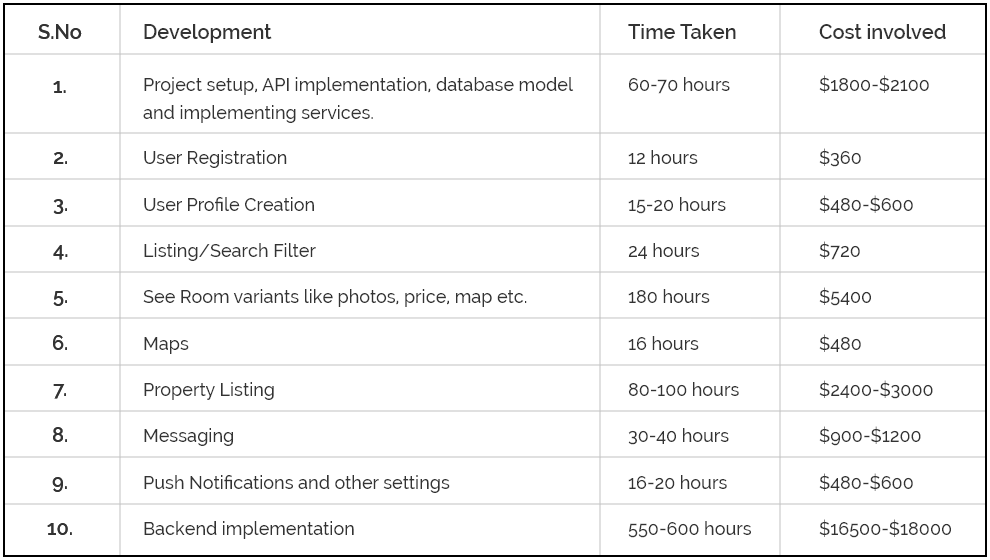
The cost to develop an app like Airbnb generally depends on the number of features you require and total hours employed in developing those features. Here is a segregation of basic features that are must to be included in this app and the time taken to develop each one of them and an average cost involved, which generally depends upon the per hour cost the mobile app development company charges.

cost-to-develop-an-app-like-airbnb The Total Cost to develop an app like Airbnb costs around $31000 – $34000.

Given, the app development charges $30/hour.

iOS 12 : Unveiling the Release Date, New Features, and Enhancements

WWDC 2018: The annual refresh of Apple’s OS iOS 12 is here. Thanks to the WWDC 2018 keynote that didn’t keep us waiting for so long and announced the host of updates at the very start of the event.

YES, the iOS 12 developer beta is available to download now, however public beta is still under the wraps and needs a few more clock rounds to go (maybe later this month). Whereas, the final build of iOS 12 will release in September after the new iPhone X series for 2018 has been revealed.

This time around, Apple has unveiled an assortment of notable features and additions, including performance enhancements, AR improvements, Siri shortcuts and suggestions, and more. Here is list of the features, an array of fixes (that disappointed you so far) and worthy enhancements that are likely to make a big impact.

Performance Updates

Apple’s Craig Federighi who took the stage at WWDC says, iOS 12 is all about performance, as expected. Apps will launch 40% faster, the keyboard launches 50% faster, and even the camera comes a lot faster, up to 70% on older devices.

Siri

siri

Siri welcomes a new feature called Shortcuts. It finds your lost items. It offers you automated suggestions on your lock screen based on your actions and lot more. So you might say, “Siri I am heading office” and the digital assistant will open your system, turn on the thermostat and check the traffic on your route to office.

3. SMS Autofill

Ease. A lot of ease. iOS 12 will recognize those verification codes in the text messages and will auto-fill them into the application that demands them, getting you authenticated and signed in much faster.

Password Manager Extension

iOS 12 features the Password Manager API which will allow developers to integrate these password managing apps and let them complete the fields.

Animoji and Memoji

animoji-and-memoji

Gave you butterflies last year! Apple decided to give it more, by adding a flurry of emoji upgrades. Amongst the one, you last have, welcome the new ones that have the faces of ghost, koala, tiger and t-rex, and you know what’s more tickling? They all include tongue-detection so you can wag your tongue to have your ghostly digital replica do the same.

Augmented Reality

Just know the significance of AR through the first major iOS 12. Apple worked with Pixar to create a brand new file format for AR called USDZ, which will work in multiple applications, including Adobe’s Creative Cloud.

The second version of ARKit 2 includes improved face track, better 3D object detection, and gives people an ability to experience the same virtual environment simultaneously.

Apart from this, there are many more little updates that are grabbing the attention and making a huge impact. Few of them includes Critical alerts for Do Not Disturb, Face ID rescans, Wink Detection, Portrait mode improvements, and more.

For latest technology trends and updates on iOS 12 stay tuned.

Unveiling the Doctor On-demand or Telemedicine App Development Cost and Features

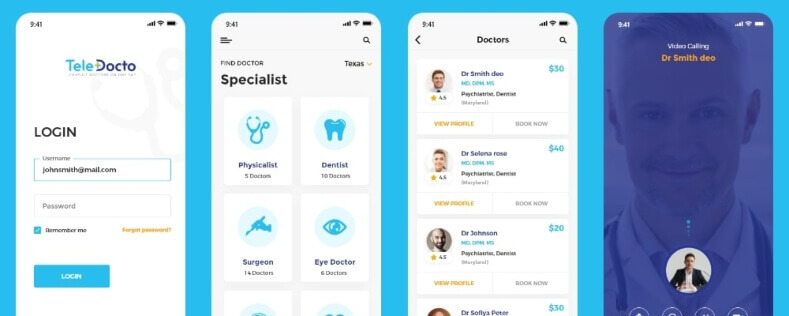
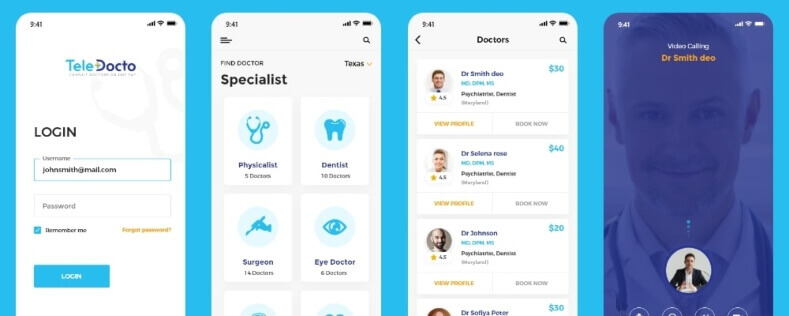
teledocto
“The healthcare system is complex, and we enter into this challenge open-eyed about the degree of difficulty,” Jeff Bezos said in a statement.

The ballooning costs of healthcare act as a hungry tapeworm on society. To neutralize the swelling costs doctor-on-demand and telemedicine app development come as a companion to manage chronic conditions that have emerged as a fast-growing and potentially disruptive segment in the healthcare industry.

Especially when barriers to entry are low, differentiating oneself through ventures that excites and shakes up the strain of society can come as succession and a bigger relief.

Doctor-on-demand or telemedicine apps are acting as an impetus for the healthcare industry to change. The app in itself is very broad when we talk about its functionalities and features limitations. But the most vital features which act as a bedrock for the app are listed below.

The Doctor-on-demand app is an aggregation of two individual apps that is:

1. Patient App

2. Doctor App

And a robust and secured Admin Panel which links Patient’s and Doctor’s App through it.

Let’s funnel down the list of features Patient’s panel cover:

Patient App Features

patient-app

  • Sign Up

Patients can register themselves via email or mobile number. Since the app deals with sensitive data, we recommend you to use two-factor authentication, which includes SMS/voice/phone verification.

  • User Profile

Users can create their profile and input all details like profile picture, name, age, sex, address, city, medical ailments and more.

  • Search Doctors

Search and explore Doctors by filters like specialization, degrees, ratings, location, etc.

  • View Doctors Profile

After selecting a Doctor, user should be able to view doctors’ profile with details like photo, specialization, address, consultation fees, email, phone, available appointment slots.

  • Book Appointments

Patients can check the doctor’s availability via calendar and book an appointment with the doctor by selecting the communication mode (phone call, via chat, video calling, or in-person). The appointment can be canceled or rescheduled.

  • Booking Detail

Allow patients to book for self as well as dependent profiles like family members or friends.

  • Appointment Type

Give the ability to patients to select the appointment type i.e. between on-demand and scheduled.

  • Select Payment Mode

Patient should be able to select payment mode and select insurance, health plan (if any).

  • Make Payments

Patients can make secured online payments through multiple payment gateway integrations like cards, mwallet, net banking, etc.

  • In-App Video Calling

Integrated audio and video calling for live patient- doctor engagement.

  • In-App Chat/ Messaging

Ability to chat or text message with doctors.

  • Electronic Medical Records

Patients can share medical reports and other health related data with doctors for diagnosis and treatment.

  • Review and Ratings

Patients can give doctors’ ratings, reviews and feedback.

  • Mark Favorites

Mark favorite doctors to make it easy to find-out and access doctors at a glance.

  • Notifications

Notifications (email, SMS, push) to remind patients of their upcoming appointments, medicines, payments, etc.

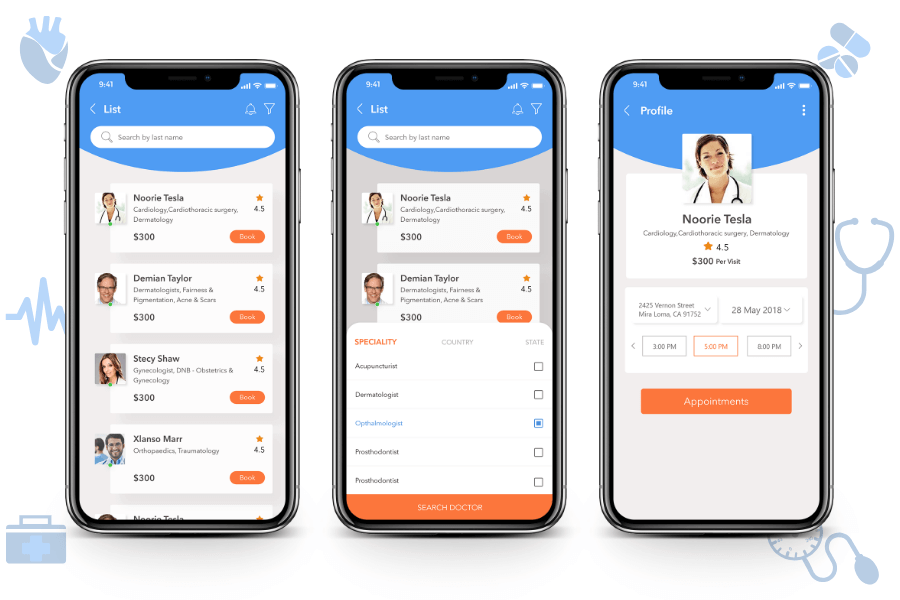
Doctor App Features

doctor-app

  • Doctor’s Profile

Doctor can create their detailed profile, add clinics they serve with location, list their availability timings etc.

  • Schedule Appointment

Doctors can schedule appointments for patients as per their availability.

  • Accept or Reject Appointment

In non-emergency situations, a doctor may decline to see a patient by reject option or accept when available

  • Set Availability

Doctors can set availability status to online/offline and can also control on-demand availability toggles like if available for phone call/video call/home visit.

  • ePrescription

This feature allow doctors to send online prescription to patients which will be saved to either databases.

  • Live Video Call

Doctors can take live video calls with patients, add other medical specialist in the call through video conferencing.

  • White Boards

This feature is optional. Doctors can use whiteboards to explain anything to patients/ other doctors.

  • Store and Forward

Doctors can securely store & share medical data, images and patient histories.

  • EMR Integration

Doctors can integrate patient’s histories & records with EMRs to make seamless remote visits.

  • Multi Way Video Solution

This feature can be kept as an add-on where doctors can connect themselves with their peers or other specialists and take video conferencing.

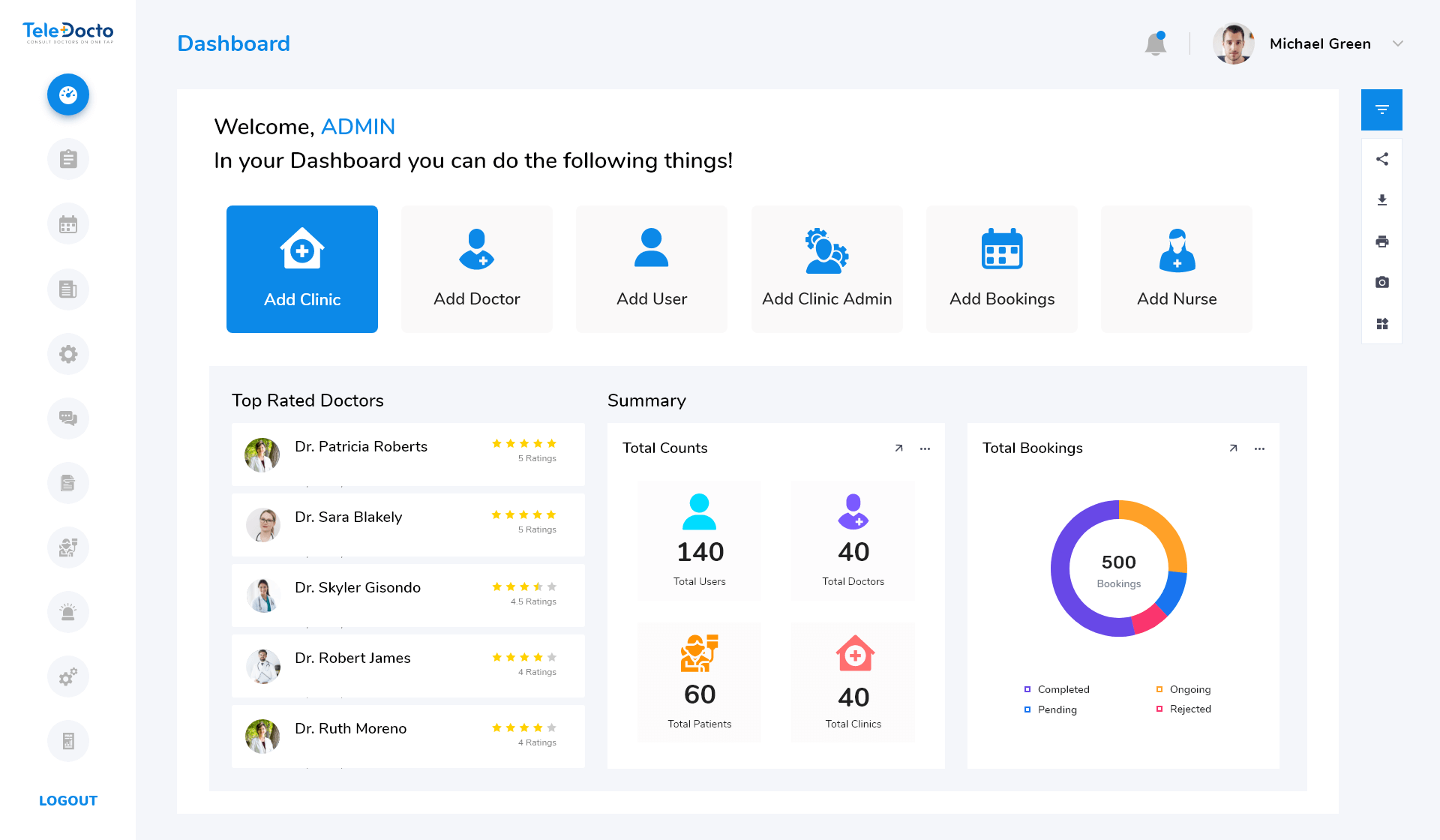
The Admin Panel Features

on-demand-doctor-admin-panel

  • Patient Management

Admin has the ability to view full patients’ information as well as their medical history.

  • Doctors Management

Admin can manage and view details of doctors, their area of specialization, categorize them as per specialization.

  • Specialty Management

Admin can manage specialties, appointment fee, check their status and take action by edit, make them active, inactive.

  • Report Management

Admin can take a full view on reports related to every patient. Admin can check number of appointments booked, no. of ongoing appointments, cancelled appointments etc.

  • Site Statistics

Admin can check total patients, providers, clinics and total earnings.

  • Appointment Statistics

Admin can check total appointments, active appointments, cancelled appointments, and completed appointments.

Related reading : Your A-Z Guide To Develop A Fully Integrated Telemedicine App With Cost and Key Features

telemedicine-cta1637135879

Technologies Stack of Doctor-on-demand App

  • Programming languages : Kotlin, Java (Android), Swift (iOS)
  • Insurance verification : PokitDok
  • ePrescription : EazyScript
  • Video Conferencing : WebRTC
  • Chat : Twilio, Socket.io
  • Database : MySQL
  • APIs and frameworks : Stripe, EC2, S3

Cost of Developing a Doctor-on-demand or a Telemedicine App

The total cost to develop a doctor-on-demand app depends on following services you take while hiring a telemedicine app development company:

  • UI/UX Design
  • iOS and Android native app development
  • Backend development
  • Web development
  • Project management
  • Quality assurance

According to our estimation and developing similar kind of telemedicine apps with customized features for different clients, the costs heavily depends upon the hourly rates the healthcare app development company charges which vary greatly from $20/hr-$50/hr.

But on average, the total cost for a basic on-demand doctor app starts from $25,000-$40,000 and could go as high as $40,000-$70,000.

Why Node.js is The Best Technology Platform for Developing mHealth Applications?

Unveiling the relevance of node.js in developing healthcare and telemedicine applications

Over the past two decades mHealth has evolved to become a major health communication channel for delivering health care, promoting health, and tracking health behaviors.

The phenomenal increase in the usage of smartphone apps has tremendously influenced the public adoption of mHealth apps that includes the increasing use of: in-person clinical interactions (online consultation or remote diagnosis) with healthcare providers by the means of audio and video enabled telemedicine applications and data collection tools (collecting e-prescriptions, reports, images), taking online appointments, and sometimes collecting information through wearable devices (e.g. fitness tracking wristbands) & other digital monitoring devices.

As per a leading report, nearly 80% of physicians in the United States use smartphones for their medical practice. Since digital technologies are providing a new approach for consumers in regards to the accessibility to information & care and to physicians as well, it is extremely vital for physicians and care providers to develop a mhealth app that is highly secured, scalable and feature-rich.

While there are myriad of technologies and development platforms to choose from, it becomes perplexing to pick the best amongst all. But if you’re looking for a high-performance app that works seamlessly without any external interruptions, Node.JS platform tops the chart for healthcare application development.

telemedicine-cta

What are the Key Advantages with Node.JS for Healthcare Industry?

1. Instantly Find Nearby Doctors Location

Undeniably, Node.js works wonder in real-time web apps. Since Node.JS uses NoSQL databases like MongoDB for processing queries, JSON stored data allows Node.js to smoothly function without the impedance mismatch and data conversion.

Advantage: It makes swift for patients to retrieve nearby doctors and consult them quickly.

2. Emergency Assistance through Video Conferencing

As Node.js provides an event-driven architecture which optimizes application’s throughput and scalability, this enables applications to speed up the synchronization process and handle more concurrent client requests very easily.

Advantage: This allows developers to enable a seamless, interruption-free connection amidst doctors and patients.

3. High Performance and Secured Connection

There are many market leaders who have leveraged great benefits from node.js application implementation, few of them being PayPal, WalMart Labs, Linkedin & Groupon who used this technology platform to experience faster performance in their peak days.

Advantage: Node.JS high performance, scalability, and security enable to develop a healthcare application that runs swiftly without any degradation in performance, something which a healthcare industry critically needs.

4. Sleek User Experience

An application built with Node.js provides fluid user experience to patients in accessing app features and functionalities, hence enabling a frictionless experience.

If you are looking for developing fully functional m-health application built on node.js platform, then Codiant’s seasoned team of node.js development can help you in delivering the exceptional app solution. We have a strong portfolio in the clinical continuum segment and are continuously delivering unsurpassable solution across the globe.

The top 5 Domineering Advances in Financial Services Technology

Fintech, mobile, and new platforms are driving a digital transformation of the banking industry. The traditional banking landscape has taken a U-turn in the next five years. Safeguard features such as advanced cryptography and biometrics are already acting as a protective layer against frauds and scams. This wave of disruption is unstoppable. Let’s take a glimpse at how the global megatrends in digitalization and IT department are affecting financial services industry.

1. Blockchain Technology

Blockchain technology is inherently revolutionizing banking and financial services. It decentralizes financial management from a central authority to a widespread network of computers. It has the potential to benefit various sectors, with its immutable ledger of apparently near-unhackable information. PSD2 Blockchain could be the key to the success of third-party financial services.

2. Open Banking

Open Banking is forcing large, established banks to be more competitive with smaller and newer banks, ideally resulting in lower costs, better technology, and better customer service. Through the use of networked accounts, open banking could also help lenders get a more accurate picture of a consumer’s financial situation and risk level in order to offer more appropriate loan terms. This comes as a great opportunity for financial companies to take the advantage of Open Banking.

3. Advanced ATMs

Subsequently, ATMs are coming with the new power of contactless payments, much like Apple Pay or Google Wallet. While some ATM innovations are already on the place, the inception of biometric authentication, iris recognition and other technologies are helping banks to achieve security by protecting against ATM hacks.

4. Flourishing Non-Banks

According to a 2016 report from market intelligence firm Greenwich Associates a large portion of banks resources is necessarily dedicated to security, compliance, and other industry-specific requirements, which has allowed non-banks — or financial service providers that are not regulated by the banking industry — to flourish. Since these non-banks or financial companies can allocate a large chunk of their assets to financial technology they might be able to pioneer at a much rapid pace as compared to traditional banks thereafter, attracting digital savvy customers in the process.

5. Automated Financial Services Employees

The advancements in financial technology will probably result in the reduction of in-bank personnel. A recent report from Citigroup indicated that a whopping 30 percent of bank jobs might be lost by 2025 due to the automation of retail banking services. And maybe, the bank employees inch forward as robo-advisors for effective money management. In a nutshell, smart mobile technology and trends are driving finance & banking technological advancements on the roads of convenience, ease and simplification. And if you’re a fintech company or a government bank looking forward to augmenting your customer experience than banking and finance IT solution provider can be a right choice to go with.

Are you looking for banking and finance IT solution provider?

Contact us

Integration of Wearable Technologies into Patients’ Electronic Medical Records EMR

Give your healthcare services a tech makeover

Healthcare is a big responsibility, which soon becomes a chaos internally when the information slips amongst the cracks, when communication gaps takeover and data sharing sinks down. In this critically challenging healthcare ecosystem, healthcare service providers, hospitals and clinical professionals go to the edges to keep the operations seamless and swift.

The disruption in healthcare technologies promises to revolutionize the way information passes between connected networks. Concentrating on wearable devices and/or healthcare wearable technologies which are commonly available as fitness trackers, insulin pumps, cardiovascular defibrillators, and vital signs monitors HWTs have the added advantage of tracking and monitoring physical activities (PA) and vital signs, which are related to medical and fitness and wellness. Some of these measurable parameters being heart rate, blood pressure, pulse rate, muscle activity, glucose level, sleeping pattern, electrocardiogram (ECG), core temperature, oxygen saturation, stress levels and monitoring eating habits.

Technology advancements in healthcare sector have made it possible to integrate these medical devices with clinical software/ EMR/EHR, and this is where Codiant stands with you.

Future potential

Market for wearable devices expected to be worth $51.60 billion by 2022

Integrating Health and fitness data with EMR or simply transferring the patient’s health data to Doctors’ clinical software would help:

  • Better monitor patients remotely
  • Improve and organize the amount of data physicians receive
  • Expand the reach of patient care to rural areas

Usage model of EMR Gateway solution

An EMR Gateway provides a framework to connect wearable devices through USB, Bluetooth, serial port and establish a communication conduit with each device and start collecting data through it. The data collected in the Data Store gets converted and comes in the form of HL7 format. The data store here can be referred to any database in the Healthcare enterprise or public storage like Microsoft Health vault.

Next, the clinical system interacts with data store and interprets the data to provide various health forecasting by functionalities like report analysis, charting, trend, etc. subsequently, helping physicians to provide an optimal and healthy solution to the patients.

Wearable Technology in Numbers

The growth of wearable technology during the past 5 years has been remarkably fast.

growth-of-wearable-technology

By 2016 the number of connected wearables was already 325 million, and figure 1 show how the amount of connected wearable devices is estimated to grow during the next 4 years (Statista, 2017). Pretty evidence how remarkably fast the market for wearables is currently growing. .

Final Thought

HWTs have several benefits on tracking and monitoring fitness and medical daily activities independently. Gathering these functions in a single device and integrating the collected data to the EMR, will definitely have a huge potential in promoting the meaningful use of EMR. This integration will provide a long-term view of a patient’s overall health, filling in data gaps to enable evidence-based care. Over all, smart HWTs will increase both patient engagement and preventive care, and that ultimately will save time and money.

A Wakeup Call : Telemedicine In Healthcare

Healthcare providers are implementing telemedicine solutions to improve the quality of care, expand clinician access to colleagues and patients, and more efficiently allocate resources. The quantum of telemedicine in healthcare is accelerating at breakneck speed.

And it’s no surprise; telemedicine holds great potential for reducing the variability of diagnoses as well as improving clinical management and delivery of health care services worldwide by enhancing access, quality, efficiency, and cost-effectiveness.

The definition and scope of telemedicine solutions remain fluid and can be classified into two basic types, according to the timing of the information transmitted and the interaction between the individuals involved—be it health professional-to-health professional or health professional-to-patient. We can segregate it like:

a. Store-and-forward telemedicine that involves the exchange of pre-recorded data between two or more individuals at different times.

b. In contrast, real time, or synchronous, telemedicine requires the involved individuals to be simultaneously present for immediate exchange of information, as in the case of videoconferencing.

In both the cases, store and forward as well as real-time the form of information that can be transferred can include a variety of media such as text, audio, video, files etc.

Now let’s dive in to see the most valuable features a telemedicine platform must possess.

The Important Features A Telemedicine Platform Must Include:

Store-and-forward telemedicine

It involves acquiring medical data (like medical images, biosignals etc.) and then transmitting this data to a doctor or medical specialist at a convenient time for assessment offline without any drop in resolution.

Remote Monitoring

Remote Monitoring enables medical professionals to monitor a patient remotely using various technological devices. It is primarily used for managing chronic diseases or specific conditions, such as heart disease, diabetes mellitus, or asthma.

Online Scheduling

Patients can view and schedule your available appointments.

EMR Integration

Integrate patient’s histories & records with EMR’s to make seamless remote visits and to give an ability to send clinical documentation to/from your EMR.

Secure Messaging

By adopting a secure messaging system for healthcare allows your team to respond to more patients, faster and better. Also it gives them the ability to coordinate with patients and other clinicians to provide prompt service to clients.

/>

High Definition Video Consultations

It is vital to have HD video calling and conferencing possible to eliminate the need to transfer a patient that needs specialized ongoing care.

Integrated Billing

An integrated medical billing system opens the gateway for reporting in many areas such as access to more information, health service providers can determine which procedures are losing money consistently, and make strides towards closing any financial gaps. If patients are canceling consistently on a particular day or doctor, and the clinic is taking the monetary hit, that data will be evident via the system.

HIPPA Compliant

All information shared and stored should be fully encrypted as per HIPAA requirements. As well as it should give clinicians an ability to communicate through HIPPA-compliant messaging and video calls.

The goal of a telemedicine network is to support and improve medical decision making. And having this array of features in your app can help you create a telemedicine app in its broadest way.

For any query regarding healthcare and telemedicine app requirements you may contact us, we have hands on experience in developing a gamut of telehealth and telemedicine apps.

Related post: Telemedicine App Development Cost and Key Features

Introducing the Latest Updates in Admin Panel to Manage Drivers, Dispatch and Track Reports

Every other taxi app we get to build from diverse countries, we have one demand in common; the dire need of Admin Panel’s Ride Reports. Taxi Operators are in awe of this feature. Naturally, who will not want a standard report featuring the prolific results on all scenarios ranging from taxi booking to dispatching helping them to get maximized revenue!

Here we will talk about the most pressing need and paramount panel of Taxi App solution that helps taxi operators to survive the stiff competition, manage the thinnest of glitch, take decisions and automate the operations flawlessly. The Admin Panel covers it all.

How Our Admin Panel Will Turn the Tables for Your Taxi Business:

Our dispatch panel offers you endless possibilities to manage the Taxi drivers, Cabs, Customers and Dispatch by providing you an exclusive login. Furthermore, it helps you to monitor progress and take actionable decisions by tracking ride reports. Let’s stride to it one by one.

The Dashboard

View a brief of entire system. Track your taxis and active drivers on a real-time map. Check ongoing trips, Notifications and more:

  • Check the number of Active Drivers
  • The Number of Active Customers
  • The Active bookings
  • The On-going Trips
  • The total Amount Earned etc.

taxi-admin-dashboard

Live Map

Admin can view a real time map and track their taxis on Google Map in real time location. Get information about all the taxis that are busy or empty status via the colors. Here yellow taxis are busy while Blue are empty.

taxi-admin-live-map

Tracking Reports

We offer you a report section in the Admin panel where you as an Admin can see Driver Report, Customer Report and the Ride Report. Our advanced payment reports help you to track the earnings, plan your business by putting the strategies on place which needs attention, and catalyze actions on areas which are weak by putting extra marketing efforts.

taxi-admin-tracking-reports

Add Butler

Scale up your business with one-click taxi booking device. Taxi Butler helps you to book more rides and is perfect to be installed in hotels, restaurants, bars company receptions and other private spaces witnessing frequent footfalls. Our admin panel allows you to manage butlers from a single place.

Ride Management

Admin can check all the rides done, ongoing, requested, accepted, and canceled so far. With a real time Map running aside.

taxi-admin-ride-management

Manage Drivers

Admin can manage the drivers at a single place. View and edit their name, email, phone number, and check their status. The admin can immediately put a driver account on Activation mode if he enrolls in or sign up and deactivate the account if he terminates from the job. In a nutshell, Admin can add/modify/delete any Driver.

taxi-admin-manage-drivers

Message Drivers and Customers

Admin can send messages to any or all drivers and customers at a time.

taxi-admin-messages

Manage Customers

View the details of all the customers. Take necessary actions.

taxi-admin-customers-dashboard

Check Transactions

Check the date wise earnings earned by the rides on a particular date or past dates.

taxi-admin-transactions

This is not the end to the features of Admin Panel. There is more to be further added to Admin; that we will soon discuss in the next part of this blog. Till than stay tuned!

Rekindling The Fire: iPHONE 7 And All The Exclusive Official Updates

The curtain falls! And the much anticipated iPhone 7 that has kept prompting the hysteria in the recent weeks has finally cracked the speculations and tech rumor mill that has been running at fever pitch in its juggernaut Apple event held in San Francisco, California.

The Apple event which began with ‘Carpool Karaoke’ on the most awaited day of 7 September, 016 released its new stable of products i.e. iPhone 7, 7 plus and the Apple watch.

Starting from the elephant in the room, let’s unveil the seventh iteration of ever popular iPHONE’s new features, specifications and the untold speculations that made a sharp cut this time and of course, turned the tech giant world upside down.

APPLE Ditches 3.5mm Jack – Launches Wireless AirPods

RIP Headphone jack! Apple has done away by killing the traditional headphone socket and made the room for other components and promoted the use of wireless earphones, oops Airpods (make that habit!)

Cook says “it had taken courage to take the step”. Nevertheless, this would be the inspired decision for the rivals ahead.

All New Improvised Dual Camera

Optical image stabilization has made the punches this fall, where the resolution remains the same at 12 megapixels (marking no change from last year’s iPhone 6S and 6S Plus) and the larger iPhone 7 Plus makes the amazing debut with two 12-megapixel cameras; one with a wide-angle lens and the other with a telephoto lens.

Stereo Speakers

A big cheer ran out for the stereo speakers, which can output 50% louder sound. One lies in the earpiece and the other on the bottom.

Water And Dust Resistant

For the first time in the iPhone’s history, the new phones are “water and dust resistant,” up to IP67 (i.e., splash proof, not submersible) Good enough to be submerged in up to 3.2 feet of water for up to 30 minutes.

Battery life

Biggest battery life that will raise the eyebrows! How does it come up? Up to 2 hours longer battery life than the iPhone 6S! Fingers were already crossed.

Overall, the changes are definitely incremental, draws cheers and the innovation though not surprising but dramatic enough to catch the pace from the rivals.

Digital Spotlight

Apple devotees, the world has all eyes set on iPhone7, with 384,000 followers the anticipation game is strong. How about launching an iOS App with the new version of iOS 10, iPhone7 and 7 plus on board?

Get the dazzling iOS app… Our tech savvy iOS developers at Codiant software technologies are curious to hear your ground-breaking idea! Contact us now. It’s the right time for hitting the appstore with our cutting edge iOS app development.

The Total Cost to Create an On-Demand Delivery App

The gold rush engagement of the excessively hyped and overly used On-demand delivery services interlocked with the transportation giant Uber at the helm has fuelled a new workforce of freelancers by far, while at the same course of time, morphed as an outstandingly unstoppable pollination for all-round the corner services, every next person is seeking out.

Uber for what? Fastfood, Takeaway, haircuts, parking, handymen, cleaners, massage, couriers, supply teachers, barmen, postage—Whoa! Just think of a service, the Uber is here! If not, somebody down the line is already putting gears on it.

It also means you’ve got the replacement for that ‘X’ (we always mean ‘Uber for ‘X’) and it is pre-written, there is near-to-no chances for it to subscribe failure. Certainly, its On demand + Uber… Figures are never hard to come by!

Be it, earning from on-demand or investing for on-demand… Well, at this moment the investment we’re discussing is “the cost it takes to develop an on-demand delivery app like Uber”!

And for that you’ve to tune your mind to understand what it takes to design and develop the most successful apps of On-demand. Here are the breakdowns of the costs and time investments.

uber_for_x

How much does it cost to build ‘Uber for X’ at CODIANT?

There’s an enormous looming cost of development —one that’s complex to measure, but not that hard to predict. Speak with us telling your requirement and we’ll be there for you.

REQUEST A QUOTE

We adjust it until you find a fit..

Still Wondering for that perfect idea for On Demand Delivery? Check out these verticals. And truthfully, you will not be disappointed.

Codiant’s Takeaways to scale your On-demand Startup-

  • Start Small i.e. ensure that your demand and supply targets are kept to a minimum.
  • Tap into an existing network.
  • Promote your app before launch through social media, offline advertisement, or referrals.

Key features for an on-demand delivery app

The most important features for an on-demand delivery app are:

1. Making orders

Providing a smooth convenience of booking an order after quick access to goods and services.

2. Dispatch Management

Dispatch management is the quintessence of any on-demand delivery solution. This module provides operational teams with an interface for scheduling driver pickups and deliveries. With complete, end-to-end visibility of the delivery business as a whole.

3. Real -Time Tracking

Showing your customers where their package has reached validates the preeminence of your service. Moreover, when the customers can access real-time location of the driver it adds gold stars to your service sufficiency.

4. Payment Delivery

Payment through credit card or mobile wallets is yet another important feature of an on-demand delivery app, which takes around 4 days to put into effect.

5. Ratings And Reviews

Customers can express their opinion about the services they received and then rate them bad, good, average, excellent as per their experience. Most on-demand delivery apps incorporate this functionality. On an average, it takes around 6 days to implement it.

If your app focuses on food delivery or grocery shopping, then additional features should be added:

  • Product search
  • Shopping lists
  • Wish lists
  • Real-time messaging or calls

And you’re done.

Getting build an MVP is also a great idea that saves your cost and time and helps you in launching your product in the market at its earliest.

How to Calculate the Cost to Develop an App like Uber? Deep Estimation

The growing demand for Uber-like clone applications is accelerating at the speed just like your car at a highway. Just a bit of modification in the existing Uber business model and a new Taxi app is ready to rule the market. When all the heads turn towards Uber-like taxi booking app development the only question that itches in the head is “How much will it cost to make an app like Uber?” Here is the list of features that influences the cost to develop an app like Uber. Let’s take a sneak peek.

The Basic Features of Taxi App

While talking Taxi App, make a note an Uber will always have 2 separate applications and one admin panel each having different functionality. 1. Passenger App2. Driver App3. Admin/dispatcher Panel

Passenger App Modules

As the name depicts the passenger app is for users who book the taxi. Check out the basic features of passenger app essentially needed.

  • Register/Login : Easy onboarding through email, social media logins, accounts etc.
  • Book a Ride : An interface to set the pickup location, call a taxi, select the type of cab.
  • Contact Driver : Coordinate a pickup by calling or messaging the driver.
  • Track Driver’s Location : Check the driver’s real time location through GPS tracking.
  • Price Calculator : Check the estimated cost of a ride from point A to point B.
  • Payment Option : In-app card payment through credit/debit card. If not this, passenger can pay directly to driver by cash.
  • Cancel Booking : Customers can cancel trips anytime in case of any plan changes.
  • Push Notifications : Keep your users updated on order status, estimated time of taxi arrival, car model, drivers name etc.
  • Trip History/ Ratings and Reviews : Check booking history, messages, ratings & reviews etc.

Driver App Modules

  • Easy Registration : Drivers can request a signup and add the necessary details.
  • Real Time Requests : Drivers get notified for new ride requests with all the pickup details.
  • Accept/Reject : Drivers can accept or reject ride in limited time frame.
  • Trip Information : Drivers get the pickup and drop information about their customers.
  • Navigation : Built-in navigation with Google Maps to provide the best route and ETA information.
  • Contact Passenger : Drivers can make calls to passenger to clarify pick up location.
  • Start/End Trip : Drivers can start and end the trip to generate the automated bill.
  • Track Earnings : View entire job history and daily earnings.

After building these two applications, the Admin/dispatcher panel is required who will manage the operations and performance, manage drivers and customers.

An Admin Can:

  • Manage customers.
  • Manage vehicles.
  • Manage dispatchers.
  • Track trip.
  • Create new booking requests.
  • Start/end trip.
  • Contact passenger.
  • Track earnings.
  • Rate customers.
  • Provide help & support to passenger and driver.

The Cost Components Depends upon these major portions of work that is involved into an app like Uber.

The Backend Work Include Following Nuggets of Tasks:

1. UI/UX Design

UI, UX designs for taxi app must be handcrafted keeping in mind the holy grail of the domain. It demands more simplicity, intuitiveness and clarity. Design Timeline : The Design timing of taxi app massively depends upon your choice of to-do list for us that will include the list of functionalities, features and other interactive elements. Check out our design style.

2. Users Registration/ Login Page

For Users : Traditionally, users are required to create a profile on the taxi app before booking their ride. But in order to increase the user base in your early stages “no profile bookings” can serve as a great giveaway. Email registrations are again conventional but social media integrations are more effortless and time savior. For Drivers : For driver app the registration process can be much demanding and complicated requesting for a photo, car license, plate number, driver’s license copy etc. User Profile Add Ons : You may opt for integrating a rating and reviews system for better app security and increased customer satisfaction. This feature will allow your customers to rate and review about your services like driver’s behavior and hospitality which further can be of great help to you in deciding whether to charge a fine or gift a bonus. Development Timeline : Typically user registration and profile creation requires 120-140 hours of time. (Not to mention, time decreases as the manpower increases) It’s all depended on the project deadline.

3. Geo-location Services and Routing

While Uber is hailed as a location-based startup from day one, routing and GPS technology from the bandwagon comes as a holy need. GPS technology helps you identify your customers’ current position, help your users fetch the neighborhood taxis and build the best route for the driver. Technology Stack

  • To identify a device’s location:

The Uber app for iOS uses the Core Location framework to locate a user’s device. While Geolocation for the Android version of the Uber app was implemented using Google’s Location APIs.

  • To provide driving directions:

To display point-to-point directions on a map within the app, developers of the Uber app for iOS used MapKit. Android routes and directions are made possible by the Google Maps Android API.

  • Integrating with mapping software:

Initially Uber was paying Google for accessing their solutions (Google Maps for both Android and iOS versions of their app). But later on the taxi giant buyed mapping technology companies to solve their logistics issues. In you early stages, you can simply ace up the game with Google maps integration with your taxi app. Development Timeline : It takes approximately 120-140 hours to build location and routing functionality.

4. Push Notification and SMS

Uber uses push notifications and SMS for informing passengers about on-ride updates like driver details, ride details and other discounts on ride fare etc. and uses messaging for bridging the communication between the driver and the passenger. Technology Stack For Push Notifications, the Google Firebase Framework or Apple Push Notifications service must be used. While Uber uses twilio for sending messages, you can also ask your developer to pick Nexmo or Plivo for powering text messages. Development Timeline

  • Push notifications – 36 hours.
  • SMS integration – 20 hours.

5.Payment Integration

Uber uses a cashless system. And its main early selling point was using an in-app payment which eliminates any human-to-human cash transfers from the equation and hence resisting the drivers to overcharge customers. Next comes is Dynamic pricing where depending on the traffic situation and car availabilities Uber takes out the pricing quote like discounts or add-on fare during peak hours. While the prize quote comes out as base fare, cost per mile, cost per minute etc. Technology Stack To offer in-app payments you can choose to offer following payment gateway integration:

  1. Braintree
  2. Paypal
  3. Stripe
  4. Apple Pay and Google Wallet

Development Timeline : It takes around 100-120 hours for integrating the right gateway.

How Much Does It Cost To Build UBER?

When you go for developing an app like Uber, you would need to pay for following services:

According to our estimation and developing similar kind of taxi apps with customized features for different clients, the costs heavily depends upon the hourly rates the taxi app development company is charging which vary greatly from $20/hr-$50/hr. A total of cost for a simple taxi app may land to $25,000-$40,000 and can go as high as $100,000-$150,000.

How Much Does Codiant Costs for Taxi App Development?

Contact us


How Uber Works? Insights into Business and Revenue Model

Uber services are like a fad in the world of technology. One of the most common things we have noticed is that people are scrambling to spot the left-out Uber services, which is still to be tapped in the marketplace.

Uber’s strengths are not just in the terms of providing cheap rides but the on-demand transportation service has captured the market in building a large and powerful logistics business.

Uber’s business model which is the highest-valued private technology company so far operates in about 270 cities and more than 60 countries worldwide, and as of this June, Uber completed 5 billion total trips.

What Draws The Strengths of This Billionaire Company?

1. Revenue Generation

The soaring need of on-demand rides has triggered a rising need of this big fish in the market. What draws the strength of this the global ridesharing leader? Let’s distill the facts:

2. Brand Equity

Uber is currently valued at over $68 Billion and is slated to progress even more downright. Due to the high valuation of brand, Uber is incessantly attracting investors.

3. Low Fixed Investments

Uber does not require high fixed investment due to its aggregation policy which becomes the main reason behind its rapid expansion.

4. Dynamic Pricing strategy

Uber works on dynamic pricing strategy that is in peak hours, midnight and bad weather the company raises its prize. This becomes extremely beneficial for the company and drivers to earn a good amount of money.

5. Emphasis on Customer Satisfaction

Uber places itself a notch higher to provide better customer satisfaction and enhanced user experience.

6. Growth Rate

uber growth chart

Source: Business insider

Other than this, Uber wins in:

  • Verified drivers and Cars
  • An unlimited fleet of vehicle
  • No full-time drivers, as it does not hire the drivers
  • A very little competition. But the major competitor is Lyft
  • Lower prices compared to traditional taxi operators

Uber’s Interesting Facts

  • Uber service is available in 83 countries and over 674 cities worldwide (Source: Uber)
  • Uber fulfills 40 million rides monthly and has over 77% of US ride-hailing market (Source: Wiki)
  • Total number of rides by 2016 – 2 billion (Source: Forbes)
  • Uber gross revenue 2016 – $20 billion (Source: BusinessInsider)
  • Uber driver’s average income – $364 / month (Source: Ernest.com)
  • Venture capital raised – $11.5 billion (Source: Crunchbase)
  • Uber net revenue 2016 – $6.5 billion (Source: BusinessInsider)
  • Uber valuation in 2017 – $69 billion (Source: Bloomberg)
  • In the US, Uber has over 160,000 active drivers, receiving $656.8m of payments during Q4 2014 (Source: Benenson Strategy Group)
  • The top two reasons for drivers to choose Uber are higher income (91%) and work-day flexibility (87%) (Source: Bureau of Labor Statistics)
  • It’s largest competitor Lyft generates a fraction of net revenue ($700 million) compared to Uber ($6.5 billion) (Source: FutureAdvisor)
  • However, Uber has given Lyft a boost – generating greater engagement on the app (Source: Forbes)

Uber’s Business Model Canvas

Uber’s Valuation

Source: CBInsights

In 2013 Uber valuation was $3.9 billion now it jumps to $68 billion in 2017.

Uber’s Weaknesses

1. Privacy Concerns

The CEO less company still continues to serve up fresh embarrassments of privacy policy. The so-called ‘God view’ real-time interface allows Uber employees to spy on users’ rides.

2. Low Barriers to Entry

Apps like Uber prevailing in corners of the world are the direct outcome of low barriers to entry by the ride-hailing company Uber. Eventually, the company has started facing competition from multiple fronts.

3. Drivers Earns less

Despite Uber being the biggest startup company on the planet, it does not serve much to its key workers viz. Uber Drivers.

This chart compiled by Earnest.com compares the average income of Uber workers from Airbnb, TaskRabbit, Etsy, Lyft and several other companies.

Source: Earnest.com

Takeaways

  • Start with small ownership model.
  • Choose any industry and jot down the most common problem it has. Find a solution and come to us with your business idea and disrupt the existing business model through our technological infrastructure.
  • Think like a brainchild and take baby steps. Don’t rush to include everything in the first go.

Contact us for:

Think Big. Disrupt Your City/Country With UBER Like App

Get in Touch

Tap What’s Next! The 10 Most Trending Mobile App Ideas Of 2018

Remember the saying, “The value of an idea is in the using of it”. Because every idea is driven from the pain points of a user, and a user is the customer, obsessed with Mobile Apps. It comes as no surprise, you as a startup/business/brand have to tap the “Customer Obsession”!

To make the world simple and fast, to satiate the over demanding customers, and to finally disrupt the technology space here are the skyrocketing mobile app ideas of 2018 that will make a game-changing technology debut and will definitely soar your bank accounts.

On-demand App Ideas 2018

“ The on demand hypergrowth is upon us. In the next 5 to 20 years most of people will be able to get anything within a 5 to 60 minute window.” | Gary Vaynerchuk

So what’s your business? Does your business serve with mobile app?

If you are looking to create something in any vertical you can debut it as an “Uber for X”. This trend of instant gratification economy is accelerating.

From food delivery to a spontaneous getaway by a taxi, from a relaxing massage to on-demand beauty, from laundry to car wash service, baby care to pet care and more, today’s technology has got you covered.

Here are all existing Uber Apps for your reference:

uber-for-x

Augmented Reality App Ideas 2018

According to Global industry Analysts, the global market for Mobile Augmented Reality (MAR) Apps is projected to reach US$3.9 billion by 2020. The Research and Market report forecasts the global mobile AR and VR apps market to grow at a CAGR of 74.4% during the period 2016-2020.

Augmented reality (AR) is growing rapidly and becoming more mature and robust, which combines virtual information with the real environment in the real-time performance.

AR gives vendors many opportunities to innovate and enhance real world experiences. There are a plethora of verticals where AR proves to be miraculous.

Augmented Reality App ideas for Different Verticals:

Augmented_Reality

  • AR for Interior Design – Pottery Barn, Chairish
  • AR for Automobile Industry- Audi A3 HK, Audi Kurzinfo
  • AR for Restaurant- Yeppar, Foodpix, Kabaq
  • Augmented Reality – Education
  • AR for Sports Apps- AR sports Basketball
  • AR for Healthy Food Checker
  • AR for Tourism- Wikitude, Waalkz, Layar
  • AR for moving and freight industry
  • AR Based E-commerce, Retail Mobile app

Virtual Reality Apps 2018

Virtual Reality is not only poised to change the entertainment industry but industries like Education, Healthcare, Air and Space, Marketing, Journalism, Travel, Real Estate, Automotive, Retail , and skilled trades are also transformed dramatically with AR and VR. Click here for more details.

Internet of Things App Ideas for 2018

The Internet of Things market is expected to grow from USD 170.57 Billion in 2017 to USD 561.04 Billion by 2022, at a Compound Annual Growth Rate (CAGR) of 26.9%. The world of IoT is endless so is the possibilities.

Here are few profitable IOT app ideas for startups:

  1. Automatic Smart Parking and smart roads
  2. Connected Portable ECG Device and other telemedicine apps
  3. Water Quality Monitoring
  4. Smart Trash Bins and irrigation system
  5. Cloud-ready temperature sensor with the Arduino Uno
  6. Wireless Sensor System using IoT -Internet of Things
  7. Secured Smart Healthcare Monitoring System Based on IOT
  8. Smart Security Solutions based on Internet of Things (IoT)
  9. IoT Home Security Model and IoT Vehicle Simulation System
  10. Multi Room Music Player using IoT

Healthcare and Telemedicine Apps

teledocto

The Telemedicine and Telehealth apps have become the lifeblood of healthcare industry. They are playing crucial role in strengthening healthcare services by overcoming many of the barriers to healthcare like geographical, technological and cost related. As per the latest research, telemedicine will attract 7M patient users by 2018 whereas telehealth is expected to grow in the U.S. at a compound annual growth rate of 27.5% reaching $9.35 billion by 2021.

Here are some of the top telemedicine apps in the world where Careclix (A telemedicine app developed by Codiant) ranks no.1 in the list of 17 best telemedicine apps by healthline.

Chatbot Apps or Business Bots

Unsurprisingly, Chatbot app development is heralded for providing better and quick customer services across diverse verticals like:

  • Ecommerce industry
  • Banking and Insurance
  • Healthcare industry
  • Travel and tourism
  • Call centers
  • Finance industry

The 2018 year will be a foray into how the chatbots landscape is set to dramatically change within the next 3 to 5 years. These overwhelming stats will demonstrate how the economy is soliciting the new online experience.

“Chatbots are expected to increase cost-savings in billions of dollars a year in ecommerce, banking and healthcare.

Efficient, correct chatbot interaction is expected to increase from just 20% in 2017 to 93% in 2022.

Businesses are increasing their interactivity with other businesses within a chatbot experience to provide the ultimate experience.”

Artificial Intelligence Apps

“AI Technologies Will Be in Almost Every New Software Product by 2020” | Gartner

Gartner predicts that by 2020, AI will be a top five investment priority for more than 30 percent of CIOs. Indeed AI is the driving force.

Here are few of the best existing apps of AI:

  • Elsa- Your professional coach for improving English accent.
  • Robin- An AI app that allows you to write text through voice, get local information, jokes and GPS navigation while you are on road.
  • Google Allo- A personal assistant app that does your work without moving a finger.

In Trends:

future-of-AI

Sources: //Statista

Blockchain Apps

No doubt, after chanting bitcoin and cryptocurrency so far in 2017, the term Blockchain is no new. It has made huge splashes in the tech community. The technology that underpins digital currencies spells out five big ideas for blockchain apps 2018 to come in roll. Let’s check them out.

  • Distributed Cloud Storage
  • Digital Identities like Passport, E-Residency, Birth certificates, Wedding certificates etc.
  • Smart Contracts
  • Digital Voting
  • Decentralized notary

Hope that gives an idea!

Consult our experts for a clearer vision and Blockchain App Development.

Instant Messaging Apps

instant-messaging-app-codiant

Instant messaging apps that offer all the features of popular IM apps like Whatsapp, Skype, Viber and Messenger. Take inspiration from existing messaging apps and think of creating a medley of all those, Because Social Networking and Messaging is the New Black.

Graphical Restaurant Reservation System

An online reservation system for restaurants that would allow you to see a graphical layout of the establishment. You would see what tables are available at what times and you’d be able to book a desired table at your favorite time. And this is all possible with a mobile app without needing to call the restaurant. Isn’t it a great idea?

Mobile is not the Future. It’s Now! The chase of apps and a simplified life is never ending. The world will never run out of ideas but it is equally important to use those ideas. So stop sitting on them and get them wheels. Drop us a line now.

Related reading : 100 Mobile App Ideas You Should Invest In Today