Everything You Should Know About Online Cannabis Delivery in the United States

cannabis-delivery-app-codiant

The growing legalization of online cannabis delivery in the United States has stirred up questions in all its aspects and wonders.

The global legal marijuana delivery market size was estimated at USD 13.8 billion in 2018 and is projected to expand at a CAGR of 23.9% by 2025.

According to reports, a total of 33 states have legalized marijuana for medical use, 10 of which allow adults to legally use the drug for recreational use. And that number may continue to rise, as more people are accepting the idea of legalizing marijuana across the United States.

This blog is dedicated to medical cannabis providers, particularly those living in New York, Massachusetts and Canada where only medical cannabis delivery is allowed with the following regulatory structure.

California- Permission Granted For Recreational and Medical Cannabis Delivery

  • During delivery, the deliverer shan’t engage in any other activity other than necessary rest, fuel and vehicle repairs. He/she should have a retailer’s license, govt. issued ID and badge by the employer.
  • Cannabis must be in secured storage and opaque.
  • Vehicles must be outfitted with a GPS tracking system attached to vehicle; licensee must own a dedicated GPS device used for delivery only.
  • No more than $10,000 value cannabis is allowed at any time.
  • Driver must maintain a log that includes all stops.
  • Delivery receipts must contain the details of the retailer, deliverer, employee who packed along with details like description of cannabis, date & time of delivery, customer signature, etc.

New York – Permission Granted Only For Medical Cannabis Delivery

  • A registered organization has to take a prior authorization from the New York State Department of Health (“Department”) to sell dispense or distribute approved medical marijuana products via a delivery service.
  • They will have to get approved the delivery service plan with written approval from the department.
  • Also, vehicles have to go through the approval and identification process including make, model, year, vehicle, vehicle identification number (VIN) and plate number.
  • Delivery organizations must secure the storage compartment of the vehicle and describe the precautions against any theft or accidental loss of marijuana.
  • No transport or delivery outside of New York State’s border, to any Native American reservations, or federally owned properties within New York State is allowed.
  • Organizations should have the method to validate the patient’s certification information and designated caregiver’s registry identification card.
  • Description of a clear process for receiving and fulfilling delivery requests from certified patients or designated caregivers only, including a method to validate only they will be available to personally accept delivery.
  • Transport vehicles must be staffed with a minimum of two agents, at least one of whom must remain with the vehicle at all times.

Massachusetts – Permission Granted Only For Medical Cannabis Delivery

– Must-Follow Regulatory Structure of New York + Below Mentioned Points

  • Delivery times and routes must be randomized.
  • The registered marijuana dispensary (RMD) must retain shipping manifests for at least one year.
  • Each vehicle used for transport must have a GPS monitoring device that is monitored by the RMD during transport.
  • Each delivery agent must have access to a secure form of communication with personnel at the sending site at all times.

How Much Does It Cost to Develop a Taxi Booking App

on-demand-taxi-app-solution-codiant

It has been several years since taxi booking apps have forayed and their popularity is massively mushrooming. Conventional taxi service providers couldn’t agree more their market is diminishing.

Cab refusal, overcharging and nuisance were just some of the problems addressed by on-demand taxi apps like Uber. And from this day forward, there rolled out a train of taxi apps meeting the budding passenger’s needs.

Of many reading this blog to reckon the taxi app development cost let us make it clear the cost has its total dependency on the feature set and third-party integrations. And before developing an app like Uber, one needs a deep understanding of its business & revenue model, technical considerations and competitors as well. So, let’s explore in detail the diverse taxi app development essentials.

Business Model of Taxi Booking App

There are three major types of business model of taxi app-

  • Aggregator Model
  • Ownership Model
  • Revenue Generation Model

Aggregator Model

Under this business model, the cab aggregators partner with cab operators to provide rides on request. The aggregator receives a commission from operators on each ride that occurs and apart from this, the cab operator also pays a fee for leveraging the conveniences of the technology platform. Popular taxi-hailing companies like Uber, Gett, Ola works on the same model.

Ownership Model

This model works best for taxi fleet owner-operators. Riders can book the taxi from their taxi booking app by entering the pick-up and drop-off location and enjoy the ride as the taxi operator arrives and take them to the destination. This model does not have any middlemen like Uber. The taxi operator is only liable for paying drivers and other operational costs like fuel, maintenance charges of cabs and technology platforms.

Revenue Generation Model

Other than the two models discussed above, the additional source of revenues that can be taken into consideration by app development companies are:

  • Surge pricing at peak demand
  • Different prices for the range of car models
  • Extra service charge for chauffeurs and premium cars
  • Costs for extra luggage on the trip
  • Charging a certain rate on per mile basis
  • Imposing charges on waiting time of the driver
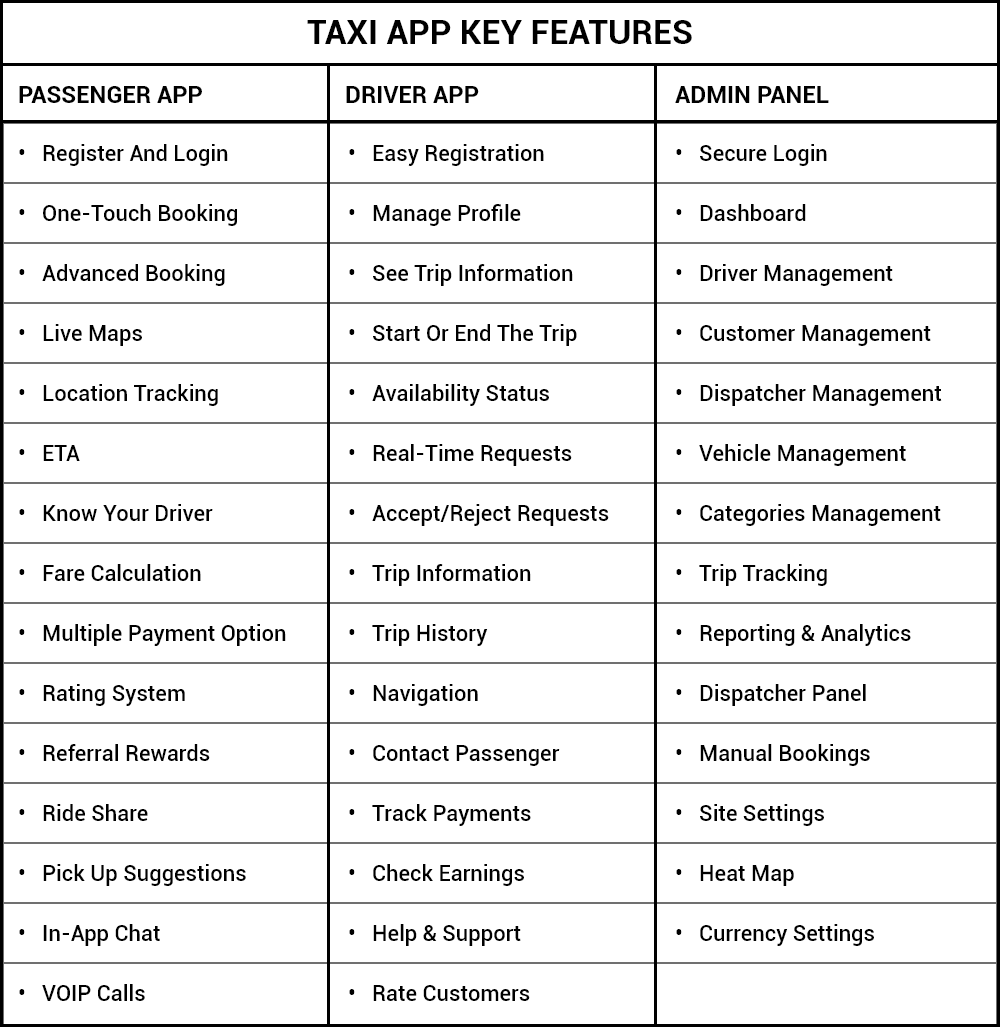
taxi-app-key-features-codiant

How To Create A Taxi Booking App: Steps To Follow

  1. Conduct A Market Research

Foraying into the market without gathering the insights is no less than shooting arrows in the dark. Ensure that you study the market, gather facts and figures, analyze them, and ultimately draft your own conclusion. While exploring the market for a taxi booking app, pay heed on the following checkpoints:

  • What is the actual demand of your target audience?
  • Have you chosen the right geographical area?
  • Will you be able to gather the required resources?
  • What payment mode will be suitable for your target audience?
  • Is your taxi booking app idea capable enough to beat the market competition?

And there can be a huge list of questions that you need to figure out at this stage. Ensure that you are simplifying the idea and making your app stand out in the market. In case, if you are standing on the same lines as your competitors then you won’t be able to pull out desired market results.

  1. Choose A Suitable Business Model

Selecting the right business model will decide the performance of your app in the market. It will include a decision on a few things like the type of monetization strategy, the structure of the app, the type of services offered, integration of third-party platforms i.e. payment, GPS, and more.

Deciding on these many factors will help you to streamline your taxi app development process. Pre-planning your strategies and having an idea of what can be done is always a good decision that eliminates unnecessary errors and things.

  1. Consider Technical Requirements And Specifications

Now, when you are done with the business model, you need to decide on the list of technical tools that will be used in your development process. Consider deciding the technical structure and architecture that you are going to integrate with your app. This decision will be done in the presence of a technical team who have thorough knowledge and experience or either you can also go for outsourcing a few resources to decide. After this stage, you will be able to understand the cost estimation, the development time, and the success rate of your taxi app.

  1. Decide The Best Resources To Work

This stage is again a critical phase because selecting the resources that would be carrying out the whole development process is not easy. You need to understand your team size, expertise, experience, and geographical location. Moreover, prepare a list of technical requirements and select team members like no. as developers, UI//UX designers, QA testers, project managers, etc. Ascertain that selecting people will be the most critical stage of the whole process because individual experts charge their own costs on an hourly basis. Best option is to hire a mobile app development company where you will get bundled expertise in transport and automotive industry.

  1. Supervise UI/UX Team With Your Brand’s Motive

This stage is essential because here you can actually visualize how your taxi booking app will look and how the design should align as per your vision. You need to start this process before moving on to the actual development. The UI/UX designers will understand the brand vision, goal and strategy and come up with different mock-ups and wireframes. So, you need to make pre-discussions and plan every minute detail of the design beforehand.

  1. Stepping Up With Backend Development

As the name suggests that backend process means the backbone of the whole development strategy. The developers are responsible to bind all the functions of the app and their outputs. This stage has to be perfect because the whole foundation is dependent on it. Most languages used in the app development process are JavaScript and Python. But there can be other languages as well based on the app requirements.

  1. Directing The Testing Process

This is probably the last stage of the app where the QA testing team will use various tools to understand the performance of the apps. The usability, functionality, efficiency, quality, and effectiveness will be checked in multiple environments. This step must be part of the development process because launching without going through the testing process can create blunders and a single error can ruin your efforts.

  1. The App Launch

After testing, you are good to go! Now you can easily release and launch your app in the market. Take the feedback from your customers and work on it. Also, the post launch maintenance and updates should not fall from the cracks.

Core Technologies Used

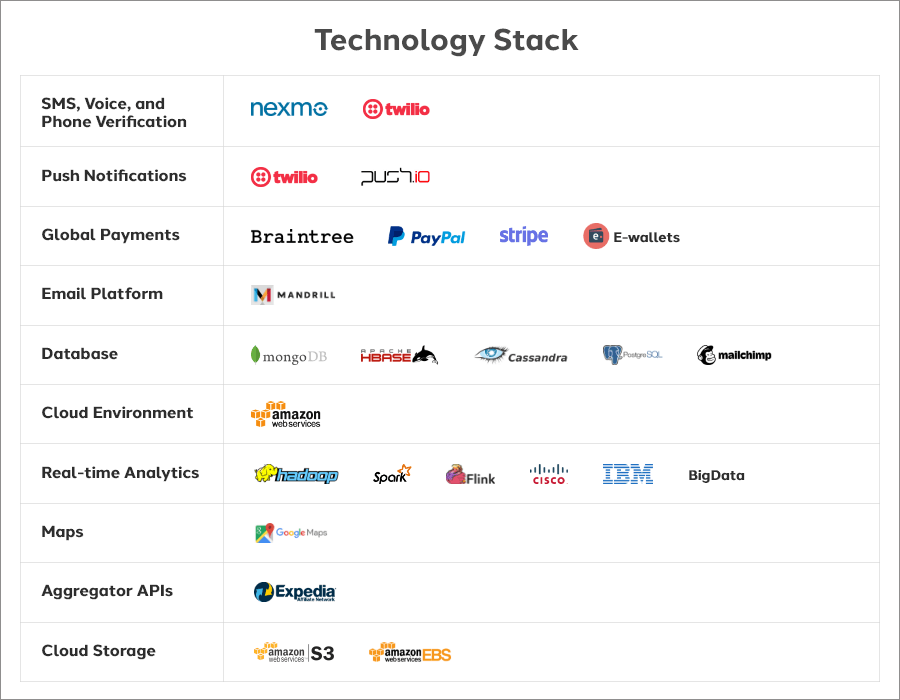
  • SMS Adaptor – Cloud communication providers like Twilio, Nexmo, Plivo, Sinch
  • Push Notifications – Google Cloud Messaging (GCM) and Apple Push Notification Service
  • Payment – Braintree, Stripe, Paypal
  • Email – Mandrill, SendGrid
  • Analytics – Google Analytics
  • Geo Location (Navigation) – Google Maps, Mapkit
  • Device Location – CoreLocation framework, Google’s Location APIs
  • Cloud – Amazon S3, Amazon Cloudfront

Competitor Analysis & Risk Factors

  • Lyft – Lyft was founded in 2012 in San Francisco, California. Like Uber, Lyft also operates in the Application Software space. It offers its services in areas nationwide and in roughly 220 cities, which includes Vietnam, The Philippines, Thailand, Singapore, Malaysia, and Indonesia.
  • Gett – Launched in London 2011, GetTaxi an Israeli on-demand mobility company is backed by Volkswagen and currently operates in more than 100 cities across the United States, the United Kingdom, Russia and Israel.
  • Grab – Founded in 2011, Grab is famous for offering its services in the Philippines, Indonesia, Vietnam, Thailand, Singapore, and Malaysia. They aim to make the taxi industry a safe and efficient transport medium.
  • Ola – Initiated in 2010 in Mumbai as an online cab aggregator, Ola has an extensive network that spreads across India, Australia, New Zealand, UK (169 cities) and with over 100,000 cars. Ola is famous for offering a diverse range of cab services through its mobile application.
  • Didi – DiDi was founded in 2012, and its headquarters is in Beijing, Beijing Municipality. Like Uber, DiDi also works within the Application Software sector and is known in the Chinese market. It has confirmed its partnership with Lyft, Ola, Bolt, and Grab to expand its global footprint in Australia, Mexico, Japan and Brazil.
  • Bolt (Taxify) – Headquartered in Tallinn, Estonia, Bolt operates in 34 countries and more than 150 cities. Bolt is hailed for offering the best commission to drivers and reasonable charges to its customers allowing it to earn over plentiful passengers and drivers.

Related Reading : Top Ridesharing Apps Worldwide and Lessons to Be Learned

taxi-cta

Revenue Model of Taxi Booking App

  • Dynamic Pricing – When the demand for taxi is higher than the availability like on bad weather days, strikes, traffic congestion, peak hours and public holidays, taxi aggregators can apply the dynamic pricing strategy by multiplying the cost per mile.
  • In-app Advertisements – In-app advertisements like video ads, banner ads, and interstitial ads can be another effective monetization strategy to earn money through app.
  • Promotional partnerships – By making partnerships with brands looking for marketing strategies can prove to be a win-win situation for both the parties. Such type of collaborations give a huge audience base to the brands and owners can earn money through it.
  • Premium Rides – Besides running the ordinary cabs, app owners can also give the option of premium rides and include luxury sedans, SUVs in their fleet and charge extra for the amenity. Like Uber gives a premium segment of UberBLACK, UberSUV, UberLUX and so on.
  • Commission – The commissions earned on each taxi ride the passenger books comes as a direct source of income for taxi aggregators. Like for e.g. Uber charges for a ride per km and the time spent and earns the commission on every kilometer.

Cost to Develop a Taxi Booking App

The total cost of taxi app development depends on the following factors :

  • App Platform – Do you want to develop the app on the iOS platform or Android or both? The cost varies platform wise.
  • App Design – The user interface and user experience is the essence of any app that grabs users’ attention and keep them glued. So, you should not compromise with the design for saving some bucks and hire the best UI/UX development company after checking their portfolio.
  • App Development – The development cost of a taxi booking app depends on the geographic location of the mobile app Development Company you’ve hired. Though the companies have different hourly rates, still app development market in India is relatively cheaper than that of the US market.
  • Third-Party Integrations – Apart from the development of features and functionalities in the Customer App, Driver App and Dispatch panel, if you go for any third party integrations it will add to the cost more as its development is time-consuming and require extra efforts.

A Ballpark Figure:

Still, if you want a ballpark figure for taxi app development or taxi dispatch software it may range from $20,000- $30,000 USD (Cost is subjected to change country-wise).

FAQ

1. How Much Does It Cost To Develop A Taxi Booking App?

The total cost to create an online taxi booking app ranges from $20,000- $40,000 USD. The app cost includes stakeholders like Rider App, Driver App, and the Admin Panel.

2. How Much Time Does It Take To Develop A Taxi Booking App Solution?

It roughly takes 4-6 months to develop the MVP or preliminary version of a taxi app operative on single mobile platform (iOS or Android). This includes rider app, driver app, Admin panel development and back-end development.

3. How to Create an Online Taxi Booking App?

Follow these steps:

  • Do a strong competitor research to study their business model and marketing strategies.
  • Identify a taxi app development business model you want to work on.
  • Research your target market and understand the current market situation.
  • Search for the best taxi app development company or a team of taxi app developers.
  • Select the technology stack and kickstart the app development process.
  • Develop a solid marketing plan and release the app in the market with solid campaigns.

4. What are the top taxi booking apps to get inspired from?

The top taxi hailing apps are Uber, Lyft, Didi Chuxing, Gett, Ola, SeeWay, GoCatch to name a few.

Blockchain Technology in Healthcare : Use Cases, Benefits & Challenges Unlocked

The blockchain revolution has forayed into the healthcare ecosystem, and it has come a long way to notable transformations. Unlocking the true value of interoperability, blockchain technology creates unique opportunities to eliminate the friction, cost and complexities, enabling trustworthy collaboration, and creating secure and immutable information.

Hiring a Blockchain App Development Company for forcing digitalization strength to strength in your healthcare app has become a driving necessity. With the overall vision of blockchain to disrupt healthcare, there are many potential use cases where it has enhanced healthcare operations. Let’s explore and understand. But before that, let’s take a cursory glance on what blockchain is all about.

What is Blockchain?

Blockchains are distributed systems that log transaction records on linked blocks and store them on an encrypted digital ledger. In other words, a block is a record of new transaction (medical data like medical device logs, patient’s sensitive information, temperature-sensitive medicine info during transport TTSPP time, or the location of cryptocurrency). When a new block is completed it gets attached with the old previous blocks carrying information and this way blockchain is created.

Use Cases of Blockchain in Healthcare

  • Supply Chain Management : Seamless supply chain management comes as a challenge in every industry but in healthcare it comes with complexities and risks attached which can directly impact patients’ safety and health outcomes. Blockchain technology secures and optimizes health supply chain for the manufacture, distribution, and dispensing of pharmaceutical products. It offers solution to keep a track on drug ingredients, temperature of medicines while shipping, product tracing and verification, detection of counterfeit, unapproved and dangerous drugs.
  • Secure Patient Healthcare Records : Blockchain technology can allow patients to access their care records by providing them with a security key that matches their provider’s security key. Blockchain helps in gathering massive amounts of patient data and facilitates patient data sharing and improving interoperability to help population health initiatives. It also ensures the integrity of medical record by keeping it safe and unaltered.
  • Making Patients Aware of Clinical Trials : Research has shown that 85% of patients were unaware of the relevant clinical trials during the time they were considering treatments which debarred them to benefit from treatments that the trials offered. Also, the inability of healthcare providers to recruit patients in need led to major loss of time and money spent on developing drugs. Distributed ledger in blockchain technology helped in increasing the quality and quantity of patients recruited for clinical trials by storing the medical data of patients anonymously and making it visible to trial recruiters which helped them to reach out qualified patients.
  • Makes Claim Processing Easier : Today, there is no transparency and visibility between both the parties i.e. the healthcare stakeholders and the patient. Smart Contracts in blockchain improves data accuracy for providers, regulators, and other stakeholders, and give them more control of their own data which makes the processing of claims and payments efficient, secure and frictionless.
  • Identifying and Matching Patients : In healthcare solving patient-matching is no less than a challenge. Blockchain is certainly a technology that can be used to track the unique patient identifier.

Related Reading: Meet the Top Five Industries Unlocking New Values From Blockchain

Unlocking the Benefits of Blockchain Technology

  • Data Security: Blockchain is equipped with the latest cryptographic features that safeguard patient sensitive information and all medical data. It helps in checking the data authenticity with the help of digital signature and provides full protection to data.
  • Cost Savings: This ledger technology eliminates third-parties and banks by enabling peer-to-peer transactions which aid in lowering the transactional cost at a greater extent.
  • Increase in Patient Satisfaction: A blockchain platform coordinates patient records, a history of procedures, and insurance claims to reduce redundancies and prevent losses. This helps healthcare providers to access medical history and insurance information and make quick decisions. This helps in improving the patient experience as well as the healthcare business model.
  • Accessing Distributed Data: Distributed ledger technology stores all the data in the nodes of a blockchain platform which allows hospitals, insurance companies, and patients to access the medical records from a single point which is secured enough and has full control that who should and shouldn’t see the patient’s data.
  • Healthcare Data Management: As aforementioned, if all the data has to be stored on a single point with open access will certainly add to woes and a severe threat to confidentiality. In such cases, permission blockchains such as Hyperledger Fabric or Corda set rules for giving permissions to companies to access the data.
  • Immutability: Data stored in the blockchain cannot be altered by anyone. Not even the admin, owner or third party.

Challenges of Blockchain Technology in Healthcare

  • Healthcare industry lacks structures to collect, share, and analyze information resulting in a lack of interoperability.
  • Existing systems are managed in an off-line architecture, with centralized, local databases, whereas blockchain technology is decentralized and in the cloud.
  • The inflated presence of healthcare units operating in off-line architecture, with centralized, local databases, makes it hard for existing systems to switch on blockchain, as the technology is decentralized and in the cloud.
  • Interoperability challenges among various healthcare professionals and hospital systems result in a lack of coordinated data management and exchange, resulting in fragmented health records.

With that said, blockchain can help improve interoperability, security, compliance, management, shareability, and accessibility of patient data in many ways. When are you going to adapt the ledger technology in your healthcare app? Our blockchain app developers have all the needed experience to meet your requirements and expectations.

Are You Taking A Swift Action To Improve Doctor-patient Communication?

Effective doctor-patient communication is the heart in building a therapeutic doctor-patient relationship which consequently becomes a conduit in reinforcing the doctor’s ability to gather minute health and daily lifestyle information of the patient in order to facilitate accurate diagnosis, counseling, and establishing a caring relationship with patients.

Good doctor-patient communication offers patients tangible benefits. And healthcare chats apps and/or Telemedicine apps comes as the biggest rescue to fuel better and reliable interpersonal communication.

From real-time conversation to video conferencing, remote care to personalize monitoring, managing patient records to coordinating care & more- doctors and caregivers are no short of reasons to adopt the new holy grail of healthcare – the telemedicine apps. Before we move on to unwrap the row of benefits the healthcare chat app offers, let’s quickly go to the facts and figures.

Did You Know?

  • 75% of the doctor, urgent care & ER visit could be safely handled over a video chat or phone call.
  • 79% of respondents to a survey say that they feel more connected to healthcare providers who don’t spend a lot of time on paperwork during visits.
  • 93% of physicians find value having a mobile health app connected to Emergency health services.
  • 74% of hospitals that use tablets or other mobile devices to collect information from patients are more efficient than those who don’t.

Top Benefits Healthcare Chat App Offers:

  • Good Doctor-patient CommunicationSeamless communication between the doctor-patient helps doctors in regulating patient’s emotions, facilitate comprehension of medical information, and allow for better identification of patients’ needs, perceptions, and expectations. Healthcare chat apps provide one-to-one secured and private communication allowing patients to connect with doctors anytime, anywhere.
  • Medical Report SharingHealthcare chat apps upgraded with WebRTC technology helps patients and doctors in exchanging medical reports, X rays, e-prescriptions, images etc. within the message thread making it simple for both the parties to share the files without the threat of getting damaged or lost.
  • Accessible to Remote AreasOften patients in remote areas are deprived of quick care in case of chronic diseases and have trouble accessing doctor consultations. The patients have to endure longer appointment commutes and spend big bucks for small chronic treatments. With telehealth, patients in a rural or remote area can get quicker access to healthcare specialists thus saving time and travel costs.
  • Reduction in CostRemote care, e-prescriptions, and online consultations significantly reduce the healthcare cost, saving money for patients and doctors as well. Recently, the American Hospital Association reported on a telemedicine program that saved 11% in costs and more than tripled ROI for investors.
  • Group Communication with SpecialistsLack of communication creates situations where medical errors can occur. Multi-way Video Calling enables doctors to invite other participants that may include other healthcare specialists, surgeons to join the call and achieve perfection during both diagnosis and treatment.

Apart from the ones discussed above, fitness apps, personalized monitoring, and wearable apps also account for a good reason to elevate patient care.

Final Word

As per the latest research, patients reporting good communication with their doctor are more likely to be satisfied with their care, and especially to share pertinent information for accurate diagnosis of their problems, follow advice, and adhere to the prescribed treatment.

Integrating WebRTC in healthcare solution or just developing a “telemedicine mobile app” has become a pivotal need for quality patient care. Healthcare professionals should understand the significance of doctor-patient communication and the serious consequences of miscommunication and act upon it promptly.

How Augmented Reality is Reshaping Real Estate Industry?

As the demands of potential home buyers are skyrocketing with boom in internet, Realtors are leaving no stone unturned to meet their rising demands. If buyers wish to see the property without leaving their cozy homes and offices, AR based real estate apps have proven to be the tickets of their living fantasy.

Augmented Reality is bringing real-world experience by creating an artificial environment in real-time and trust us there can’t be any better way other than AR and VR for digitally touring properties.

According to Emarketers US VR and AR forecast, 42.9 million people in the US will use VR, and 68.7 million people will use AR at least once per month. This represents 13.0% and 20.8% of the population, respectively.

The magnitude of AR in real estate is more nuanced with its ability to leave the mark on potential home buyers, owners and real estate professionals. Here we jot down the numerous ways augmented reality apps are contributing in revolutionizing the real estate industry.

real estate app case study

Benefits of Integrating AR in Real Estate App Development

  • AR Allows To Take Virtual Tours Of Apartments – Virtual reality platforms allow the user to tour an apartment, ask questions, record presentations, and make notes. An app named Realync works on the same perspective.
  • Saves Realtors and Buyers Time – It comes as a big sigh of relief for agents with AR/VR. Displaying homes has become a lot easier and smoother for their prospective clients. With interactive experience, AR apps also allow realtors to know when a prospective customer is viewing their property and their location.
  • Allows Clients to see the Location of Properties – The GPS Geolocation technology in the AR app allows the client to view the location of properties that are close to their current location.
  • Enables Immersive Viewing Experience – AR apps provide clients with a three-dimensional viewing experience as well as visual communication of property for interactive presentation. It allows buyers to experience the look and feel of property inside out.
  • Brings Life to Intangible Products AR lets you visualize the products in real-time in 3D (e.g. opening doors, rearranging furniture, exploring property amenities etc.) which reduces the sales time and increases the likelihood to pre-sell the projects.
  • Fasters Decision-Making Process – Some clients may miss out on finding the perfect property simply because they aren’t inspired. Immersive AR experiences narrow down the choices of viewers to explore more property since they get the abilities to envision the possibilities of their dream home and get a real-like view as per their taste and imaginations which easily satisfies them without having the need to hunt for more by going places.
  • Helps in Effective Marketing – Realtors can use AR-enabled app as an effective marketing tool. By seamlessly showcasing the properties to investors they can quicken their decision-making process of whether or not they wish to invest in the property. Furthermore, the geofencing feature allows realtors to send right notification and messages to the right audience at the right time.

augmentated reality app developers

The Bottom line

Augmented Reality apps have gained massive momentum after Apple’s ARkit debut last year. More and more real estate companies have dipped their toes in the water. Also hailed as future of home showings, AR apps have accelerated sales for property agents, brokers, and architects. So why miss out? Contact a real estate app development company and leverage the benefits of augmented reality now.

How Workout Apps Are Saving Big Bucks of Fitness Enthusiasts?

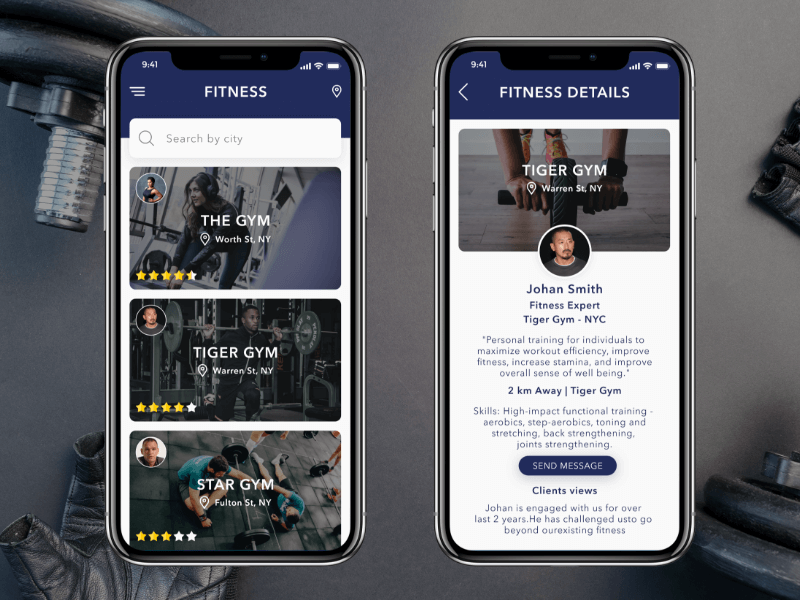
Workout Apps are new cool and it’s no secret! Now no fitness enthusiast out there looking for an optimized workout with specific instructions fear the whopping charges of hiring a personal trainer. Whether you’re a gym person, at-home workout obsessed, or looking for sessions to shed down weight by following a conscious diet plan there is an app for it. With plenty of fitness routine options, high intensity-interval training packages, diet and nutrition plans and more there are many different types of fitness apps securely sitting in the home screen of fitness enthusiasts.

Here we round up the set of activities that is helping fitness aficionados to workout in a regimented way while sparing the hefty expenses a personal trainer would otherwise charge.

  • Workout streaming service is known for on-demand workouts where you can tune with live Daily Burn workouts with trainers. The workouts here extends to a timeframe of 10, 20, 30 …minutes depending upon the plans.
  • Offline workouts apps come feature-packed with unlimited audio workouts that feature recorded coaching from different trainers.
  • Diet and nutrition app that offers meal plans, grocery lists and recipes. They offer healthy eating plans that align with your nutritional goals or weight loss goals.
  • Fitness tracker apps also comes with the ability to track the water intake, set up reminders to drink fluids, and can help quickly assess hydration with handy graphs.
  • Yoga workout apps built for strength, flexibility, and conditioning brings tranquility through its sessions, unlock new virtual environments, tracks progress and help you stay motivated.
  • HIIT aka high intensity-interval training app is the strength-training workout apps loaded with full directions and video demonstrations that works wonder for people who want to work out at home and get trained on how to put together solid workouts. The HIIT workout app also offers preset workouts or a “smart workout” based on an assessment of your fitness level.
  • Social fitness apps allow users to share their fitness data with friends, family and other users. Sharing goals and accomplishments helps them to stay motivated.
  • Competitive fitness apps connects users with their friends and other anonymous people and enable them to compete against each other.
  • Moreover, if you are an athlete, maybe a runner, cyclist, or yogi, fitness apps like Strava, Asana rebel, Gixo can be your best bet.

With all these features packed in the apps, it becomes really easy to stay fit and save the major investment on personal trainers.

In this flourishing mobile app industry, developing a Fitness app has become a new mantra of progress! Whether you are a gym owner, personal trainer or a fitness coach stay up with the trends and shift your business online.

Fantasy Sports: Statistics, Emerging Trends and Investment Opportunities

Fantasy sport is an increasingly significant social phenomenon whose penchant has risen to elite ranks- ample enough to attract big investors, fantasy players, and fans. From draft party to brand marketing and sponsorships to playoffs fantasy sports get fans engaged with the competition. And in that flux, fantasy sports app participation inflates to follow weekly matchups, make trades, check updated score etc.

The meteoric rise of fantasy sports players had remarkably impacted the financial bottom line of the business which aggregates league fees, transaction fees, web hosting fees, challenge games, informational materials and so on.

Here we conduct systematic research that employs data from famous and most trusted research institutes and agencies. Have a look.

fantasy-sports-infographics
//Of the 56.8 million players, more than 40 million play fantasy football.

Interesting Fantasy Sports Market Statistics (India)

  • India is fast becoming the battlefield of fantasy sports operators with a whopping number of 60 operators and growing.
  • Rapid growth in India in the last 2 years- from 2 million users in 2016 to 20 million in 2018.
  • Out of the users who have ever played fantasy sports- 96% of them have played it at least once in the past 1 year.
  • With 20 million fantasy sports users, India rapidly catching up with western countries.
  • Fantasy Sports is highly sticky- 89% of the users play it at least once a month.
  • Engagement wise, users spend 42 minutes a day on a fantasy sports app.
  • 2 out of 3 or 67% of online sports fans in India are aware of fantasy sports.
  • Projected Fantasy sports users by 2020- 100 million, 30% of online sports fans in India.

Investors Are Spending Millions into Fantasy Sports

Reports say fantasy sports are paralleling online stock trading. People who engage in online stock trading (over 44 million in the U.S. alone) are three times more likely than the general population to play fantasy sports online, according to Nielsen data.

Draft Kings and FanDuel – daily fantasy football apps – have witnessed successful venture capital raises and market shares with driving consumer demands.

The Growth Opportunities in Figures

America is the largest production of Fantasy Sports, the revenue market share over 58% in 2017, the second-largest area in the world is Europe, and revenue market is about 14% in 2017.

According to a study, over the next five years, the Fantasy Sports market will register a 13.24% CAGR in terms of revenue, the global market size will reach US$ 33199.64 million by 2025, from US$ 13906.77 million in 2018.

Related: How to Develop a Fantasy Sports Mobile App like Dream11?

How Codiant Can Help You?

Codiant proffers all types of fantasy solutions to the clients globally. We have delivered an array of fantasy sports app and web development solutions including daily and season-long fantasy sports with fully customized and integrated features.

5 Promising Features Of IOS 13 Developers Need To Know About

Unsurprisingly, Apple is known for breaking its own records and no denies it has always kept its bar high and relentlessly made the user experience much more mesmerizing. Thanks to the incremental improvements.

And with iOS 13, it feels Apple’s main focus is on quality-of-life updates. In developer lingo, it’s all about refinement. We all have gone through the list of iOS 13 updates no less than a whale, but when compared to previous versions of iOS, there is a line of lesser-known features that failed to make big headlines but are most sought after. Here is the promising list:

1. NFC Gets More Muscles

NFC that powers Apple Pay has got more powerful. As said in the WWDC conference, now apps will be able to write directly to blank tags, as well as interact with tags through native protocols instead of only allowing iPhone apps to read NFC tags. This opens up a range of new application possibilities for developers, including the ability to develop iOS apps that read passports and contactless smart cards and interact with NFC-enabled hardware.

nfc-gets-more-muscles

2. Security and Privacy Got New Layers

Whoa! Unlike in the previous version now you will start to see reminders about apps that track your location. This new iteration will periodically remind you about apps that are tracking your location in the background. No wonder you can always limit the tracking. Not the end, the apps that annoyingly wanted access to Bluetooth now can be declined; second, the personal notes feature in users’ contacts is now totally personal (no app can see what’s in it). Last comes with sigh–you can remove the location data from a photo before sharing anywhere.

3. Photo Adjustments Takes A Step Forward

Another cool feature to shout out! Though other apps have this feature for ages, having it in Apple is a new add-on. Now you can easily adjust perspectives in the photos meaning you got the ability to adjust the x-axis and y-axis skew for a photo.

photo-adjustments-takes-a-step-forward

4. Locating What’s Lost Got a Lot Easier

The Find My app becomes an umbrella app for both Find My Friends and the Find My iPhone apps. Now you can find whatever you need to find from a single app. Plus, it has a nifty feature to awe you- it allows you to find lost devices even when you don’t have a WiFi or LTE connection.

5. Keyboard Comes in Action with QuickPath

Apple finally added a new swipe keyboard option with iOS 13. The new gesture-based keyboard available directly from the system keyboard is smart enough to offer suggestions through the QuickType bar, and help you auto-complete your sentences.

It’s a wrap! Stay tuned for more updates, soon in the next blog we’ll have a war of features between Android Q and iOS 13.

Top Taxi App Features to Outdo Giant Competitor like Uber

Competition for Taxi Apps heats up in Asia, Europe and the Americas as home-grown apps flourish across the region. The Taxi booking app industry sorely needs a range of game-changing features to compete with Uber-like upstarts.

In the wake of excessive competition where every next brand is trying to have the back of customers in every service they offer, it has become vital for taxi operators to adopt all those laidback features that can level-up their game against the aggressive rivalries and give them an exclusive facelift to make a dent in the taxi industry.

If you are one such taxi fleet owner and operator vying for those unique offerings that others have yet not eyed upon then congrats you took the hiatus on the right place. Here we uncover the passenger’s most wanted line of features.

1. A Personalized Chauffeur Treatment

Hire highly experienced, licensed, and professional chauffeurs who are fully committed to giving your customers a luxurious ride-hailing service. There is no better approach than making your customers feel aristocrat while they’re taking an ordinary road transit cum a taxi app ride.

  • A Service level Chauffeur gets the doors opened for riders.
  • Takes the scenic route if a rider wants to see the sights, or take an optimized route to their destination for sparing their time.

These services give customers a heavenly treatment and make their ride extra special, stylish and lavish.

2. A Bespoke Journey As Per Rider’s Taste

Tailor the journey of your riders’ as per their own preferences and tastes. Ask your riders for their music choice, favorite route, and cab temperature settings. This way you can make their journey extremely relaxing and delightful.

3. Pre-Book Airport Services

Unlike Uber and other similar apps, keep your app flexible enough that allows customers to pre-schedule airport rides and let them choose an option to request Airport Gate Greeter service.

  • Chauffeurs can welcome riders’ by standing with a name sign at the arrival gate.
  • Give riders’ ease by handling their luggage and taking them off to a smooth ride.

4. Introduce A Unique Referral System

No denying as a business we always think of generating profits. But this time think of customers’ profit as well. Offer them a unique referral code that allows the riders to refer to other riders and offer them a chance to earn commissions every time their referred riders take a ride.

5. Advanced Ride Scheduling

We’ve seen travelers pre-booking their flight, bus or train tickets months before. Why not make their travel transit fully accomplished by letting them pre-book their taxis as well!

Allow your riders to pre-book the rides a month before at fixed price charges while guaranteeing them no price surge and an option of a refund if they cancel it before specific timeframe decided by you. This gives riders peace of mind for their safe journey and also an extra privilege of getting the money back in the wallet in case they happen to cancel the journey.

In order to outdo the rivalries in this intensified taxi hailing competition it has now become crucial for taxi operators to develop an outstanding taxi app that adopts first-string features and functionalities for making rides extra luxurious and lavish.

Looking To Embed Advanced Taxi App Features In Your Existing Taxi Booking App? OR Want To Get Built A Taxi App From Scratch?

Contact us

Know the Cost and Features of Mobile Wallet App Development

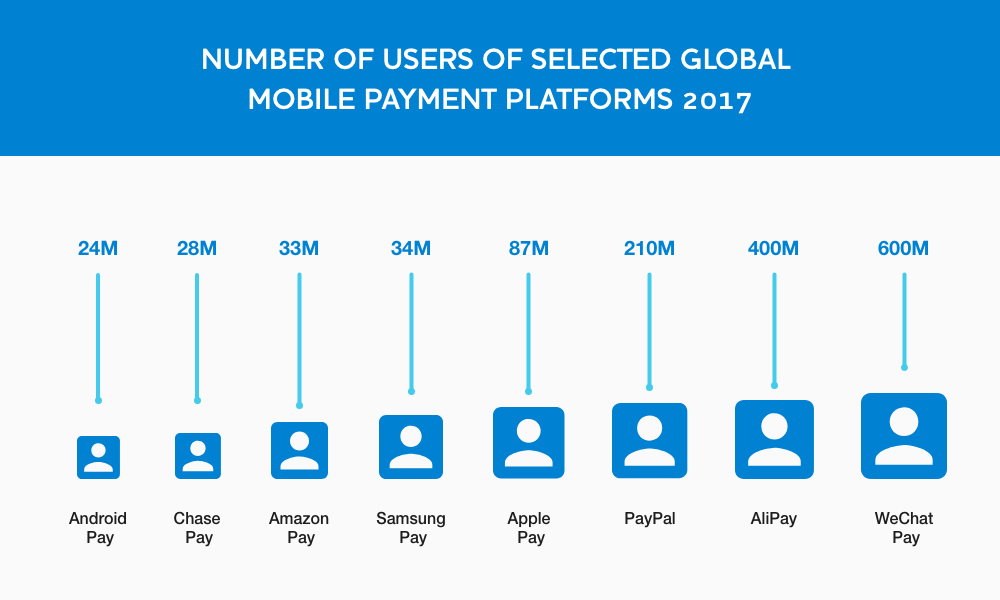
Mobile wallet has become the dominant mobile payment system around the world, replacing cash and physical wallets, and by 2020, the next-gen payment technology market transaction value worldwide will be around $9000 billion.

Industries like Retail, Financial establishments, telecommunication companies, transportation, logistics, and technology companies are tightly connected with the mobile payment technology and their dependency on it is increasing exponentially, of which, E-commerce has swept a large part of its rapid growth.

In this flourishing online marketplace where digital wallet has become the engine of mobile commerce, it has become extremely vital for online companies and businesses to integrate m-wallet in their apps and match the pace with the accelerating virtual world.

If you are amongst those online companies juggling to determine what mobile wallet type you need, list of features that should be included in the app and if you’re crunching the numbers in the head for total cost estimation of mobile wallet app development then you have landed on the right place.

Before we plunge in depth, let’s take a glance on the economic and growth potential of mobile wallets and their SWOT analysis.

Related: How much does it cost to develop a mobile wallet app like Paytm

SWOT Analysis

1.Online Merchant Proprietary Wallet

Strengths :

  • Control the commerce experience
  • Access to customer data
  • Keeps the customer in the merchant’s online environment

Weaknesses :

  • Requires customer onboarding
  • Limited to a single merchant, not leveraged across merchants categories
  • Program administration is extensive
  • Increased risk of fraud/data theft

Opportunities :

  • Lower cost
  • Can incorporate promotion/loyalty into the experience
  • Control the shopping cart

Threats :

  • Third-party UX may be superior
  • Risk of competitive incursion from every other wallet

2. Online Merchant Third-party Wallet

Strengths :

  • Customer experience (one-click buy)
  • Lowers cart abandonment rate

Weaknesses :

  • Lack of control of the experience
  • May not have access to customer data
  • Multiple providers on the same site can confuse customers and increase cart abandonment

Opportunities :

  • Fast and easy to implement for merchants

Threats :

  • Competitive incursion from OS/OEM providers whose wallets can be used for online purchases

Source : Aite Group

Key Features of the User Panel

  • User Registration : For smooth and easy sign-up enable the user to sign-in with their social media accounts or email id.
  • Authorize Bank Account : Users are asked to fill in their bank details through which they want to carry out their transactions.
  • Add Balance : Users can load money in their e-wallet and use it for the transactions.
  • Check Balance Status : Users can check their wallet balance after making successful transactions.
  • Money Transfer : Users can easily transfer the money to other users by entering their account information.
  • Transfer to Account : Users can also transfer large funds to other users quickly and conveniently.
  • Pay Bills : All bill payment can be done by the payments stored in the m-wallet or directly by users’ bank account/ cards.
  • Split Bills : An interesting feature that allows users to split the bills among their group by adding other users’ account information.
  • Push Notifications : Users receive notifications about offers, promos, cashbacks etc. so that they can redeem it immediately.
  • Invite Friends : Users can also rope in their family members, friends and circle by invite friends’ option. And in order to promote the app, you can also giveaway points/money on successfully added referrals.
  • Transaction History : Users can track the entire transactions made by them in the past.
  • Budgeting tools : This tool helps user to flexibly plan their budget and track spending, so as to stay in control and achieve the goals.
  • POS Integration : POS system stores credit and/or debit card info and allows for digital payment.

Key Features of the Admin Panel

    • Dashboard : It allows admin to track and monitor details of the registered users.
    • Create QR Code : The QR code is generated by the Admin for the user to carry out online transactions.
    • EMI Options : Admin can set the EMI option for clearing payments making it affordable for users.
    • Push Notifications : Admin can send push notifications to customers reminding them about the in-wallet coupons and offers.
    • Promotional Offers : Admin can give special offers to customers during festivities, special occasions, etc.
    • Manage Customers : Admin can manage customer information, add/block registered customers.
  • Usage Analytics : Admin can access reports of no. of daily transactions, no. of app downloads, offers that are most liked and availed by customers etc.
  • Manage Revenue : Admin can track total revenue earned till date.
  • Manage Promotions : Admin can add or remove various running or scheduled promotions.

Additional Features

  • Digital Receipt : Through this feature, you can send a digital receipt to customer after every transaction.
  • Categorization : This feature helps user in organizing the cards and sorting them indifferent categories.
  • Secured Transactions : Add a protection layer to your app by enabling users’to access throughtheir digital signature.
  • Rewards & Points : Keep your users engaged by offering them reward points, loyalty points, cash bonuses,etc.
  • Fully Protected : Develop a PCI compliant secured mobile wallet app to protect your app against any vulnerabilities.
  • Refer a Friend : Allow users to earn by referring a friend.

Hurry! Want to develop a mobile wallet app like Paytm, mobikwik or freecharge? It’s easy to start.

Hurry! Want to develop a mobile wallet app like Paytm, mobikwik or freecharge? It’s easy to start.

Get in Touch

Top Ridesharing Apps Worldwide and Lessons to Be Learned

It’s not always necessary to experiment or commit a mistake and then learn. Agree? The experiential learning can be gained by a greater insight into your competitors working business model. Simply by analyzing your competitors’ key business strategy and watching whether their idea or strategy works in practice or not can provide you a glimpse of what to follow and what not. Fortunately, this thumb rule follows everywhere from sports to business. Online Ride-hailing business is no different! Not all ridesharing apps are created equal, and apparently, this comes as an inspiration that emboldens the framework for Do’s and Dont’s. Here we come with a round-up of top ride-sharing apps worldwide and their key strategies and/or innovations in place which may help you to scan the domain and substantially develop a taxi app that would be loved by many.

1. Uber : Leads the Pack

Uber the ride-sharing giant allows the customer to book a private or shared car with a few taps from a mobile app with payment taken by different modes as per the users’ ease. Founded in 2009 by CEO Travis Kalanick (now resigned) and Garrett Camp Uber has become the entrenched transport option. Range of ServicesUberPop- Peer-to-Peer rides UberPool- Ride-sharing UberChopper- Aerial tours(12 min, 15 min and 25 min)

Source: UberRange of Cars: UberX, UberXL, UberSelect, UberBlack, UberSUV, UberLUX Areas of Operation: Available in more than 600 cities across 65 countries of the world Related: How Uber Works? Know the Uber Business and Revenue Model

2. Lyft

Lyft- an Uber-like taxi app solution was launched in 2012 by Logan Green and John Zimmer. Considering the ridership volume, Lyft is the second-largest carpooling service currently available. Range of Cars: Lyft Lux, Lux Black, and Lux Black XL rides Areas of Operation: Available in approx. 300 U.S. cities, 2 Canadian Innovations

  • Surge Prices in prime time never reaches the height as sometimes Uber charges.
  • Lyft does not take the cut of revenues from the surged prices.
  • Lyft offers in-built discounts when times are slow.

3. GETT

Formerly known as GetTaxi, Gett is one of the fastest growing cab-hailing services in the United Kingdom, known for its black cabs and corporate ground travel specialty. Range of Cars: Gett Taxi, Gett Green, Gett Taxi XL Areas of Operation: It covers more than 120 cities globally, but only has a U.S. presence in New York City right now through its partner Juno. Innovations

  • Gett pays its drivers hourly wages rather than a percentage of every fare.
  • It is more reasonable when it comes to pricing, though it charges a premium during busy hours.

4. DidiChuxing

DidiChuxing is not quite as big as Uber globally, but it is the biggest ride-hailing service in China. Uber has a fierce war with DidiChuxing in China. Uber completes 1 million daily trips in China, whereas, Didi completes 1.5 million trips each day in China (and 30 million rides per day in 400 cities). In terms of revenue, DidiChuxing was valued at $20 billion as of February. Uber is currently valued at around $62 billion. Range of Services: Peer-to-Peer rides, car-pooling services, bike sharing services Range of Cars: Economy Sedan: DiDi Express DiDi Express Select, DiDi Express Pool, DiDi Taxi, DiDi Premier, DiDi Bus, DiDi Car Rental, DiDi Mini Bus, DiDi Enterprise Solutions (Luxury Sedans or SUV), DidiLuxe (Luxury Sedans), DiDi Bike Sharing (Bicycle). Areas of Operation: Available in 400 Chinese cities, Brazil, Japan, Mexico, Australia, Hong Kong, Taiwan Innovations

  • Made significant investment in AI technology, Machine Learning and Big Data to predict and meet riders’ needs.
  • Made investment in green initiatives such as new energy vehicle networks.

5. GRAB Taxi

Founded in Malaysia by Anthony Tan in 2012, GrabTaxi is a growing taxi-booking service in Southeast Asia. Range of Services: Taxi, cars, carpool and courier services Range of Cars: GrabCar (Sedan), GrabCar+ (Premium vehicles), GrabCar Economy 4-seater option. Areas of Operation: Available in 21 different cities across 6 different countries in Southeast Asia: Singapore, Malaysia, Philippines, Thailand, Vietnam and Indonesia. Innovations

  • Grab does pre-screening of drivers.
  • From 4 to 13 seaters, economy to premium, Grab has every type of car you need.
  • GrabCar provides a range of limousine services and vehicles for passengers with different needs.
  • Passengers can also rate the driver through “share-your-ride” over social media.
  • GrabTaxi has integrated GrabCar into its existing mobile app in order to maximize its current customer database.

Reboot the Future of Transportation

Make your own operating philosophy while you head towards developing a taxi app. Design a product that fosters collaboration and innovation across every touch point and create a taxi app that umbrellas the need for everyone.

How to Battle With the Most Common Challenges of an Online E-commerce Marketplace

Being an e-commerce startup entrepreneur, challenges come gifted as soon as you kickstart the ecommerce business. We often see companies tussling with them without any principle to embark upon agile transformations in order to achieve desired objectives.

ecommerce-codiant

Based on our experience across numerous e-commerce operating models, we see the following most common challenges faced by e-commerce businesses of all sizes.

Product Sourcing- Choosing the Right Product

Product sourcing refers to finding and buying products at a real wholesale price and to sell through your business online for a profit. This comes as the most initial and challenging task to tackle when starting an e-commerce marketplace.

If you’re just invading into online retail sales, you’d have a clear picture of sourcing products and about its various techniques that gives best profit margins.

There are five major types of sourcing techniques:

1. Drop-shipping – Dropshipping is a process where your wholesaler stores all the products you offer on your website. When you make a sale online, the wholesaler is responsible to ship the product directly to your customer. Your customer pays you the retail price listed on website, and you pay the drop shipper your wholesale price. This way online retailers can benefit from dropshipping.

2. Light bulk – A term coined at WorldwideBrands.com, it allows you to buy products from your wholesale supplier in small and affordable quantities. Here you’re in charge of warehousing the products and shipping them to your customers.

3. Volume Wholesale – On contrary to Light Bulk, in Volume Wholesale you can buy products from a wholesale supplier in large quantities and you’re responsible for handling storage and shipping.

4. Importing – When you buy goods from manufacturers in other countries in a large amount, with cheap production.

5. Liquidation – When you purchase merchandise in a bulk from reclamation centers or B2B auction websites.

Key Takeaway:

  • DropShipping is the most used and proven method for new sellers to start with for Product Sourcing.
  • It eliminates shipping and storage issues and any inventory investment.

If in case you’re totally a new beginner or don’t opt for dropshipping than here are a few.

Tips and techniques for inventory management:

  • Set par levels of the products i.e. minimum amount of products that must be present all time.
  • Practice FIFO (First-In First-Out) for non-perishable products.
  • Prepare and plan for unpredictable situations.
  • Do regular auditing.
  • Make a breakdown of products with a low, moderate and high-frequency of sales.

Segmentation and Buyer Personas

Customer segmentation means breaking your customers into groups of like buyers those have similar characteristics and make a strategy for each group. While Buyer Persona is a method to customer segmentation that in simple definition by HubSpot can be defined as the “fictional characters created to represent the different buyer types within a targeted demographic, attitude and/or behavior set that might engage with a site, brand or product in a similar way.”

When it comes to e-commerce marketplace it is a very head-scratching task and not at all an easy feat to segment customers. It is hard to scale, optimize, and maintain different buyer personas.

Tips and techniques to segment customers:

  • Define your personas broadly. Don’t bifurcate them at a very granular level initially otherwise you’ll end up in marketing and acquisition strategy. Rather drill them down in collecting persona details and knowing your customers closely. You can do your customer research by utilizing tools and bring them altogether.

Generating Targeted Traffic

As soon as you plunge online, “be everywhere” online is mandatory. Expanding your reach & word of mouth on one or more platforms seems to be the only way out. Well, maybe not. Focusing on one single channel keeps your all resources on a single point-– especially when you’re totally a new beginner.

Just a little homework before you opt for a user acquisition channel-> Identify your target audience. Create a marketing campaign that targets your customer persona, run it with your own small budget and cross verify the engagement by tracking the click through rate via website analytics.

  • User Acquisition Channels – Find and identify your own user acquisition channel through the following steps.Take it from Growth Marketing Conference.
    • Understand common growth channels
    • Identify your competitive advantages
    • Pick your top 1-3 channels
  • Digital Marketing – Digital Marketing channels are the most powerful engines to drive traffic to your online store. Activities like SEO, PPC, email, display ads, social media marketing, retargeting and affiliates help in driving quality traffic to the online website.

Customer Retention

In an online e-commerce marketplace, it is easier and less expensive to retain customers than to acquire the new ones. To woo your customers and to bring them back for more you’ve to set your sales goals, map your own customer journey by analyzing questions that convert on a purchase. You can ponder over questions like:

  • How your customers did became aware of your e-commerce website?
  • Do you get lot of referrals?
  • Are your customers following you on social media?

Once you know your customer journey, start applying your lead acquisition strategy that works best, optimize it on each step and improve customer retention in the process.

Choosing a Long-term Technology Partner

When you head towards running a successful e-commerce marketplace, it is necessary to seek an e-commerce development company that can be your technology partner for the long term. Online markets are often dynamic. They are subjected to change and develop progressively with new technology market trends. In such scenarios where you aim for continuous growth hiring a reliable e-commerce solutions provider is a go-to choice.

How to Make a Delivery Service App like Postmates?

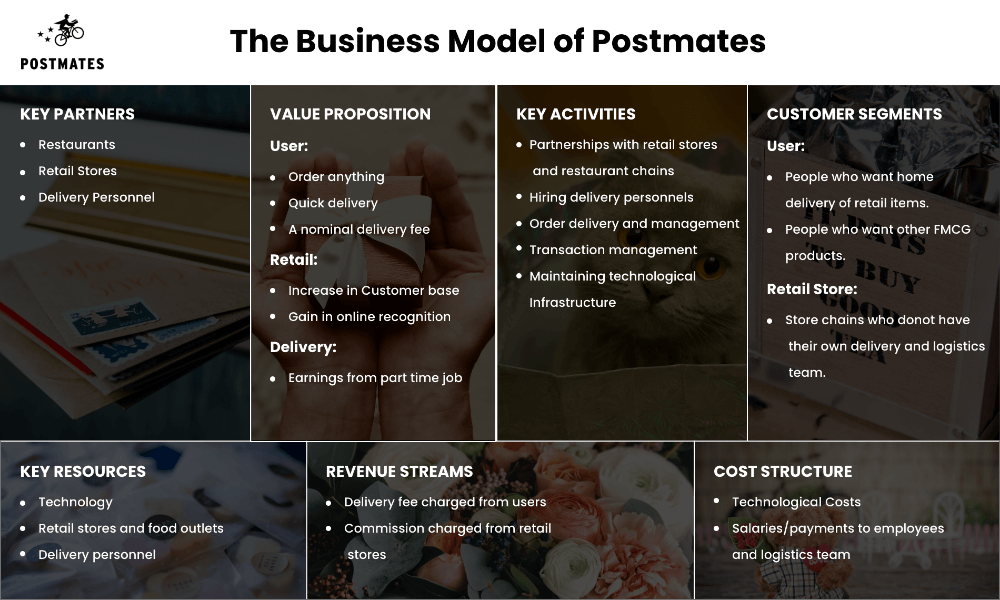
Undeniably, Postmates has become an umbrella term for on-demand logistics and delivery. This urban logistics and delivery platform that powers local, on-demand logistics focused on fast deliveries from any type of merchant at scale bridges the gap between merchants and users and often reduces transactional friction by looping middlemen out altogether.

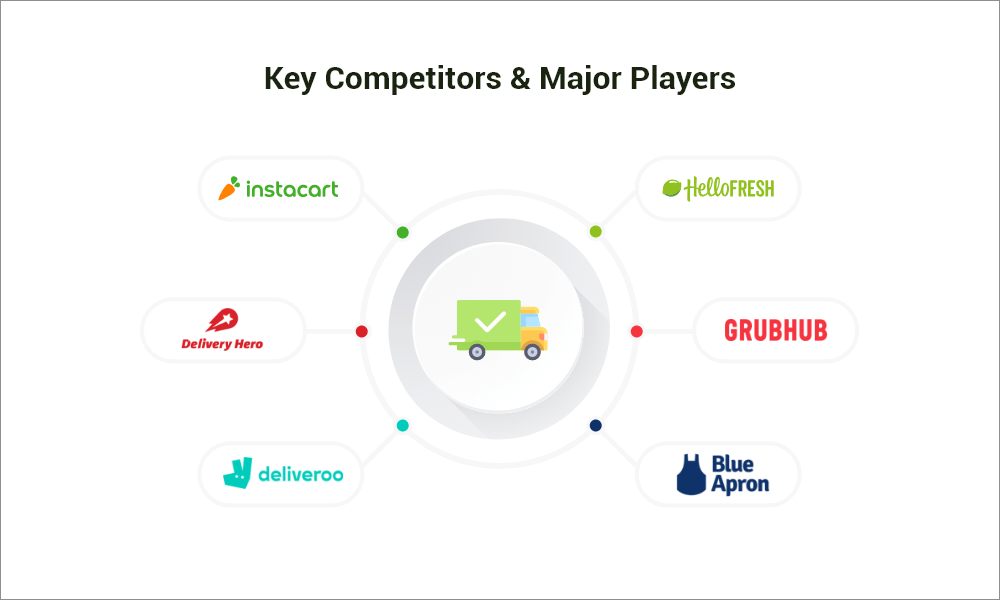
In line with several other on-demand unicorns like UberEats, Deliveroo, Doordash, Instacart …these platforms have emerged as the leaders in the food delivery market. But unlike them, Postmates has not limited its reach just to food delivery but has widened its horizon by offering to deliver or pick up anything from anywhere at any time across your city.

Imbued by the same, there are many new delivery service providers popping up with the desire to build an outstanding platform like Postmates in this app-crowded market. To make their homework easier, we decided to get down to the nitty-gritty of developing an on-demand logistics and delivery app in full swing.

"postmates/

Some Facts and Figures

Year founded: 2011

Founders: Bastian Lehmann, Sean Plaice, Sam Street

Postmates’ share of the US food delivery market- 9.1%

Number of businesses that partner with Postmates: 250,000 businesses

Number of cities Postmates operates in: 400 cities

Average number of Postmates deliveries per month: 2 million

Size of Postmates delivery fleet: 60,000

Estimated value of Postmates: $1.2 billion

//For a few more interesting Postmates statistics click here.

postmates-competitors

Key Features

The app has four main roles:

  • Customer App
  • Vendor App
  • Driver App
  • Admin Panel

Customer App:

  • User Authentication (Sign up, Log In, Log Out)
  • Profile Creation and Profile Management (Add, Update, Edit information)
  • Smart Search (Search via category, subcategory, and keywords)
    • Search nearby restaurants, retail stores from your current location and saved addresses.
  • Order Food/any other item
    • For Themselves
    • For Another Person (Friend, Relative, Business Partner)
  • Pick up & Drop (Select the pickup and drop-off location of order within the app)
  • Service Tracker: (Track request based on service like order accepted, waiting for the retailer to confirm, order accepted, under process, driver accepted the info, driver picked item and on the way to drop off location)
  • Track Order (Real-time tracking to get an accurate sense of where the driver’s vehicle is and its expected arrival)
  • Cancel Request (Cancel order within 5 minutes)
  • Re-Order (Quickly order something from the order history with a few taps)
  • Multiple Payment Options (Card, CODand wallet)
  • Order Scheduling (Schedule the order in advance and get delivered at right date and time)
  • Rating and Review (Give feedback on the pick-up and delivery experience)
  • Promos & Offers (Notifies new deals, promo codes for discounts at checkout)

Vendor App:

  • Category Management (Search, add/update categories, subcategories)
  • Product Management (Add product details like product name, image, price, description)
  • Add Payment Method (Online, COD)
  • Order Alerts & real-time notifications (Receiveorder request notification)
  • Order Management(View order details, customer details, confirm/cancel the order, update thestatus of the order)
  • Check order status (Pending , arrived, nearest)
  • Feedback (Received Feedback from all customers on respective orders)
  • Account Management (Create a profile, view total confirmed orders, canceled orders, total sales)

Driver App:

  • Manage Account(Create a profile, add documents)
  • Order notification(Receive a delivery order notification)
  • Order details (View order details, pick-up and delivery addresses)
  • Customer details (View customer name, address, phone no.)
  • View maps (View customer location on the map)
  • Accept/ Reject the order request
  • Contact Customer (Message/call to the customer)
  • Pick order and drop an order
  • Make payment to Retailers
  • Take payment from Customers
  • Update their location status
  • Receive feedback and rating from customers and merchants
  • Statistics (View total confirmed/canceled orders, total jobs done per day)
  • Manage Account
  • Manage Categories (Add, update, delete categories, sub-categories)
  • Manage Retailers(Add, update, delete retailers, check their active status)

Admin Panel:

  • Manage Account
  • Manage Categories (Add, update, delete categories, sub-categories)
  • Manage Retailers(Add, update, delete retailers, check their active status)
  • Manage Customers
    • View all registered customers
    • Message them personally/ broadcast
    • Edit/ Manage customers
  • Manage Drivers
    • Add new drivers
    • Update driver details
    • Activate/deactivate drivers
    • Check their current status (online/offline/LIVE tracking)
  • Manage Products (Add, update, delete products)
  • Manage Order status (Check order statusconfirmed, pending, canceled, complete)
  • Manage Payments and Commissions
    • Manage payment for vendors, customers, and drivers
    • Set the commission rates
  • Manage Notifications (Receive notifications on order confirmed, order details, drivers’ status taking an order, customers’ status if he cancels, promos and offers)
  • Feedback Management
    • View and manage ratings and reviews
    • View feedback of customers on driver, app, service, and merchant.
  • Manage Retailers dashboard
  • Reporting and Analytics tool
    • View total customers, retailers and drivers
    • Highest ranking merchants demand wise
    • Total number of active drivers, offline drivers, busy, hold or waiting
    • Total value of orders
    • Customer satisfaction report

postmates-competitors

5 Big Changes in UI/UX Design Trends You Should Watch Out For

Every year is a change. With New updates, New evolutions—shaping the next generation of designs. The trailblazers, UI/UX Designers, and beginners individually contribute to create most creative, speaking and phenomenal designs with new labels and levels that awe users with zero weight on their cognitive mind.

While we move forward with the changing trends, customer behavior, shifting designs and interactions, we throw some light upon outlandish and unconventional design trends that you should definitely vie for.

Quirky and Abstract Illustrations

quirky-and-abstract-illustrations-ui

Be brave! Start experimenting with visually more interesting illustrations. Illustrations are powerful tools that help you to create your own storytelling. It creates a visual trigger that quickly transmits the vital message.

Push your limits by trending reference styles like the comic book styles, vintage and retro-style, photo montage style, the glitch effectand the pop culture energy, with the use of solid lines and colors, bright and loud color combinations that are winning the interest.

Biggest and Boldest Typography

biggest-and-typography

Text messages are the nucleus of any design. They are growing in size as well as importance. They make the statement by directly speaking out the meaning you try to explain in the images. It has to be loud with more visual weight and clear readability.

Trending Fonts- Typeface Selection, Sans serif fonts.

Trending Styles- Kinetic typo, Words Repetition, Edged typography, Font pairings.

High on Design- Geometric Patterns

geometric-patterns-ui

Attract Attract Attract! Grab the eyeballs of your visitors with breathtaking background andvisuals that speak your brand mood. Go unconventionalby using geometric patterns, shapes, and objects that grapple attention. From minimalistic to overloaded, from irregular shapes to set patterns. Be a go-getter.

3D Graphics

Integrate various 3D graphics into mobile and web interfaces. It looks photorealistic and eye-catchy. And keep the words; no visitor will scroll ahead without taking a pause and viewing it attentively.

Visual Storytelling

Give life to abstract definitions. Be the best storyteller by the use of vectors, original characters and create the mood of the viewer by transferring your imagination effortlessly.

In this frenetic pace of speedy industries growth, many have lost the track and missed to spend their creative energy on realistic design goals. Instead they find ease by iterating and getting stuck to the same roadmap of designs they have used over and over. To cut this off, designers have to do research and learn different aesthetics and nuances in trends. Have to walk over the changing habits of customers, before it’s too late!

The simple habits you can look out for:

  • Start with conceptualization before attaching with the details.
  • When prototyping, go with what comes in mind, design most obvious idea first rather than diving in details.
  • The lesser the better. Keep no room for mediocre, extras. This way you save the time of trimming.
  • See your designs from different angles, take the print. Discuss, Describe. Talk. Test it.

Streamlining your design habit as this will help you out in a longer run.

Codiant is recognized as a top Illinois Web Design Agency on DesignRush. We’re known for creating immersive web designs that increase engagement and drives business value.

How to Develop an E-Commerce Mobile App?

It wasn’t earlier super common to find retailers or vendors having brick and mortar commerce area as well as e-Commerce apps for selling their services. But as soon as consumers inflected more towards mobile devices, phones and tablets, to acquire goods and services, the choice of having e-Commerce apps turned into an inevitable necessity.

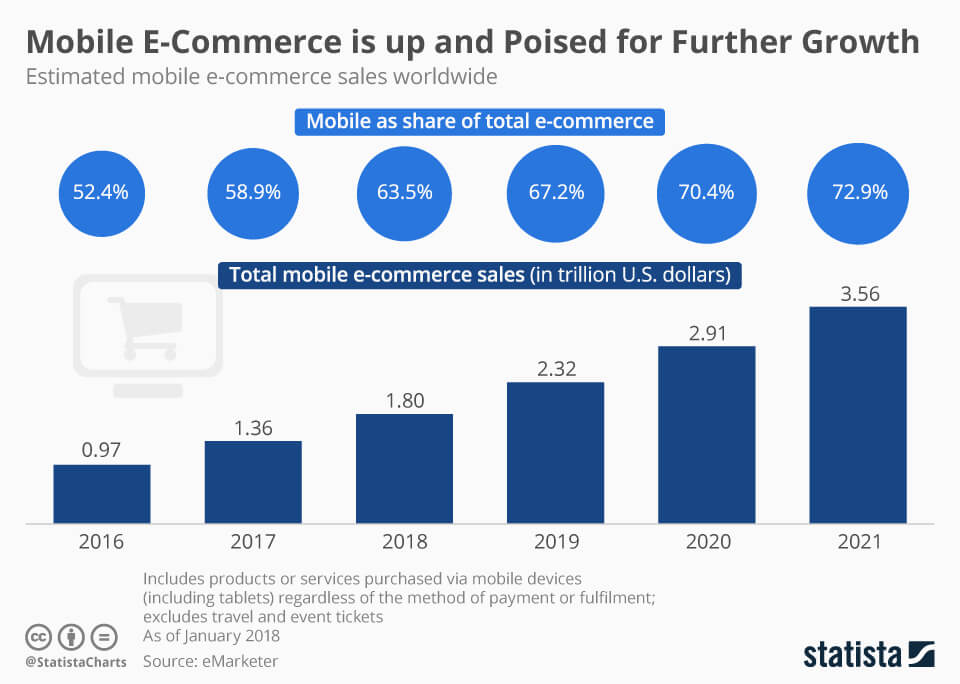
According to eMarketer estimates, retail e-Commerce sales reached $2.3 trillion in 2017, a 23.2 percent increase over the previous year. The mobile share of this stood at 58.9 percent, or $1.4 trillion. In 2021, mobile e-Commerce could rake in some $3.5 trillion and then make up almost three quarters (72.9 percent) of e-Commerce sales.

statista-facts-ecommerce

The Need

In order to democratize the on-door delivery services and to bring convenience at the doorstep of the consumers, every retailer out here looks for an extended superpower that can help them in simplifying the supply chain management, automating operations and managing deliveries.

In such exigencies, e-Commerce apps come as the biggest rescue.

E-commerce apps lure shoppers with a variety of deals, offers and a wide range of products and services to choose from, speeds up the buying and selling of goods while saving a big chunk of time. Furthermore, it minimizes the recurring cost by hiring virtual support resources and provide the customers’ flexibility to buy product 24/7 anytime anywhere.

The Business Model

1. Key Partners

  • Logistics Partner
  • Distribution Partner

2. Key Activities

  • Supply chain optimization
  • Marketing

3. Key Resources

  • Delivery Staff
  • Technology
  • Warehousing
  • IT Infrastructure

4. Value Proposition

  • Convenience
  • High-quality customer service
  • Flexible Payment Options
  • Customization and innovation

5. Revenue Streams

  • Retail Sales
  • Commission on third-party sales
  • Advertisement revenue

6. Customer Segments

  • Consumers of all ages

7. Cost Structure

  • Technology
  • Logistics
  • Marketing

key_competitors

Choose the Type of Model

1. Aggregator Model : Aggregate retailers, vendors in a mobile app/website.

2. Retail E-commerce App : Build an app/website for your own retail chain.

Key Features of an e-Commerce Mobile App

  • Customer App
  • Vendor App
  • Admin Panel

Customer App

  • Sign up/login : User can create an account with details like name, email id, mobile no., password, confirm the password.
  • Social Login : Makes the signup process convenient by enabling users to log in through their social accounts like Facebook, Instagram.
  • Profile Creation : Users can create their profile by entering all the vital information like name, email, DOB, state, country, phone number and address.
  • Find Stores : Users can find all the listed stores and search the products.
  • View Product List With Images : User can view product list with image, price and brand.
  • Search by Products, Brands and other Filters : Users can search product items, filter products (with price, brand type, ratings, & reviews), view product details.
  • Product Comparison : Users can compare product features, price, ratings, delivery time and find the best product at best rates.
  • Add to Cart : Once the product is finalized, users can add products to the cart.
  • Add Product to Wishlist : If the users want to save the product for later buy they can add them in the wishlist.
  • Coupons, Offers : Users can check and apply coupons, check offers, loyalty programs and discounts.
  • Multiple Payment Options : Users can make payment through credit/debit cards, online banking, and wallet payments.
  • Track Shipment : Users can track shipment status- if packaged, dispatched, or on the way.
  • Push Notifications : Users will get push notifications for product offers and delivery status.
  • Voice Search and Image Search : Users can also search the products through voice and image. This comes under advanced functionality.

Vendor App

  • Register/Login : Vendor/seller can register his/her business.
  • Set Up an Online Storefront : Vendor can upload his/her varied product collection online.
  • Check Active Subscription Plan : Vendor can check his/her subscription plan (active/expiry/renewal date)
  • Manage Orders and Catalog : Vendor can manage orders (receive order request, check availability, send the invoice to admin) and the catalog (add products).
  • User Review : Vendor can check user’s ratings and reviews.
  • Reporting & Analytics : Vendor can check the reports (like the number of products sold, product viewed, the frequency of visits, users’ bounce ratio etc.) and extract meaningful insights to better understand and improve business performance through strategic decisions.
  • Push Notification and Alerts : Push notifications can help buyers and sellers both by alerting users about new deals, product launch, discounts, offers and more.

Admin Panel

  • Login : Admin can log in by entering the set username and password and keep the account secured.
  • Admin Dashboard : Dashboard helps admin in checking no. of active users, no. of active sellers listed in the app, no. of active orders, products dispatched and manage them on the go.
  • Manage Products : Admin can manage products (no. of products dispatched, delivered, returned etc.)
  • Manage Buyers/sellers : Admin can activate/deactivate users registered on the app, message them personally and broadcast the messages.
  • Manage Promotions, Reward Points : Admin can manage customer reward points generation and in-app promotions.
  • Manage Payment : Admin can check the total earnings and set commission rates to be taken by the vendors.
  • Manage Referral/Invites : Admin can set up and manage programs to incentivize customers.
  • Reports and Analytics : Through reports and analytics tool, admin can drive strategic actions by extracting meaningful information from the reports generated and take necessary business action for better performances.
  • Ratings and Reviews : Admin can manage customer ratings and reviews by enabling/disabling them for certain products.

Advanced Features

  • Product search with QR codes
  • Live chat support
  • Real-time order tracking
  • Payment Gateway
  • CRM integration

tech-stack-ecommerce

The Total Cost to Develop an E-Commerce App

The cost to develop an e-Commerce app generally depends on the number of features required, the complexities involved and total hours employed in developing those features which further depends upon the per hour cost the mobile app development company charges.

Nevertheless, the tentative cost to develop an e-Commerce app costs around $27000 – $34000! Given, the app development charges are $20/hr-$50/hr.

How to Make Online Corporate Food Ordering App?

Yes! Restaurants are now turning more towards online corporate food catering services.
online-food-delivery-app-codiant
As e-commerce and on-demand delivery get easy, businesses are now bisecting their services at a more granular level. Restaurant owners, Hotel Chains, and food startups are way confident in taking online food delivery app services to prosper day by day, as people are getting more dependent on instant services.Following the same fad, the online corporate food delivery also calls out a need for creating a niche for them. This kind of specialized app platform simplifies the way companies feed their employees with healthy meals and lunch.

Types Of Meal Delivery

  • Tailored office meal programs: Tailored office meal program allows employees to customize their food by picking different dishes from the restaurant to complete their platter.
  • Order meal by choice: In this type of food delivery, employees can choose their favorite food from the long list of delicious cuisines served by the nearby restaurants and order their favorite food.
  • Daily ON-TIME delivery: If the office staff wants to have meal packages delivered at their workspace daily on their lunch/dinner time, they can choose on-time delivery. In this case, the restaurants cater food of their own menu decided by themselves with variety of different options every day. This way employee can eliminate their time to think of what to order and what not. EAT Club promptly delivers the individually packed lunches all at once to each office, 99.7% on time.
  • Dietician meal program (optional): If the employees want to follow a strict diet, he/she can consult a dietician registered on the app platform and order nutritional food as recommended by the dietician.

types-of-food-delivery

 Business Model

1. Key Partners

  • Restaurants
  • Local food joints
  • Bakery & Beverage points
  • Technology Partner (to build app & website)
  • Payment processors
  • Drivers with vehicles
  • Investors

2. Key Activities

  • Product development and maintenance
  • Hiring Drivers and managing their payouts
  • Product Marketing and customer acquisition
  • Partnering with Restaurant partners
  • Procuring food from Restaurant & local food joints
  • Receiving orders and processing food deliveries

3. Key Resources

  • Technological platform
  • Skilled drivers and logistics team

4. Value Proposition

  • Fresh and delicious meals delivered to office employees
  • A healthy meal with daily new choices to eat
  • Monthly meal packages reduce the time to think what to order
  • Gives restaurant partners fixed daily customers

5. Customer Segments

  • Office employees
  • Corporate trainees
  • Busy Professionals
  • Office Celebrations
  • Professionals wishing to give treat in-office

6. Cost Structure

  • Technological cost
  • Salary of employees
  • Advertisement and marketing cost
  • Miscellaneous

7. Revenue Streams

  • Commission from restaurants
  • Advertisements

food-cta

 How Does It Works?

  • User signs up and creates a profile or log in to the food ordering app.
  • Chooses the type of meal program. (Daily on-time delivery/Customized order)

OR

  • Chooses the type of meal delivery (breakfast/lunch/brunch/dinner).
  • User places the order.
  • Selects the payment mode. (COD/Wallet/ Credit/debit card)
  • The restaurant delivers the meal at the office.
popular-food-delivery-apps

How It Makes Money?

  • Commissions earned from restaurants: Restaurants pays the charges as per its positioning on the app platform to promote it amidst the customers. As well as the commission earned on every order is yet another major source of income.
  • Online and Offline Advertisements: Placing ads on your app platform for promoting restaurants, offers & discounts can help you earn extra money.
  • Strategic alliances with startup restaurants: Breaking a lucrative deal with startup restaurants for launching them on the app platform by charging a small fee can help restaurants gain recognition amongst the localites and help you earn a significant amount.
  • Convenience Charges: Earnings from convenience or delivery charges earned through the customers for delivering the food.

Corporate catering and business lunches are part and parcel of every industry. This new corporate food ordering portal is going to create a big room in the food industry on the grounds of profitability and opening new avenues of business generation. Seize the opportunity now and get an online corporate catering and online food delivery app developed now.

Retail Battlefield : How to Win the New Age Customers?

Failing retail companies, whether it be brick n mortar store or an online storefront, are usually over-managed and under-led, warns American scholar and leadership guru Warren Bennis. In today’s time, where exemplary customer care remains the nucleus of any business’s success, a majority of new entrants have failed to craft a stronger online proposition. To be able to plan a right strategic move and to prepare a marketing mix, the brand has to understand the core buying behavior of the customer as well as their pain points.

The Four C’s that today Customers Vie For:

Convenience: Ease and comfort of buying

Cost: Costs to satisfy

Customizability: To match their specific needs

Credibility: To put their trust upon

Studies say, 66% consumers switched brand or business due to poor customer service.

82% consumers who switched said the brand could have done something to stop them.

The Solution: Omnichannel Marketing

Hubspot defines omnichannel marketing as “a multi-channel sales approach that provides the customer with an integrated shopping experience” irrespective of the device or channel they use to interact with the brand.

Examples of Omni-Channel Brands

  • Disney
  • Virgin Atlantic
  • Bank of America
  • Oasis
  • REI
  • Starbucks
  • Chipotle

As opposed to a multi-channel platform, a successful Omni-channel initiative should be coherent across all the channels, as shown in the above graphic and should be aligned with all the multiple platforms involved in the customer journey. To achieve the synchronization between them and to execute it smoothly, the brand requires incessant coordination, empathy towards customer pain points, investment in technology and manpower, and most importantly, time.

Unlocking the Potential – Results of Using Omnichannel Strategy

How to Harmonize Omnichannel Marketing for Retail Growth?

  • Understand Your Customers Needs

As said by Laurent Simonin, CEO of Smart Traffik, explained in an email interview with Retail Customer Experience, it’s all about reducing the gap between online and offline. “A seamless customer journey comes under the influence of social media, mobility, geolocalization and the fact of being constantly connected, and provides a frictionless experience that will harmonize the customer journey, whatever the point of contact is between him and the brand/retailer,” said Simonin. Today’s customer wants to face only a single entity regardless of the channel used- app, web, store, via email or online chat. And Omnichannel makes the cut. It interlinks all the multiple channels without any breakage.

  • Understand Your Customers Needs With Data

Data and Content is the king when it comes to Digital Marketing. So in order to understand your customers gather data about them from different channels such as their in-store experience, email, social media, web, and geographical location. Extract their digital behavior, understand their channel preferences, and trace out a graph to standardize the data. After studying it, draw a customer retention strategy and figure out how you can provide personalized experiences to your customers.

  • Customer Feedback Matters

Pull out all customer feedback, analyze them thoroughly, and draw insights. This will help you to catalyze action and take the next step in crafting strategies to increase your brand engagement. If these strategies are put in a right place, it will help you in boosting engagement, increasing conversion rates, and decreasing shopping cart abandonment.

  • Create Brand Advocates

“Word of mouth” in consumer decision making is an influential source of information that plays the highest role in making purchasing decisions. According to the Nielsen Global Trust In Advertising Survey, 92% of people trust recommendations from friends. Look at the data:

MCKINSEY: While word-of-mouth has different degrees of influence on consumers at each stage of the consumer journey (Initial Consideration, Active Evaluation, Moment of Purchase), it’s the only factor that ranks among the three biggest consumer influencers at every step. Therefore, creating brand advocates that talk about products, services and experiences can help in increasing conversions as well as in improvising customer experiences.

  • Avoid Common Pitfalls

Before placing any of your strategies in place, just personally experience how people will visit your app/web/store; how they will shop, in other words, just become a customer and validate their experience and then figure out, what problems have you faced and how can you enhance the shopping experience. By gradually mastering these new touch points’ retail marketers can increasingly achieve exemplary customer satisfaction as well as stronger sales incentives.

IOS Vs Android App Development: Which Is Best?

The scale of the markets is one major reason that, app industry is ballooning at a greater pace, with its ripple effects large enough to cause any downturn to the app economy.

When the boom of app market rose sharply– as they have in recent years— the war of choosing between iOS app development and Android app development made businesses scrambling in the endeavor of a question, should we develop iOS App or Android App?

While it is always safe to pick any of the one with nearly zero chances of meltdown, still there stand certain factors which makes your decision even firmer if scrutinized closely:

Let’s funnel down:

  • Will your app’s target user base will be the people with greater income?As per the research, generally iOS apps are prominent in the areas with greater income bars and Android is prominent in the low-income areas.
  • Which location/market does your app mainly cater to?

In Graph: Popularity of iOS and Android by Country

The greater the market reach, the greater will be the number of app downloads. As seen in the above graph, the penchant of Android app development is more than that of iOS app development.

  • What is your budget?
    The app price mainly depends on region to region where you are getting it designed/developed. Here is the graph depicting rough estimation of app development cost area wise.
  • Will your app be paid or unpaid (Premium or Freemium)?

    In Graph: Illustrating the differences between Apple’s App Store and Google Play in terms of app monetization.As per the statista report, paid apps are much less likely to be successful on the Google Play than in the iOS App Store.
  • The Market Share of Android and iOS
    In 2017, Android represented an incredible 86.2% of global mobile smartphone sales, making its highest ever market share based on sales to end users.

Apple’s App Store as always outpaced Google Play on revenue. In the first half of the year 2018, the App Store generated nearly double the revenue of Google Play on half the downloads, according to a new report from Sensor Tower.

  • Favoritism of Enterprise Apps towards iOS Platform

Despite Android’s surge in market share, Apple’s iOS remains the most important mobile platform according to the company representatives surveyed. 80 percent of the respondents state that building apps for both iPhone and iPad apps is very interesting to them, while only 71 percent consider Android smartphones a very interesting platform.

Final Word

The decision of choosing between iOS app development and Android app development largely depends upon certain factors that may vary from company to company or domain to domain. If you are a business still scrambling and facing problems to choose the apt platform best for your business type, you may consult our experts or Mobile app developers. We would love to hear from you and share a valuable piece of advice.

How Will You See Financial Services in 2020?

Meet the top ten technology forces booming in Financial Services Technology Two major challenges for financial services industry: first, keeping pace with rapidly snowballing technology and tools; second, meeting the flourishing customer demands. Quite obvious, these challenges come as a part and parcel in every industry. However, the prospering technology boom in blockchain, cloud services, chatbots and others are fiercely sweeping and addressing these issues in one fell swoop. To acclaim you with the prodigious innovation in banks that will change the face of fintech industry in next coming years, we have compiled a list of top ten technology forces captured from the PWC’s new research report. Embrace these unprecedented technology trends and get ready for your next moves.

1. FinTech Will Drive The new Business Model

The convergence of financial services and technology, aka fintech, has become a disruptive force in short span of time following the same everlasting fad established financial institutions must quickly reconsider their business models or risk obsolescence in significant parts of the financial services value chain. Fintech promises to address the growing expectations of consumers, who demand more personalized and simplified services, swift operations and greater value for their money.

2. The Sharing Economy Will Be Embedded in Every Part of The Financial System

The immense popularity of on-demand companies like Uber, Airbnb is a live example of flourishing ‘sharing economy’. It effortlessly narrates that people are becoming comfortable with the notion of peer to peer (P2P) economy, and find it extremely simple to directly deal with other people. To the same penchant, this notion of peer-to-peer (P2P) engagement is taking hold in a broad swath of industries including financial services. Leading examples being P2P payment technology! Results, the role of banks in consumer transactions will steadily decrease.

3. Blockchain Will Shake Things Up

Blockchain could make the financial services industry’s infrastructure much less expensive. Also, Blockchain systems could be far cheaper than existing platforms because they remove an entire layer of overhead dedicated to confirming authenticity. And not only this, the list of potential uses of Blockchain is also limitless, from financial transactions to automated contractual agreements and more.

4. Digital Becomes Mainstream

Branches would be obsolete, eliminating the pesky paper work while Blockchain, internet of things and wearables will be driving bank interactions. Reportedly 95% of transactions will be digital in 2020.

5. A Bigger Shift Toward Internet of Things

With other developments, ‘Internet of Things’ will take a major leap. It will allow insurers to anticipate risks and customer demands with far greater precision than ever before. The winners will be able to price products based on a deeper understanding of risk; the losers will merely compete on price, compressing their margins with lower revenues and proportionately higher payouts.

6. Advances in Robotics and AI Will Start a Wave of ‘Re-shoring’ and Localization

Robots in the financial industry are looking far beyond basic bank-teller skill sets. New robots will now target social and emotional intelligence, natural language processing, logical reasoning, pattern recognition, physical sensors, and more. By the year 2020, it is expected that robots and artificial intelligence will automate a considerable amount of underwriting and investment activity, especially in larger and more mature markets due to the massive availability of data.

7. The Public Cloud Will Become The Dominant Infrastructure Model

The cloud will provide financial institutions with the scale, flexibility, and risk control that will enable them to tackle colossal changes, and also provide an agile IT infrastructure that will enable them to rapidly evolve as the finserv revolution.

8. Cyber-security Will Be One of The Top Risks Facing Financial Institutions

Cyber-security is the leading challenge to the adoption of IoT technology because insecure interfaces increase the risk of unauthorized access. Some of the major concerns in IoT are Attack surface, Perimeter security, Privacy concerns, & Device management.

9. Asia Will Emerge As a Key Centre of Technology-driven Innovation

Pwc report says, around the world, the middle class is projected to grow by 180% between 2010 and 2040; By 2020, the majority share of the population considered ‘middle class’ is expected to shift from North America and Europe to Asia-Pacific. And over the next 30 years, some 1.8 billion people will move into cities, mostly in Africa and Asia, creating one of the most important new opportunities for financial institutions.

10. Regulators Will Turn to Technology

The bank regulators will rely totally on technologies and rapidly adopt a wide range of data gathering and analytical tools. They will monitor the industry more effectively and predict potential problems instead of regulating after the fact. If you are a bank regulator or a financial service provider looking to secure the services and match the pace with technology, Codiant can help you with needed financial app development services that perfectly resonate with your customer needs.

Looking For Fintech Industry Pioneers For Your Financial App Development Needs?

Contact us

Know the Cost and Key Features to Develop an On-demand Beauty App

Beauty has always been about instant gratification. The beauty professionals’ serving on-door is no longer a privilege reserved only just for celebrities. “Ubers for beauty” has readily become available; thanks to the growing number of on-demand beauty apps such as Glamsquad, Priv, Vênsette and Soothe based in the US, summoning hair stylists, make-up artists, and masseuses. Just a simple swipe on your smartphone and the service person is available on your doorstep.

The stakeholders in the on-demand beauty space are salon chains, individual salons, stylists, freelance makeup artists and entrepreneurs. The hike in on-demand sector due to the provision of sheer convenience and comfort of homes has witnessed tremendous growth of online salon services.

on-demand-beauty-app-codiant

Features of “On-demand Beauty Apps”

Customer App

  • User Registration : Easy authentication process.
  • Sign Up/login : Easy sign up and login option from social media channels, email id or phone no.
  • View Salons : Customers can view list of salons registered in the app.
  • Select Salons/stylist : Select the nearest salon or stylist in the area.
  • View Profile : View full profile of the salon with its available timings, contact details, ratings and reviews.
  • Book an Appointment : Customers can easily book the appointment from “Book Now” button.
  • Make Payment : Easy payment transfer to the selected beauty salon through credit/debit cards, mWallet and net banking.
  • Chat with The Stylist : Customers can chat with the stylists regarding the timings, service charges, explaining address or any other concern.
  • Rate & Review : Customers can check the ratings and reviews of the individual salons.
  • View History : Customers can check the history of the appointments booked, check upcoming appointments or schedules.
  • View Subscription Packages : Customers can view different beauty packages and the ongoing offers on them and subscribe them.
  • Push Notifications : Send push notifications for reminding customers about their appointments, offers, deals, coupons etc.

Salon/Stylist App

  • Register : Salons or stylists can register from social media channels, email id or phone no.
  • View User Request : The salon owners can view the users’ request and as per the type of service requested by the user, salon owner can assign the stylist for the service request.
  • Accept/decline User Request : After viewing the user requests, salon owners or stylists have full liberty to accept or decline the requests.
  • Manage Services : The salon owners can manage their own service section. They can add/update/delete the services offered as per the stylists’ availability or user requirements.
  • Manage Catalog : Salon owners can manage their own catalog and choose to display their specialties, expertise from the range of services in the beauty space.
  • Schedule Appointments : Salon owners can set their own timings, appointments availability, and showcase in their profile.
  • Schedule Stylists : Once the user make successful request, salon owner can schedule the stylist to fulfill the users’ request at doorsteps.
  • Manage Costs : Salon owners/stylists have the full liberty to manage the costs of the services they provide anytime.

Admin Panel

  • Dashboard : Admin dashboard where Admin can have a full view on no. of salons registered in the app, total no. of users, ongoing services etc.
  • Manage Salons : Admin can add, update, and delete salons/stylists from their list.
  • Manage Users : Admin can add, update, and delete users from the app. View their contact information and broadcast messages.
  • Payment : Admin can view total earnings, no. of transactions, and all payment related information.
  • App Marketing : Admin can handle all the marketing related activities, manage deals, offers, coupons, advertise etc.

Advanced features

  • Blogging
  • eCommerce
  • Mark visibility of salons (Away/Available)
  • Vlogs (beauty related videos)

Technology Stack

  • Database : MySQL, MongoDB, Postgress, Mail Chimp Integration, Cassandra, Hbase
  • SMS, Voice and Phone Verification : Twilio, Sinch, Nexmo
  • Payment Gateway Integration : Paypal, Braintree, Authorize,net
  • Cloud Environment : AWS, Microsoft Azure, iCloud, Google Cloud Platform
  • Real-time Analytics : Hadoop, Spark, BigData

Cost of developing an On-demand Beauty Service App

The total cost of developing an on-demand beauty service app platform depends upon the functionality and features you incorporate and the number of complexities involved in the development. Furthermore, the cost also depends on the following factors:

 AND/OR

  • UI/UX Design
  • iOS and Android native app development
  • Backend development
  • Web development
  • MVP testing
  • Quality assurance (Polishing and bug fixing)

Summing up all the components above, an average on-demand beauty app costs around 20k-30k USD for iOS and Android platform.