100 Innovative Mobile App Idea That You Can Consider Investing In

Want to become an aspiring entrepreneur?

But struggling to find a unique and trending, yet a challenging mobile app idea that can fetch millions of dollars for you!

As every day the number of Android and iOS apps deployment are increasing, making it difficult and highly competitive for apps to gain customers.

Thus, making it a great challenge for budding entrepreneurs to come up with unique app business ideas. However, to your rescue and guidance, we are here with a list of some unique and edgy business ideas that the market is craving for.

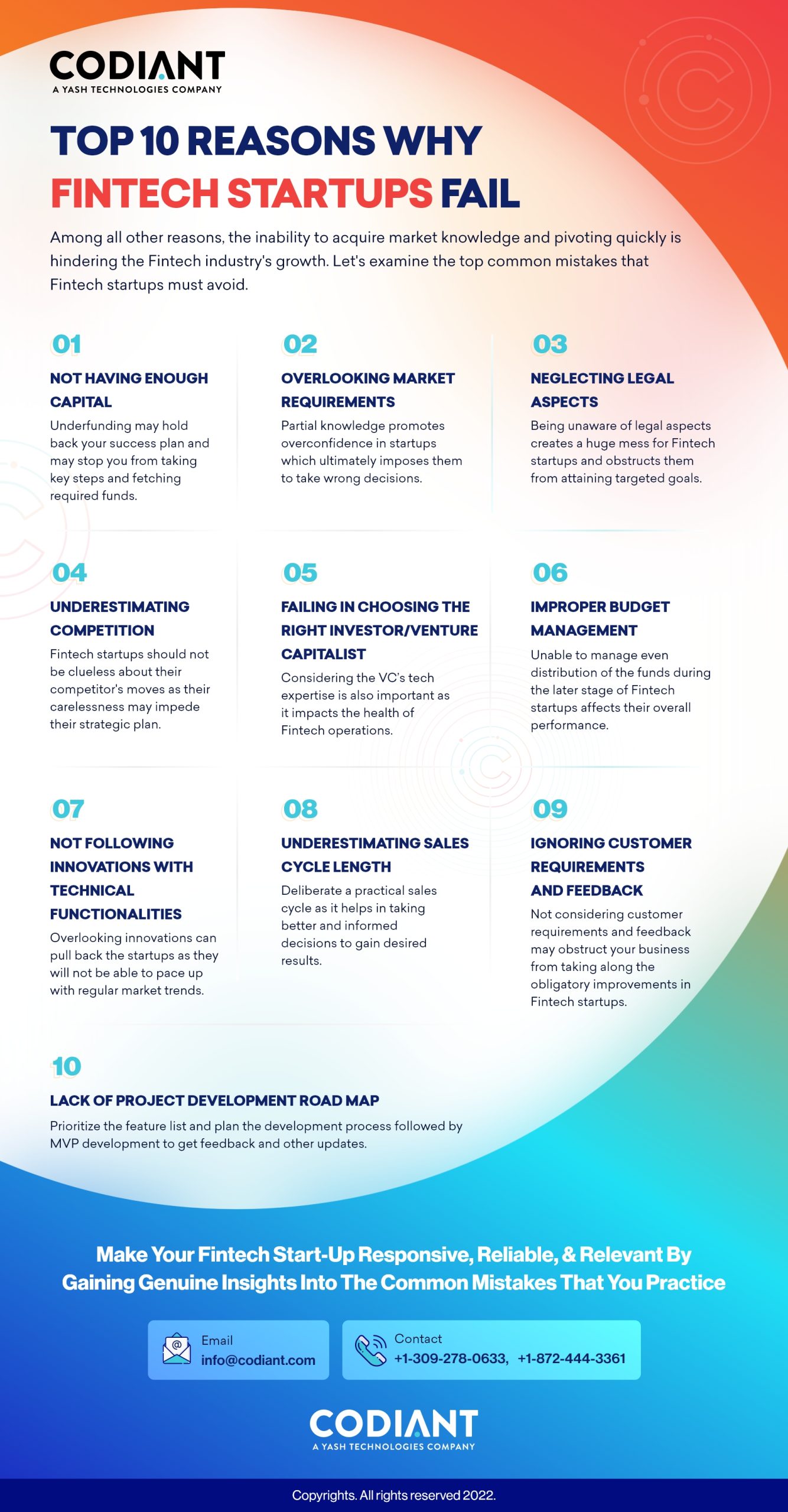
Here we go with 100 mind-blowing app ideas that you can invest in and build a successful start-up:

100 Innovative Mobile App Idea That You Can Consider Investing In

1. Real-time Car Sharing Mobile App

How if you are riding from point A to point C and a rider nearby wants to go to the same point C or in between B? This way riders can earn and save resources. No deny carpooling mobile app is the parent of this unique concept. But this time let’s get finicky. Prioritize your passenger’s safety and ride-sharing experience to be the new Uber of your city, country, and the world.

2. On-demand Car Wash App

Not everywhere. Does your city have one? If no, you’ve to take the lead. The choice is yours. We have a demo ready for the car wash app. Take a quick look. It will hardly take 10 minutes. The car wash mobile app will help car owners easily find the nearest washing station, or order a car wash within their house at their convenient time.

3. An Instant Messaging App

An all-in-one simple messaging app with the features of Skype, WhatsApp and FB Messenger. Build an instant messaging application with no ad distractions, enable features like video/audio calling, file sharing, emoticons and formatting, screen sharing and message editing (since no such feature is available in WhatsApp/Messenger), quoting and more.

4. Parking Finder App

Facilitate your customer by allowing them to track GPS details and helping them in finding the nearest parking location in real-time wherever they are present. This parking finder app can help motorists find, reserve and pre-pay for public parking around the city or near their destination. You can partner with a slew of professional sports leagues, stadiums and family attractions, collect data from parking lots and work out more.

5. A Home Security App

An app solution to provide security features like sensing activities on doors, windows and safes. Track pets, kids and other valuable products. Monitors the temperature of the house is a good idea to invest in. This way you can serve customers by increasing their home security and putting their home under surveillance 24×7, in their absence as well. So, this year build a universal app that can connect with their security devices easily.

6. Grocery Delivery App

Contract with local stores in your city and aggregate them on a grocery delivery mobile app. Your customers will give you their orders, you place them and then sell your service at a profit. You can also charge to deliver customer orders for a fee. Know the fastest method to launch and validate your grocery app. Contact us. Fresh grocery delivery ideas-

  • Deliver meal kits with ingredients pre-measured for specific meals
  • Deliver nutritional and organic farm fresh items
  • Fresh fruits, salad and sprouts delivery

7. Online Food Delivery App

With no signs of slowing down, online food delivery app development has become timeless in the food marketplace. The mobile app will help you to manage your restaurant business on the go, such as accepting orders online and tracking order delivery status, etc. How about leveraging this fad by bookmarking more specialties? Here are ten profitable online food delivery app ideas to follow. Click here.

8. Pickup & Order Delivery App

With more than 350,000 restaurants, retail shops, grocers, and more all across your city, there stands a dire need for delivery agencies. Courier delivery or pick-and-drop delivery apps can be your cup of tea. Order delivery at doorsteps is highly demanded among customers, whether it is food, grocery, packed items, electronics, vehicles, and more. It’s like whatever the company can deliver, customers would like to get it delivered to their convenient destination.

9. An AR-based Real-estate App

Be the early AR grabber. The future of home findings and home showings lies in Augmented Reality. Fuse AR in an existing real-estate app and allow your customers to instantly view any of the chosen properties, and test out furniture placements in their real spaces by aiming a smartphone or tablet on a condo building or home. In this digital world, an AR-based real-estate app can definitely take your real-estate business to a whole new level. Learn more: How Augmented Reality Is Reshaping Real Estate Industry?

10. On-demand Taxi App Solution

The trend of taxi app development will be unstoppable. Launching a taxi app with your novelty can help you stand out in the online taxi space. At Codiant, we’ve developed a couple of customized taxi apps with unique features to facilitate customers and drivers at the same time. Check the case study.

11. User Reviews & Recommendations App

A user rating and review app of the best restaurants, food, shopping, nightlife, entertainment, and other service providers in the town. This app would help users to know the credibility of various service providers available in the town and outside as well. Such ratings and reviews help businesses to gain ranking and acknowledgment among customers to gain recommendations.

12. A Media Sharing Network App

A media-sharing network app to find and share photos, videos, live videos, and build brands. Such apps can be made a little advanced by integrating tools that help the users to edit images and videos, add effects to images, and a lot more.

13. A Sharing Economy Network App

Build a multi-purpose platform to advertise, find, share, buy, sell, and trade products and services between peers. Fresh Possibilities Are:

  • Apartment sharing app where travellers can rent a room or a home to your app.
  • Dog owners can leave their dogs with a host as their caretaker.
  • An app where people can borrow cars from neighbours or people can rent cars by the hour or by the day.
  • Rent a bike from a neighbour.
  • A peer-to-peer marketplace for people to provide services for others. Allow sellers to create online stores to market their services.
  • Renting a boat or yacht to people who like to experience adventure.

14. A Marketplace Mobile App

An online marketplace app for people to hire people to do their jobs and tasks. To minimize the hassle and promote convenient communication remote and freelance hiring apps are ballooning in the market. In the rapidly elevating remote world, such types of apps are in great demand to increase efficiency and explore global talent with ease.

15. A Money Lending App

A peer-to-peer network to borrow cash at better interest rates as compared to investors or savings accounts. Users can keep track of all those to whom they owe money and who owes them the money with all relevant information and contact details.

16. A Wi-Fi Sharing App

Remember the barter system? Reinvent it with anything say like enable people to share their Wi-Fi network in exchange for anything they would like to share in return. Without sharing the Wi-Fi password, user can share their internet connection simply by scanning the QR code from the app. It allows the internet user to connect for a definite period of time or until they disconnected once.

17. A Cloth Resell App

Everyone likes to upgrade their wardrobe every now and then, and by saving a few bucks who wouldn’t like that. Let people sell their branded clothes and accessories online and recoup their investment in luxury items. Wish to see how it happens? Contact our business developer for a quick demo.

18. Remote Tuition Platform

These types of eLearning apps are best for people to learn from volunteer teachers where professionals and non-professional educators can teach with their expertise and personal experiences. The user connects with native speakers who want to master that language. This one-to-one online language lesson would be super-hit and highly valued.

19. Learning Apps for Disabled People

A special education app that helps children with autism spectrum disorder develop skills and learning. We have developed a social networking app for autism affected people in the UK which helped their family members to share their stories, post status, send messages, read and write blogs, ask questions, and do event listing to attend or invite.

20. A Crash Course App for Exams

Make an exam prep app that prepares students for their upcoming exams by covering the key highlights of important topics and helping them memorize quickly. Their learning and test practice can be promoted with study tools, help, guides, discussion, study material, quizzes, frequent tests, and many more.

21. A Reminder App for Adults

Integrate plug in’s for reminders like medicines, meetings, deadlines, home care, etc. These apps integrate with users’ calendars and send reminder notifications on their phones at the set time. The user can even organize their to-do list to manage every activity efficiently.

22. Online Dating App

An online dating app to discover, date, meet and socialize with compatible singles and divorcees. Users can also find the date on their special interests like geeks, nerds, comic lovers, adventurers, and many more.

23. Discussion Forums

An open discussion platform to find, discuss, and share news, information, and opinions, gain and share knowledge and connect with people who contribute to sharing their insights and recommendations.

24. Social Shopping Networks

Support creators, artisans, and artists. Make a network where people can spot them and shop their handmade items, share great finds, and make purchases. The users can also share the pics with others to seek suggestions on a style.

25. Fantasy Sports App

Tap the growing obsession and stimulating play, and build a daily fantasy sports platform where users can play fantasy cricket, football, rugby, basketball, and other games and win excessive money. AI-equipped sporting apps are revolutionizing the gaming industry and are the right time for entrepreneurs to build a great business with sports apps. Related Reading: How to develop a fantasy sports mobile app like dream11?

26. Events & Ticket Booking App

Get developed an online events ticket booking app that helps users book eTickets for movies, musical events, seminars, sports events, and recreational & cultural events just like Book My Show. These mobile apps fasten and ease the online ticket booking process.

27. A Traveling & Hospitality App

Make an app like Airbnb and allow your customers to book stays, and find nearby adventures and places around the world. Include a guest and host app in it that allows hosts to list their property, set prices, and receive bookings. And for guests to easily find rental properties, make bookings, and payments. With these apps, customers face less or no chances of being cheated and enjoying their tour.

28. A Workout or Exercise App

In this busy world, it is becoming very difficult to take care of your fitness. So, let your users experience a full-body workout through Workout or exercise apps. Whether it is running, functional training, yoga, suspension training, or cycling, train your users in real-time or give them demos.

29. A Meditation & Yoga App

Bring your yoga instructor everywhere you go. Make a meditation and yoga app to give a wide variety of video demonstrations with vocal instructions to your users with a daily dose of inspirational quotes. The app will help you to gain mental stability, and a healthy lifestyle, enhance your attention span, and many more.

30. Diet & Weight Loss App

Poor diet and bad eating habits are becoming a major concern among people with untimely and unmanageable weight gain globally. So, it will be a great business idea to make a weight-tracking tool app that tracks diet and suggest exercise and offers a huge food database in the most user-friendly option for losing weight.

31. Logbook Apps

A logbook app that consists of pre-set libraries with exercises and a wide choice of workout routines available for the users. It works as a to-do list and stores information about workouts. It is like a task scheduling and motivation app that reminds users about their daily to-do tasks and motivates them to perform it timely.

32. A Graphical Restaurant Reservation System

A reservation system for restaurants and pubs would allow users to see a graphical layout of the formation and see what tables are available. It gives an exact idea of the restaurant ambiance and helps customers to make the right and instant decision while making reservations in the restaurant. Every customer prefers quality food, and services along with surroundings, so it would be a great and profitable business idea for you to indulge in it.

33. Food Donation from Restaurants App

Many restaurants, catering, and event companies often end up with plenty of leftovers, but resist the cost or taking the liability of figuring out how to donate and deliver them to those in need. Making an app that delivers leftover food from all the restaurants to the hungry, instead of to the trash can be worthy. This will help save the wastage of food and feed those in need.

34. On-demand Doctor App

Why not scale up your healthcare business by developing an on-demand doctor app that connects caregivers, physicians and doctors with patients suffering from chronic diseases and other people in need through video calling (telemedicine app) or an audio call. Such mobile apps are quite handy for doctors and patients as well, who like to make an instant appointment or schedule their doctor’s appointment in advance.

35. On-demand Beauty App

Get built a beauty and wellness app to make girls’ life a little easier and prettier. Be it nails on-demand, fitness on-demand or make-up on-demand, let your app serve girls of all ages through an expert beauty app. Through this app, the user can easily find and hire the right stylist anytime with an on-demand beauty services app.

36. On-demand Alcohol Delivery App

Let your customers get their daily or occasional shots of a favourite wine, beer, or liquor delivered to them within a few hours. Bring a variation by offering cool offers like a feature of splitting a bottle between their friends and paying for quarters, tracking the amount of beer they had taken in a day/month and so on. There are many ways to make your app stand out.

37. Blockchain-based Supply Chain Management App

Increase the efficiency and transparency of SCM with blockchain technology. Various ideas for this vertical can be real-time tracking of food staples, in-clothing supply chain and Pharma supply chain app. The supply chains that use blockchain technology can increase speed, and transparency, and reduces errors in businesses.

38. A Corporate Voting App

Make a polling or voting app for enterprises or organizations that help them record, track and ensure that each eligible person uses only one vote. This app can help make key decisions by polling, and selecting an appropriate person for any desirable designation. The users can even carry out surveys through the app by creating attractive mobile-friendly surveys, forms and polls with ease.

39. Logistics & Warehouse Tracking App

This app can help track the products in real-time from the supplier to the shelf by tracking drivers, vehicles, shipments, and clients all in this all-in-one app. Your mobile app will help the logistics company to manage their business without losing income, handle warehouses, track driver’s locations, and ensure maximum truckloads. It infuses ultimate transparency into the entire business process.

40. Business Registry & Licensing App

Plan an Asset Registry app to help increase the efficiency of transaction processing and aid in preventing property fraud. The user or would-be business owner can register their proposed business idea through the app in a hassle-free manner. Contact us for more details.

41.Identity Management App

Blockchain-based identity management app helps in enabling fully secured password-less experiences for your customers and employees. You can include features like password management, lifecycle management, single sign-on, and group automation.

42. A Social Networking App for Tokers

Build an app where tokers can safely share their cannabis activities, post photos and connect with fellow tokers. You can also add a tint of uniqueness by making a tinder app for tokers where they can find tokers in the nearby area with whom they can smoke.

43. App, Swipe, Go- eCommerce App

Leverage the super hit idea of Amazon Go where you can just pick up an item from the store and walk out with it and the cost will be automatically deducted from your e-wallet. The Amazon Go convenience stores utilize a complex network of sensors on shelves, cameras, and A.I. to track what people pick up and place in their bags.

44. An AR Based Interior Design App

Develop an AR-based real-estate app to help clients with a 3D viewing experience to visualize the furniture or decor elements in the surrounding space with the help of AR. Give them the ability to switch from different colors, fabrics, patterns, styles and other decorative choices that suit or fit in your space.

45. An On-demand Expert Provider Solution

An app to allow users to instantly connect with service experts of any type. Be it family consultation, legal advice, fitness consultation, real estate, e-learning or any other users can always connect with service experts. It is an all-in-one app that facilitates users to get almost every service at their fingertips.

46. A Freelancer App

An app to hire freelancers on-the-go. Let users across all domain specialties register themselves and offer their services at affordable prices. Such an app idea could be a great support for those individuals and students who look for a part-time job to earn something without hampering their ongoing tasks.

47. A Public Transit App

An app that will give users all the crucial information about public buses, metros, trains, and taxis city-wise and area-wise. User can access their time, schedule, and routes, and can also track them on the live map. It is a GPS-assisted app in which the user can enter their destination on the public transit app and can find all the possible routes and trip options available on the app with price details and journey time as well.

48. A Photo Saving App

An encrypted photo saving app that allows users to create their albums on the app where they can save their photos, lock them, and even share privately with their friends or family by custom viewing mode like who can see their album.

49. A Money Saver App

This app will record the daily investments made by the users’ category wise like shopping, dining, medical, grocery, fuel, etc. and send him alerts on surplus expenditure in any particular category to limit the expenses.

50. A Reading App

In the mobile age, everyone wants to go digital. Be it novels, magazines, newspapers or anything else users want an all-in-one app for the same. Make a reading app that covers all the stuff and users can subscribe monthly for accessing them. The user can even purchase the digital reading rights of the available book as well.

51. A Short Video Sharing App

Just like we have Instagram for photo sharing, you can make any videogram app for video sharing that allows users to make short DIY or any other professional videos with features like adding lower-thirds, text, background sound, etc.

52. An NGO Collaboration App

An app where you can connect all the NGOs city-wise on a single app and help them raise funds through people who want to make a significant contribution through a trusted platform. You can also include in-app features like event or activity creation to engage with people who can support volunteers for some major causes.

53. On-demand Babysitting App

Register experienced sitters in an app and help parents find sitters and nannies around with a tap of a button. The parents can search for the relevant fit based on their skills, educational background and other required features.

54.A White Glove Delivery Service App

White-Glove Services are transportation services beyond usual delivery expectations. We all face issues when it comes to transporting fragile items or things that require extra care. Building an on-demand pickup and delivery app platform to help users transport their items with proper padded packaging and security can come as a rescue.

55. An Eat Together App

No need to eat alone when you have Eat Together app. Design an app that allows people in a campus, office, restaurant or any other social place to find a company to eat at based on their preferred time, location, and schedule. This way they can break their loneliness, build new connections and enjoy we time.

56. A Person Rating App

Imagine an app where anyone who connects with you in daily life and gets impressed or upset by your behavior, work, service, habit or anything else can rate you on the app. This way you can build your profile and build authentic credibility which can help you at the time of interviews, meetings, or any misfortune where you have to validate your behavior.

57. A Fashion Club App

This app will help fashionistas to the club and sport the best dress they wish to wear on occasions like parties, formal meetings, weddings, travels, etc. Fashion-savvy people can get opinions based on it they can shop. This way you can turn it into a smart eCommerce app.

58. A Personal Consultant App

This app will help users to find the right or best solutions to the problem they’re confused about. You can classify experts based on their field and users can seek a solution by message, video, or voice call by giving a nominal fee.

59. A Part-time Job Finding App

Here users can register their interests, hobbies, and expertise and seek part-time jobs with certain deadlines and earn extra income. A wide range of age group people can easily register themselves and look for a suitable job that they can deliver as per it is demanded.

60. A Real Estate App with Virtual Tours

Get built a next-generation real estate app that helps property buyers to take a virtual tour of the property on the app i.e. Live broadcasting and allows them to chat with brokers or sellers in real-time. Such technology integration in your mobile app can take your real-estate business to a whole new level. 61. Spot Nearby Places Develop an AR-based app that helps users to spot nearby restaurants, hotels, pubs, parking, hospitals, etc. just by hovering the phone on the buildings or nearby places. It will be a very useful and powerful app for almost everyone globally to find what they want within a few seconds.

62. A Water Alert App

An app that interactively tracks your daily water intake and motivates you to drink water periodically by the means of inspiring quotes, necessities, warnings, etc. Such apps are basically designed to set regular reminders every two-three hours, which remind the user to drink water and maintain the daily water intake.

63. Employee Feedback App

An anonymous employee feedback app that consents employees to share their opinions on improving the company environment, and shares feedback and ideas. This will solve the problems of companies internally without going to Google. This will help companies not only grow and raise productivity but also promotes employee engagement.

64. A Chauffeur Hiring App

An on-demand app to hire professional, reliable and licensed car chauffeurs and drivers for your private local and outstation drives. Features include real-time tracking, checking drivers’ profiles, insurance, packages, etc. The user can hire the chauffeur after checking out their expertise, total kilometres are driven, types of vehicle expertise, customer reviews and feedback, and many other details.

65. A Housing Society App

Create an app for housing societies and townships where all members of the society can join the group and the admin can post all upcoming events, collect contributions, discuss and share problems with solutions, including the feature of polling and voting, take decisions based on the majority and more features can be added.

66. A Water Sharing App

Many a time it happens that a building/flat or a house has excess water and some adjacent areas are devoid of water supply. This app will help identify needy homes and people with abundant water can drop them a message and communicate about water sharing.

67. An Online Kitty App

Often women are fond of kitty parties but some do not get time to contribute, gather and party hard. An online kitty will help ladies to contribute money to a central pool which will essentially be a mobile wallet and the lots can be drawn turn-wise through a built-in feature. Additionally, you can create invitation cards, wallpapers, party schedules and events, and many more. It could be a great interactive and interesting app to engage all homemakers to rejuvenate themselves in their free time.

68. Stop Procrastinating App

This app will help people stay focused and boost their productivity from time to time. Features include sending notifications, blocking social media apps after a fixed time (as decided by the user), and cutting distractions. Not only the app but could also a software program that works effectively on Windows and Mac computers to bolster students or employees to maintain their concentration in learning and working respectively to achieve their tasks easily and quickly.

69. A City Guide App

This app will help tourists and travelers explore places, restaurants, hotels (with ratings and reviews), famous shopping points, and historic places in the city with their brief significance. It would act as a personal guide to any new traveler. The mobile app could be a great and handy solution, especially for travel freaks, who like to explore every new place on their own.

70. A Budget App

A budget management app that helps users to track and manage their money from a list of banks, credit card issuers, brokerages, lenders and other financial institutions. Additionally, it should also have a feature to help guard users against spending too much.

71. Online Medicine Delivery App

Create an online pharmacy app where users can purchase medicines, and get them delivered to their homes. The app should also assist users with medical queries and treatment plans, usage information, side effects and safety warnings. The customer can place the order within a few clicks and can possibly seek online discounts as well and get genuine medicines delivered to their doorsteps in no time.

72. Lost & Found App

This app can help users find their lost things. Users can report lost, stolen or found items here. It can also be used to report missing people, children and pets. You can integrate advanced technologies to facilitate users in the best possible manner, such as image recognition, powerful matching algorithms, chatbots, and other features to make the platform more efficient and easier for users to find their lost entity.

73. A Graphic Design Tool App

Allow your users to design, share and print business cards, logos, presentations, social media images and more. This tool could be very handy for amateur graphic designers and experienced digital artists to multiply their talent and fine-tune their skills exponentially.

74. Animated Videos Maker App

Enable your users to create animated videos, professional presentations, and video ads by giving them a library of readymade templates and styles, characters, and backgrounds. The app will support its users to create some dazzling video animations in the minimum possible time and share them easily with their friends and social media platforms as well.

75. Language Learning App

With the easy reach to the global world, people are preferring to interact with each other in their native language and are raising the demand for handy and remote language learning apps. To make learning easier and more convenient such apps can be life saviors for learners. This app can have beginner, intermediary, and expert-level language learning content to help people learn new languages along with their pronunciation.

76. Brain Training App

Create an app that helps users to improve memory, problem-solving capability, attention, speed of processing and thinking, cognitive skills and many more. The user can perform a brain workout daily with a different set of games each day to keep it challenging. Every day new challenges and learning help to analyze the users’ strengths and weaknesses.

77. Uber for Trucking App Solution

Create an on-demand trucking app solution to match carriers with shippers. This will help shippers find potential carriers or transport companies that fit their budget and delivery criteria. It will also help truckers and carriers to find shippers so that they don’t face empty truck problems anymore. Want to know the features in detail? Click here.

78. Custom Gift App

There are people who do not get time to personally buy a gift for their loved ones. This app will help them customize a gift and make a hamper through the app itself which can be later delivered to their doorsteps. The customized gifts will add a personal touch to the buyer’s gift and it could be a lifetime memory to whom they are gifting. Being a custom gifting app owner, you can be part of various emotions and beautiful memory-making.

79. Dating + Matrimony App

Create an app that makes the journey from dating to wedding seamless. It will allow only potential match seekers to log in by taking their unique identity and other important information. You can make your app free to use with some basic and common features. Further, can monetize it with a subscription package, integrating advanced and important features which help users to connect and take it to the marriage.

80. Chatbot App Development

Build AI-powered chatbots for automated communication and virtual assistance. You can foray into any industry for unleashing its power and bringing in intelligent conversation in your business. These apps use text and voice commands to initiate human conversation and respond with automated messaging, decision buttons or options, and synthesizing voice.

81. A Wish List App

We all have seen eCommerce apps having the option of Wishlist(ing) the items or marking their favorites. Why not redefine the concept and make a separate app where we can save all the items, products, and desires category-wise. And tick the checkbox right when the wish is completed. This will further help achieve milestones and fulfil the desires in an organized fashion.

82. A Taxi Aggregator App

We all have used different taxi apps and have faced one common problem of late taxi arrivals. So, the idea is to club all the existing taxi apps like Uber, BlaBla, Meru, Ola and all the ones popular in your city. This app will show the nearest taxi, pricing, and information of the drivers accepting your rides; you can compare and call the one that suits your choice. It will make all these businesses competitive and allows customers to pick the best and cheapest service provider in their area in a hassle-free manner.

83. A Digital Receipt App

This app will record all the transactions that you have done in the month. Whether it be on shopping, grocery, fuel, restaurants, travel and others. It will divide your monthly spending categorically. This will give a fair idea of where the expenditures are done most. It will also save the digital receipts in the app for tracking the total spending.

84. An AR App to Scan Any Object

Create an app that enables users to scan products, images and illustrations and discover hidden content using augmented reality. These types of apps can easily gel up with the surrounding physical world to the digital world on your smartphone.

85. AR Gaming App

Create an app that allows users to use their actual surroundings in the gaming zone and create an immersive experience. Such types of interactive games are very much in demand among teenagers and young age groups. So, it could be a brilliant business idea for you being an entrepreneur to enter the gaming market world.

86. A Virtual Makeup & Hairstyle App

It gets an expensive trying look on oneself by applying it in real and then gets distressed by undesirable results. Having an app where individuals can have a virtual facelift can turn out to be money, resource, and time saver.

87. Astrology & Horoscope App

If you’re an astrologer or tarot card reader you can take your profession online by foretelling the fortunes, revealing insights and career trajectories about people. As a matter of fact, there are a number of such apps available in the market but to gain user traction delivering a personalized user experience can do wonders for your business.

88. On-demand Home Services App

Create an app like TaskRabbit, Handyman, and Thumbtack that provides convenience to customers to search and book for on-demand home service solutions at their doorstep. The services can include on-demand home cleaning, repair, spa & salon, plumbing, car washing services, laundry and more.

89. On-demand Babysitter App

Finding a last-minute professional sitter for your baby is no simple task. Having a custom nanny finder app or an on-demand babysitter app in your local city could prove to be a big relaxer for many working mothers. Through the app, parents can filter the babysitter’s list based on their preferences and convenience after analyzing their background and educational skills.

90. A Family Locator App

Create an app that allows users to stay in sync with their entire family located remotely. This app can have features like creating a group, viewing the real-time location of circle members, receiving real-time alerts, sharing texts, images, private video calling, etc.

91. Child’s GPS Watch & Phone Tracker

Create an app for child safety and parental control. It can have features like a GPS locator, family chat, app control, battery control, GPS watch, SOS button, Geo-fencing, water resistant, and many more. The GPS watch can be accessed on any smartphone, tablet, or PC.

92. On-demand Fuel Delivery App

Don’t you feel buying fuel should be as easy as buying a dress on Amazon? Fuel delivery apps will let users buy fuel, track the delivery on a real-time basis as well as help prevent adulteration. No more need to drag the vehicles to the nearest petrol pump!

93. Media & Entertainment App

Develop a custom broadcast app that helps in post-production project management, live streaming media and other media workflow. Integrate advanced technologies, such as AI to track down user behavior and suggest the best options. This will help users to spend more time watching their favorite videos, rather than spending time finding that one.

94. Music Discovery & Lyrics App

A music discovery and recognition app will allow users to identify music in seconds that they might not have information of but like it. The app will also allow the user to watch its video and check the lyrics. On this app, the user can easily understand and read out the lyrics of different languages’ musical discoveries.

95. Water Quality Monitoring App

An IoT-powered app that assists users in monitoring and sharing water quality parameters, collecting data for simple comparison and analysis.

96. Smart Office Monitoring System

An IoT-based smart office system that knows or can determine office users’ needs, and acts according to this knowledge. With smart technology, the offices will become more efficient than ever before, which manages staff to have more time to work on important projects or tasks.

97. Smart Trash Bins Software

IoT-based waste management using smart dustbins will reduce human resources and efforts along with the enhancement of a smart city vision. This software assures sending mail notifications and status on the dashboard of dustbins when the garbage level reaches its maximum. If the dustbin is not cleaned in a specific time then an alert would be sent to the admin who can take appropriate action.

98. An Online Restaurant Reservation System

This app would allow users to check out the graphical layout of the establishment. The users would be able to see the filled and vacant tables. It will work the same way you book seats in the book my show app. Such digital solutions can help restaurant businesses to boost their efficiency and ROI while serving the customer in the best possible manner.

99. AR App for Healthy Food Checker

An AR-based nutrition checker app that will check which nutrients are in your meals in an easy-to-read format and their benefits for your health. You can also introduce a facility for people with some food allergies, pregnant ladies, or people who are on certain dietary restrictions or specific food preferences.

100. AR App for Tourism

There can be many apps that can be developed using AR in the tourism industry. Some of them are helping travelers find their way, educating customers about the places they visit, AR geo channels to break the communication barrier and improving customer experience.

Bottom line:

Being an entrepreneur, what’s your take on ideas execution, rapid mobile app development, app launch, and digital marketing, ultimately driving ROI?

What we discussed above are timely and timeless mobile app ideas sitting on the most urgent seat of development and execution.

A shrewd businessman is the one that addresses the needs on or before time by crushing the solutions.

How to Choose the Right eLearning App Development Company?

The rapid adoption of digitalization in the education industry has revolutionized the face of learning and knowledge. The learners are gaining access to global information on their smart gadgets at their convenient time and place. The growing demand for eLearning methods among learners of diverse age groups has pushed schools, colleges, and other educational institutes to come up with an eLearning solution to gain new and retain their learners at the same time.

The top eLearning mobile app development companies have already integrated many advanced technologies such as AI, VR, ML and others to enhance user experience and learnings with premium solutions. But, all this varies according to the project requirements. Therefore, before you plan to hire an eLearning app development company, it is highly recommended to first examine your project’s demands and requirements thoroughly.

That’s not it, there are various other aspects that you need to take care of before recruiting an eLearning software development company as per your custom requirements.

Factors to Consider while Selecting an eLearning App Development Company

1. Understand Companies Portfolio

An organization’s portfolio is their previous work with other clients. This will help you to analyze their technical expertise, project themes, business domains, client experiences and feedback, developers’ skillsets and other details of the eLearning mobile app development company.

If possible, have a discussion or interview with the company’s previous clients to understand the clear and real picture of what the company is claiming about their deliveries. Apart from that, perform a detailed study of the tasks completed by the eLearning software development company on that particular project building.

Last but not the least, also learn about the different types of eLearning projects and check their case studies and see how it is performing in the growth market landscape.

Related Reading: Learn how a multi-lingual education marketplace app developed by Codiant has witnessed an exceptional response among its stakeholders.

2. NDA to Secure Your App Idea

Businesses and entrepreneurs often have nightmares about the security of their business idea and concepts from leakage. Because many cases are brimming around the market, such as low-quality clones or theft of app ideas before the original idea makes it into the market due to the loose security precautions exercised by the app development companies.

Being an entrepreneur and idea presenter, it is your responsibility to ensure the privacy of your idea. Therefore, why not legally bind the app development company with whom you are discussing your unique idea through a Non-Disclosure Agreement to ensure the concept and idea confidentiality.

3. Technical Expertise of Team

To develop an app, expertise in technology is a crucial aspect – especially when technology is evolving each day. Gaining expertise in all these new technologies is not an easy task for any developer.

Hence, interview the tech team experts to analyse their knowledge, experience and expertise, which will help you in decision-making on whether to hire the company for your eLearning app development or not.

During an interview session with tech experts, learn about their working skills with advanced technologies, such as Artificial Intelligence, Machine Learning, Big Data and AR/VR. Also, about their working knowledge on cross-platform development and the working style or interaction with the team members.

4. Analyse their Working Style and Process

Before onboarding, any app development company, figure out its development process and enquire about the workflow flexibility to handle and deliver the project’s requirements under a tight deadline.

Furthermore, extract information about the assets and resources that are used in a project. It will help you to figure out how effectively they follow the defined process and available resources.

Figure out their working approach, like what drives their solution development – learnings or pre-existed tools. And how this approach is yielding results for the client, whether it is delivering a positive impact to the business or not.

5. Communication Channel between the Involved Parties

While hiring an eLearning app development company, you must be aware of how the company collaborates or communicates with its clients and team as well. Additionally, learn about their working style and how they handle any challenge or bottleneck situation when the project is in progress. Make sure to figure out their communication effectiveness and collaboration during the process.

Being a client, it is crucial for you to always remain in the loop with the development team to be aware of every tiny update in the project. This is very crucial for you, as you will be able to track the project’s progress and can make valuable suggestions or feedback wherever it is required.

6. App Designing Compatibility with Market Standards

The user experience of a mobile application usually defines its quality and acceptability among visitors. An excellent user experience is the main deciding factor for the success and failure of the application. Thus, it is also important to be aware of the app development companies designing abilities. With the rising demand for mobile applications, users’ expectations are also very high. It includes easy navigation, quick loading time, high-quality images, informative but crisp content or message, and many more.

Delivering an outstanding user experience through the mobile application is an important part of your product strategy. As the EdTech app attracts global users, therefore it requires an extra cautious attitude and only expert hands to design the most subtle and appropriate user interface and navigation flow.

Being an expert eLearning mobile app development company, we suggest you, be watchful in terms of your app design.

7. Effective Delivery Management

Often clients experience miscommunication or no/least progress updates about their project. As a result, the end product is not up to the mark or turns out irrelevant to the client’s requirements. To avoid all these issues and build an effective and faultless product, the company must keep its clients updated with each progress.

To achieve the on-time delivery of the final product, it is important to follow a guided approach with effective delivery. Hence, study the company’s product management cycle and transparency policy.

Ensure the company follows an agile methodology, which can speed up the development process and boost communication between both parties.

8. Trusted QA and Testing Measures

It is a common practice to test anything or a product before purchasing it to understand its working and how receptive being a user you are to the product’s functioning. The same goes with a mobile application, perform testing on your own and with trusted sources along with a development company.

Regular interruptions in operating the app can annoy the users and lose their interest in using the app. So, make sure to deploy only an excellently designed and developed application for your end-users. It should be free of any technical glitches or defects before deploying the app on the app store.

Thus, when you hire an eLearning app development company, ensure they follow the most up-to-date automated and manual testing and quality assurance measures.

9. Maintaining and Customizing the App

Every application demands updation and marketing to serve its users with something new and interesting stuff every now and then. Trying to fix bugs and introducing other features to engage users regularly with your application requires a lot of effort and strategies.

With the evolving market demands and business strategies, you must customize your application and maintain it accordingly without hampering the existing processes. To present such updates, you can’t afford to hire a new team or developers separately.

So, if you have an existing team of developers, then it would be easier and safer for you and the project’s code as well. Because the developers would be aware of the codes and don’t need to speed extra time understanding the codes. This way they will write new codes without hampering the existing functionalities.

10. Development Charges and Pricing Model

Prior to hiring the eLearning app development company ask for their package cost and after-deployment charges. Get a brief idea of the project deadline as well, which will help you to figure out your average development budget and later on expenses as well.

Before you finalize the development company, discuss how they are going to influence the project’s functionality. In the initial phase, what you require is a basic version of the mobile application that prioritizes user and intuitiveness. You need not waste your money on not-so-important or useless features at the initial stage.

Conclusion

It requires a significant investment to hire the right eLearning app development company. Hence it is critical to find the most suitable one that ensures you’ve invested your money in the right place. So, before you invest, consider all the above-mentioned cautions to find the best eLearning app development company for your dream project.

Codiant is an expert and experienced EdTech app development company, and we understand an eLearning app development isn’t only about brainstorming, developing and deploying. It also requires round-the-clock support service and maintenance to infuse new features and updates in the application.

So, if you are aiming for a mobile-friendly, competitive and profitable eLearning mobile app development, then Codiant can be your most reliable and apt technical partner during your entire development journey.

Top 7 Payment Gateways in the USA for the E-commerce Store

Since the introduction of the online shopping concept, the online payment system has become a casual routine in no time. The major building block of the evolution of the online shopping system was to give the customer so much confidence that they can easily make payments digitally without the concern of any online fraud or getting burgled of their payment details.

Payment gateways evolved as the leading service providers to facilitate customers in making secured digital payments. The e-commerce stores can easily integrate these payment gateways into their digital platform to facilitate customers and make the payment process secure, convenient and quick.

Currently, there are a great number of payment gateways that exist in the USA market. Let’s find out the top 7 payment gateways in the USA for the E-commerce store that are helping businesses to gain trust and build a reliable brand with customers.

Top 7 Payment Gateways in the USA for the E-commerce Store

1. PayPal

PayPal is one of the most popular and top payment gateways in the USA market that offers its services to global businesses and individual users as well.

The company was introduced in 2002 and is currently the most used payment processor. It accepts international and multi-currency payments. Currently, the Paypal payment gateway is available and used in 203 countries all over the world.

Pros and Cons of Paypal Payment Gateway

Pros Cons
An easy-to-use platform to send money to others. For business transactions, fees are charged.
Provides high-level security and fraud prevention. For instant access to transferred money, charges 1% of fees.
To keep information safe, stores bank or card details in encrypted form. For any doubtful activity, freezes the account instantly. Only releases money, until you can prove that nothing wrong is done.
Offers varied payment solutions, such as on-site and on-the-go payment services. A tedious process to reach out to customer services.
Integrates Seamlessly with most business software.


2. Stripe

Stripe is another market-leading E-commerce payment gateway service provider, headquartered in San Francisco, California. The company was introduced in the market in 2010 and is currently a fast-growing payment gateway company.

Stripe is an API-based cloud payment gateway in the USA, providing merchants complete control over the payment method they like to integrate. The latest feature company is offering to its customers is to provide a loan in order to make the economy smoother.

Pros and Cons of Stripe Payment Gateway

Pros Cons
Easy and quick to set up an account. Limited functionalities for retail businesses and restaurants.
Offers flat-rate, transparent pricing with no setup, cancellation or monthly fees. No discount for small value businesses.
Accepts and processes in 135+ currencies and is operational in about 42 countries. Without software development expertise, Open API and tools are difficult to use.
Supports highly customizable checkout flow.
Offers 24/7 customer support via phone, email and live chat.


3. Authorize.Net

Authorize.Net is one of the most suitable and apt payment gateways for small-scale businesses and is highly preferred among them in the USA market. It is a pioneer company in providing payment gateway services, since 1996.

Authorize.Net is the most suitable payment platform for E-commerce stores that are developed on Magento and OsCommerce-like platforms. It is equipped with a number of add-on features such as a simple checkout system and fraud prevention.

Pros and Cons of Authorize.Net Payment Gateway

Pros Cons
Accepts all major digital cards. User interface is not user-friendly.
Broad support for multiple currencies. Account setup and monthly gateway fees are quite high.
Provides robust security and anti-fraud feature. An all-in-one option may confuse some customers.
Supports recurring bills i.e. month-to-month billing with no long-term contracts.
Excellent customer support and services.


4. Amazon Pay

Amazon an E-commerce store, introduced its payment gateway services in 2007 for its customer base to ensure effortless transactions on its platform. In no time, it became a very reliable and promising E-commerce payment gateway in the USA market.

The users are not enforced to pay only to Amazon merchants, however, they can securely pay to external websites and apps as well. In 2019, Amazon Pay associated with WorldPay to facilitate its customers to accept payments through the Amazon Pay payment gateway.

Pros and Cons of Amazon Pay Payment Gateway

Pros Cons
No setup cost and hidden fees is charged. High transaction fees, especially for inexpensive goods sellers.
Introduces regular feature upgrades. Sometimes fund withdrawal takes 2-3 or more days to clear dues.
Ensures to maintain A to Z customer protection.
Supports multi-currency processing and provides services in 18+ countries.
Promotes transactions and minimizes cart abandonment.
Amazon integrates Alexa to support easy order status tracking and promotes customer satisfaction.


5. 2CheckOut

2CheckOut (2CO) is one of the top payment gateways in the USA, especially for E-commerce businesses. It is recently acquired by VeriFone – a worldwide leader in commerce and payment solutions. It is an all-in-one monetization platform that helps businesses to maximize their revenue.

2CO payment gateway can accept payments from 200+ countries and territories. Based on the chosen subscription plan the facilities and services changes. However, it offers 45+ online and offline payment modes to its individual customers and retail businesses.

Pros and Cons of 2CheckOut Payment Gateway

Pros Cons
Available in 29+ different languages and supports payment processing in 100 currencies. Conversion rates are 2-5% higher than average bank rates.
Supports advanced fraud protection and management. Cannot process card present transactions.
Offers 3 types of subscription plans to facilitate varied users and businesses.
Charges no setup or monthly fees.
Provides 24×7 technical support and a dedicated account manager for the business.


6. PaySimple

PaySimple is a new-age e-commerce store payment processing system in the USA market. It is a SaaS-based platform introduced in the market to infuse a new life to small and medium-level businesses and E-commerce stores.

This modern E-commerce payment gateway system accepts all major credit cards and e-check payments. PaySimple offers a quick and easy way of payment to its customers. The only drawback it has is, it is only available for the USA-based market and users.

Pros and Cons of PaySimple Payment Gateway

Pros Cons
Easy to set up and activate the profile. Have a lot of hidden charges.
Ideal for small-to-medium scale service-based industries. Does not support international businesses and brands.
Supports e-check processing and payment.
Provides excellent customer support services.
Is equipped with advanced technologies – supports all types of financial transactions.


7. WePay

WePay is a very popular and strong online payment gateway that offers high-quality security to its customers and businesses. WePay is a great option for e-commerce stores to integrate with their business platform.

WePay’s services and API are more inclined towards crowdfunding portals and are organized for that types of payments. It supports instant onboarding with no additional charges. It allows customization for businesses to shape their customer’s checkout experience through the WePay payment gateway. Its API and services work well for crowdfunding.

Pros and Cons of WePay Payment Gateway

Pros Cons
It offers customization to redesign the customer experience during checkout. Overall processing rates vary from platform to platform.
It doesn’t charge any additional and instant onboarding facility. Customer Support is not up to the mark.
Eases and fastens the E-commerce checkout process and minimizes cart abandonment rate. Suitable for only larger businesses that want to offer services for merchants.
Provides robust and secure payment facility.
Supports the use of Apple Pay and ACH payments.

Final Thoughts: Top 7 Payment Gateways in the USA

The global E-commerce market is witnessing an exceptional change and is inclining toward complete digital transformation. Now, having a payment gateway integration with your mobile E-commerce store checkout process has become a necessity.

As a result, it has become a mandatory integration for every existing and new entrant E-commerce business to choose one of the top payment gateways in the USA for their E-commerce store. Thus, to ease your pain, we prepared a list and tried our best to shed some light on the top 7 payment gateways in the USA.

Based on your business requirements, you can pick the most suitable one. Or can connect with the Codiant team for assistance as well for the E-commerce app development and for integrating the best payment gateway in your E-commerce store.

A Complete Guide: Microsoft Dynamics 365 in E-commerce Industry

The E-commerce business count is mushrooming all over the globe, which makes it a highly competitive and struggling industry to gain a competitive edge over its rivals. Moreover, the companies get to fetch a massive database of varied details in a shorter span of time, which makes it overwhelming for such businesses to manage, store and update data and finances on the go.

However, it is important for E-commerce businesses to present their business on a platform, where they don’t have to struggle with such data management and operational issues. Considering this emergent need, nothing can beat the implementation of Microsoft Dynamics 365 Commerce software integration. Dynamics 365 commerce development helps businesses to drive employee’s productivity, optimize supply chain, build brand loyalty, and boost revenue by sales channel optimization.

If you are also looking for such a kind of solution to scale your business solution, then read further to gain valuable insights about Microsoft Dynamics 365 in E-commerce Industry.

What Is Microsoft Dynamics 365?

Microsoft Dynamics 365 is a combination of modular SaaS (Software-as-a-Service) applications and services based on the cloud platform. The software is designed to transform and support the core operations of customers, employees and business operations. Dynamics 365 combines components of CRM and ERP systems, along with productivity applications and Artificial Intelligence technology that integrates your data, processes, and business logic.

Thus, to facilitate all these operations in a single software, Microsoft Dynamics 365 put together sales and marketing functions, supports automation, integration and analytics-driven sales and marketing opportunity, which helps to efficiently prioritize, connect, and convert leads into customers.

Microsoft Dynamics 365 is built on the Microsoft Azure cloud platform and was introduced in the market in 2016. Eventually, Microsoft became the first major vendor to infuse the qualities of ERP and CRM individually. This leads to presenting a reliable and trustable platform and a great range of services. Along with that, the integration of the Microsoft 365 app provides a dedicated method to manage visitors and services.

Microsoft Dynamics 365 in E-commerce Industry

Microsoft Dynamics E-commerce is the latest edition of Dynamics 365. It offers an omnichannel E-commerce solution that supports building a website, tracking customers’ requirements and behavior, provides a personalized user experience, connects brick-and-mortar stores to a digital store, engages seamlessly with customers across channels, boosts operations, facilitates efficient resource management and attracts detailed analytics to upscale your business.

It is an upgraded version of Dynamics 365 Retail. The Dynamics 365 E-commerce platform supports businesses to keep an eye on and improve staff productivity to a great extent and establish the business as a loyal brand in the market. The infusion of such advancements in business operations and supply chain management enables businesses to run smoothly and generate good profits and ROI.

Benefits of Microsoft Dynamics 365

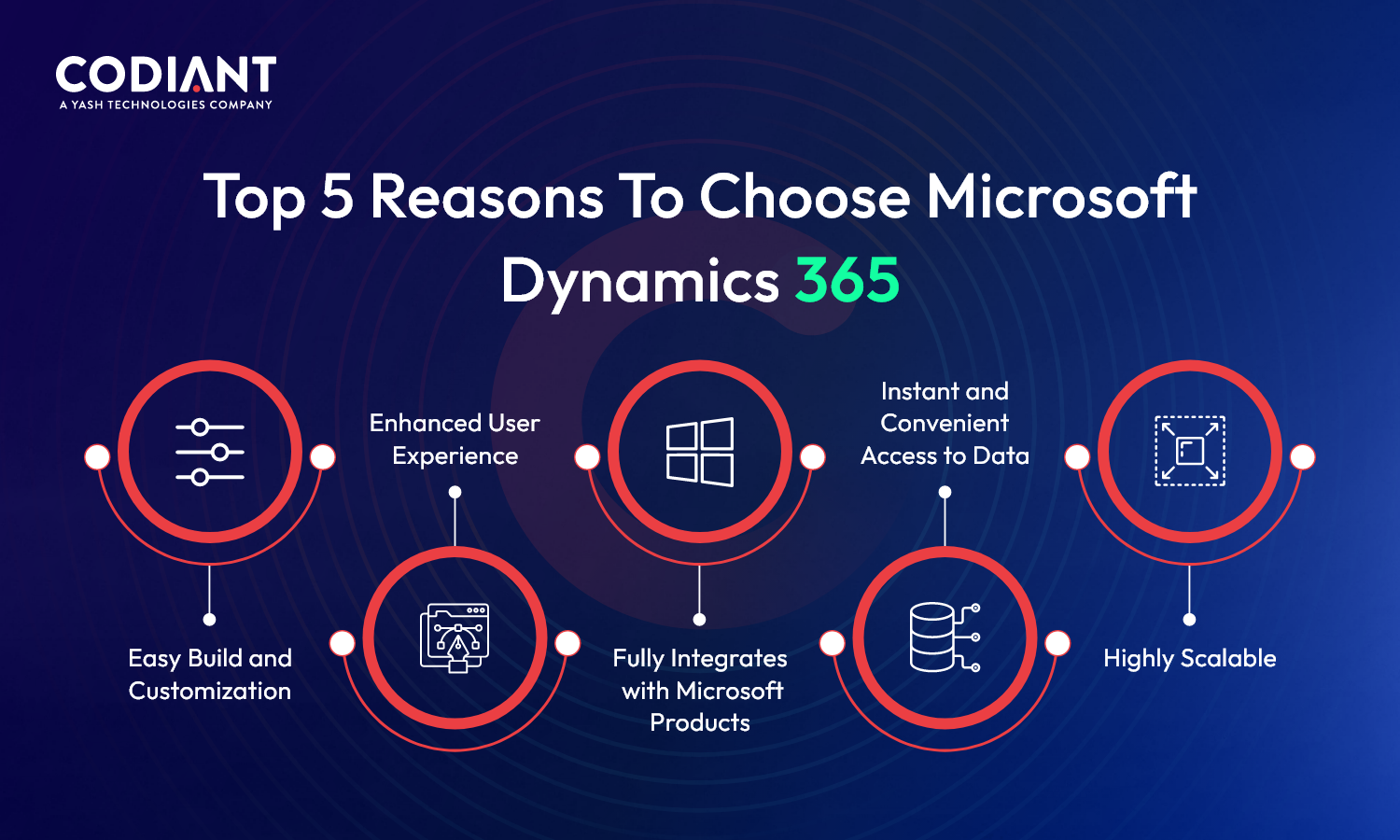
  1. Easy to Use and Deploy- Microsoft Dynamics 365 is available in the cloud and hybrid cloud environment, which makes it easy and flexible to use and deploy in whatever manner you like to support your infrastructure and budget.
  2. Fully Integrates with Microsoft Products- Dynamic 365 software can fully integrate with various Microsoft products and Office 365 suite. It makes easier for employees to work with, switch between apps and minimize data transferring time between apps.
  3. Facilitates Easy Search- By using Dynamics 365, you and your team can search and find apps easily, which will help you in simplifying your business operations, in case the business requirements evolve after a while.
  4. Enhances Customer Service Experiences- Dynamics 365 can collect a variety and huge amount of data on each customer, which helps to analyze the customer’s activities and helps to understand their buying pattern, sentiments and brand loyalty, which ultimately enhances customer service experience.
  5. Enhances Productivity- Microsoft Dynamics 365 provides easy and quick access to data, tools and valuable insights that enables employees to make better and informed decisions, enhance their work efficiency, productivity and minimize the time in searching for accurate data and information.
  6. Provides Real-Time Insights- The availability of built-in Predictive Analytics in Dynamics 365 provides access to real-time insights. Additionally, the integration of advanced technologies, like BI, ML and Cortana provides the access to predictive insights, prescriptive advice and suggests the next actionable step.
  7. Strict Security & Control- Dynamics 365 is a cloud-based solution that offers its users strict security and data access control apps and data that are built in cloud services along with users and administration access.

Top Reasons to Consider Microsoft Dynamics 365 for your E-Commerce Business

  1. Easily Build and Customize E-Commerce Site Dynamics 365 commerce integration offers easy customization of your E-commerce site with built-in web-authoring and development tools that are placed in the Store Starter Kit (SSK). Regardless, of the size of the website, you can easily customize the website and can also scale up as your business requires.The much advanced and customized website following the market trends can help you to attract more revenue to your autogenerated web storefront. All this becomes more convenient, as D365 commerce integration offers the following modules in SSK.
    • Container
    • Product detail page
    • Search product
    • Purchase or place order and track order status
    • Marketing and advertisement
    • Content management
    • User account management
    • Product recommendation algorithm (Upsell and Cross-Sell)
    • Buy online and get the order from the nearest pick-up store
    • Product Ratings & Reviews
  1. Enhance Customer/User Experience Dynamics CRM E-commerce allows you to track your employee’s and customers’ interaction and user experience with the platform. This keeps you (business owner) ahead in understanding customer behavior, customer services, customer acquisitions, customer retention and loyalty.Such a detailed and varied study about the customers can help to formulate the right strategies and provide much-needed customer assistance, promote user engagement, design marketing methods and strategies, generate leads and raise end-buyers figures. The successful implementation of all these initiatives and processes also helps to deal with frequent issues, like cart abandonment and one-time buyers.
  1. Connect Multiple Apps for Comprehensive Insights Dynamics 365 E-commerce suite is equipped with a number of applications, tools, services, and AI-enabled solutions that helps to fetch detailed information over ongoing activities on the website to keep you updated with business performance. Such details help to analyze individual customers’ requirements and predict their needs by suggesting the right option under the recommended product section. The detailed access of all the customer-related data and information can be accessed in real-time and help to implement comparative analysis, which provides a detailed picture of your customers in terms of website surfing, placing orders, order frequency, reviews & feedback, customer services and many more.
  1. Instant and Convenient Access to Data Dynamics 365 commerce development facilitates easy access to data because it is a cloud-based and centralized software. As a result, you can access any type of business-related data in just a few taps once you logged in to your account. All these data are accessible in real-time and can also maintain the level of data security.The cloud-based software enables to illustrate administration control or specify access rules to maintain the sensitivity of the data. To make this possible you can use encryption keys to protect data from any kind of unauthorized access, view or export.
  1. Easily Scalable Without Worrying about Hardware Microsoft Dynamics E-commerce is a cloud-based software that easily supports scaling up of business website stores; owing to its independency on hardware support. The successful scaling of the website also supports accommodating global traffic 24×7.You can even add new software you wish to scale your business processes and operations, hence website upgradation turns into quite a convenient experience for you, as a business owner.Apart from that, you don’t have to worry about the automatic and rapid increase in the size of data and its management complications, as you don’t have to constantly upgrade the size of the backend.

Step-by-Step Process of Implementing Microsoft Dynamics 365

Step 1- Business Process Planning

Initially, in this step, the management of resources is carried out. Such as human resource personnel and all the needed supplies for Microsoft Dynamics 365 Commerce software integration.

Simultaneously, evaluate ongoing business practices to analyze which processes can be automated or improved by the proposed E-commerce system.

It is a very crucial phase to figure out which process in your business can be automated with Dynamic CRM E-commerce solution implementation. The study will also help to identify the accurate goals and scope of the implementation.

Step 2- Procedure Review

Collaboration and cooperation are important for the success of any business digitalization. Hence, ensure the team works effectively together and reviews the features and capabilities of Dynamics 365 E-commerce. The technical team must be aware of every aspect of the proposed E-commerce solution and identify skill gaps before moving ahead.

Identify the manual process which requires automation by the new system and propose necessary and valuable customization before rollout. Thus, it will ensure the smooth automation of the processes.

Step 3- Create a Data Migration Plan

It’s needless to remind, however, accurate planning is required to streamline organizational chaos. Likewise, to implement Dynamics 365, it is important to define existing data that needs to be converted to the new system. The ERP system solely relies on the data hence, data migration should be performed accurately, so that the new ERP system also provides the right details and information.

Once, the data has been sorted, checked and approved for migration; collect and segment data into logical tables in the spreadsheet to streamline the E-commerce conversion to Microsoft Dynamics 365.

Step 4- Test Extensively

Test that the database is full with correct and required data to validate the system output, test accuracy and make sure the system integration and interfaces work properly in sync before wider training starts.

Some organizations implement in-person training, whereas others go with e-Learning, or may follow a combination of both to provide quality training.

Whatever training approach you follow, you can streamline the process operations by ensuring the following specifics.

  • Train tech-skilled team members as E-commerce software superusers, so that they can manage low-level issues and give a free hand to the IT experts to deal with critical issues.
  • Make the training process interesting and engaging to promote engagement and build a healthy competitive environment among colleagues.
  • Offer an incentive or small perk to complete training quickly. It will motivate employees to learn quickly under a healthy and fun process.

Step 5- Rollout and Evaluation

Prepare a go-live checklist for days and weeks to ensure all the proposed functions are ready for deployment;

  • Go live then implement system testing
  • Evaluate schedule and budget for temporary and full-time staff
  • Confirm data backup processes
  • Identify a communication protocol for system downtime
  • Check network speed and system reliability

Be ready to deal with some glitches and have the tech team on standby to implement updates or changes. After rollout, evaluate your Dynamics 365 commerce development against defined goals and objectives that are defined in the planning stage.

How much does a Microsoft Dynamics 365 Implementation Cost in 2023?

The average cost of D365 commerce software integration varies under multiple influential factors, such as organization size, premium or essential license, and implementation complexity. Based on the organization’s size i.e. Small, Medium and Large; the D365 implementation cost will look something like this.

  1. Small Projects The small projects are usually focused on implementing the financial modules, such as fixed assets, and bank reconciliations only. Under this scenario, your business can implement Microsoft Dynamics 365, which cost somewhat around $30,000 to $50,000, and additionally charges a monthly subscription too.
  1. Medium Projects A medium-sized project includes financial modules along with inventory control, sales and purchasing modules. To implement Microsoft Dynamics 365 for a medium-scale project, cost about $60,000 to $100,000 and charges an additional monthly subscription.
  1. Large Projects Large or complex projects usually include more modules, such as finance, sales, inventory control, purchase, and manufacturing. Being a complex project, it requires more manpower, time and effort to implement things correctly and accurately. Thus, implementing Microsoft Dynamics 365 in your E-commerce business will cost about $120,000 to $350,000.

Hire Codiant to Save Money and Time!

The implementation of Microsoft Dynamics 365 is not at a cakewalk; thus, it requires careful planning and strategies, along with expert solution providers that can help you to avoid common issues.

Additionally, depending on the organization’s size and the data, the transfer of legacy data will be complicated, as it requires precise hands and expertise to migrate data successfully.

Overall, Codiant being your service provider can manage all the various operations involved in D365 E-commerce implementation. We specialize in the E-commerce industry and our experts can easily manage the purchase, deployment and initial configuration of ERP solutions.

If you need assistance with Dynamics 365 commerce software integration, our team of certified experts can help you in a convenient way. Contact us, with your requirements and we are here to help you in the best possible manner to scale your business in the competitive world.

Reimagine and Redesign Your E-Commerce App Platform With Microsoft Dynamics 365 Implementation

Get in Touch

Cloud Computing Vs. On Premises Solutions: Cloud Deployment Models

In today’s tech world, businesses are having a great number of options when it comes to selecting data storage options. Among all the options, businesses are inclining toward cloud infrastructure to save themselves from the stress of handling and maintaining infrastructure and data security. One of the common cloud choices in the ongoing market is cloud software and on-premises. Both the cloud models are quite effective in delivering services and serving benefits to their users. As a result, it has become quite an overwhelming experience for businesses to land on the right decision that is suitable for their business. So, to answer your queries and resolve your concern about going with the right choice, we are formulating a comparative study on cloud and on-premises i.e. cloud computing vs on-premises. Continue reading, if you are looking for suitable guidance for your business.

What is a Cloud Deployment Model?

A cloud deployment model is a systematic and compatible combination of hardware and software that facilitates the accessibility of data in real time through the internet. It also determines who has the ownership and control over the cloud infrastructure along with its nature and purpose. Businesses of all sizes and verticals are rapidly inclining to cloud computing services model to present their data, services and core applications. Businesses are adopting cloud infrastructure to minimize the risk of data loss, minimize security risks and increase flexibility. There are majorly 3 types of business system deployment models that are popular among organizations. Let’s discuss them in brief to understand the concept.

Different Types of Business System Deployment Models

1. Cloud Infrastructure/Public Cloud

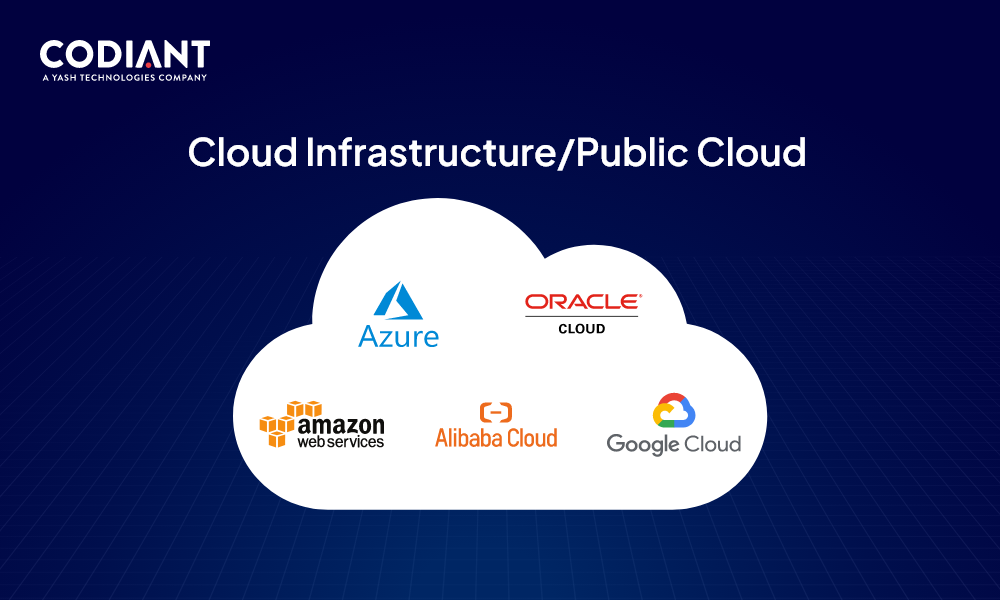
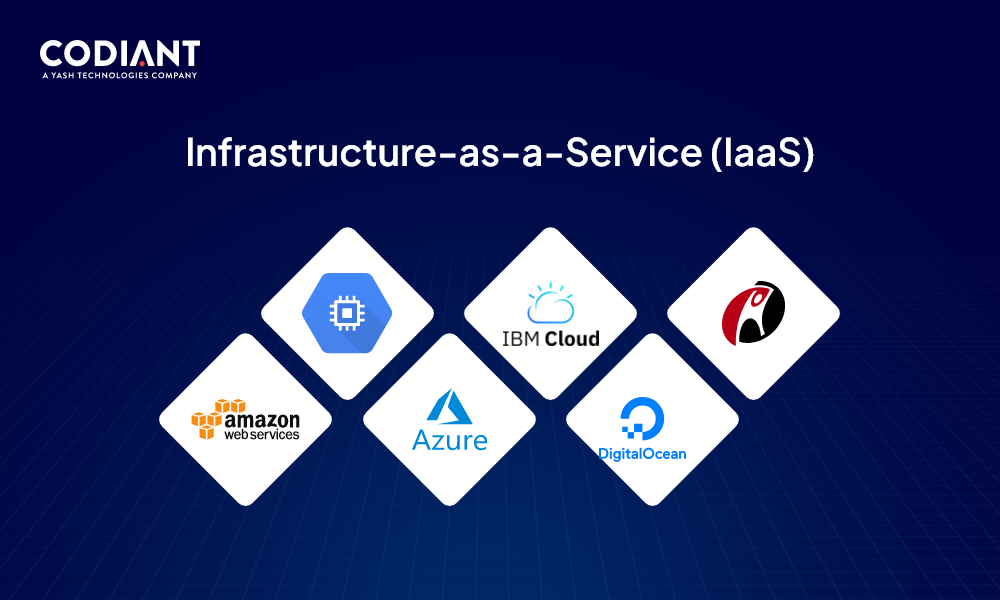
cloud1667382281 It is a commonly adopted cloud model among organizations, where the cloud service-providing organizations have to take care of the quality and size of hardware. The service provider owns the hardware and other supporting network infrastructure to provide much-needed services to its clients. In Public Cloud Infrastructure, the service provider is liable to take care of data center management, infrastructure maintenance, and physical security. It is so, because the service provider shares its infrastructure with multiple customers, ensuring to separately maintain each customer’s data. Additionally, the service provider had to take care of data security by offering multi-layer security controls. The companies majorly prefer Amazon AWS, Microsoft Azure, Google Cloud, Oracle Cloud, and Alibaba Cloud as the Public Cloud Infrastructure service provider.
2. On-Premises Solutions/Private Cloud

As the name suggests, the private cloud infrastructure is designed and only used by a single organization. It is exactly the opposite of the public cloud deployment model. The service provider doesn’t require to share their hardware with any outsider. It is a kind of in-organization cloud service that is accessible and maintained only by the in-house techies. The on-premises or private cloud systems are quite expensive to build and manage as require a dedicated team of resources and hardware which demands capital expenditure in acquiring and maintaining them. On the other hand, the major advantages private cloud serves are high privacy, security and greater control of the data and users. The private clouds typically maintain security by integrating sophisticated firewalls that offer access-only permission to authorized personnel.

3. Hybrid Infrastructure

It is quite evident with the name hybrid infrastructure – is a combination of two different services i.e. public cloud and on-premises or private cloud. The main purpose of hybrid cloud infrastructure is to avail the benefits of both cloud deployment models. The hybrid cloud architecture typically includes an Infrastructure-as-a-Service (IaaS). The hybrid cloud model allows to store frequently used and sensitive data in the private or on-premises cloud, whereas, other data for backup and archives are stored in the public cloud. This type of model is very apt and serves the best benefits in healthcare, finance and government domains. These industries require to maintain the sensitivity of the data by categorizing crucial data on-premises while allowing less-sensitive data on the cloud or public cloud infrastructure. The hybrid infrastructure minimizes the data security risks in the public cloud and provides virtual storage by offering a public SaaS service model. The interconnected environment of both the cloud infrastructure allows the users to place their sensitive data as per their requirements.

Related Reading: How to Choose A Trustworthy Cloud Service Provider?

3 Service Models of Cloud Computing

To land on the most suitable cloud deployment model for your business, many points needed to be considered. Before that, let’s understand the concept of all the 3 service models of cloud computing i.e. Software-as-a-Service (SaaS), Infrastructure-as-a-Service (IaaS) and Platform-as-a-Service (PaaS).

1. Software-as-a-Service (SaaS)

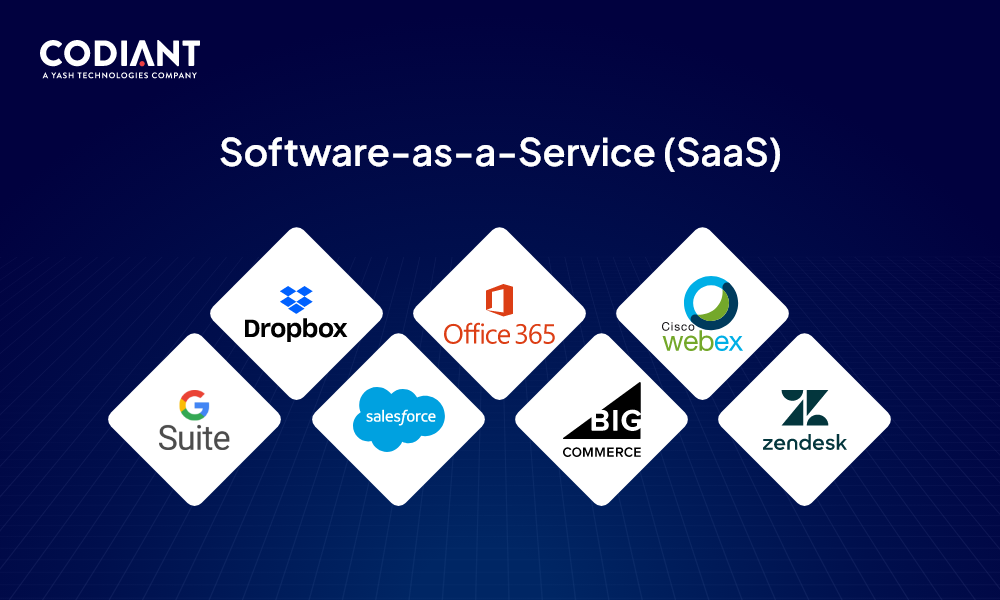
saas1667382352 The SaaS services can be accessed directly over the internet, it doesn’t require prior installation and can be availed at minimum subscription charges from any part of the globe. Hence, SaaS services are easily accessible to a majority of users and the services are managed centrally. The centralized management of software and services allows top-quality security, software upgrades, etc. that can be performed on the user’s device after their permission only. There are a variety of SaaS products available in the market, such as Customer Relationship Management (CRM), Billing & Invoice Systems, Human Resource Solutions, Help Desk Applications, etc. Some of the well-known SaaS solutions providers in the market are, Google G Suite, Dropbox, Salesforce, Microsoft Office 365, BigCommerce, Cisco WebEx, ZenDesk, etc.
2. Infrastructure-as-a-Service (IaaS)

iaas1667382386 The Infrastructure-as-a-service cloud model allows service providers to lease or rent the servers to multiple clients. The users can work over any operating system or software without having any additional maintenance and operational cost of servers. Clients can scale up or down the IaaS server size as per their requirements and can avail guaranteed Service Level Agreement (SLA) in both scenarios. IaaS is an apt choice for companies, such as startups and small to medium-scale companies who experience a shortage of investment in arranging hardware to build huge server rooms. Additionally, they aim to scale the business at a rapid pace and beat the market competitors. Some of the major IaaS service providers that offer exceptional services are Amazon Web Services (AWS), Google Compute Engine (GCE), Microsoft Azure, IBM Cloud Private, IBM Cloud Virtual Servers, DigitalOcean Droplets, Rackspace, etc.
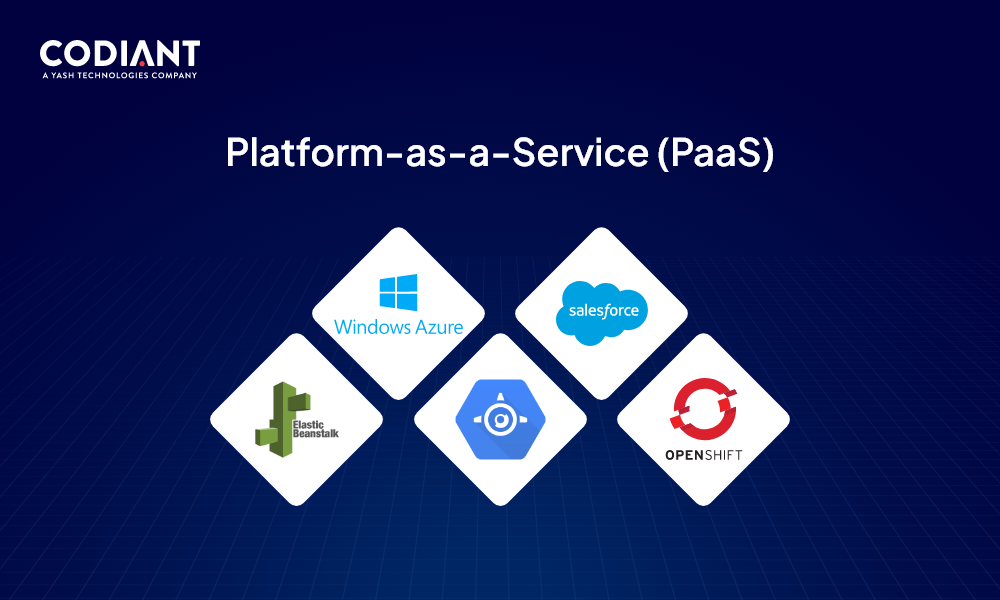
3. Platform-as-a-Service (PaaS)

paas1667382411 PaaS cloud service is usually preferred in organizations when your project demands multiple developers and vendors. This service makes it easier to build a customized solution by rending or subscribing to all the required computing and networking resources. It ultimately eases the app development process and helps to limit the development cost of companies. In simple words, the PaaS cloud computing model allows companies to build, run and manage the app development progress without investing a huge amount in arranging the required size of IT infrastructure. This makes the development, testing, and deployment of applications an easier and faster process. PaaS services make everything possible and handy for organizations to innovate and scale their project. Some of the renowned PaaS service providers in the market are AWS Elastic Beanstalk, Windows Azure, Google App Engine (GAE), Salesforce.com, Force.com, OpenShift, etc.

Difference Between Cloud Infrastructure and On-Premises Solutions: On-Premises versus Cloud Infrastructure

Cloud Infrastructure/Public Cloud On-Premises Solution/Private Cloud
Deployment
The service provider is responsible for the system maintenance on their server. However, the deployment of the data takes place on the third-party server. The company can access the resources from the cloud 24×7. The company is the service provider here and only an individual can use or access the private cloud. The deployment is done in-house using the company’s resources and is responsible for its maintenance as well.
Control
In a cloud computing environment, the ownership of data is not transparent. Despite sharing the data and the encryption keys with the third-party provider, during the downtime, the ownership and accessibility remain a concern. The enterprises enjoy complete control and privacy over their system. This is why most of the big companies prefer to maintain their private database.
Security
There is the minimum scope of any hardware, software, or infrastructure failure and breach in data security. The clients experience multiple disasters and redundancy protocols for data security. To maintain the secrecy and security of data, such as in banking or government platforms, the data cannot be shared. For such domains, an on-premises cloud is the best solution.
Compliance
Cloud solutions have to follow specific compliance policies, which is not safe for government domains, therefore the govt. companies never choose cloud-based or public infrastructure. In contrast to that, the companies that comply with govt. policies to safeguard people’s data and limit data sharing and access. For such companies, the on-premises cloud serves best.
Cost
For small size businesses, it is a very pocket-friendly cloud option with a nominal subscription fee. The setting up and run time is quite quicker and cheaper. The individual maintenance and operating cost of on-premises cloud are high and demand regular investment. It doesn’t end with the initial setup investment.
Scalability
The cloud size, server resources, internet usage and bandwidth are highly scalable. All this becomes handy due to the presence of virtual servers and resources which can be conveniently resized. Cloud scalability is pretty tedious, as the existing resources are already in use and to scale the storage – buying & deploying new resources is required. All this is not an easy task and only a few cases support convenient scaling.

On-Premise vs Cloud: Pros and Cons

On-Premises Solutions/Private Cloud

Advantages

  1. You own full control over your data, hardware and software platforms. So, you can decide what and when to configure, upgrade and change required in the system.
  2. Data can be accessed easily with any device via. internet and authorized users can even access data without an internet connection.
  3. Can be used instantly once you sign up, no further investment is required.
  4. Being an owner and a responsible person for the server, you are solely accountable for implementing required security firewalls or measures to keep the data safe and secure.

Disadvantages

  1. On-premises cloud implementation is quite expensive, as it requires sufficient purchasing of hardware and even demands more to scale the storage space.
  2. It also involves additional maintenance costs to keep software’s up-to-date and ensure a seamless response.
  3. The implementation of an on-premises cloud is time-consuming because it requires the installation of software on the server and every computer system.
  4. The in-house tech experts are liable for taking care of any tech issues.

Cloud Infrastructure

Advantages

  1. The cloud services are easily scalable i.e. on the requirement the customer can increase the server capacity.
  2. The user can access data or applications from anywhere and anytime via Internet connectivity.
  3. Can limit the expense by defining cloud storage and paying monthly charges for upgrades, software licenses, daily backups, and support.
  4. The cloud infrastructure offers its security, to save its customers from worrying about data vulnerability.
  5. The cloud infrastructure is quite eco-friendly and energy efficient by saving businesses from powering and maintaining their on-premises servers.

Disadvantages

  1. It requires consistent internet connectivity to access data from the cloud.
  2. It follows standard software to support diverse users, and thus can only be customized to a limited extent.
  3. Initially, cloud services are cheap as compared to the on-premises cloud, but in the long-term cloud services are quite an expensive investment for any organization.

Wrapping Up!

The pace with which organizations are shifting towards cloud infrastructure, it is quite evident that they are trusting the services they are getting along with data security. But, the major point that needs to be considered is to select a reliable and genuine cloud service provider. Thus, research the market, perform comparative analysis, and then go with it. Because if your cloud service shuts down then your business is at a huge risk. Apart from that, to migrate your data to the cloud, your business requires expert hands to perform it with accuracy and ensure not to lose any data. Therefore, to facilitate your requirements, Codiant can be the right service provider and we are ready to be your trustworthy cloud migration partner.

Grocery Delivery App Development: Cost, Technologies and Key Features

Today, technological advancement has introduced many new ideas in the market to cope up with the traditional business challenges and the on-demand grocery app development is one of them. It is not just offering convenient, automated and dynamic grocery delivery services that are enticing customers but also helping entrepreneurs and other business owners in scaling up their business solutions.

Subsequently, many startups are planning to invest in this soaring business opportunity to eliminate the customer’s pain of standing in long queues every now and then.

Considering this, in this blog we have tried to cover a detailed description of the on-demand grocery apps i.e. its significance, business models, popular apps, tech stack, key features, grocery app development process, cost of developing grocery delivery app, and more.

Scroll down to gain deep insights!

The Future State of Grocery Retail Around The World

Fueled by evolving customer expectations, technological advancements and new opportunities, the trajectory of online grocery can be understood with the following graph:

Future-State-of-Grocery-Retail

  • The Global Instant Grocery Market size is expected to reach $14780 billion by 2030, rising at a market growth of 3.0% CAGR during the forecast period
  • 63% of the population are likely to buy groceries using online modes i.e. smartphones, apps and more.
  • IBIS report states that there is a continuous growth in the grocery delivery industry and it has recently reached $757B with a growth rate of 2.9%.
  • Popular grocery delivery apps like Doordash and Grubhub have around 39M and 16M users.

Top 5 Benefits to Build A Grocery Delivery App

Benefits-to-Build-A-Grocery-Delivery-App

1. An Efficient Model That Promotes Cost Effectiveness

An online grocery business app is the best fit for people who are initially planning to start their business with a low-budget investment. Anyone can go with the app development having basic features. It also lower downs operational costs like inventory management, billing, checkout, etc.

2. Level Up the Brick and Mortar Stores

If you are running a brick-and-mortar store then you must switch to the online grocery app that helps you in follow the current trend and stay ahead in the market competition. The on-demand app solution provides the best opportunity to automate business operations and ensure a backup of mobility solutions.

3. Saves A Lot of Time and Resources

Turning on to the grocery delivery business enables business owners to handle a huge customer base easily and thus they can invest their time and resources in bringing efficiency to their services. Moreover, an on-demand business can also offer the convenience of managing daily chores from the comfort of the customer’s home.

4. Gain Greater Customer Reach

While customer base of the traditional store is built with personal relationships or mouth-to-mouth publicity. Whereas the online store can drive a huge audience with the search engine traffic which is easily accessible to the users as it has no geographical limitations.

5. Provides Ease of Marketing

As online grocery store can reach a wide audience, it holds the massive power to market their products and services easily. Business owners can easily save a huge cost while targeting the right audience and ensure flexibility in measuring data and statistics like cost per click, impressions, rate of engagement, and more.

Different Types of Business Models To Adopt By Grocery Business Owners

Types-of-Business-Models There are different types of business models explained that are fulfilling multiple business needs. Read them thoroughly to get an idea about the model that suits your business.

1. The Inventory Model

The Inventory model works on the idea of storing products in a safe and well-maintained warehouse in order to offer timely product delivery and other related customer services to fulfill customer needs. The owner in this collects products from multiple vendors and takes the responsibility of handling customer issues with a smooth interaction. The model is generally considered a little expensive because the single-product-based businesses use and bears a huge cost of building, maintaining warehouse, and transportation.

Bigbasket is one of the best examples of an inventory model.

2. The Shopping Model

This is a well-known model used by many giant business owners. This model also works just like the multi-vendor model but the only difference is that customers do not get the option of selecting the shop from which they are purchasing. The order is directly taken by the platform and they send it to the individuals who collect the products and send them to the desired delivery location. This model is preferred by most businesses because the owner only needs to have a strong delivery chain and good connections with multiple stores.

3. The Multi-Vendor Marketplace

The model is also known as the zero-inventory model because the owner does not hold the responsibility of managing inventory rather multiple vendors come together to offer their products and services using the on-demand platform. And in return, they provide a part of their sale to the platform owner as a commission. Finally, the transportation and packaging are either managed by the seller or internally by the e-commerce platform.

4. The Hyper-Local Model

This model works on the basic objectives of providing speedy delivery, empowering the local shopkeepers, and helping people in fulling the demands of the local area. The business owner has to ensure close collaboration with the local vendors so that the market demands of a specific area can be fulfilled easily. It is just similar to the multi-vendor store where the owner does not manage the inventory but offers a platform for the local vendors so that they can sell the products.

Most Popular Grocery Apps In The Market

Popular-Grocery-Apps

  • Farmigo

The app is famous for its fresh products that are available for purchase like dairy products, meats, snacks, and more. The farmer’s app offers good quality products at a better price as compared to the other supermarket stores. Additionally, a functional user interface of the app helps people to order items in a hassle-free manner. An interesting community section in the app allows users to check out other users who are also using the app.

  • Shipt

A leading company that offers groceries to their customer’s on-demand basis. It has many unique features that made it popular as compared to other apps. The users can check out the items that are especially available on sale and can raise a request for the non-listed items. In addition to this, a user can repurchase the previous order items by using the buy again feature.

  • Instacart

This is one of the leading apps in the grocery delivery app market worldwide. The unique features that make the business stand out in the market include first free delivery as the user joins the app. It allows one to buy groceries from multiple stores at the same time and the user can also compare different store prices for better decision-making. Moreover, the user can also reduce the delivery charges by choosing the app membership.

  • Postmates

This Postmates app work on the concept of providing more than just groceries. People can place an order for any available product from the app within the pre-defined location and can get delivery within an hour. The delivery services are also extended to the delivery of restaurant food with a nominal delivery fee charge based on the distance covered. Also, the 24 hours service availability makes the app unique and worth using.

  • Big Basket

The Big Basket app has got much popularity in terms of the excellent customer services offered by them. With the fast and safe product delivery, the app has improved user engagement and in case of late delivery, the user gets a portion of their payment back in their account. Also, in case of any queries, the user can connect via the chat option and communicate seamlessly.

 Technologies Required To Develop A Grocery Delivery App

The selection of technologies for app development is important because it helps in managing the app’s scalability, smooth functioning, and security. Therefore, it is important to pick the right technologies.

Given below are the technologies that will be used by any grocery delivery app development company:

Frontend:  Angular, Java, CSS, HTML, ReactJS

Backend:  Laravel, Node.js

Database: MongoDB

Payment gateways: Stripe API, Braintree SDK, PayPal API

Cloud environment:  Google Cloud, AWS

Location Tracking: Mapkit framework for iOS and Google Map SDK for Android

Social login:  Facebook, Google, and Twitter APIs.

Key Features To Be Used In Grocery Delivery App Development

The main reason to include features in the grocery app development is to reduce customer efforts for product procurement and offer them a unique experience during their grocery shopping journey. There are majorly three stakeholders of the app that helps in managing the efficient working of the app.

Customer Panel App

  • User Login

Make the login process seamless by using phone no., social media credentials, and email to ensure better time-saving.

  • Search Products

Users should be able to browse the product categories to choose a single product from the available list having detailed information.

  • Push Notifications

Upon completion of the order, notification must be sent to the user with information about the order status, delivery, product offers, and more.

  • Avail Offer

Users can check out available offers, discounts, and coupons before checking out the order. The feature cut down the original cost and minimizes the chances of cart abandonment.

  • Google Map

The feature automatically detects the user location which reduces user efforts of typing address manually every time they place an order. Later on, the user can also save their permanent address for future orders.

  • Live Location Tracking

The user can track the order delivery person from his way to the mentioned delivery location.

  • Schedule Order

The user can easily schedule a preferred order and place a delivery time as per the availability of the slots.

Delivery Panel App

  • Login/Registration

The delivery person will register themselves using email, phone no., and password. entering the required details like email, phone no., government id, photo and more to ensure user authenticity and security.

  • Profile Management

The person can upload their personal details like photos, government id, contact details, etc, to ensure security and authenticity.

  • Delivery Order Management

The user can easily manage order-related queries like pending order requests by sending acceptance or rejection on the same and sharing related order details.

  • GPS/ Live Tracking

The delivery person can easily find out the customer’s address and check out the easiest route to reach there.

  • Order Store Notification

On the order acceptance, the delivery person informs the store manager via notification to start preparing the order for quick delivery.

  • Check Feedbacks

The delivery person can check the customer feedback to know their experiences using products and services and improvise on it to ensure better customer retention.

  • Customer Support Via Call or Live Chat

The delivery person can connect with the customer to resolve any order/service-related query by connecting via call/chat.

Admin Panel App

  • Manage Profile

The admin can create a profile using a number, email, and password to access customer and delivery personnel accounts and manage other activities on the app.

  • Dashboard

The admin can have a clear view of the activities like orders, deliveries, payment, inventory and more.

  • Manage Vendors/Stores

Admin can manage a huge chain of stores and vendors and ensure the inventory stock meets the rising customer demand.

  • Manage Customers

The Admin can check and manage customer activities and coordinate in case of any emergency.

  • Manage Payments

Admin can check and manage the total earnings on a weekly, monthly, or yearly basis.

  • Report Management

Admin can check daily, monthly, and weekly reports to check service quality and customer engagement.

Advanced Features

  • Loyalty Programmes

The creator/app owner can build a huge fanbase using the tactics like physical gifts, non-tangible rewards, memberships and more.

  • Behavioural Tracking

This ensures tracking customer behavior over the services of an app which includes most searched orders, recent items ordered, the average shopping time etc.

  • AI-Based Delivery System

The delivery process can be automated with optimized routes. The unmanned fleet can help in boosting productivity, detecting risks and preventing frauds.

The Process of Grocery Delivery App Development

Process-of-Grocery-Delivery-App-Development

1. Plan Your Idea or Strategy

Initially create a strategic plan, discuss it with the team, do the brainstorming and draw the plan that fits perfectly with the business needs.

2. Calculate Features and Functionalities to Be Added

Make sure to pre-test and check all the features and functionalities that need to be added to the app as it will help in controlling the development cost by overlooking insignificant features and functionalities.

3. Pay Attention to Wireframes and Prototyping

Create an intuitive wireframe including all the necessary features and functionalities that lays down a path for prototyping. Once both the processes are completed then we can move to the final stage of development. But still, the changes can be made in the prototyping, as many times as needed before development.

4. Start Processing the Development Stage

At this stage, the team starts working on functionalities and features to turn them into successful code to build the first version of the app. It includes proactive participation of the developers with guided aesthetics to ensure smooth development.

5. Go Through the Quality Analysis and Testing Phase

The testers take every minute detail into account with the rigorous method in real-time to offer successful deliverables as and when needed.

6. Get Ready for The Deployment

The app delivery will be done with continuous maintenance, functionality check, and required improvements to display the app as intended.

7. Don’t Forget to Offer After Delivery Support Services

The ever-changing technological and business requirement demands a continuous evolvement of the strategies. Thus, make sure to offer constant upgrades now and again to maintain its performance and growth in the market.

How Much Does It Cost to Develop A Grocery Delivery App?

Estimating the cost of app development is not much easy. One needs to include multiple basic requirements of the app development phase. Here are some of the factors that will help in defining the cost required to build a grocery delivery app:

Complexity of The Project

Integrating more complex features increases the development time and thus costs higher. For instance, if you will include features like live tracking with heavy traffic and multiple vendor store then it will cost higher as compared to the basic features. So, one needs to thoroughly conduct market research and understand their business requirements to perform the right selection of features and functionalities.

Number of Features

Some common features like live tracking, push notifications, multiple product listings, order history and more are very basic features that cost nominal charges. But some business requirements are fulfilled by advanced features like multiple payment gateways, geofencing, facial recognition and more which will automatically cost a higher amount.

Size of The Team

The development cost varies depending on the number of developers hired. Also, the speed, as well as quality is totally dependent on the team size. If the team size is small with a higher workload then it may create a risk of managing multiple resources associated with the project.

Number of Iterations

Feedbacks are the best ways to ensure accuracy and provide speedy deployment of the product. It is suggested that there must be frequent iterations from the client side to the team in order to ensure the quality and feature requirements are just as similar as client expectations.

Developers Experience

It can be a time-consuming process to search and find a suitable team of developers with the required skill set and the right expertise to offer a better experience to the users and clients. So, begin your research to find and hire the right developers who can fulfil the specific requirements of the project.

Technologies Used

The use of technology in the development of grocery delivery apps can vary. So, it is required to understand the project requirement that decides on the right set of technologies. The project requirement can be for either the Android platform or for iOS or for both.

Team Composition

  • 1 Project Manager
  • 1-2 Android App Developers
  • 1 UI/UX Designer
  • 1 Quality Analyst

Summing Up!

Creating a grocery delivery app without a dash of innovation can leave you in a dangerous position or just will not make a great pay out. Understanding its current market scenario and the gaps are way more significant to bring innovation and beat the rising market competition.

Codiant is one of the excellent and well-known grocery delivery app development companies that can help you in integrating all the consumer-driven features in the native or cross platform app as per the business requirements.

Connect with our experienced and expert team of developers who will help in applying more detailed tips and tricks to enhance or develop your on-demand grocery delivery app solution.

What is Market-Ready or White Label App Development?

If every other business had to start from scratch, not all business could match the pace of head-storming competition.

A real businessman doesn’t always crawl a tortoise walk to reach the zenith of success. The digital world is evolving rapidly. You go slow, you lose!

Regardless of what your business is, the tech industry has a quick solution for all within their budget.

The solution is famously termed as a White Label Apps or Market-Ready Mobile Application. These solutions provide a ready-made solution for businesses to take their presence online in no time.

Since the introduction of the concept of white label app solutions was introduced, the adoption rate of mobile apps among medium and small businesses has amplified. As a result, about 42% of small-scale businesses are currently owning a mobile app to facilitate their customers.

Being an entrepreneur, if you are looking for such convenient solutions and seeking more details about this concept, then let’s understand the concept of white label application, its types, benefits, and other development details.

What is a White Label App?

A white label app is an industry-specific generic app developed by the company to sell the working product to multiple clients by re-branding the app as per the business specifics.

In other words, a white label mobile app is developed by a third party that can be rebranded for different companies, where the development company owns the source code of the app.

Though these apps are market-ready solutions, business owners don’t need to invest more finances and experience a long waiting time to present their online branding. The software development companies, develop such types of apps as a blank slate, that is created with the intent of reselling the application.

To stand out in the crowded app market and make an early start, the companies ensure to infuse enough online branding which ultimately increases the business popularity.

Not only the small or medium-scale businesses but also the businesses that are operating on a tight budget, for such businesses the white label apps are no less than a dream come true, to scale up the business processes in a cost-effective way. Mostly, the white label applications are industry specific and follow a set of common industry-based features.

However, the app can be upgraded and customized as per the business branding and requirements.

For example; E-commerce apps’ general features include search filters and a checkout process, whereas a white label app developed for food delivery or restaurant business includes features that support customers to search for food items, place an order, and set up a delivery or make reservations.

Looking for A Custom, Market-Ready Grocery Delivery App to Build Your Online Grocery Shopping Platform?

arrow

Looking for A Custom, Market-Ready Grocery Delivery App to Build Your Online Grocery Shopping Platform?

VISIT GROFEE

Types of White Label Mobile Apps

Considering the technical characteristics and the features a market-ready mobile app offers, it can be categorized under two major groups i.e. Single-Tenant and Multi-Tenant. Here, tenant refers to the app customer, which is you the buyer i.e. the owner of the app. Let’s understand the difference between both types.

1. Single-Tenant White Label Application

A single-tenant white label app is a single copy that is provided to the customer. It means, that all the customers will receive a customized and separate app, which is equipped with their business branding only. On the other hand, the same app is sold to other customers as well but is branded with their business elements.

For a single-tenant white label app development, the developers use the single back-end code for all their customers or say, buyers. This depicts that the app is significantly new and separate for each client, which allows flexibility in updating and scaling the application, without hampering other clients’ app working.

Having a single customer for the specific environment, the single-tenant white label app could be a little pricey.

2. Multi-Tenant White Label Application

A multi-tenant white label app follows a specific set of features and serves the same platform for all the customers i.e. buyers of the application. Such apps only allow to customize the UI design of the application and don’t allow playing with its codes.

Such types of apps can be typically termed, Software-as-a-Service (SaaS) model. Under this model, the service provider hosts the universal app in the cloud and makes it available for buyers over the internet who can avail of the services after paying the usage charges.

Comparatively multi-tenant apps are quite a cheaper and more convenient option for most of the small and medium-scale businesses. Here the cost of the app environment is shared among the app buyers. However, performing any update or changes in the app, will affect the activity of all clients, regardless of whether one requires that service/facility or not.

Benefits of White Label App Development

Benefits-of-White-Label-App-Development

  1. Low Investment- The white label apps are ready-made solutions, which don’t require any initial expenditure. It is very convenient and beneficial for a number of start-up businesses with a limited budget. The market-ready apps do not require the heavy expenses as well that are required to build the highly customized single-owner app.
  1. Substantial Customization- The white label apps can be customized to an extend to infuse the client’s/buyer’s brand image. It is quite beneficial for the client to sync a product or service with their website or social media platforms.
  1. Quick Turnaround Time- For any business, time is a very sensitive factor. Thus, choosing a ready-made solution helps to save precious time and swiftly acquire the market. Likewise, in a market where no such business idea exists, for that also the white label application can turn out to be an instant solution and helps to make rapid profits.
  1. Easier Maintenance- Being in association with an app development company, makes it easier for businesses to have the right and apt post-release maintenance support. It is so because, the one who develops the project knows all the details and glitches about it, therefore, it becomes easier for them to handle any issues and assist their client in the best possible manner.
  1. Rapid Market Penetration- Making into the market at the right time and without wasting your precious time is the key for any business to build a brand identity in the market. All this becomes possible and quite easier by adopting the white label app, rather than waiting for a custom app development and investing a hefty amount.
  1. Create Your Brand- It is an easy and effective method to build your own brand and enhance brand visibility at the same time. The white label app solutions are the best for startups to make their bright presence in the competitive business environment.

How are White Label Apps Developed?

A White Label App Development undergoes three different stages as described below;

1. Development Stage

A development company or a white label app development company usually develop a fully functional app while considering the target audience and the industry-specific goals.

The mobile app is the generalized version that deals with the majority of the operations or we can say, the app is equipped with all the basic functionalities that a number of businesses follow under a specific industry.

2. Rebranding Stage

Owning a white label application, for a development company it becomes quite easy and convenient to sell the app to multiple businesses that are serving in the same industry.

To make this possible, the development company ensures to infuse the business identity in the application by updating it with business-specific products, slogans, logo, and other details.

In this way, the pre-existed app is rebranded by the development company to make it a customized solution for the business or their client.

3. Acquisition of Rights

The company or business that generates the request for a solution or is likely to acquire ready-made software to automate their business, requires to own the rights, and gain control of the app.

The businesses can purchase full-time access to the application with the existing functionalities or can go with cloud apps and use the app based on the subscription period.

Cost of Owning A White Label App Solution

The cost of owning a white label app cannot be fixed, as every project is different and follows variable features and functionalities, which influences the development cost to a great extent.

However, based on the business requirements or the existing white label solution the price of the app can be estimated with the help of a professional developer.

Additionally, the one-time app set-up fee may also be charged as per the companies’ norms, which could be about $2000 or more based on the custom requirements of the business.

Apart from that, the development company also charges a maintenance fee. It also includes an account manager, dedicated load balancers, and more. The charges vary based on the support and setup required by the customer.

Conclusion

In the digital world, mobile apps are considered the best and most convenient way for a business to grow and achieve its expectations. Owning a white label application is turning out to be the most suitable option to instantly extend the business reach without any research hassles and recruitment efforts to raise the operations.

Codiant is a white label app development company that helps businesses with customizable market ready apps for industry sectors like food & grocery, taxi apps, telemedicine app, on-demand counselling app, and more. Our cross-industry white label solution have historically turned the buyer’s business into a profitable one.

For further details, you can connect with our experts to gain knowledge about the existing market ready products and how the solution can be the apt solution for your business operations.

How To Write A Mobile App Product Requirements Document

A well-defined product requirement document is the essence of a traditional project management team to deliver a successful digital solution. Interestingly, almost 70% of the projects face failure due to negligence in preparing the precise software requirement specifications document. Considering this figure, without a doubt we can deduce that the successful deployment of any project begins with a well-planned product requirements document.

Hence, to develop a successful and compelling project, understanding the project’s requirements is the key. And being an entrepreneur, possessing the knowledge of how a mobile app product requirement document can be prepared will give you a big picture of your project.

This blog will introduce you to the PRD concept and further details about it, such as types, processes, characteristics, and other details to draft an impactful outline for your mobile app development or web development.

What is a Product Requirements Document?

A Project Requirement Document is a compilation of the proposed project’s purpose, specifications, features, functionalities and behaviour of the working project. The document covers all the different aspects of the digital project from the initial phase to deployment.

In simple words, a PRD defines ‘how you are going to build the project’ and ‘what you are going to build’.

The PRD can be referred to at any stage of mobile app development. This document can also be used to represent it to the stakeholders and investors while demonstrating the detailing of your proposed project, it includes an Android and iOS app or a website.

It is a detailed blueprint, which guides all the departments involved in building the project to maintain the project stability and get the desired end product. All these details mentioned in the software product requirements document helps to ensure that no blind spot is left.

Why a Mobile App Product Requirement Document is Needed?

Every software or project development is carried out to propose a solution to a problem. But, concluding at a solution and framing the problem in the right manner is the key aspect that needs to be comprehended before moving ahead.

Though these queries can be answered easily when you follow to frame the accurate answer for the 4 W’s, i.e. What, Why, Who and When. To answer all these questions the PRD document is prepared, which provides detailed information about the product and makes it easily understandable to any individual. Let’s get into further detail.

1. “What” you are building?

This is the first and foremost question that needed to be answered, it will communicate your idea accurately and make it easy for tech and non-tech individuals to understand your project’s vision. Initially, these details will communicate the core functionalities of the product that you are aiming to develop.

Further, the research work is carried out and other team experts are involved in it, then the product details get matured. It includes the introduction of varied micro-services and their dependencies, API integration and other tech details that the project requires.

2. “Why” you are building it?

The question, why you are building a product should always be accompanied with, what are your project development aspects.

A definite and guided answer to this question will let your counterparts and team members have a unique experience, get an additional revenue stream, and identify your project’s goals accurately.

3. “Who” is your target audience?

The target audience of every product varies based on the project idea and solution it is offering to the end-users. Evidently, the common project ideas cover a wider customer base, whereas some exceptional and unusual ideas are only exposed to a niche.

Hence, develop the project while keeping the target audience in the mind, such that the product is usable for them. This will define the success of your proposed project.

4. “When” do you need the project?

To develop a project, preparing a software product requirements document is the critical step to initiate the project development.

Documenting all the specifics and dependencies of the project will help to prepare an efficient product roadmap, and assign modules priority – all these details allow every team member to understand their role and tasks with the timeline. As PRDs also include the tentative launch date of your product.

Collecting all these details is a complicated and time taking process, but the effective and accurate answers to all these questions will help to prepare a detailed PRD. This will enable the development team to organize each phase precisely and build quality and timely end-product.

Types of Product Requirement Documents

1. Business Requirements Document (BRD)

A Business Requirements Document (BRD), is a detailed report that comprises of project’s needs and requirements, the purpose of proposing the idea, what solution you are presenting with it, its features and functionalities, and other details along with the expected project timeline.

However, to define all these requirements, a lot of research work is carried out to map out the overall structure, limitations, and other details of the project, before starting any work on the project. As a result, the BRD infuses clarity, holds attention and removes ambiguity in the project’s requirements.

2. Customer Requirements Document

The Customer Requirements Document is a detailed document that defines what the software or system needs to do while considering the customer/end-user perspective. The document is written in layman’s language, no technical or complicated terms are used to demonstrate the user’s point of view.

Thus, a well-written customer requirement document should be clear, concise yet well explained, and unambiguous. These details help designers and developers to understand your requirements, and can also define the deadline, estimated budget and other details.

3. Software Requirements Document or Software Requirements Specification (SRS)

An SRS is a document prepared for the proposed project, which held project details, such as requirements, expectations, and standards. These details can be arranged in the form of spreadsheets, text documents, schemes and other required elements to present the product’s requirements and vision in a much easy manner.

In simple terms, a Software Requirement Document provides a detailed project description of how a project is visualized to work and how the development team should implement the entire development flow. A good SRS defines consistent details, correct information, a hierarchy of operations, verifiable and modifiable details, etc.

4. Quality Requirements Document

A quality requirements document demonstrates the project’s quality and the capability that must be present in the end product. The quality documents are submitted to the Project Manager to analyze the project’s feasibility and outline the quality control plan prior to project commencement.

A Quality requirements document comprises multiple factors, criteria, and benchmarks that must be fulfilled. It includes consistency, reliability, usability, availability, maintenance, and customer experience. Generally, a Quality Requirements Document is written by a business analyst or a project manager.

5. Technical Requirements Document (TRD)

Software development is a process that follows a systematic approach to transform the required specifications into effective and accurate codes. The TRD report comprises of defined purpose, proposed functionalities, implementation, and operations performed by the features that developers have to manage.

A TRD document provides clarity in project development and structure to handle and manage the problems/operations. Overall, a technical requirements document is no less than an organized flow that proposes a foundation for further processes.

6. Market Requirements Document (MRD)

A Market Requirement Document (MRD) is a document that is written to define overall market opportunities a mobile app product can experience and explore. The document represents the market size, target market and competitors in the local and global markets.

MRD is usually a strategic document that is compiled by the product marketing manager or sometimes the product manager to define all the initial and basic requirements to kick-start the project. The document also defines the revenue opportunities and features list along with categories.

7. Functional Requirements Document (FRD)

A Functional Requirements Document is a formal and written detailing of the mobile app requirements specified to achieve business goals. It is a form of formal contract which ensures the client agreement and keeps the technology team on the same page to make them aware of all the do’s and don’ts.

The major purpose of preparing an FRD is to bridge the gap between the business and technologies – define the requirements and functional solutions directed to the mobile app product development. It is usually prepared by the technical team after going through the BRD and SRS documents.

8. User Interface Requirements Document (UIRD)

A User Interface Requirements Document focuses on preparing and anticipating the prospective audience and target customers might need. The document is prepared after detailed research which ensures that the user interface have elements that are easily accessible, understandable and facilitate suitable actions.

A detailed UIRD makes it easier to build the app or website because it provides a guided and detailed view of the proposed product to developers in a simple and easily understandable language. This helps them to anticipate where the issue or error may arise. The document is prepared by the UI designing team after analyzing the project’s idea and detailed specifics.

What are the Key Points of the Software Product Requirements Document?

1. Goal & Objective

To design a product requirement document for a mobile app, the first and foremost step is to clearly define and identify the goals and objectives. This can only be possible once the development company accurately understands the business idea which will help them to propose an effective set of functions for the expected digital solution.

2. User Personas and Stories

Defining a user persona and hypothetical stories helps to determine how the right audience and target users can engage with the product. Google Analytics can also be used to create user personas. Using all the basic details to analyze the user and the buyers helps to align and market your product/services in order to yield better results.

3. Functional & Non-Functional Requirements

The mobile app development should include a detailed product requirements document (the types of mobile app product requirement documents are explained above). The functional description should be followed by non-functional app requirements, such as app security, device compatibility, performance, multi-language support, etc.

4. Wireframe & Design

In this stage, the design expectation for the mobile app development can be presented in the form of wireframes and mockups. Additionally, further details and specifications can be documented in the User Interface Requirement Document that helps in designing the product by following more creativity and the suggested ideas. The wireframes and mockups work as a blueprint to present where the expected features will fit on the page and other details.

5. Sitemap

The documentation of the sitemap presents the complete list of all the pages or screens that are required for the app/website to run smoothly. Apart from that, these pages are arranged in a sequential manner to demonstrate easy navigation. This arrangement of screens ensures that the screens are linked in such a way as to present a meaningful process.

6. Technical Specifications

The detailed description of the technologies and technical elements that can be used to build the project that best depicts the client’s expectations. Choosing the right tech stack can be the basic building block of an app or web. Some of the popular tech stacks that developers commonly prefer are MEAN (MongoDB, Express.JS, Angular.JS & Node.JS), MERN (MongoDB, Express.JS, React & Node.JS), LAMP (Linux, Apache, MySQL & PHP) and MEVN (MongoDB, Express.JS, Vue.JS & Node.JS).

7. Assumptions, Constraints, and Dependencies

The requirements and expectations of a product’s success are usually put under assumptions. A successful product is defined under multiple factors, it includes expertise and experience in the target market as well as niche market knowledge. The presumption in the mobile app product requirement document assembling comprises assumptions about the user, business, and technical resources.


Ways to Develop and Manage Product Requirements

Here are some of the ways that can guide you to effectively develop and manage mobile app product requirements;

1. Implement Usage of Requirement Management Tools

To deliver a project within or before the assigned deadline, it is suggested to implement the usage of requirement management tools and collaborative project management software. These tools can help your business to store and share valuable details that must be needed for developing and managing the mobile app product requirements document.

2. Define A Process for Requirement Changes

A project development process normally undergoes requirement changes or unexpected requirement changes. To handle and cope with such planned or unplanned changes in the project – defining the mutually deduced developing steps to implement required changes could be an intelligent call. It will help to eliminate any last-minute mismanagement and panic mode in the team.

3. Implement a Risk Analysis

Being an intelligent team, you can predict, plan and be ready to deal with any unforeseen situation or any potential issue. All this can be handled and planned in advance by implementing a risk analysis study and defining a possible measure that can be instantly followed by the assigned team members if such issues arise.


Characteristics of a Quality Mobile App Product Requirements Document

A mobile app product requirements document can turn out to be an incredibly effective tool if it possesses specific features and qualities, as mentioned below. The mobile app scope document can be a very helpful and guiding tool for all the team members, thus it should be designed very intelligently and in a well-researched form.

  1. Specific Qualities- The project’s requirements need to be outlined before getting into the project design & development phase. Aim to extract details from clients which depict their purpose, projects goal and other details or qualities. However, keep it simple and crisp, so that the concerned person can get the overview and required information on the respective issue.
  1. Complete- Ensure to provide well-organized and quite detailed information about each functional specification for developers. It will help them to learn details and implement specifics accurately. In contrast to that, if you are not having enough details about any element, then mark it as ‘TBD’ (to be determined) and take follow up periodically.
  1. Feasible- The PRD must be designed after analyzing the project’s requirements and platforms (Android, iOS or hybrid), along with the existing team’s efficiency, capability, time and budget. Such detailed study, helps organizations to analyze their team and the target, such that it is attainable and useful in achieving their goals.
  1. Prioritize- Setting the hierarchy of each element, functionality and module is very important and much needed for the development team to plan their task, as well as the client too to get the basic working version of the project in a minimum set timeline. The ranking of all the functional and user requirements operations will fasten and align the development approach.
  1. Unambiguous- The mobile app scope document in the initial phase is prepared to avoid miscommunication and confusion at the last moment. Therefore, it is highly recommended to document every requirement, so that in the end, both expected and delivered results match each other.

Conclusion

The sole agenda of preparing a mobile app product requirements document is to present a guided track to develop a quality and successful product. Thus, ensure to mention all the requirements of your business, including functional and non-functional requirements, technical dependencies, assumptions and restrictions as well. It will maintain a record of every operation, decision, change/update and client’s expectations.

The PRDs can be an easy and convenient way to introduce updates and suggestions that enable team members to easily understand the requirements and work over them parallelly with the ongoing development process..

So, if you are aiming for mobile app development but experiencing a hard time preparing a well-defined PRD to interact with your development team, reach out to us, and we will gladly assist you with your issues.

How to Build An App Like Clubhouse- An Audio Social Network App

Think Social Conversations. Think Clubhouse.

The Clubhouse has exploded onto social media and cornered the market with its excessive popular concept of live audio.

With the user base ranging from musicians, creators, authors, entrepreneurs, parents, sports fans, stock traders, comedians, and more… the app has effortlessly picked the interest of users from all niches and backgrounds.

Apparently, while the app was performing exceptionally well to entice users but the pandemic has been the major catalyst to spark its growth when people were stuck at home and were finding ways to share their emotions confidently.

The launch of Clubhouse has resolved this problem and swept a good number of audiences. Entrepreneurs can invest and strategize in this innovative idea by integrating a robust list of features to attain success.

The Clubhouse is an invite-only only voice-chat app that has covered a huge audience and succeeded in offering a wonderful user experience.

Are you excited to know the history of the Clubhouse app?

Scroll down the article to get detailed information about Clubhouse, its working process, the reasons behind its immense popularity, and the comprehensive stepwise process of developing an app like a clubhouse.

Read on!

What Is Clubhouse?

Clubhouse is an audio-based social networking app that is specially designed to help people carry group conversations easily on the topics of their interest. It allows people to create separate rooms so that speaker can take the lead as a room owner and audience can listen to it. The room owner can also allow other people to join in as a speaker.

The app promotes the significance of human interaction particularly when they are miles apart. In short, it is an audio-based app to connect with others in real-time by talking, listening, and learning from each other.

Why Clubhouse App Is Going Viral and Hailed as The Investor’s First Choice?

Clubhouse-App-Is-Going-Viral-codiant

The hottest and latest audio-based social platform is driving people of all age crazy and making them frenzy. Fuelled by influencers to celebrities, the app has a dash of exclusivity that is attracting investors globally to blow billions of dollars and register users online.

The reasons behind the popularity of an app like Clubhouse are worth considering. With its unique and alluring features, the app development succeeded in taking a huge market share. Here are the features of attraction that is increasing the network of users and their acquaintances.

  • The invite-only app ensures user authentication and verification making it a secured space to share the voice.
  • The audio room option is where users can participate, invite their friends, or leave the room anytime.
  • Allow users to listen or share their audio on different topics inside the rooms created.
  • An interactive audio-only app removes the obligation of facing camera and come forth to share their voices.
  • An interactive platform to create a network and connect with a large audience easily with specific user interest.
  • It allows you to work at ease and convenience, further extending the platform’s popularity.

Apart from this, the other technical expertise that contributed to the app’s popularity are easy personal optimization, simple navigation and user interface, the TikTok like nature that picks users’ interests and create a highly interactive environment.

Clubhouse-facts-codiant

How To Develop An App Like Clubhouse?

Building an app like Clubhouse involves a few simple step procedures that need to be followed. Let’s check the below-mentioned points to make your idea work:

Carry Out the Market Research To Find Market Fit Product

Every successful idea is an outcome of the initial research that provides confidence to an individual to move ahead. So, before you jump into the development phase of the clubhouse like the app, it is necessary to check the viability of your product. Make sure to understand and identify the target audience, check the nearby demographics and check current related trends.

Also, while checking the external environment factors, it is crucial to analyze your value proposition and the potential of your product to satisfy the market demands.

Select the Specialist Development Team

The team acts as a backbone in the process of turning up your idea into reality. Conduct in-depth market research to find the best UX designers & experienced team of developers who can thoroughly understand your idea and put down the necessary efforts to make it a great success.

Also, don’t forget to create a systematic workflow that can act as an initial roadmap for the team to move ahead. Once you are done with your team selection, consider discussing the feature list you want to include in your app to make it unique from your competitors.

Build an MVP Version of The App

MVP refers to the Minimum Viable Product in which the minimum number of features and functionalities are used to develop a testing app version at a low cost and given timeframe. Creating an MVP version is crucial to understand the performance of the app and getting genuine feedback from the first adopters.

But make sure to offer the value to the prospects with minimum features to open the doors of its success further. With a good MVP, design mockups, and prototype, one can easily attract new prospects and turn them into regular users. Also, it can be a key to raise the required funds for the project development.

Top Features to Include in Clubhouse App Development

Some of the common and not-so-common features included in the Clubhouse app are as follows;

  • Profile- The user can create their profile and update details that they like to share or show to fellow app users. User can also link their other social platforms links to reach people through multiple sources.
  • Invites- Existing users can invite outsiders to connect through the app by sharing the unique invite reference link.
  • Language Filters- The app is all about verbal communication, therefore to facilitate users the company has introduced a filtering function, where users can choose rooms in the language they understand.
  • Customizable Notification- Notifications are for increasing user engagement with the app, but sometimes it may turn annoying for the user. Therefore, the user can customize the notification based on their convenience.
  • File Sharing- Users can share images and documents of a reasonable size limit with other users with ease.
  • Private Rooms- In Clubhouse, the users can even avail of the feature of a private room, where the user can interact with a person after getting the invitation accepted.
  • Clips- The live listeners can snip the recent or ongoing rooms’ 30-second audio and share it anywhere with a link to invite people to join the room. However, the host can even turn off this feature for other members.
  • Replay- This feature allows the creator to record the audio of the room and save it to their profile and club. They can even download the audio and share it on other platforms, like a podcast. The host can even set the recording permission for other members too.
  • End-to-End Encryption- In the Clubhouse, the user is getting end-to-end encryption, where the data and audio communications are highly secure and stored in an encrypted form.
  • Audio Quality- Clubhouse is all about voice conversation. Thus, considering the importance of audio, the user can switch the audio quality from High to Standard or vice-versa.
  • Search People in a Room- The user can easily search for a specific person in the room when the participant list is long.
  • Hiding a Room- The user can hide the rooms if they don’t want to see or visit anymore. Other users who search for it, will get the result of irrelevant room names.
  • Hand Raise- To maintain the flow and interaction in the chat room, the organizer can manage the queue by using the hands raised feature by the participants.
  • Name Change- Clubhouse allows the flexibility to its user to change or correct their names, in case they created the account with an alias or fake name. But can do so only once in their lifetime with the app.
  • Social Media Integration- The user can link their other social media account to the app. It is a great feature for businesses and public figures to connect with people and build their brand on multiple platform channels, such as Instagram, Facebook and Twitter.

Focus on Working for A Killer Marketing and Sales Strategy

Nobody will know the power of the sword unless it is being displayed on the battlefield and the same theory applies to your product. Thus, to demonstrate the utility of your product, it is essential to plan a robust marketing and sales strategy that explains the value of a product to the target audience. You can play around with these concepts to perform your best performance:

  • Concentrate on building your brand identity
  • Target to create an efficient online presence
  • Set up an effective sales funnel
  • Set up suitable sales tools
  • Decide the achievable sales goals

Carry Out the Data Analysis

Data collection is an integral part of the performance analysis which is necessary to take further decisions and understand the market demands. Make use of the modern and dynamic data analytics toolkit that can help in making good strides. After that, consider linking your data to a business context in order to take the well-intentioned decisions that lay down the path to achieve the pre-desired business goals.

Technologies Required to Build Clubhouse Like App

The required tech stack is required to bring success to your project:

Languages and Frameworks: Python, Java, HTML5, Kotlin, CSS3, Objective-C, Linux, Kotlin, Django.

Design: Figma, Google fonts

Application Hosting: Nginx, AWS, PubNub

Application Utilities:  Airtable

Analytics: Facebook Pixel, Google Analytics, Google Tag Manager, Amplitude

Back Office: Lever

Collaboration:  Google Workspace

Data Stores: Redis, PostgreSQL

Marketing and Sales Tools:  Ghost, Google Ads, Salesforce, Zendesk, Facebook Ads.

How does Clubhouse Make Money?

Developing any social media platform is super easy but making money out of it is really a difficult task to perform. There are many processes that can be applied in the apps to make money out of it:

Subscription Method

This is a very popular model which allows developers to create a free download app and the users can buy subscriptions that provide them access to explore more content of their interest. Using this strategy, the app owner can easily create the initial user base and manage to attract more users and turn them into paid ones.

In-App Advertisement

This is another popular method used in the market. The method allows the app owner to provide space for the in-app advertisements and charge a fixed amount from them. Also, the strategy offers better benefits if in case the app is able to deliver useful content to the audience. Nobody likes disturbances in between thus users switch to the ad-free version by paying a fixed amount. Thus, in both cases, there are good chances of generating revenue from the app.

Tipping

The content creators in any app are the soul of that platform and offering a virtual tip for their hard efforts is necessary to maintain their motivation. The app allows the audience to directly support them by purchasing a ticket for the content or paying a certain amount as a tip. Thus, this method helps in creating a huge user base and attracts existing and new content creators to provide innovative content for the success of the app.

Partnerships

This model is usually suitable for the app platform which has a huge market user base in any particular niche/area. The app owner can choose to connect/partner with other well-known brands that can help in generating a good amount of revenue and a strong brand image. Also, a mindful partnership will benefit the user with exposure to the new demographics of the partnered app.

Cost of Developing an App Like Clubhouse

Deciding the cost of developing an app like Clubhouse can vary because it depends on multiple factors included in the app. The factors that accounts for total cost are features, design, product complexity, time frame, and more.

Let’s discuss in detail about how these factors are going to affect the cost estimation of the app development.

Research & Design Phase

The app development begins with the discovery process where the discussion will move around the data collection, understanding of product needs, and deciding features to be included. This may vary as per the individual client requirements and affect the necessity of resources and thus ultimately bring variations in the cost.

Development Phase

After deciding on the basic features and functionalities, it is necessary to decide on the relevant tools and technologies to be included in the app. Apart from this, there are other technical fields that need to be considered like types of databases, APIs, SDKs, and more. Depending on the decided technical factors, the cost of development will vary for each individual. The more complex tools and technologies, the higher will be the cost and vice-versa.

Testing and Launch Phase

Testing is one of the crucial phases before launching the product on the market. The testing duration and tools requirements are depended on the complexity of the app. If the app is complex with diverse features and functionalities then it will take some more time to finish the testing and vice-versa. Once the testing is done, the app is ready for launch. While the version of the app launch will again bring fluctuations in the app development cost.

Technical Documentation Phase

Lastly, the documentation phase is performed to keep the record of important information about the project. The cost will vary according to the length of the documentation and the complexity involved. It is obvious that lengthy documents will require more manpower and resources and it will cost higher and vice-versa.

Moreover, the estimated cost of developing an app like Clubhouse will cost around $30,000-$40,000.

To get detailed information about your custom app development cost, contact our business development managers.

Steps To Choose The Development Team

The development team is decided based on the type of project you are working on. If you are trying to launch a startup project with fewer features and functionalities then it may require a small team to work on. Whereas, a project with dynamic functionalities will require a well-experienced and huge team to make your project a great success.

To decide which team will be suitable for your business, here are three major categories you can choose from:

1. Outsource A Team

Outsourcing a team for the app development means, handing over the task to an outside agency that can understand the project needs and perform really well for the company. This is a contractual agreement where the outside agency builds the effective project as per the expectations of the company.

Here are the few benefits that an outsourcing agency offers:

  • Offers access to the large talented individuals
  • Provides an opportunity to lower the cost
  • One can easily find a technology proficient team as per their convenience and project requirements

2. Build An In-House Team

While building an in-house team you can hire developers from scratch and fulfil your project needs. Remember that you need to go through the whole recruiting process from recruiting, and interviewing to employee onboarding which will be a time-consuming process.

Here is the list of benefits you can enjoy by hiring an in-house team for your project development:

  • You can establish a robust team as per your work culture
  • You can manage good direct communication with an in-house team
  • You will get immediate support in case of any future bug fixing or another emergency

3. Hire Individual Freelancers

Freelance developers are individuals who are not working for a company but individually work for the projects on an hourly basis. They hold a good experience in dynamic industries and thus they can easily fulfil the project needs.

Sharing down the list of benefits earned by hiring Freelance developers:

  • You can get access to the developer’s talent globally
  • Freelancers offer the flexibility of immediate support in the project development
  • You can save a lot of money because you only pay for the hours worked by freelancers

An Ideal Team Size Required to Make an App Like Clubhouse

  • 1 Project Manager
  • 1 UI/UX Designer
  • 1–2 iOS Developers
  • 1-2 Android Developers
  • 1 Backend Developer
  • 1 Quality Assurance Specialist

Summing Up!

Just like other social media apps, the trend of audio-based apps is soaring in the market and the pandemic situation has added much significance to it. Like never before, people are enjoying the audio chats and finding it convenient to use the concept of connecting without even turning on the video.

The app platform is helping to build the confidence to share their emotions with better clarity. But just developing an audio-based app will be no more than other existing apps that are struggling to gain traction in the market.

So, just to build a strong brand image and satisfy emerging market demands, it is crucial to try an innovative approach. Include a list of unique features that can be appealing to the users and can offer customer satisfaction.

Begin the journey to build this trending audio-based app and turn this robust idea into reality. Connect with the expert team of developers at Codiant who have mastered the art of developing feature-rich mobile apps in various domains. Developing the next popular voice-chat app is just a click away. Discuss your project now.

A Step-by-Step UX Design Process

Whether you got a project to develop a website, a mobile app, or any other digital solution, the most common question UX designers often encounter is “What process do you follow when designing apps and websites?”.

For a UX designer, understanding the UX process is the foundation of UX design. However, UX design patterns used to evolve periodically, which compels designers to stay updated with recent updates and trends to serve the target audience accurately.

Having a well-planned and appealing design process promotes the chances of building good UX design with an amazing user experience. Planning to build a career in UX design is quite challenging, fast-paced, and requires a diverse skillset. And to get into and sustaining in this field, requires a lot of learning and logical thinking.

In this blog post, we are going to explore a systematic, iterative UX design process that will help you design an exciting and simple user interface with improved usability, accessibility, and customer satisfaction.

Before that let’s understand what is a UX design process.

What is a UX Design Process?

A UX design process is an iterative step-by-step methodology UX teams use to create projects that provide meaningful experiences to the users. A UX design process enables designers to meet project standards, test, and iterate on several ideas to propose the best solution while identifying hidden risks and opportunities.

UX design is designed with the agenda to deliver a solution that addresses pain points and needs of the users. Apart from making the product usable, UX designers also pay attention to aspects such as pleasure, ease, efficiency, and fun while designing a user experience.

The UX process follows the same design thinking process of five stages i.e. Empathize, Define, Ideate, Prototype, and Test.

Stages of UX Design Process

The stages of a UX design process rely on the type of product the designer is working on. Different types of projects require a slightly different approach and concept to design under the standard industry norms. For instance, a corporate website designing approach and a dating app designing approach will differ from each other.

Considering the generalized design thinking concept the UX design process can be divided into 5 stages, namely;

MicrosoftTeams-image

1. Product Definition

It is the initial and quite crucial stage to identify the product requirements and is carried out prior to building anything. Understanding the context and existence of any idea is the initial priority of any UX designer. It is the crucial stage where the foundation of the final product is derived.

Under the product definition, the UX designers take the inputs from the client and then do a lot of brainstorming to understand the project requirements, competitive market, latest market trends, etc.

The product definition phase also includes the following steps:

  • Interviewing Stakeholders to gather valuable insights on the project and precisely identify business goals.
  • Value Proposition Canvas of the product to identify varied aspects of the project, such as what the project is, who are its users or target market, and what they will use it.

Understanding all these specifics helps the designing team and the client to gain an understanding of the product and how to infuse all the specifics so that it reflects exactly the same to the user and fulfills business needs.

  • Concept Sketching is the low-fidelity mock-up of the proposed product to identify the basic structure of the project the client is planning or requires.

While you will carry out defining products and have a clear overview of the project you have to start doing documentation. It should cover the features list, technical limitations, and style direction.

Some of the common questions you can work on are:

  • Describe the company, product, and the problem it aims to solve.
  • Who are its competitors, value proposition, unique differentiation, and target audience?
  • What kind of project methodology you will use? Agile (scrum), waterfall?
  • What kind of brand image should be coming out? Corporate, Friendly, Playful, etc.

Tools like Miro, Asana, Jira, etc. can help you to customize your workflow and collaborate seamlessly.

2. Product Research

Once the UX designers have a grasp on the idea of the product, now it’s time to get into the research phase. Research work supports having a clear idea about the project and the ongoing market trends.

This research work includes both market and user research which helps to identify new ideas and create the most feasible solutions by taking informed decisions.

A well-planned research work yields the most appropriate design and gets instant approval, which ultimately saves a lot of time and money. However, the research work can be a time taking process or less. To get the precise UX design the research work should be focused on the project’s complexity, available resources, time duration for the designing work, and other influential factors.

The product research phase can include the following process as well.

  • In-depth Interviews are the most common qualitative research methods that can allow fetching crucial and valuable details from the client about the project ideas needs, wants, fears, behavior, motivation, and the target audience too. All these details provide a good understanding of the user which supports UX designers to build a great product experience.

These in-depth interviews are held during the Discovery phase of the product research human-centered design process. The logistics needed to plan interviews are recruiting, scheduling, format, duration, note taking, and interview protocol.

  • Competitive Research enables UX designers to learn about the latest ongoing industry trends and identify market opportunities for the proposed product in their niche. You can also carry out surveys to your target audience with guided and specific questions.

To go more in detail, the competitive analysis can be carried out in five simple steps:

MicrosoftTeams-image-451665753043

3. User Analysis

In this stage, it’s time to utilize all the gathered information from the previous two stages to analyze and filter out the important elements or details, like what users require, why they require these specific elements. The analysis phase of the UX design process includes;

  • User Persona is the presentation of the standard user profile that represents the types of users and various elements of the product. While designing the final version of the product, such references could come to be handy as a realistic representation of the target audience.
  • Building User Stories helps designers to analyze or define the flow of the customer’s interaction with the proposed product or service.
  • Empathy Map will help you draw the ‘why’ behind user needs and wants. This way you will gain a magnified view of users’ world and the problem they face which eventually can be turned out as a product opportunity.
  • Scenario & Storyboarding presents the user’s story in a visual way. It allows UX designers to interlink user persona and user stories to streamline the flow of the interaction with the product/services. Here’s a job story format that can help you define a problem.

MicrosoftTeams-image-1

4. Information Architecture

Now you can start planning the structure of a product i.e. website or mobile app. The information architecture will help you create navigations, hierarchies, and categorizations. While designing the information architecture UX designers should pay attention to the following key elements:

  • Gestalt principles: It will help you decide how to present and organize the information on a page.
  • Mental Models: IA practitioners can figure out what users assume before interacting with a product and design accordingly.
  • Cognitive Load: The less brainpower a user has to put in while interacting with the product the better the UX. So, keep the amount of information as less as possible.

5. Design

After data collection and analysis, and having a clear picture of the proposed product/service, it’s time for UX designers to practically enter into the design phase. In this phase, the designers have to focus on multiple designing aspects, ranging from Information Architecture (IA) to the final version of the UI design.

Building an appealing and effective design with a highly collaborative design follows multiple iterations to reach the perfect point. The design phase in the UX design process includes the following elements.

  • Paper Prototyping or sketching is the most convenient, easiest, and quickest way to visualize the proposed idea in the brainstorming session. It is a hand-drawn project concept on paper or on any convenient digital tool.

Sketching is a very effective strategy that simply explains complex interactions. It helps to design multiple quick options of solutions and later decide on the most suitable option.

During paper prototyping, designers should avoid using dummy text and instead use real content.

  • Making Wireframes from the chosen sketches helps designers to prepare a basic version or structure of the app/website by including the key elements and arranging them accurately. These wireframes are preferred in further designing steps to design mock-ups and prototypes.
  • Designing Prototype is the final version of the web/app design. These prototypes are the advanced and interactive versions of the wireframes i.e. low-fidelity prototypes, whereas these advanced versions of prototypes are often termed high-fidelity prototypes.
  • Design Handoff is the end of the prototyping phase where the design is handed off to the developer. For this, you need to create a design specification by integrating all the visual design assets that are required in development such as colors, characters, styles, measurements and information such as flows, behaviors, and functionality to develop a working project based on the final prototypes’ version.

MicrosoftTeams-image-2

6. Testing & Validation

Validation/testing is the final step involved in building the user experience that involves evaluation and benchmarking the usability of the final product with real users. The validation phase in the designing process is implemented once the high-fidelity prototype is prepared. In the user testing phase, the validation process of the product is carried out by both end-users and stakeholders.

The validation phase in the UX design process can include the following activities:

  • Launch or In-house Testing can be carried out once the product design has been finalized with its usability. The team members should frequently use the platform and perform varied operations to identify issues or major usability flaws.
  • Testing Sessions with end-users or target audiences can be performed. Different types of testing can be implemented, such as usability testing (moderate to semi-moderate), beta testing, and A/B testing.
  • Surveys are a brilliant mode for capturing user responses in terms of quantitative and qualitative details. In surveys, the UX designers can add direct questions to seek a clear response from the users on specific features.
  • Analytics tools can be very convenient to deal with quantitative data and deduce valuable insights based on the user experience with the product.

Wrapping Up!

As we learned earlier, the UX design process couldn’t get fit into a defined solution due to varied industries and the demand for solutions. Despite that, whatever process you follow it always aims for the same goal i.e. building a world-class solution for your user.

To make all this possible, being an entrepreneur, one requires expert designers/teams or a UX designing company that can deliver the required solution.

If you are also looking for well-versed UX designers that can deliver your business specifics, then UI/UX team at Codiant can be the one-stop solution for you.

We are having a fine team of UI designers, and UX architects, and we are recognized as one of the top UI/UX development companies that cater to specific business requirements and organizational goals.

How to Choose A Trustworthy Cloud Service Provider?

In the breakneck world, cloud service providers have eliminated the need for hardware to operate any website or application.

There are a number of small to large scale businesses that are moving to cloud services. The businesses have very well analyzed the ability of cloud platforms, its benefits, and adopted it with open arms.

In a period of decade, cloud computing services have lured the attention of the whole tech market for the sake of remote data access and multi-user facilities.

As a matter of fact, the demand and requirements of each business is different and each business is unique in its own self, so not all solution providers can adjust into a same size frame.

As a tech company, we very well understand all these concerns and always do our best to help our clients in resolving such issues. That said, if you feel stuck somewhere over making the decision to choose a suitable and trustworthy cloud service provider, then you can find most of your answers here.

We have distilled the key factors that can help you to understand your business needs and choose the right cloud service provider accordingly. Let’s delve into it.

What is Cloud Computing?

How to Choose A Trustworthy Cloud Service Provider1665050384

Cloud Computing is an on-demand service that enables devices of clients to access data and cloud applications with the help of internet service from remote physical servers and databases.

In cloud computing, companies don’t have to build their database server, rather they can simply purchase a storage space on cloud and save all the details over there. Then the user can access the relevant data at any time of the day. The internet connection links the front-end (browser, client device, network and cloud software applications) to back-end (database, server, and computers). The centralized server only communicates with the front-end and back-end devices. Typically, each application or workload has a dedicated server.

Cloud Computing is usually preferred among businesses and individual users due to a number of reasons, it includes minimum hardware and software expenses, increases productivity, performance, high data security, and quick and efficient.

What is a Cloud Service?

The term ‘cloud service’ stands for the delivery of wide range of on-demand services to companies and customer with the support of internet service. The services can also be used for professional services that support the selection, deployment, and continuous management of different cloud-based resources.

Cloud services can be properly managed by cloud computing service providers and vendors. Customers can access the data from servers, so the companies don’t require to host the application in its on-premises servers.

The cloud service is designed to deliver easy, quick, and affordable access to data or applications without requiring any personal infrastructure or hardware.

For instance, checking email to access any document, people or employees prefer cloud services to access data instantly and at any location with internet connectivity.

What is a Cloud Service Provider?

A Cloud Service Provider is a third-party company or an agency that offers components of cloud computing i.e. infrastructure, cloud-based platforms, and storage to its clients. Cloud Services allows its clients to only pay for what they need/use.

There are 3 types of Cloud Service Providers, it includes IaaS (Infrastructure as a Service), SaaS (Software as a Service), and PaaS (Platform as a Service).

cloud_computing_service_delivery_models_1000x6001665050411

  1. Infrastructure as a Service (IaaS)IaaS is the origin of cloud computing, where the infrastructure components are delivered that exist in on-premises data center. The web services comprise of database, personal digital servers, storage, and additional on-demand services. The user is charged on the basis of storage space used.
  1. Software as a Service (SaaS)SaaS providers offer a diverse range of business technologies, like CRM (Customer Relationship Management) software, HRM (Human Resource Management) software, Data Management Software, Productivity suite, all such services that a vendor can host and provide through the internet. SaaS is the cheapest way to migrate to cloud, and it requires third party support to customize and implement services as the size of the business.
  1. Platform as a Service (PaaS)PaaS offers cloud infrastructure and services for users to access and perform relevant functions. It is commonly preferred in the software development process. Under this service, the clouds are centralized on a network, and don’t hold any control over its infrastructure.

How to Choose A Trustworthy Cloud Service Provider?

  1. Cloud SecurityData is the lifeline of any business, so data security remains the major concern for any business. For that, businesses usually implement plenty of security measures to preserve their customers’ valuable data and applications. To get all such services at a place cloud service is the most suitable option.The user doesn’t have to pay any additional charges to define the level of security they require for their business. It is like a shared responsibility between the customer and the cloud service provider. The high-level security authentication access is applied to filter the traffic and configure the accurate needs of the business. All these authentication rules can be configured and managed centrally, which minimizes the overhead cost and allow IT teams to focus on other business areas.
  1. Cloud ComplianceResearch thoroughly while selecting cloud service providers that support you to meet compliance standards that are applicable in respective business industries. Every industry has different norms and regulatory compliance, such as HIPAA, GDPR, or ISO.Each regulation has different requirements, breach response, and reporting. So, analyze where your responsibilities lie, and check off the compliance aspects with the service provider. As a matter of fact, some industrial regulation forbade to store, process, or transfer the customer data to cloud platforms whose data storage ability is confined under geographical boundaries or have some specific requirements for data protection, access authority, or data confidentiality.
  1. Contracts and SLAsBefore finalizing the cloud architecture provider carefully review the contracts and SLAs, if required go for amendments as well. It can build a transparent and healthy contractual relationship between the customer/client and the cloud service provider.Therefore, a guided and focused approach should be attempted over legal requirements for the hosted data security, especially under GDPR regulation. In addition to that, make sure the SLA includes the exit or penalty clause, if assured services are in vain or not delivered.
  1. ArchitectureCloud Computing Architecture is a combination of multiple components that are required to provide Cloud Computing Services. The different components include a front-end platform, a back-end platform, internet connection, and a cloud-based service delivery. The front-end of cloud-computing consists of clients’ part, whereas the back-end part consists of a database server or cloud itself. A database server or cloud comprises of virtual machines, security mechanism, data storage, servers, etc.So, while selecting the cloud service provider, analyze how their cloud architecture can go with your business workflow, while considering businesses ongoing and future perspective both. For instance, an organization has already invested a lot in Microsoft tools then, can go with Microsoft Azure. It will streamline your business process and workflow.
  1. CostCost is one of the major concerns for any business decision making to choose a cloud service provider. Initially, you can go with a pay-as-use option where you can find multiple storage options, with discounts and offers occasionally.In contrast to this, a low-cost cloud service offering might be tempting to grab your attention, but you do not always get what you see. So, choose wisely and verify every detail, if needed go for bargaining or ask for some special discounts and offers.

    Generally, you can get to explore three different ways to purchase on cloud service platform, which are as follows;

    • Pay-as-you-Go: Pay the amount for the size of data storage space used, no upfront cost to pay.
    • Reserved: Purchase and reserve a definite size of storage space for a period of year (whatever time duration suits you), with an upfront cost based on storage space.
    • Volume Discounts: Acquire multiple services from the same service provider as your company grows, and as a result you can relish additional discounts for specific services.
  1. Technologies and SupportThe suitable cloud platform should work in a streamlined manner with your business standards, architecture, and services to align workload, management, and technical environment.While shifting from traditional server to the cloud platform, data migration is the most complicated aspect and for that businesses require expert assistance.

    Examine if the cloud service provider extends proper support and technicalities to smooth the data migration process. Most of the cloud service providers have tool assessment to help in migration that support server, database, or application migration.

  1. Backup and Disaster RecoveryCloud Service Platforms can also be used as an alternate backup plan to keep their data safe from any type of disaster, natural calamity, power failure, etc. Like this, the organizations can keep their data safe from unforeseen natural and unnatural threats.The cloud services also keep the backup of your data, to be doubly-assure. In that reference, analyze how frequently the cloud service provider takes the data backup. As there is no point in being associated with such a service provider that is not at least backing up the data once a day. There are service providers that keep the backup of data for 45 days, and can extend the duration if a request is raised.
  1. ReliabilityStudy and analyze the past performances of the cloud service providers during the past few years to measure their reliability. Check out the points from where the service provider can handle both planned and unplanned downtime.It could be a crucial aspect to get into the depth to check to what extent the data recovery and data backup can be possible during the unplanned situations.

    Well, you can’t expect perfection, as downtime is inevitable and every cloud provider faces such circumstances at some point. But what matters the most is how the service provider tackles such situations or how much preparation/preventive measures have been taken in advance.

Conclusion

Choosing a right and trustworthy Cloud Service Provider is not a choice, rather it is a necessity for any business. Businesses always seek highly secured, round-the-clock support with quick resolution as a cloud service provider but at an affordable rate.

In all such aspects, Codiant can guide you accurately in the process of cloud service selection, which can appropriately serve all your business requirements.

We have a team of cloud solution providers and data migration, that can understand your business workflow and monitor the data migration to cloud with utter precision.

In addition to that, you can also reach out to our expert business associates, who can help you to design a solution to enhance your data security, scalability, flexibility, and all in a cost-effective way.

How to Create a Money Lending App in 2023 – Tips and Strategy

Human desires keep evolving from time to time and meeting all of them in this challenging and fast-growing world is quite a difficult task.

Everyone gets stuck once in a situation where dealing with a money crisis looks next to impossible.

Previously, people used to visit banks to get loans as their financial helping hands but now the same process has shifted to digital platforms, such as money lending apps.

Yes! The trending quick money lending apps have taken the front seat of traditional money borrowing methods and they are doing exceptionally great.

To develop a money lending app, an entrepreneur needs to understand the following basic concepts of money lending apps.

In this blog post, we will cover the following points i.e. the basic concept of money lending apps, peer-to-peer lending apps, how loan lending app work, what must-have features in loan lending mobile app development are, and more.

To gain detailed knowledge about money lending apps, read on!

What Is A Money Lending App?

Money lending apps are digital applications that are designed to allow individuals to borrow money on an instant basis. The basic purpose behind the loan lending app development is to offer the convenience of getting a hassle-free, quick, and zero physical documentation process. The borrower gets flexible access to their profile and receives borrowed money directly to their bank account.

What Is Peer-to-Peer Lending App?

The peer-to-peer lending app is one of the most popular concepts that connects lenders to borrowers. The borrower can raise the request through quick money lending apps to borrow money and lenders can also follow the same process to lend money. In return, the lenders get a good percentage amount for the same.

How Do Money Lending Apps Work?

The process of money lending apps is quite similar to the banks but the only remarkable difference is that it eliminates the interference of the intermediaries and offers the convenience of getting a loan amount with just a few clicks.

An individual need to follow a few simple steps like:

  • Download the money credit loan app
  • Create a user profile using identification information i.e. name, social security numbers, etc.
  • Select the borrowing amount
  • Select a preferred interest rate and duration of loan repayment
  • Connect individual bank accounts to the lending app account

Once the above process is done, the online application is submitted to the lender for approval. The lender checks the borrower’s profile, his/her credit score, the lending amount, the interest rate, and the repayment loan duration. If the lender agrees to the borrower’s loan condition then the application is forwarded to the loan officer for review.

The loan amount gets directly transferred to the applicant’s account, in case if, the application is approved.

Money Lending App Must-Have Features in 2023

Money-Lending-App-Features-codiant

1. Registration/ Login

Create an easy and simple user registration process to deploy an easy payday loan app. Allow them to sign-up using their phone number, email-id, or social media credentials. Once they are on board, you can collect user data in the upcoming stages.

2. User Profile

Allow users to easily update their personal information through the money lending app. Such that, get easy access to reach to their loan application along with details like transaction history, loan amount, interest amount, payment options, loan status, etc. To make it more informative users can also fill in other details like their work, marital status, hobbies, etc.

3. Loan Application

This is one of the crucial features of top money-lending apps. Make sure that you bifurcate the loan process into simple steps. Guide them throughout the journey. Don’t let them switch to any other stage to complete the loan process as it may annoy users and degrade your customer base.

4. Multiple Payment Options

Try to provide multiple payment options like debit/credit cards, net banking, and other popular gateways. Remember that the greater the flexibility in completing the transaction, the better will be the user experience. Also, it assures that you will not lose your customer base for any inconvenience caused during the final checkouts.

5. Transaction History

Create a space where users can easily save and access their transaction history and details. It includes the total amount received, how much is still due, how much is yet to receive, or what amount they still need to pay for their loan. The availability of such information in one place in the money credit loan app will streamline the whole loan process. Also, the user will have clarity on the number of transactions and thus there will be zero delays in it.

6. Push Notifications

This feature of the quick money lending app will allow you to stay connected with your app users. You can create string connections by sending them recent updates, reminders for loan repayment, new deals, promotions, and much more.

7. Chat Bots

An AI-enabled money lending app development will allow users to get 24*7 service like customer care. The user can resolve their queries, get addressed to their frequently asked questions, and more. It eliminates the hassle of having any customer care service person availability all the time.

8. Multi-lingual Support

To offer better user satisfaction, the app to lend money must include a multiple-language support feature. If in case, the user is not familiar with English then they can choose any preferred native language.

How Much Does It Cost To Develop A Digital Lending Platform In 2023?

Deciding the cost of loan lending mobile app development is quite difficult. There are many factors that collectively affect the overall cost of loan lending app development. Let’s consider and discuss the multiple factors that may affect the cost estimation.

1. App Complexity

The money lending app can be developed with basic features as well as unique advanced features. So, if you want to spend a minimal amount then you can go with basic functionalities. Otherwise, integrating advanced functionalities will definitely cost a higher amount.

2. Team Location

Every location has its own pre-defined set of rules and the cost is dependent on that factor also. So, you need to conduct market research to understand which location will cost you less amount as compared to other defined locations.

3. Team Composition

The team working on the project closely affects the lending app development cost. There are usually two options with the organization, you can either hire freelancers based on the project requirements or can build your in-house team. But hiring an in-house domain-wise expert may cost higher as compared to freelancers who will work on an hourly basis.

4. Years of Experience

With experience comes expertise in any field. Commemorate that an individual with more years of experience will always cost higher than the one having less experience. So, before hiring a lending app development team of individuals, consider analyzing the project requirements and selecting the team based on the level of expertise needed to carry forward your project.

5. Platform of The App

The type of platform is decided based on the project model. There are a few apps that work specifically on Android or iOS or both. Moreover, companies also prefer hybrid or native money credit loan app development platforms based on their requirements. The cost of hybrid apps is comparatively less than that of native apps.

The factors affecting the loan lending mobile app development cost are not just confined to the above-mentioned points. There can be other factors too like the technologies used, project design, API integration, and more.

The ballpark figure of money lending mobile app development cost may range from about $25,000 to $100,000 or more. It all depends upon the variable factors, such as features, app functionalities, and the above-mentioned factors that directly influence the app development cost.

Required Technologies to Build A Quick Money Lending App

The following technology stack will be required for the development of the best app for instant money loans.

  • Framework: Spring, Java 8+, Play, Slick, Spring Boot, Lagom
  • Mobile Platform: React Native, Android, iOS
  • Backend: Laravel, Node.JS
  • Frontend: Bootstrap, React, HTML5, CSS, JavaScript, JQuery
  • Database: MongoDB, PostgreSQL
  • UI/UX Design: Adobe XD, Photoshop, CorelDraw, Figma
  • Hosting: Amazon Web Services

Technologies-to-Build-A-Quick-Money-Lending-App-codiant

Conclusion

Life is all about uncertainties and we never know when an individual will require a certain amount of money to deal with any unexpected situation. Considering multiple such scenarios, the trend of money lending apps is growing hastily. Individuals are finding it more convenient to borrow money using their loan lending mobile apps instead of following the traditional methods of banks which charge high-interest rates.

Today, humans need money more than their income and to fill up this money crisis, a huge demand for money-lending apps has been raised in the market.

Many fintech players and business start-ups are looking to invest in loan lending mobile app development. And emphasizing the growth of this industry, we at Codiant have enabled our clients to develop a fully-secure quick money lending app with a delightful customer experience and an automated application process.

If you are also a financial institution or an entrepreneur looking to invest in a similar niche then you can connect with our experts. We develop a well-rounded instant money lending app that covers the entire loan lifecycle from application to disbursement into customers’ bank accounts.

Top Trending Mental Health App Ideas To Inspire From

Happiness is the building block of human being as well as businesses looking to win. Biological studies suggests, when we are stressed, burnt out, happiness is the first to escape.

Beyond everything else in life, Mental Health is the most significant aspect which should not be overlooked at any cost. Unfortunately, it is the only missing link in today’s society that must be addressed.

Hopefully, we’re living in digitally empowering society and here every industry has a tale to tell. Health and wellness industry is no different. Top entrepreneurs have demonstrated the efficiency of Mental health app development that dictates yoga, mindfulness and meditation as profit-centric model with happiness at core. There are hundreds of mental health apps rolling out in the market and emerging to make their new identity.

These mental health apps can be seen as an inspiration board with a tray of distinct features that is likely to fill your business model with a saga of innovation.

Moving down to this article, you will get a detailed understanding and major implications of mental health app market trends, its needs, ideas, development process, the top trending list of apps, and more. Trust or not, this article will be your one-stop guide for all things “Mental Health App Development.”

Market Overview: A Push For Winners

The market demand for mental health apps is increasing rapidly. The Statista 2021 shows, Calm app was the most downloaded meditation and sleep app in the United States accounting for 40 percent of downloads. The apps helped people to improve their sleep habits and bring a healthy routine into their life.

The availability of mental healthcare apps has increased in the market. From 2015 to 2021, the total number of available apps is 53,054 i.e. 6.51% increase as compared to previous years.

The Emerging Need To Develop Mental Health Apps

  • Immediate And Better Access To Mental Healthcare Now that time has elapsed when people used to schedule physical appointments and wait for hours just to get mental health consultation or treatment. Now patients can go for digital visits without actually hampering their daily schedules. The audio or video calls are the new ways of eliminating appointment scheduling stress and creating a relaxing environment all around.
  • Maintain Anonymity Of The Patients Many times, people are scared of sharing their identity while taking mental health treatment. But mental health apps allow the freedom to hide their identity and keep their personal information anonymous which eventually increases the no. of patients. An onymity also leads to building patients’ trust and self-confidence.
  • Remote Location Timely Treatment Not everyone has a mental health practitioner in their locality and thus it becomes a barrier for patients to visit a long way to consult the mental health practitioner. Whereas, mental health apps allow patients to connect with a therapist within seconds using video/audio calls. Connecting digitally also eliminates emergencies and even patients can get special tips and suggestions related to mental health.
  • Enhances Communication Between Patients and Therapists The digital platform allows both patients and therapists to be in their comfort zone. They can connect 24/7 whenever needed and can share real facts for better treatment. Also, therapists get the opportunity to share special offers, important information, and other related notifications. The ease of connecting and sharing every little information with just a few clicks is what a mental health app provides.
  • Bring Efficiency With Record Keeping and Monitoring The mental health apps help the therapists to draw more precise conclusions and provide the best advice to the patients. Many times, therapists suggest patients use the app and track their daily data so that they can detect the problem easily and provide the best possible solution.

Top Mental Health App Ideas For 2022

  1. Emotional Wellness App Mental health apps are digital platforms that are specially designed to deal with mental health issues. The app takes care of all the instability of one’s thoughts, emotions, and stress level by finding out the triggering factors. It keeps sending little reminders about emotional misbalance and spreading self-awareness to cope with life’s challenges.The apps help to follow these essential stages that ultimately leads to better emotional health:
    • Self-screening/monitoring- It helps in determining different symptoms of current mental health.
    • Providing help- It introduces the triggering factors on which a person needs to work on.
    • Support in sticking to your plan- It offers a set of mindfulness music, exercises, and other activities to engage a person in better activities.
    • Promote mental well-being in your life- By sending regular motivational quotes and tips, it manages to keep a person’s mental well-being in life.
  1. Meditation And Mindfulness App Meditation app is the new sticky on the home screens of smart phone these days especially after the pandemic has hit the world hard. People were forced to stay at home and work which created a lot of pressure and anxiety. In the same backdrop, meditation landed as the best route to stay calm. These apps are aimed at supporting users to reduce the pace of increasing thoughts, to release negativity, and to let body and mind stay in a peaceful zone.Some of the excellent reasons to use mindfulness apps are:
    • Increases the level of positive emotions
    • Helps in improving self-acceptance
    • Lowers the fatigue level
    • Reduces sense of external pressure
    • Enhance individual focus and reduces mind wandering
  1. Mood And Symptom Tracking Apps Sometimes it is really difficult to understand the mood swings and the reason behind them. But now mood and symptom tracking apps have made it easy to analyze human activity and find the best suitable solution for it. The user can keep a track of the mood and symptoms by taking regular assessments to gain clarity on their current mental condition. Some apps show mood swings through calendars and graphs. Also, people can choose to note down their thoughts to keep detailed records of their thoughts.Some of the reasons to use mood and symptom tracking apps:
    • It helps in managing mood and feeling better
    • Provides you a roadmap to manage your lifestyles in a better way
    • Help in making better and informed health decisions
    • It leads to the prevention of negative mood triggers
    • Encourages in working for improved quality of life
  1. Virtual Therapy App As the name suggests the virtual therapy apps allow users to connect with the therapists from the comforting spaces of their homes. Anyone suffering from stress, anxiety, or any other related mental health issues can search for the suitable therapist and share every other issue without hesitating.The app provides engaging options to communicate with each other i.e. allow video and audio calls with the therapists. The usage of these apps is not only restricted to the users but therapists can also increase their customer reach by connecting with other therapists and getting a huge customer database.There are some other benefits of using virtual therapy apps like:
    • It is a good choice for people in remote areas
    • It promotes higher affordability and convenience
  1. App For Women’s Well-Being Women are the most sensitive yet hard-working creations on earth and that is why they need some extra care. The apps for women’s well-being are specially designed to track mood swings and their menstrual cycle. Women can easily find the list of doctors, therapists, and other healthcare practitioners. There is an option to conduct video and audio calls through which women can connect with the experts and seek the best advice and treatment to deal with their mental health issues. The app can also suggest guided meditations and other stress-relieving activities to bring peace and calm in women’s life.
  1. Sleep App The app is specially designed for folks who are suffering from a lack of good sleep every night. The app can help people to feel rejuvenated and stress-free so that people can sleep properly by leaving all their worries. The user gets the option to enjoy some soothing music and different audios that offer a peaceful sleep.

How To Build A Mental Health App?

Developing a mental health app is a strategic task where one needs to consider essential features that effortlessly fit in the market demand and expectations. Make sure to design a simple user interface and skip all the unnecessary data that depart the user.

Steps To Develop A Robust Mental Health App

  • Discover target audience and platform Developing a mental health app is a critical task and to make it a success, one needs to have a clear vision about it. Choose the target audience based on certain demographics like children, teenagers, senior citizens group, LGBTQ+, and many other migrants.Or else, if you have a bigger picture in mind then you can choose to have a broader target audience.Now the next step will be to choose a suitable platform for the app development like Android, iOS, or cross-platform.
  • Conduct competitive and market research Competitive research is the best method to know the success and downfall of the previous and current marketing practices. Therefore, it is always suggested to not restrict your study to the success stories but always have a look at the market failures also to plan your smart practices for the same.
  • Create a strategic detailed plan Before moving ahead it is crucial to have a detailed business plan that brings clarity to your thoughts and removes trial and error methods and unnecessary wastage of time. It is a kind of summary that you are drawing in front of you. There’s no doubt that there will be some adjustments or changes in the plan but still, it will bring efficiency and cost-effectiveness to the app development process.
  • Hire an experienced team of developers To hire an expert team for the app development, there are usually two options i.e. either hire a team of individual freelancers based on their skills and expertise or hire an experienced mobile app development company having an expert team.The type of resources you will require in your team are:
    • Android/ iOS developers
    • UI/UX designers
    • Server-side developers
    • Quality assurance specialists
    • Project manager

    However, it is suggested to hire a company because app development is not about fulfilling the technical requirements but also focusing on the legal requirements in the healthcare and wellness sector.

    There are a few permissions needed from healthcare authorities and experts which need to be handled before investing time, effort, and budget in the app development.

  • Build an MVP Creating an MVP is a great practice used to speed up the development process and slow down unnecessary costs and efforts. This practice is widely used in the app development industry as it allows bringing improvements and getting clear set feedback from the clients and users.This stage has much importance especially in the healthcare industry because a poor UI may impact the health of the users. He/she may feel much stressed instead of healing their anxiety and bringing calmness to the mind.
  • Monitor and testing It is necessary to test and monitor the app before releasing it in the market because app development is a sensitive process just like the mental health of a human. Also, testing helps the development to identify the bugs, glitches, and increase the quality of the app. Testing and monitoring is also one way of creating a good market reputation for the mental health app.
  • Share release and required updates Once the development team is done with the testing part then the app is ready to be released in the market. Now, multiple tools and performance metrics must be used to analyze results and bring the necessary updates for better user engagement.

Top Mental Health Apps in the Market

  • HeadspaceHeadspace is a meditation app that has its name recalled to encourage users to deal with a healthy and stress-free life. Both beginner and advanced level people can use it easily. The app is used to gain higher satisfaction levels and with affordable monthly prices.
  • MoodkitAs the name suggests, it offers a bunch of activities that helps a person to fix their mood. The app emphasizes changing a person’s thoughts and encourages them to practice self-awareness to maintain a healthy attitude for a healthy life.
  • MindShiftThe app is specially designed to deal the human anxiety situations. The app can be used free of cost and therefore it is used widely. The special technique used in psychotherapy.
  • HappifyThe major aim of the app is to reduce anxiety, stress, negative thinking and to take care of emotional well-being. It has many in-built games, activities and other engaging tasks to bring happiness to your brain.
  • MindDocThe app helps the users to get clear statistics of the mood swings and let them maintain better emotional and mental health. Also, it offers a range of meditation and other useful sessions to improvise the emotional health of a user.

Summing Up!

Mental health apps have taken a huge market share and also a lot of space in human life. With the changing lifestyles and increasing trends, the mental energies are blemishing and creating a need to use these trends. So, we have enough market demand, ideas, and strategies to heal the cause and bring a revolutionary change in the market. This article has given enough information, to begin with, but, there is always a scope to add more.

Now, to gain success in your path of mental health app development, you can connect with an experienced team of technical experts at Codiant to gain a lot of insights, facts, and suggestions. You are just an effort away to frame a picture of your ideas.

Best Practices For Presenting Design Concepts To Stakeholders

Couldn’t agree more! UI/UX Designers are the highly creative and curious heads in the entire development team.They are the real user experience architects who design the prototypes; from where the project starts taking shape and gives a glimpse of how it will look and work after the development phase.

From tossing fresh ideas to bringing all the minute details that demonstrates the user action to complete any goal, the designers invest their creative instincts and logics into the design solutions.

But often designers find it challenging when it comes to presenting design concepts to stakeholders.

A project gets wheels only when a designer is able to bring ideas on the table clearly. The better the presentation, the higher the chances of persuading stakeholders to step into the next development phase.

Here we discuss some of the best tips and principles that will help you reflect your exact state of mind while communicating your design as clearly as possible.

We have curated a detailed process step, that will let you understand how to set the project goals and create an interactive and engaging presentation that will take your project to next level.

Know Your Audience

Before preparing for your presentation, it is important to learn to whom you are going to present!

Are your stakeholders non-designers? Or they have partial knowledge of how design works or let’s say they are pro. Figure it out. This exercise will hit the bull’s eye and increase your chances of gaining a positive response from the stakeholders.

On a side note, during the presentation, always remain open to taking constructive feedback. Designing is an iterative process that goes through a lot of feedbacks to reflect the final result. The process involves project team members, users, and stakeholders as major critics. Nonetheless, to maintain the design specs, proper collaboration and regular communication are a part and parcel that helps to match the clients’ expectations.

Regular and cordial communication with the team will also help to make an interactive design and enable to meet the audience’s expectations as well. Apart from that, to jump off to a good start, you can consider asking a few questions;

  • What is the role of each participant?
  • What they are expecting from the project design?
  • How much do they know about the project?
  • What are their expectations from this presentation?
  • What has been their working experience with the designers in the past?

The requirement of each project is different and demands a unique design approach as well. To make all this possible, the designer is the sole responsible person that ensures to achieve both the projects and business goals with an innovative design.

In a presentation, the designer needs to understand how the correct message can be communicated to the audience without hampering the project’s goal. To make this possible, the designer can prefer a visually clear way i.e. charts and graphs, which makes it easier for stakeholders to understand and link the design concept with the business goals.

Plan a Simple and Visually Engaging Presentation

Generally, presentations are a quick affair that has to highlight all your deep thoughts in a single swipe.

Given the stance, a designer has to be crisp enough to leave an impressive mark on stakeholders with their design and verbal explanation at the same time.

It is not an easy task to grab everyone’s attention and expect positive feedback in a small presentation. Evidently, every individual will have a different opinion, requirements, and different preferences for different teams and departments.

It might be possible that the audience in the presentation is not aware of the project details from the initial stage. Therefore, to maintain the interest and engage the audience try to quickly summarize the context, project goal, and how you concluded to pick the specific shape and structure to present this design.

To plan an engaging presentation, here are the following aspects that one can consider;

  • Take In An Executive Summary- Draft a short, non-technical, easy to understand executive summary that includes most of the contextual information, goals, and challenges of the project.
  • Logically Structured Presentation- Make a well-structured presentation by defining the points that are going to be discussed ahead and what is the overall goal.
  • Avoid Long Texts- Use small chunks of text that make it easier for the audience to understand quickly, add visuals and present all the details in multiple slides.
  • Add Animation and Motion- Animations are not only for adding some fancy stuff to the presentation, however it can easily drive audience attention, explain a concept in an interesting manner, and minimizes complexity in understanding the variety of reasons and designs.
  • Finalize- Wrap up by seeking feedback and questions from the audience along with the points of improvement (discussed the point in detail in the next step).

Follow Storytelling Approach and Use Practical Examples

There is no doubt that you’ve prepared a highly engaging and interactive design that seems apt from all the business aspects, but how you are going to engage with the audience and maintain the same pace throughout.

To make this possible, storytelling can be the most suitable and engaging factor to hold on to the audience’s interest and convey the facts and findings with a suitable solution. While narrating the story, some of the following key factors can be considered.

  • Who is the main character of your story? It is not about any movie story, here the sole aim of any project or application is to gain user traction. So, while making the design for the project the main character is going to be the end user only, and to some extent, it would be the client too. Thus, the design will be made while considering the expectations and likes and dislikes of the target users.
  • Define how the designed solution can help users and clients to achieve their goals.
  • Demonstrate how the user experience is going to be after achieving the desired goal. It can be explained by using some practical examples if you are following the storytelling approach.

Collect Feedback

Now it’s time for stakeholders to absorb your presentation and design, before firing any questions or suggestions.

Meanwhile, the designer can raise a few queries to rule out confusions and let the audience understand what type of guidance or feedback you are looking for from them to achieve the project goals.

Every individual has a different perception, so expect a variety of feedback coming from the audience.

Being a designer, no doubt you are having more design knowledge as compared to the stakeholders. Despite that, prioritize your clients’ feedback over your instinct because client has more clarity about their business goals and requirements. Their on-point suggestions could take your design to the next level.

In contrast to that, if things are going upside down, you can definitely push back on clients’ feedback. You have been hired after considering your expertise, so giving an honest, yet polite recommendation would never do any harm.

In addition, ensure to keep a note of all the received feedback, criticism, suggestions, and positive highlights as well.

BUT, before seeking feedback from the client, make sure you consider the following points;

  • Justify your design decision accurately, then only ask for feedback.
  • Ask questions that guide your audience to consider the design as achieving the project’s goal.

Feedback from the audiences can be collected in different ways:

  • Synchronous Mode- Sharing the presentation link with the present or virtual space audience.
  • Asynchronous Mode- Sharing the presentation link before or after the presentation with the both present and virtual space audience.

Record Your Presentation

Recording an engaging presentation enables you to reach out to every individual from your audience when you couldn’t meet synchronously.

These well-curated and interactively designed presentation supports communicating your decision clearly to the stakeholders, especially those who couldn’t make it to the presentation site.

The presentation recording allows every stakeholder, including those who attended physically and virtually to submit their reviews based on a detailed understanding of the presentation.

Therefore, to retain the interest of all the attendees with the recorded presentation, the following points should be considered;

  • Presentation must be highly interactive and should maintain the right balance between visuals and textual content.
  • Avoid putting too much information on a slide, it might bore the audience or kill the presenters’ time in reading long paragraphs, rather than explaining the details.
  • Too much information may also increase complications for the virtual audience to understand the designers’ perspective over the specifics of the design.

The Takeaway

Keeping these five points into consideration while UI/UX designing and conducting the presentation will help you to present an impactful message of the project.

Take all the constructive feedback and implement the changes positively, if required then discuss the points which seem dicey.

Designing is an iterative process and requires a dedicated approach to achieve perfection and deliver to the client’s expectations.

At Codiant, our POC designs are acting as a decision catalyst for our clients. From design thinking to user experience design to creative design at scale services, our design solutions are the interface of problem-solving equation.

We don’t like to brag about ourselves, our work does that for us, take a look at our previous works and the happy customers’ list.

Codiant- A Yash Technologies Company To Visit GITEX Technology Week, 2022 Dubai

Get ready for the technology powerplay at GITEX 2022, Dubai, October 10-14. As the expert team of Codiant is coming up with smart & value-added IT solutions for industries across.

The Codiant-A Yash Technologies Company once again has set the ball rolling to chase innovation and exhibit its well-rounded technology products and custom IT solutions at the most prominent tech exhibition in the Middle East Region- GITEX Global 2022.

Codiant’s tech experts, this year will display a whole new array of tech products, mobile app and web development solutions majorly for industries like Healthcare, E-Commerce, On-Demand, Learning Management Systems, Hospital Management Systems, Fin-Tech, Real Estate, ERP, CRM, and others.

If you are attending the event, we will be more than happy to meet you in person and discuss how our digital transformation solutions can enhance your business inside out.

Codiant-at-GITEX1666187583

About GITEX

GITEX Global is dubbed as the world’s biggest technology show. It is scheduled to be organized from October 10-14 at the Dubai World Trade Centre.

The event will host more than 4000 exhibitors, 800+ startups, 1000+ keynote speakers, and 200+ government entities from 170 countries.

Codiant Is Excited To Make A Huge Buzz Yet Again!

Zooming back to GITEX-2021, Codiant has been a bearer of good news for many startups and small to medium enterprises. Our client reviews that interpret a big thumbs up, are in itself a testimony to the fact that we have helped them become towering figures in their space.

We stand on our toes to create tech solutions that help businesses navigate the most burning problems and complexities.

Companies looking for game-changing IT solutions can meet us or just visit us to exchange meaningful conversations and build deeper business connections.

How DevOps and Agile Will Drive Greater Business Performance

Every small or big organization aims to enhance and accelerate their business processes while maintaining high customer value. To achieve that, the amalgamation of two techniques can be the most intelligent solution for an organization when a single method doesn’t turn out to be effective. In that reference, the organizations that are more likely to practice DevOps and Agile methodologies can enhance and streamline their entire business processes.

The DevOps Engineers by following Agile Software Development tactics can give a new dimension to the existing or proposed project development. Both the tactics are implemented in an organization to take care of the scalability, development, deployment, maintenance, and monitoring of software. It simply puts IT operations and Software Development processes together to maintain the timely delivery of the end-product/software.

A combination of these two techniques can help businesses to overcome the shortcoming and challenges they have been going through while experiencing a rise in customer satisfaction levels which yields a spike in profit and revenue generation.

What is Agile DevOps?

The concept ‘Agile DevOps’ is a combination of two different technologies that are put together to smoothen the entire project/software development process. Basically, both are modern software development practices that are considered to build a product, launch, and iterate.

To understand the Agile DevOps concept, it would be better to learn about both the terms individually. Ultimately, it will help to analyze how well both the technologies/methods can work together and can be implemented to fasten and align all the software development phases.

Let’s take a look and compare approaches to analyze how both practices can help businesses to drive greater performance.

What is DevOps?

DevOps is derived from the combination of two words i.e. ‘Development’ and ‘Operations’. It is a software development methodology that aims to put IT operatives and Software Development together on a common platform to gain the business objectives more effectively and effortlessly.

The DevOps Engineers follow a common practice to remove the barriers between the IT operations, Development, Quality Engineering, and Security Teams. Thus, under the DevOps model, the engineers ensure to keep both operations and development teams closely knit across the entire software development life cycle, from research and development to testing and operations.

The combination of two completely different teams and processes promotes Continuous Integration, Continuous Deployment, Transparency, and Automated Testing in the code repository. The DevOps practice is often defined as an alignment of development and IT operations to speed up the organization’s application delivery and services.

What is Agile?

Agile is a software development method, which is categorized into multiple phases to improve the process of app development and release. It requires continuous collaboration with stakeholders and improvement at every development phase. It promotes flexible responses to implement the relevant and acceptable changes.

The agile method generally boosts a disciplined project management process that initiates regular inspection and adaptation, a guided leadership to encourage teamwork, self-management, and accountability, following best practices to allow high-quality software delivery in a minimum time period, and typical business aspects to align development process with customer requirements and company goals.

To facilitate software development, the agile method follows varied frameworks, like Scrum, Kanban, or Extreme Programming (XP). These frameworks form the basis for familiar software development processes like DevOps and Continuous Integration/Continuous Deployment (CI/CD).

Difference Between DevOps and Agile

  1. Basic PhilosophyDevOps- It follows a practice of integrating the development and operations team together to upgrade productivity and team collaboration.Agile- It follows a culture of continuous delivery of small manageable project updates through iterative development and testing.
  1. UsesDevOps- It is implemented in the end-to-end project development process.Agile- It can be implemented in any department to enable easy management of the complex project.
  1. Team SizeDevOps- It has a huge team size, as it includes all the departments involved in the business process.Agile- It has a small team size which enables easy management and quick delivery.
  1. Focus AreaDevOps- Put the development and operations team on the same platform to practice continuous development and testing.Agile- Promotes the environment that supports mid-way changes to enhance project quality.
  1. DeliveryDevOps- Aims to provide continuous delivery on the daily or hourly basis.Agile- Updates incremental deployment after achieving each task/sprint i.e. on a weekly or biweekly period.
  1. DocumentationDevOps- Automation eases the documentation process to ensure team collaboration. It emphasizes communication through official documentation only.Agile- Minimum and only crucial documentation is followed to enhance flexibility in the development process.
  1. ToolsDevOps- AWS, TeamCity, Puppet, Chef, Docker, Jenkins, Ansible, GitLab, OpenStack, Kubernetes.Agile- JIRA, Trello, Slack, Kanboard, Active Collab, Bugzilla.
  1. FeedbackDevOps- Promotes internal team’s feedback to enhance processes and speed up delivery.Agile- Follows customer feedback and market requirements to update or design the product accordingly.

Benefits of Integrating DevOps and Agile For Greater Business Performance

Integration of DevOps and Agile methodology in an organization can lead to great business performance. The organizations that are practicing Agile and DevOps methods parallely can witness almost 50% to 60% growth in their revenue. Additionally, they can experience quick project delivery, a rise in user satisfaction, and cordial & effective team collaboration.

Integrating the practices of DevOps with the Agile culture requires changes in existing attitudes and strategies. The organizations experience a number of benefits by integrating DevOps and Agile methodologies to boost business performance, which is as follows.

  1. The product release process get simplified and product offering gets improved by integrating DevOps and Agile methods in the organization.
  2. The team members can understand each other’s tasks and roles in the development phase. The mutual understanding gets increased and is especially important for Project Managers, Scrum Masters, and Product Owners. Hence, to manage the project successfully, these entities should be aware of every step to deliver the product in complete coordination.
  3. Minimizes the risk associated with the project delivery or project failure, as the teams are working in coordination to deliver the result. Additionally, it also infuses perfection in the project and delivers more value.
  4. Integrating DevOps with the Agile development method can support managing sprints and milestones effectively. It includes the entire DevOps team, ranging from developers to testers in planning tactics, daily stand-ups, and retrospections.
  5. DevOps focus on business automation and likewise includes agile workflow and project planning to streamline the business operations and process. The emerging fields that integrate both the techniques together are, AIOps- uses Artificial Intelligence to automate manual workflow in the IT environment.
  6. The amalgamation of DevOps and Agile in the organization involves the assessment and measurement of key DevOps metrics and KPIs with end-to-end development.

Ways To Use DevOps and Agile Services Together

1. Smart Assessment

Assessment is the major and primary step that enables to build a roadmap for further steps. It includes cultural readiness, past implementation process and strategies, leadership responsibility, and IT service management processes.

2. Improve Teamwork

The team working by forming a team of DevOps Agile must have a better knowledge of multiple products. They should be well-versed in the development. These skills will improve teamwork while infusing business values. The practical knowledge of DevOps and Agile can support to give a new shape to the work.

3. Build Small and Straightforward Strategies

Apply agility in the project and organization process through rapid processes and assisting suitable technologies. For that, you can firstly create an MVP (Minimum Viable Product) that can provide value to customers, employees, and the organization.

4. Discover and Evaluate Challenges Individually

Usually, an organization goes through four types of problems: Simple, Complex, Complicated, and Chaotic. The specific problem can be dealt by implementing the most suitable practices and principles. Process automation can be applied quickly to questions and result in minimum errors, enhanced efficiency, and employee satisfaction.

5. Analyzing Quality after Every Milestone

The analysis of project quality is a vital aspect of the entire development lifecycle. This is another vital factor that can be used after the integration of Agile and DevOps. Furthermore, Testing plays a crucial role in adjoining the two methodologies. Functional Testing is applied in the Agile method. However, to check the quality of the software DevOps requires load testing and performance testing. Hence, for continuous development regular testing of software becomes important.

6. Analysis and Progress Measurement

After integrating DevOps and Agile methodology, the project managers need to track the progress. As well as, allow successful releases of multiple versions and rapid production. Apart from that, the user needs to implement specific measures to track its effectiveness.

Factors To Be Considered While Integrating DevOps and Agile

1. Seamless Teamwork Flow

Implementing the DevOps and Agile method in a team ensures that team members have a broader understanding of all aspects related to development and management. These team members are aware of DevOps business value and the practicality of Agile at the same time. The entire team is equipped with skills and ability to release, service and change management, automation tools, environment provisioning, and application deployment. The build-and-run product-centric team without a doubt can solve the business problem of Agile development-to-operations.

2. Defining Software Lifecycle

Defining a software lifecycle while integrating DevOps and Agile method can increase consistency, minimizes cost by reducing waste, and speed up the time to market. It means fewer instant changes and minimum errors. Both DevOps and Agile work together to maintain consistency and pace up the marketing of products or services.

3. Quality Assurance in Each Phase

It is another crucial factor to include QA in the development cycle while integrating DevOps and Agile. Testing handles a vital position when combining these two. The functional testing is applied in the Agile method, whereas DevOps requires load and performance testing of the software. Hence, continuous testing is equally crucial as continuous development.

4. Using Right Tools

Using suitable tools is the primary key to ensuring the successful integration of DevOps and Agile in software development. It also helps in creating and replicating the framework using Infrastructure as a Code (IaaC). The developers find it easier to deploy the application on different platforms without putting in any reworking effort and dedicating any additional time.

5. Automation and Documentation

Automation of the code scanning process eliminates the occurrence of any potential error. On the other hand, the DevOps team documents the entire process of the software release. It is suggested to document all the details to store for future reference. This automation and documentation enhances the overall productivity and minimizes the scope of errors as well.

Conclusion

Considering all these details and comparisons, it’s quite evident to understand that both DevOps and Agile methods deliver the end-user value in quite an efficient way but by following different paths. The agile method makes developers and the development process more efficient, whereas the DevOps method enables the operation team to maintain continuous integration and continuous delivery.

Codiant is the leading Agile and DevOps consulting company known for delivering quality app development solutions. We support our clients with measurable changes by adopting multiple methodologies, including DevOps and Agile app development integration.

Recruitment App Development: Cost, Benefits & Key Features

Flashback-5 years back! Job aspirants went to great lengths to find their dream jobs. The cut-throat job competition quite literally brought them down on the knees to find the suitable opportunity they’ve been vying for. Creating a long-page resume stapled in the traditional file along with their curriculum certificates was an inevitable thing.

Sigh! We’re in 2022. Where the foray of technology in every sector has made inroads to almost every problem. Recruitment app development is the result of one such innovation.

Though getting a job online still might not be a cakewalk today but about 65% of job seekers find recruitment apps as the most reliable and quicker job search tool to hunt for jobs, through their smartphones round the clock.

The struggle for searching for a job does not fall only on the shoulders of job seekers. In fact it’s a twin stress for recruitment professionals as well; looking for a suitable candidate to match their requirements. Almost 68% of the recruiters consider Recruitment Apps as the most efficient tool to find qualified candidates from the pool of talents.

Recruitment Job Portal App Development is transforming the recruitment experience of companies and job seekers completely. This positive construct and ease-to-search are thereby resulting in high demand for job portal apps, such as Indeed, Monster, LinkedIn, etc.

Given the scenario, this could be a brilliant niche market to invest in the job search mobile app solutions. In this post, we have tried to envelope the complete package that best describes the how-to, why-to, how much, and how many of the buzzing topic Recruitment App Development Space. Keep reading.

Top Benefits To Develop a Recruitment App

1. Quick & Cost-effective

Candidates can quickly filter the suitable job opportunity and apply for them in a few seconds. They don’t have to burn their pocket to make their physical presence count.

2. Job Alerts

A good recruitment app learns about the candidates’ preferences and regularly updates them about the relevant job openings so that the candidate never misses any great opportunity.

3. Easy Job & Candidate Filtering

The candidate can effectively filter the job options based on their experiences, skills, and other preferences. Similarly, the recruitment professional can also filter the suitable applicant based on their experience, skills, and qualification.

4. Painless Resume Sorting

The recruitment mobile applications offer an easy resume filtering feature to find the desired resume. By checking the right filters, the hiring personnel can easily and quickly sort out the applicant’s lists whose resumes are suitable for the organization’s ongoing requirements.

5. Promotes Organization as a Brand

The recruitment software supports employers to promote their online business presence. It helps them to generate awareness among people about the vacancy and attract highly-qualified candidates to their brands through such job search portals.

6. Perfect for Bulk Hiring at a Time

The hiring professional can recruit a variety of talent at a time to fulfill the organization’s advancing requirements. Such apps help in organizing the shortlisted and hired candidate’s database to access the candidate’s details quite easily and instantly at any point of the time.

7. Increases Productivity Rates

Such recruitment app development enhances the recruiter’s productivity, where the recruiter can create new vacancies, monitor new and existing applicants, and communicate with the right candidate to ensure a swift onboarding process.

8. Enhances Engagement

With recruitment apps, the candidate and the company both parties can receive relevant and on-time reminder notifications. Both the parties can connect through the chat feature to take forward the recruitment process or resolve any query when required.

9. Minimizes Humanized Errors

Humanly it becomes difficult to juggle between loads of tasks which might lead to some error or miscommunication between the candidates. Therefore, performing such a recruitment process through smart recruitment mobile applications can minimize the workload and reduce the chances of errors.

10. Excellent Experience

It helps the candidate to access the platform quite easily and find a suitable organization. Similarly, for organizations, such smart job search apps ensure a hassle-free end-to-end process.

Key Features of a Recruitment App Development

A Recruitment App Development is a combination of three different applications that work collectively to turn out to be a recruitment app or software. Based on that, each app have its own unique features and are distilled down to ease your app development research;

Key Features of Customer App

  1. SignUp/Login: It’s the first screen candidate interacts with. Users can register or log in with their email address, and other relevant details, or can prefer social media credentials.
  1. Edit Profile: Users can add and update their details based on changes in job requirements to get the relevant job feeds.
  1. Search/Filter Jobs: The user can manually search for specific jobs with relevant keywords or can also filter the job opportunities list based on their specifications.
  1. Upload & Mail Resume: The qualifications and learnings of a person upgrade regularly, so they need to update and upload the latest resume. The user can also individually mail the resume on the required job post through the job search app directly.
  1. Alert Notification: User receives alert notifications based on their activities, latest job updates, the response from any recruiter, and so on.
  1. Bookmark Jobs & Employers: Candidates can bookmark the job and the employer/organization they are interested in to apply later on.
  1. Multilingual: To ease the user experience, providing the app in multiple languages helps the customer to easily understand the job post and make the decision.
  1. Payment Gateway Integration: Candidates can make online payments whenever they purchase any package.

Essential Features of Recruiter App

  1. SignUp/Login: The recruiter also first goes through this screen to register or log in to the recruitment software. Use email id and organizations details to get into the app or software.
  1. Manage Profile: Add/Edit/Update details about organizations, such as owner, team size, location, industry, etc.
  1. Job Creation/Posting/Editing: The recruitment manager can post relevant job details when required and the admin can grant the access after details verification.
  1. Accept/Reject Applicant: The recruiter can accept or reject the applicant’s job application at any time during the entire recruitment process.
  1. Resume Filtering: The hiring manager can filter the list of resumes based on its organizations’ requirements and then can go through the resume details manually.
  1. Resume Downloading: The recruiter can download the resume of candidates they like to approach for further processes.
  1. Email Prospects: Recruiter can connect with candidates through email with detailed job descriptions and communication details.
  1. Track Applications: The recruiter can keep track of the received job request and the actions taken over them.
  1. Payment for Plan Subscription: The recruiter can make payments to upgrade the membership plan.

Essential Features of Admin Panel

  1. Dashboard: It provides a quick view of almost everything, such as managing users, candidates, recruiters, and other things instantly.
  1. CMS: The admin can manage recruitment apps or website content with the help of a CMS.
  1. Job Post Management: Admin can keep track of all the job posts done by the recruiters.
  1. Real-Time Analytics: Admin can generate real-time reports of recruiters, candidates, job posts, job search, and many other activities.
  1. User Profile: Admin verifies candidate’s details and updates about relevant new job posts.
  1. Recruiter Profile: Admin verifies the details of recruiters to maintain job post genuinity and eliminates fake job situations.
  1. Schedule Interview: The interview is the most crucial phase of the recruitment process, which finalizes the decision of selection or rejection. So, interview scheduling through the app could be a beneficial feature for the recruitment app.
  1. Ads Management: Admin can monetize the platform by implementing an interface to manage the advertisements easily.
  1. Membership/Subscription Management: Admin can keep track of candidates and recruiter’s active and inactive subscription packages.

Additional Features

  1. Review & Feedback: Any recruitment app user can submit their reviews and feedback based on their experiences.
  1. In-app Call and Messages: The recruiter and candidate can directly connect to each other in case of any query through the job search application.
  1. Resume Creation: The app itself creates the candidate’s resume within no time, based on the provided details on the job search portal.
  1. Cloud Environment: This feature makes data access easier and enhances the user’s experience. Cloud environment makes recruitment mobile applications more robust and scalable.
  1. Document Scanning: The user can add relevant documents to their profile with an in-app document scanning feature to maintain the user’s data accuracy.
  1. Job Questionnaires: The customized questionnaire for an individual company will help them to analyze the candidate’s skills and learnings to choose the most suitable candidate for the job.

Top 10 Market Players of Recruitment Apps

  1. LinkedIn
  2. Indeed
  3. Yello
  4. Glassdoor
  5. JobAware
  6. ZipRecruiter
  7. TalentBin
  8. Workable
  9. Monster
  10. Shapr

Team Structure of Recruitment App Development

Eventually, it all comes down to the best Recruitment App Development Company when measuring success. You require the best resources and talent. Apart from that, expert individuals are also prioritized to develop the recruitment mobile app. Usually, app development requires a team of Developers, Designers, Testers, with Project Managers.

The team size and structure depend on the size, complexity, and deadline of the mobile application. So, while you search, look for a recruitment app development company that follows an agile method of development. This scrum model allows you to work in a rigorous environment where you can come up with the changes at any stage of development.

The team members required for developing the robust job search portal apps are:

Business Analyst- A R&D expert that analyzes the business’s requirements and extracts the client’s ideas to present a well-formatted business plan for the further development phases.

Project Manager- A smart leader to manage the tasks and deduce the most appropriate solutions.

Developers- Front-end and back-end web and app developers.

Designers- Graphic Designer, UI architects and UX designers.

Tester- A quality analyst to ensure the app is free of defects and meets all the quality standards.

How Much Does it Cost to Develop a Job Search Portal?

A Recruitment Mobile App Development Cost relies on multiple variables, which could be a daunting task. As it is quite difficult to figure out all the factors and apps features in the initial development phase. The complexity of the application requires more development time and the time duration also influences the overall Recruitment Job Portal App Development Cost.

The variety of influential factors that contributes to the app development cost is the applications size, complexity, features, functionalities, third-party tools, development team, team size, experience, tech-stacks, app platforms, team location, etc.

The charges also vary on the hourly-based charges and the project-based charges. The hourly charges vary from zone-to-zone and country-to-country as well. Like for instance, the hourly development charges of US-based Developers can cost from $100 to $250; European Developers charge $80 to $200, and the Asia-based Developers charges around $25 to $100.

Considering all these factors, we will analyze the generalized average cost of recruitment app development. The average cost of a Job Search & Recruitment Mobile App Development ranges from around $12,000 to $100,000 and more.

Conclusion

The demand for recruitment apps is increasing due to rising dependence on technology and the pressing need of job aspirants and companies to streamline and fasten the entire recruitment process. This never-ending cult has attracted a huge volume of job seekers and providers to rely on job search applications.

Thus, to build a unique and attractive recruitment app that outshines the competitive market, you need to hire an expert recruitment app development company. Considering the market trends, we have described the details of a Recruitment Mobile Application to guide you properly.

If you’re chasing one such app development company, Codiant can be your apt choice! We use best development practices to provide our clients with market-leading software. We build highly versatile and secured online job software & mobile app portal on modern frameworks and design patterns.

Top 10 Reasons Why FinTech Startups Fail

Financial Technology (FinTech) is one of the most trending industries that is accelerating automation and using modern innovative technologies to influence customer behavior.

As the adoption of automation in the field of finance is increasing, it is witnessing a great number of technological innovations in the form of products and services. Concerning this, it is predicted that by the year 2028, the FinTech market will hit the approximate figure of $332 billion.

But since Finance is a very sensitive industry, most often in terms of security, legalities, privacy and interest rate changes, it becomes quite a challenging task for a startup to gain success in the FinTech industry.

Even though Fintech projects are heavily influenced by the funds and investments (which are prone to higher business risks), an extensive number of startups are still foraying in the hyped market and are unfortunately crashing down.

This brings into question, What could be the possible reasons for the failure of so many top-funded startups?

In this review of failure, we’ve analyzed top reasons to find why companies had an undesirable exit. And how being a FinTech entrepreneur you can avoid falling into a trap that may tumble down your company.

Top 10 Common Mistakes That Lead To FinTech Startups Failure

1. Not Having Enough Capital

For any business to make its successful entry, money and time are the two crucial factors that determine its effectiveness and sustainability. Usually, a FinTech app development requires a heavy budget, which includes category-specific tools, top talented developers, and other vital resources. So, having funds flowing continuously is significant for fintech startups to gear up.

To make all this possible, the app company has to be gripped by a huge budget or be backed up by investors or venture capital. This helps FinTech startups to raise timely investment for the project and save themselves from shuttering.

2. Overlooking Market Requirements

The basic aim each app follows is to come up with a feasible solution for a problem that the user faces. However, if the entrepreneur fails to analyze the right problem and accurate solution for the same, then, no money or tech experts, or any fintech app development company can save the startup from shutting down.

Hence, before finalizing any problem and solution for that; it is necessary to carry out detailed market research to analyze the feasibility and intensity of the problem a user faces in the fintech industry.

Eventually, customer experience is the basic building block of any holistic app development. Thus overlooking market requirements and just chasing capital gains will ultimately obscure real damage.

3. Overlooking Legal Aspects

When funds and finances along with crucial and personal details are involved, then taking care of all the legal and security measures becomes mandatory for any business. Therefore, a fintech company must comply with all the financial laws and legal aspects along with genuine license certification to operate smoothly and gain customer trust as well.

Many fintech entrepreneurs fail to research varied legal aspects of the industry, which raise the risk of product failure. However, going with a solid and well-planned legal strategy and the right documentation can prevent a startup from facing failure.

4. Underestimating Competition

Automation in businesses has widespread reach therefore, before entering the crowded market, it is a must to first analyze the competitors and the services/solutions they are offering.

You can’t turn a blind eye and assume that being a newbie with cutting-edge proposition in the industry you are going to be successful and nobody can surpass you.

There is intense competition in the market, and so are the chances of business failure. Before you catapult your business concept, get into the depths of competitor research and analyze all the required details.

Check out who is in the market space, what and how they are doing, and ensure to come up with something valuable and unique to offer to your customers after monitoring its risk. If you failed to do so then you may get into trouble.

5. Failed in Choosing the Right Investor or Venture Capitalist

Funds are vital for any business’s survival but finding the right and highly skilled investor is very important. Contrary to popular belief, the Venture Capitalist you are associating with should not only be the source for offering their money. Some VCs are even lifelong financial advisors and technical business experts. Many of them have previous finance industry experience.

That said, you may always count on them to offer their brand name to increase the popularity of your business and acquire market expertise like infrastructure, technology centric operations, human resource planning, performance evaluation, etc. to improve the efficacy of your budding company with a high uptick.

Failing to associate with the right experts or financial partners, could cause trouble for your business and may lead to early business failure. Therefore, before tying knots with the venture capitalist, ensure they have sufficient industry expertise, the type of reporting they expect from you, and the governance you require from them.

infographic

6. Improper Budget Management

Shortage of finances often leads to the failure of a business, hence a business must abide by proper budget management and restrain from making wrong and untimely investments.

For instance, a new Fintech company initially doesn’t need to have top-quality and expensive software for its system. Apart from that, being a new entrant in the business, it is not mandatory to furnish and automate your workplace with new and latest gadgets.

All these updates can be done in multiple phases, as the business progresses and opens its wings in the market. Hence, it is necessary to focus on customer satisfaction and quality services instead of providing all the luxuries to employees in one go. So, plan your budget intelligently and make the right investments to save your Fintech startup from facing the failure phase.

7. Not Following Innovations with Technical Functionalities

Low-tech product weapons may die an embarrassing death. Integrating new technologies in your Fintech app product may save your startups to fall into the graveyard.

Cutting-edge products backed with modern and innovative technologies enhance their working functionalities, which ultimately improves user experience and raises its market demand as well.

Technologies like Artificial Intelligence and Machine Learning help to forecast and make accurate financial decisions rather than having guesswork. Such automation reduces trivial investments and promotes intelligent investment decisions.

For example, with smarter chatbots, the staffing cost can be trimmed down to a great extent. Chatbots are equipped with AI technology that constructs a conversational experience, identifies fraudulent activities, and are responsive to the conducive environment. Hence, implanting innovations can make your startup less nightmarish.

8. Underestimating Sales Cycle Length

Often, every business considers itself a well-organized and planned business making into the market, and Fintech startups are no exceptions. Eventually, the startups consider their product or services as the best and consider them worthy to beat all the sales deadlines.

But little do they know, customers who are already swayed on the existing market products and services cannot be instantly lured to a new market entrant, only unless it provides a compelling value proposition.

That said, when the ball is in the customer’s court, the FinTech companies require to maintain patience and tenacity. And craft strategies that gradually attracts customers with their progressive services.

Additionally, always be in the real world by defining a longer sales cycle for your startup business plan, rather than expecting everything to happen instantly.

Keeping such unrealistic expectations may make you reckless and push you to take untimely decisions, which ultimately leads to fintech startup failure.

9. Ignoring Customer Requirements & Feedback

No business can survive in the market, which fails to deal with customers’ requirements and does not take action on their feedback. As a matter of fact, a product that doesn’t deal with the pain points of the customers is destined to die soon.

The Fintech business and services should follow the customer-centric approach. It should provide in-depth insights to take action on implementing any changes.

If a Fintech startup fails to fulfill customer expectations and requirements, then sooner or later the failure comes knocking at your doorstep. Hence, to avoid such a scenario with your business, consider acquiring customer feedback and act accordingly. This will help you reduce inefficiency and incapability of the product, and provide valuable and accurate solutions to customers’ problems.

10. Lack of Project Development Road Map

Introduced a top-quality unique product but having a tough time gaining buyers? This situation can be faced by any business as customers are unpredictable which apparently leads to business failure.

Well, such situations can be avoided by creating an organized roadmap to develop the project in multiple phases. Each phase is having features based on its priority i.e. higher priority in first phase development, lesser priority in the second phase, and so on.

However, making a basic version of a properly working project i.e. MVP development with enough features is preferred to validate the project idea and gain customers’ attention and feedback. Such development planning helps businesses to understand the project’s effectiveness in the market, then follow the next development phase or introduce changes, if required. This will support a business to sustain longer while saving themselves from standing on the verge of failure.

Conclusion

Success and failures are the two sides of the same coin, where a startup either succeeds or fails while investing in the Fintech industry.

All the above-mentioned points can be seen as virtues that can still save you from falling into the cracks. However, it doesn’t give the surety that the product will be a success shortly. It requires a hell lot of effort and precautions to build a successful business.

In reference to this, Fintech project development is one of the crucial aspects. And in the process of building the tech infrastructure, it requires an expert FinTech Web and App Development Company.

In order to influence, Fintech app developers at Codiant can extensively be your greatest strength. Our host of teams -from project managers to UX designers and strategists to developers- is arguably the iconic arm of any startup looking to head into the crowded market and battle on the front.

How to Hire Mobile App Developers (Android, iOS & Cross Platform)

Every recruiter goes through the tidal wave of complexities while hiring a developer. There are uncertainties on judging their coding expertise or maybe justifying their experience. One of the major abilities required to hire a developer is to check higher proficiency but considering the current multifaceted scenario, it is not the only deciding factor. To ensure the success of the organization in terms of achieving its mission, vision, and objectives, companies need to broaden their evaluating horizons when hunting for the right resource.

This article will take you to the accurate roadmap of landing on the potential developer you can hire for your organization. But before you jump on discovering hiring essentials, know that recruitment should be done smartly because it is a pricey affair. It takes a lot of the recruiter’s time to conduct interviews, onboard employees, and provide them the essential training. Remember that a single mistake while hiring a developer may cost a huge amount.

Moreover, another significant aspect before beginning your hunt for developers is considering the development platform i.e. iOS/Android, Web, etc. for which you need to hire a developer. This will simplify and filter down your research and will give you the right candidates’ options while saving your time and budget.

For instance, if your team needs to develop an:

iOS application

In this case, you will have to hire an iOS app developer with skills and expertise in Objective-C, Swift, and Cocoa Touch. The developer must have extensive experience with iOS frameworks such as Core Data and Core Animation. He/she must have good knowledge of Apple’s design principles and application interface guidelines and so on.

Android Application

For Android app development, you will have to hire an Android developer with working proficiency and experience in Android SDK, familiarity with RESTful APIs to connect Android applications to back-end services, knowledge of Android UI design principles, patterns, and best practices, and a solid understanding of Google’s Android design principles and interface guidelines, etc.

Cross-Platform

If your client doesn’t want to develop a native app on the iOS/Android platform but is looking to develop an app that runs very well on both OS then you’ll have to hunt for cross-platform app developers. The cross-platform frameworks that the developer works on are Flutter, React Native, PhoneGap, Xamarin, Ionic, among others. The cross-platform app developers must also be well-versed in developing single-page applications using techniques including front-end routing, client-side templating, consuming JSON-based RESTful APIs.

Web Development

For website development, you need to hire web developers having proven working experience in programming languages like PHP, ASP.NET, Javascript, or Ruby on Rails.

Now that you know the exact hiring requirements, let’s quickly drill down the most popular ways of finding developers online.

Where and How To Hire Developers Online?

1. Freelance Websites

  • Upwork This is a huge marketplace that makes your task much easier by just bifurcating the list of essential features i.e. skillset, experience, and other related areas you are looking for in a developer. The platform allows you to explore the top-class talents from corners of the world who are ready to work on an hourly basis at lower prices as well.Here is the list of points that you need to check to be more precise during your hiring process:
    • Draft and share a significant job description with the required details that you are looking for in a candidate
    • Check out the shortlisted candidates suggested by Upwork based on your requirements
    • Select and schedule their interview/discussion to carry forward the further process.
  • Freelancer It is one of the leading marketplaces which is known for finding developers, UI/UX designers, and other top freelancers. Recruiters find it easy to search for the top specialist and the process of finding them is very easy. They can just upload the project for which they are looking a specialist and the concerned person will respond to your query.Explore how freelancers make your task easy:
    • Users can find the potential candidate based on these categories i.e. skills, contests, languages, hourly project rate, fixed project rates
    • Now every category will display the number of specialists trying to collaborate with your project and you can easily find the one you are looking for.
  • Toptal Toptal is another well-known platform known to recruit the best suitable candidates without actually investing much time in the initial selection process from all over the world. The recruiter can look out for potential developers, designers, product/project managers, etc. The unique feature that attracts recruiters for the recruitment process is the excellent screening which measures a candidate on these parameters like professionalism, expertise, and communication skills.Have a look at the screening process used in this platform:
    • Initially, a soft skill interview is conducted
    • This followed by the technical interview and project test
    • Only 3% of the candidates can pass the exam test which makes it easier for the recruiters to continue their recruiting process

2. Design Associations

  • Dribbble It is a huge platform focused on experts in the field of animation, mobile/web design, and illustrations. The platform offers opportunities to recruiters to find the right set of skills, talent, and creativity in the form of the latest alluring designs. The design specialist uses this platform to showcase their creative work to escalate their career growth.Key steps to finding the potential experts in your niche:
    • Know the requirements of your team and the type of designer they are looking for
    • Prepare a detailed and striking Job description that creates curiosity among designers to join your team
    • Wait for the designers to apply or send them an invite to join you
    • Carry out the screening process to select qualified, experienced, and creative candidate
    • Conduct interviews and design test to check their talent and abilities
  • Behance Behance is a kind of social networking platform specially created for designers to display their design creativity and get more exposure in the outer professional world. Using Behance, recruiters can easily explore the top specialists and their connections. The kind that is featured on the platform includes animation, mobile app development designs, illustrations, web designs, and more. There is a special job section where recruiters can find the quality leads and skip the chaos of endless scrolling to find the potential candidate.Steps to find a great designer on Behance:
    • Behance has a range of discovery tools that can be used to search for the right set of skills and creative professionals that you are looking for.
    • Follow top designers or creative experts on Behance as you can explore their comments, likes, and other activities along with their top designs.
    • You can also share your required query on the job list and can yield the best potential candidates.

3. Stack Overflow

Stack Overflow is an online community, specially designed for programmers who can learn, share and connect with other experts to enhance their career growth opportunities. Majorly programmers post their questions or queries on the portal expecting that they will get the related answers. The recruiters get access to explore a large number of professionals with direct search or they can post position opportunities on the job board and continue the screening process.

You can simplify your search using available features on the platform:

  • Stack Overflow offers multiple badges and you can use them to sort your search
  • To find out professional expertise and the opportunities they are looking for, recruiters can explore the careers section
  • Also, there is an option to use tag search to get the list of relevant candidates

4. Github

Github is an online platform used by programmers to host their best projects, so that other users can get access to your past portfolio and tasks. The platform is specially used by other developers to make more informed decisions on any project; he/she will be able to cross-check their accuracy with other codes uploaded or they can either post their query on the job board section to land on the relevant result.

This platform also promotes teamwork and allows the team members to work collectively on the same project in one place. Thus, the members can update, edit, and replace the codes when needed and build a centralized channel. Eventually, these features help recruiters to find out detailed information about the potential candidate and it helps in their recruitment process.

5. LinkedIn

LinkedIn is the most popular platform to recruit candidates from all over the world. This is generally used because of the advantage of getting access to the candidate’s resume and other detailed information from their profiles and connections.

Other compelling reasons for recruiters to use LinkedIn are:

  • It allows recruiters to share job opportunities where people can comment, like, and connect easily with the hiring person or company.
  • Recruiters can easily get all the latest updates and plan their recruiter’s strategies based on the current industry scenario.
  • This platform reduces the number of spam by letting the recruiter conduct reference checks immediately.
  • Referral recruiting is another excellent feature that allows recruiters to find the best-fitted resource from their professional candidates along with the required feedback.

 6. Staffing Agencies

Staffing agencies are the organizations that help recruiters to find out the potential local candidates who can join their professional team. The candidate selection process includes checking references, shortlisting candidates based on resume screening, and then conducting interviews with the concerned organizations to select them for the required position.

How staffing agencies can benefit recruiters while hiring developers:

  • It saves a lot of recruiter’s time, training resources, and other related risks
  • It reduces the cost of payroll and on-boarding employees
  • Recruiters get the quick response to their queries and find the best suitable candidate
  • A need for the short term can be resolved quickly
  • The overall hiring process becomes much more cost-effective and efficient

7. Hiring Marketplaces

There are thousands of hiring marketplaces all around which makes the recruiter’s task easy and worthwhile. These marketplaces allow recruiters to gather a lot of information and simplify the waiting process so that you do need not look out on different sources. Using this platform, recruiters can reach out to the suitable candidate quickly which ultimately helps in making quick decisions. To search in a more precise manner, there is an option to share a recruitment announcement where you can check candidates’ responses and decide the candidate you need to work with.

8. Job Boards

Job boards are the best search engines used by recruiters to upload their job openings and search the suitable candidate to gather resumes for the screening process. It offers recruiters useful, unique, and valuable opportunities and tools to find the best fit.

There are a few tech-specific job boards that can hasten the process by directly displaying the candidates for which they are looking.

Reasons how Job Boards can help you to hire developers easily:

  • Get easy access to the wide variety and quality tech candidates
  • Get the best results out of the recruitment campaigns and minimize recruiting time
  • It is a cost-effective way of finding a suitable candidate as you can get immediate access to the experts as per your chosen area.

9. Social Media Channels

  • Twitter Twitter is a platform where candidates are not looking for jobs but recruiters can find the candidates with the right set of skills.Recruiters just need to follow these simple strategies:
    • Relevant tags are the master key to selecting the deserving candidates for your industry
    • Use the power of Twitter advanced search
    • Keep following different latest topics on Twitter to get the potential leads
  • Reddit This platform doesn’t work exactly like social media but here is a huge community where you can increase your audience reach. It engages with other social media platforms and offers an opportunity to connect with skilled aspirants. This platform is also loved by tech-rich communities because they can easily share their ideas and put up a conversation over them.Follow these steps to find relevant candidates:
    • Search candidates using Reddit Boolean strings
    • Reach out to the relevant Reddit communities to connect with potential candidates
  • Quora Quora is a great platform where you can connect with a huge audience by putting down your queries or resolving any common issues that other developers are facing.The best way to recruit candidates on quora is to:
    • Let your conversation move in a stable flow
    • Answer other’s queries with authority
    • Check out the stats of the uploaded conten
  • Facebook Facebook is the widely used social media platform where recruiters can easily find a potential candidate. It is gaining a lot of popularity these days because people are already spending a lot of time and therefore they can easily respond to the queries that you post.Tactics to use while hiring a developer on Facebook:
    • Get data and insights using the Facebook Graph Search
    • Join multiple IT groups where you can get the latest updates and find potential candidates
    • Keep an eye on Facebook events and use relevant hashtags in your job posts
  • Instagram It is the most trending platform where most of the youth population resides. Instagram is populated with visuals and therefore it is quite difficult to find developers here.So, recruiters can make use of these tactics to get relevant candidates:
    • Post your job requirements in your Instagram stories
    • Reach to the relevant candidates using the right set of hashtags

10. Paid Ads

Paid ads are the traditional ways to get leads in any kind of industry and recruiters can also use them to get potential candidates. It benefits recruiters with these many strategies like:

  • It increases the ability of recruiters to target passive aspirants
  • It facilitates you to increase your reach
  • It assists in developing a long term strategy
  • It allows recruiters to use the smart targeting features

Steps To Hire A Developer

  • Create a well-written job description

To deliver the right set of expectations to the candidate, it is required to write a well-written job description. You must include areas like experience, skillset, cognitive capabilities, and other responsibilities that you are looking for.

  • Choose the developer that understands your business

Impart some knowledge about the business idea that you are taking ahead in your journey. Candidates need to know the kind of work they are going to perform while choosing them for your project.

  • Check their portfolio

Always sticking to the resume is not the right approach to choosing candidates, rather you should check out their portfolio and find out the ability to perform tasks as per your expectations.

  • Test them by giving assignment

It is very essential to test their skills based on your thoughts, ideas, and expectations, and giving them a test is the best way to check it.

  • Ask related questions

Sometimes, asking a few practical questions related to your requirements will help you in making a clear decision about selecting the right candidate. Ask questions like:

  • Give a detailed description of your current project
  • Explain your interaction with your clients
  • How will you tackle the project after its development phase? etc.

The Cost of Hiring A Developer

Estimating the cost factor is one of the most crucial parts while hiring the developer for your company. Cost estimation is not an easy task as you need to consider many factors and figure out a relatable cost.

Let’s discuss the factors in detail:

  • Check out the type of candidate you are looking for i.e. Full time, freelance, or outsourcing
  • Discuss complexities of the project
  • Check out the location and the local pricing strategy of that area
  • Consider the experience level of the candidate

This is not the final list but you can consider other factors depending on your project requirements and other related capacities.

Summing Up!

Recruiting the right candidates for your organization or project requires a lot of research. The recruiting starts with understanding your organizational needs and building strong relations and communications with the right communities, all around. Also, you must pay attention to the value you are expecting from your developer.

We have already discussed essential platforms and features to consider and we are sure that it will help you to land at your desired destination.

Fitness App Development: Types, Key Features, and Cost

“Use it or lose it!” The much-overrated mantra to stay fit is increasingly gaining prominence as we inch closer to a society rushing to get fit overnight. In this run to stay fit, most people tend to lose patience as they fail to measure visible progress. Fortunately, the launch of many different types of fitness apps bundling mind, body, and soul workshops that also monitors and tracks progress in real-time has brought laurels for fitness freaks of all ages with different goals.

Scoring high on app store meter, fitness apps have leased the phone space from almost every person looking to shed weight, gain muscles, or simply attain wellness. As a result, the app market has got flooded with health, fitness, and wellness apps. Thus, demanding much more investment in the sector with niche-based functionalities.

Taking into consideration, the high search volumes on fitness app development, its key features, app types, and more, we’ve created this article that will hopefully address all your queries and trending market demands in the fitness app market. Keep scrolling.

Fitness App Market Overview- USA

Fitness apps are in rage as the people are paying more attention towards their health and fitness, such apps have become prominent for almost every smartphone user. The COVID-19 impact has accelerated the online fitness app trend to the extent that people are preferring to work out at their homes rather than visiting gyms or fitness centres.

In the wake of COVID-19 pandemic, the health concerns and fitness issues burgeoning among people have encouraged millions to indulge into some kind of health activity or exercise. This ultimately, increased the demand for feature-packed on-demand fitness app development and resulted in the introduction of a spectrum of fitness apps in a short period of time.

This could easily be experienced with the advancement of global fitness app market boomed in 2020, with a market size of about $3.5 billion in the US itself. As this soaring online fitness market drives massive installations, the figures are even expected to reach around $14 billion by 2026. Likewise, the number of fitness app users in the USA was around 62 million in 2018 and is expected to reach more than 86 million users by 2022.

As per the market trends, it is expected that fitness app that analyses workout regime, such as miles run or weight lifted is going to be more popular. Overall, the fitness market will witness significant growth in the next few years. Projecting it as the right time for investors to look into the opportunity in fitness app development to foray in the industry.

Statista blog1659357604

Image: https://www.statista.com/statistics/1154994/number-us-fitness-health-app-users/

If you are already planning to venture into the fitness business industry, then this post can help you understand the types of fitness app development options you can implement; and the key features for such applications.

Types of Fitness Apps

Generally, there are three basic types of fitness apps, and the major difference between them is the way they work and store details. Find out in detail, what you need to about such fitness apps before getting into development phase.

  1. Diet Planning Apps
  2. Workout and Exercise Apps
  3. Activity Tracking Apps
  4. Yoga and Meditation Apps

1. Diet Planning Apps

The diet planning apps help users to control weight and follow a healthy diet by counting the number of calories intake. Apart from that, the user can also keep track of the number of burned calories, maintain a water balance, and adopt healthy eating habits.

To adopt a healthy lifestyle, it is necessary to monitor the intake of calories along with exercise to get appropriate results. As, both aspects are tightly connected, so you can include both in your fitness app development to serve your customers the best possible manner. It could work as a USP for your business and give you an edge over your competitors.

Some of the known nutrition tracking apps available in the market are, MyFitnessPal, Nutrition Facts, Calorie Counter & Diet Tracker, MyPlate Calorie Counter, and many more.

2. Workout and Exercise Apps

The workout and exercise apps cover a broad range of features that serves fitness goal of collecting data about the user’s activities. The main purpose of such workout apps is to demonstrate to users what exercises to do and explain how to do them. Apart from that, such apps are enabled with multiple sensors that monitor heart rate, oxygen level, number of steps taken, etc.

While such apps don’t have their own hardware, it requires a smartphone to make these sensors work properly. These workout apps can be categorized into three groups;

  • Logbook Apps: These apps are like your mobile health trainers, where you can simply define or assign your workout sessions and make your personalized workout and exercise plan. The Logbook apps are quite simple and small in size that works like a to-do list to store your workout information and progress in graphs and stats. Some of the best fitness apps under this category are StrongHeavySet, Fitbod, and many more.
  • Personal Trainer Apps: Personal Trainers are in great demand among people as they can explain and guide how to perform a specific set of exercise or yoga poses along with what purpose it will serve. Likewise, with an online personal training program, the trainer can even demonstrate the complex level of exercises based on the user’s requirements.

It is safer to learn any set of exercises visually otherwise, the exercise could cause a negative impact on body or won’t yield desired results. For such personalized experiences and assistance, people prefer personal training apps. This is providing a good market scope for business seekers to aim for highly interactive and easy-to-use fitness app development to serve the needs of users.

  • Fitness Apps Paired with Device: These are the tracking apps paired with wearable. Such apps are in great demand among sports persons/athletes who like to track their every activity during the day on any kind of wearable device. Such devices could be smart watches, activity tracking bands, or any other kind of wearable device.

Some of the best examples of such fitness apps are Google Fit, Apple Health, Samsung Health, Polar Beat, etc.

3. Activity Tracking Apps

The activity tracking apps collect user data based on their activities. The activities could be walking, running, stair climbing, cycling, quality of sleep, or any other physical activity. Such apps can also monitor heart rate, oxygen level, calories burnt, skin temperature, etc. In general, the app requires the use of smartphone sensors to track all these activities properly.

Activity tracking apps help users to reach the desired goal and monitor their performance. For instance, those who are training for any competition can monitor their performance narrowly. Now, activity tracking apps became quite common in the market, so it could be quite tricky to come up with a unique idea to introduce your app in the market.

Some of the best fitness apps available in the market are Map My Run, Runkeeper, MyFitnessPal, 10K Runner, Fitness Buddy, etc.

4. Yoga & Meditation App

Yoga and Meditation apps are tailored to improve health, de-stress, and work on flexibility—like stretching out sore muscles. Great for users who wish to harmonize their body, mind, and soul rather than build big muscles.

There are many types of yoga asanas for specific body parts that are also designed to generate inner peace through special meditation. Such apps are quite like workout apps that provide different courses and various trainers based on the user’s requirements.

The Yoga & Meditation App allows users to monitor their progress and share it with their trainers. In addition to that, the user can also learn new asanas through videos and personalized trainer classes as per their package selection.

Some of the top yoga & meditation apps available in the market are Yoga Workout, Yoga Studio, Daily Yoga, and Fitbit.

Must-Have Features in Fitness App Development

It’s totally up to you to integrate the features you want to include in your fitness app, in addition to the app design and monetization model. To assist you, we have outlined below some of the must-have fitness app features to secure high user acquisition and engagement rates.

1. Personalized User Experience

Adding personal details, such as age, weight, gender, height, and other physical parameters helps to personalize the complete user experience. With such details, one can provide customized diet plans, training classes, and other customized support to achieve fitness goals.

2. Reminders and Push Notifications

Reminder and Push Notification feature is one of the important features of fitness apps. Through this feature, you can remind your customers about diet plans, training sessions, mealtime, etc. It also enhances the personalized experience of your fitness app users.

3. Activity Summary on Regular Intervals

This feature provides an overview of the user’s fitness regime at regular intervals, such as daily, weekly, monthly, or any customized time duration. It helps the user to evaluate their progress and set a goal as well to achieve a fit and healthy daily regime.

4. Geolocation & Tracking

The geolocation feature in a fitness app allows users to track their routes, directions, and pathways while jogging, running, or cycling. This will also help them to analyze their performance or progress in a period of time.

5. Wearable Device Integration

People use multiple devices for tracking and improving their daily fitness activities. That’s why it is the demand of the tech world to build such an app that facilitates synchronization with a fitness app and mobile device. The device integration feature allows users to see notifications on time and interacts with the app during inconvenient situations.

6. Social Sharing

In this social media era, people are obsessed with sharing and showing their accomplishments to a wide group of people at a time. Creating a fitness app integrated with social media feature can help you entice a huge customer base. As sharing and interacting about the fitness app the customer is using will works as free promotion for your business.

7. Gamification

The Gamification feature in your fitness app will make it interactive and interesting for users to stay motivated and enjoy their fitness activities. In this gaming feature, the user will compete with other users, it will ultimately make the whole session quite exciting and interactive. Apart from that, you can add badges, rewards, and other exciting offers to retain users and entice them to work out daily to earn rewards.

8. Video Tutorials or Live Video Streaming

Video Tutorials or live streaming facilitate users to learn exercises through videos rather than hiring any personal trainer. The fitness training video will provide vital tips and methods to perform specific exercises along with what impacts it will have on the various parts of your body. These video tutorials will provide your fitness app business an added benefit among the wide range of fitness apps.

9. In-App Purchases and Safe Payment System

In-app purchases will look like an online store, where customers can buy equipment, proteins, supplements, and health drinks through an online payment mode. Apart from that, the customer can also purchase a premium membership or any periodic subscription through the secure payment system.

10. Nutrition and Recipe Database

For fitness app development, a nutrition and recipe database could be a unique feature where customers can look for health diet recipes from numerous easy-to-cook meals. The variety of available meals will help a person to plan their diets easily along with detailed preparation instruction and nutritional values.

11. Online Consultations

A lot of people prefer personalized assistance and consultation while starting a fitness regime. Instead of training with wrong posture and incorrect usage of gym equipment, it is safer to hire a personal trainer or opt for personalize online consultation. Hence, in your fitness app development, you can add this feature based on customer demand.

Related Reading: How to Create a Workout and Personal Fitness Trainer App?

12. Barcode Scanner

Barcode Scanner can make the database navigation and search easier when a user filter any meal from a pool of item list. The barcode scanner can also add the product by using a smartphone camera and even identifies the manufacturer. In this way, user can get detailed information about their meal in a few seconds.

13. Building A Community

A competitive approach in fitness training can yield good results in maintaining fitness and health. So, providing such an experience for users to engage and interact with like-minded people, which motivates them to do well. Apart from that, from the business point of view, it can be a good feature to retain users for longer.

14. Sleep & Water Tracker

Proper sleep and adequate water intake are important for every individual’s good health. This app feature tracks the no. of hours you slept. While Water Tracking features send timely reminders via push notification feature to drink water after a period of time to keep you hydrated and energized during the day regardless of your busy schedule.

15. Customized Diet Plans

Customized diet plans are prepared for each user specifically based on their health condition and the amount of energy they need. So, if you are allergic or have any specific requirements, then such diet plans are made while taking your concerns into consideration. Customized diet plans save your time in deciding what healthy food to eat; you can simply purchase the food staples based on the diet plan and you are sorted.

The inclusion of such features in the relevant fitness app will definitely outshine your app in the competitive market and optimize the fitness app development cost. The market of fitness apps is expanding and depicting a bright future ahead, so one can plan to get into the fitness industry. Though it is not an easier task to develop a fitness app, but launching a feature-loaded app will pay off. Such apps will definitely improve the overall user experience which drives them to recommend the app to others and get good reviews and feedbacks from them.

The Total Cost To Develop a Fitness App

Now as we narrow down to the fitness app project price estimation, it’s essential to know in prior the major cost drivers of app development. As the cost to develop an app depends on multiple factors like:

  • of app platforms
  • Complexity of features
  • UI/UX design
  • Post maintenance features
  • Discovery and research process
  • Location of app development company

Since the dependency is on the above factors, it becomes hard to give an exact quote for your project’s price. But still we can share a ballpark figure! The average cost to develop a fitness app varies from USD 30,000 to USD 50,000.

How Codiant Can Help You?

Codiant has more than a decade of experience in developing and delivering on-demand apps for a range of industries, where Fitness app development is the niche that our developers hone a special expertise. We have a team of subject matter experts and UX architects that helps our clients in fitness industry do the market research, competitor, and SWOT analysis to understand the key market trends and discover unearthed features that could help their app stand out among the fitness freaks and yet be the inspiration for many.

Our ever-growing fitness portfolio is brimming with its key clients that covers new editions in fitness app categories like subscription-based fitness app, breathing and meditation, fitness marketplace and online gym workout and exercise app.

We also have a white-label market-ready fitness app solution known as GymFitApp that can help you gain quick market access with least possible investment. Alternatively, if you want to customize this mobile app with few changes then we can even invest our time and resources to replace few of its existing features, branding elements, and scale it as per your business model.