What Is Microservices Architecture: Benefits, Use Cases & Its Trends?

It’s been more than a decade since Microservices have entered the tech industry. Now, microservices architecture has become the latest love and highly preferred technology among the tech giants like Amazon, Netflix, Walmart, Coca Cole, etc. in modern software development.

Microservices trends have simplified the overall software development approach of developers, where software can be divided into small suites and independent units that are responsible for performing their respective functions and communicating through APIs.

Despite all such flexibility, often the microservices architecture got wrong. So, let’s explore in detail to eliminate any misconception about what microservices are and what it has to offer to developers and software development companies.

What is a Microservices Architecture?
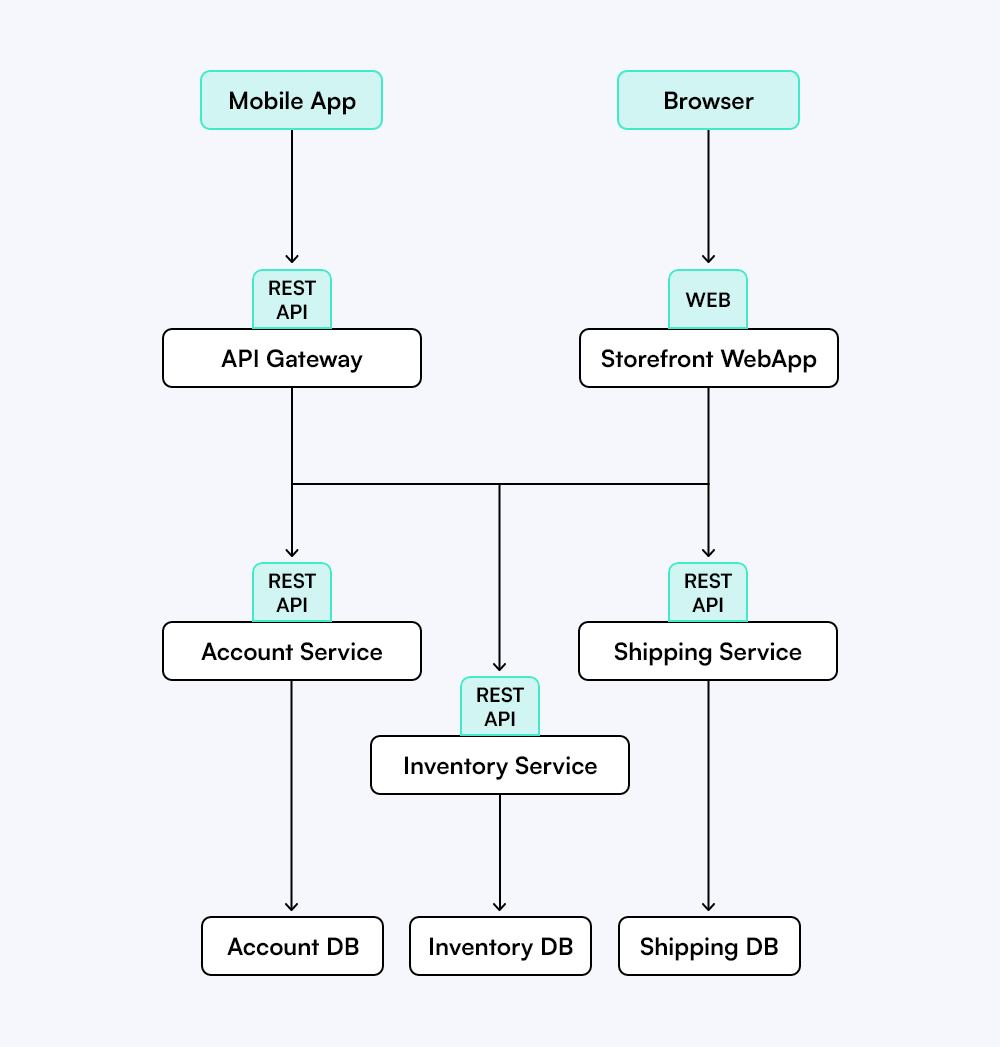

Microservices follow a pattern, thus usually termed as Microservices Architecture – is an architectural style that structures an application as a group of services that are;

  • loosely coupled
  • owned by a small team
  • highly maintainable and testable
  • independently deployable
  • organized around business capabilities

The microservices architecture supports frequent, rapid, and dependable delivery of complex and heavy applications. It also supports software development companies to upgrade and evolve their technology stack.

Microservices has resolved the challenges of project scaling of a monolithic system by being as modular as possible. In simpler words, the microservices architecture helps to build an app as a part of small services, where each service runs in its own process and can be independently deployable.

Microservices are often connected and interlinked with APIs and can avail similar tools and solutions that are developed in the RESTful API and web service ecosystem. Testing of these APIs allows you to validate the data flow thorough out your microservices application deployment.

Types of Microservices Architecture

Broadly, the microservices are divided into two types;

  1. Stateless Microservices, and
  2. Stateful Microservices

a. Stateless Microservices

A stateless microservices architecture is a type of Internet Protocol where the state/status of the previous transactions/operations is neither stored nor referenced in the very next transaction/operation.

The request is raised by the sender and can be interpreted by the receiver, meanwhile, to perform this operation it doesn’t require the existence of any prior request for the execution of the current request. In this protocol, the client and server requests and responses are carried out in the current state.

Example: Sending an SMS, where sender and receiver can send and receive the message respectively at it doesn’t require any previous permission or detail to perform the message sending operation.

b. Stateful Microservices

A stateful microservices architecture allows users to record, store and find existing information and processes over the internet.

It keeps track of all the records/processes that are performed earlier and considers it as a reference point for the upcoming record/process. In stateful application, the current transaction is usually influenced by the previous transactions.

Example: Good example of stateful architecture is FTP (File Transfer Protocol) and Telnet. Some of the common applications of stateful microservices are Online Banking Systems and email.

Benefits of Microservices Architecture

1. Promotes Scalability

Companies majorly prefer microservices because of their scalable nature. The services can be easily developed and released independently without hampering the ongoing processes and don’t demand any heavy coordination efforts in the organization.

2. Agility

The microservices development is relatively small and simple, thus in case of failure, only a specific service will get affected not the entire system. Therefore, organizations can prefer to experiment with their business logic, algorithms, and new operations.

3. Technological Freedom

Microservices architecture doesn’t rely on a “one size fits all” concept. The development team can avail the freedom of selecting the best tools to develop the solution for the specific problem. Hence, for each job or issue resolution, the development team can pick their tools.

4. Code Reusability

The small modules of software enable the development team to use the functions for multiple purposes. A service builds to serve a specific purpose can be used as the building block for another feature. This allows developers to reuse the existing codes and functionalities to develop new capabilities without writing code from scratch.

5. Simplified Debugging & Maintenance

Building individual microservices is relatively easier than coding for a monolithic architecture. This enhances the developer’s productivity, simplifies debugging of codes, as the modules and functions are reused to design the new feature, and enhances performance maintenance.

6. Resilience

If one microservices fail, then others will continue to work, as these services are not dependent on each other to perform functions or operations. The microservices can be deployed in different availability zones with cloud-enabled technologies, which ensures that users never experience an outage.

What is Monolithic Architecture?
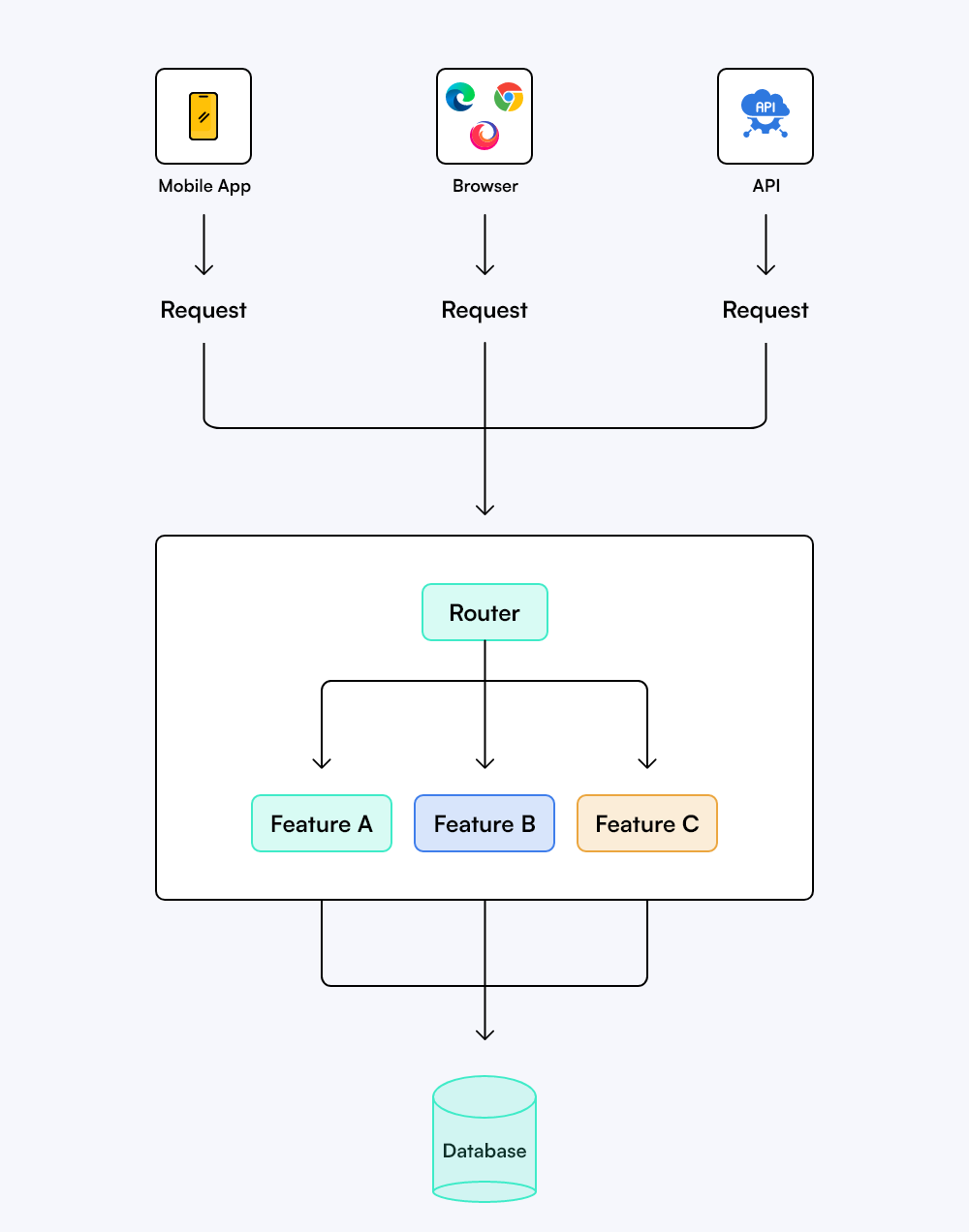

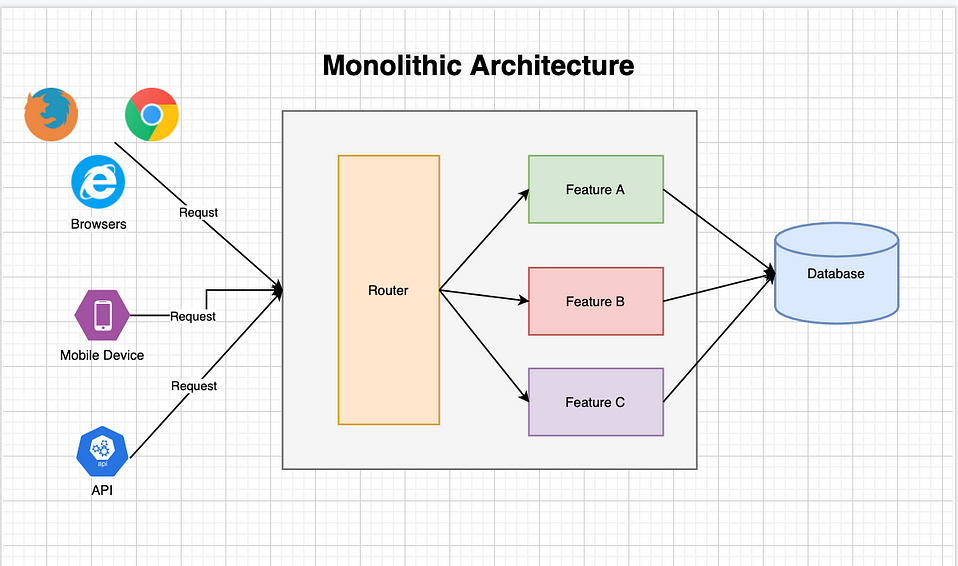
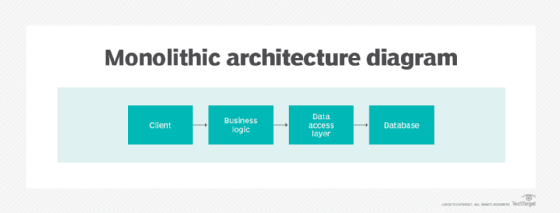
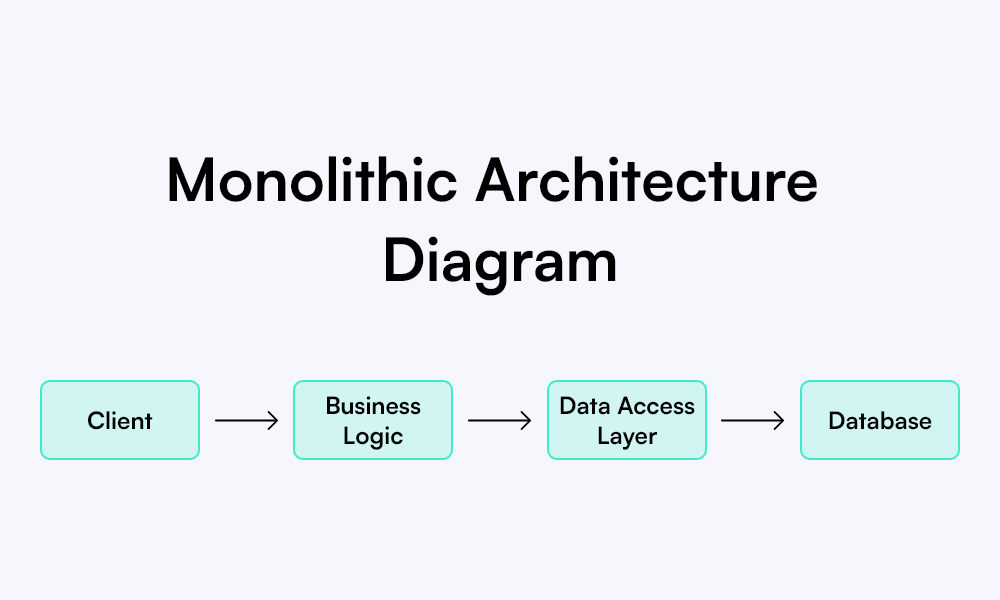
Usually, the software comprises multiple feature sets. Whereas, in monolithic architecture, all the features and modules of the software are closely packed reside in a single codebase, and are deployed as a single file.

If the software goes through any updates or changes, then those updates can’t be implemented individually. The developers need to use the existing codebase and make the required updates and then re-deploy the updated code.

In simple words, a Monolithic Architecture is like a huge container, where all the software components of the app are developed and tightly coupled, hence, the components depend on each other.

Source: https://miro.medium.com/max/958/1*6fbTgnuP51xy0eZfQESYRw.png

Source: https://cdn.ttgtmedia.com/rms/onlineImages/microservices-monolithic_architecture-f_mobile.png
Monolithic Architecture Vs. Microservices Architecture

Features Microservices Architecture Monolithic Architecture
Performance It requires a higher latency time to transfer info. from point A to B, which hampers the performance. It delivers much better performance due to lower latency time.
Complexity It is a complex architecture, to develop, and clusters and containers are highly complex which requires great management expertise. Comparatively simple to develop, and requires a single codebase and library to run the application.
Testing Testing is quite challenging. It requires additional attention to test inter-microservices interaction. Testing is easier, because of the presence of single codebase testing & debugging are convenient.
Time to Market It has a short time to market. It is easier to continuously implement new features and upgrade the existing ones. For MVP going with monolithic architecture is a good idea, but for a full-fledged app, it always requires high time to market.
Team Structure Smaller teams can work on individual services and own complete accountability for that. A large development team contributes to the same codebase but no one takes ownership of that.
Updates Due to the minimalistic nature of modules and the autonomous nature of services, quick updates can be deployed. Internal dependency within the architecture requires time to deploy updates, as multiple developers work at the same time.
Security Interaction between services via API creates security issues. Secure data processing and transferring are easier at the system level.

Best Languages for Microservices on 2023

1. For Migrating to Microservices

Select strangler application and anti-corruption layer. Then, manage the database as per services, shared database, API composition, Saga, CQRS, Domain Event, Event sourcing, Transactional Outbox, Transactional messaging, Transaction log tailing, and Polling publisher.

2. For Testing

Consumer-driven Contract Test, Service Component Test, Consumer-side Contract Test

3. For Deployment Patterns

Service Instance per Host, Multiple Service Instances per Host, Service Instance per Container, Service Instance per VM, Service Deployment platform, Serverless Deployment, Microservices Chassis, Service Template, Externalized Configuration

4. For Communication Style

Messaging, Remote Procedure Invocation, Domain-specific Protocol, Idempotent Consumer

5. External API

Backend for front-end, API Gateway

6. For Service Discovery

Server-side Discovery, Client-side Discovery, Service registry, Third-party Registration, Self-registration

7. Reliability

Circuit Breaker

8. Security

Access Token

9. For Observation

Log aggregation, Audio logging, Application metrics, Exception handling, Distributed tracing, Health check API, Log Deployments and Changes

10. UI Patterns

Client-side UI composition, Server-side page Fragment Composition

Top Microservices Trends in 2023

1. Kubernetes

Kubernetes is a container-as-a-service (CaaS) platform. It helps to automate the scaling, management and deployment of microservices. It ensures continuous deployment by providing load balancing and managing network traffic distribution, especially when traffic is high. Kubernetes serves multiple benefits to microservices architecture, therefore, nowadays, it is one of the popular containerization open-source platforms.

2. AIOps (Artificial Intelligence for IT Operations)

The adoption of AIOps in microservices architecture signifies the usage of AI and ML technology to develop tools that automate the processes fulfilled by the IT operations teams. It supports resolving complex system failure issues by automating them in varied manners. It also helps to automatically shut down any idea resource, which ultimately supports minimizing the cost and enables automated security monitoring. Hence, AIOps help to boost overall productivity.

3. DevOps

DevOps is a combination of development methodologies and operations. It comprises cultural practices in software development that seeks collaboration among departments of the organization to deliver software. DevOps ensures minimum complexity and easier interpretation of any solutions to problems. Thus, accurate implementation of DevOps microservices helps organizations to deliver the best quality product and automate their workflows through a streamlined and scalable development approach.

4. Containers and Service Mesh Security

The service mesh is a low latency, configurable infrastructure layer that follows service-to-service interaction in containerized application infrastructure. It also includes load balancing, service discovery, encryption, failure recovery, traceability, authentication, authorization, and observability. It supports security maintenance between cooperation in both containers and microservices.

Takeaway

There are many responsible reasons why businesses are upgrading their monolithic process with microservices architecture. It provides an excellent user interface and real-time access to the infrastructure and the entire software architecture details. It supports developers to boost creativity and save valuable time and money by increasing productivity.

Therefore, to experience better data management and scalable services, connect with our Microservice design specialized team. We help you to build an application or migrate the existing monolithic business to microservices and provide much-needed support and required tools to enhance your processes. This will ultimately help you to gain new capabilities and build effective connections for the services your business requires for growth.
PWA Vs Native App: Which One Should You Choose?

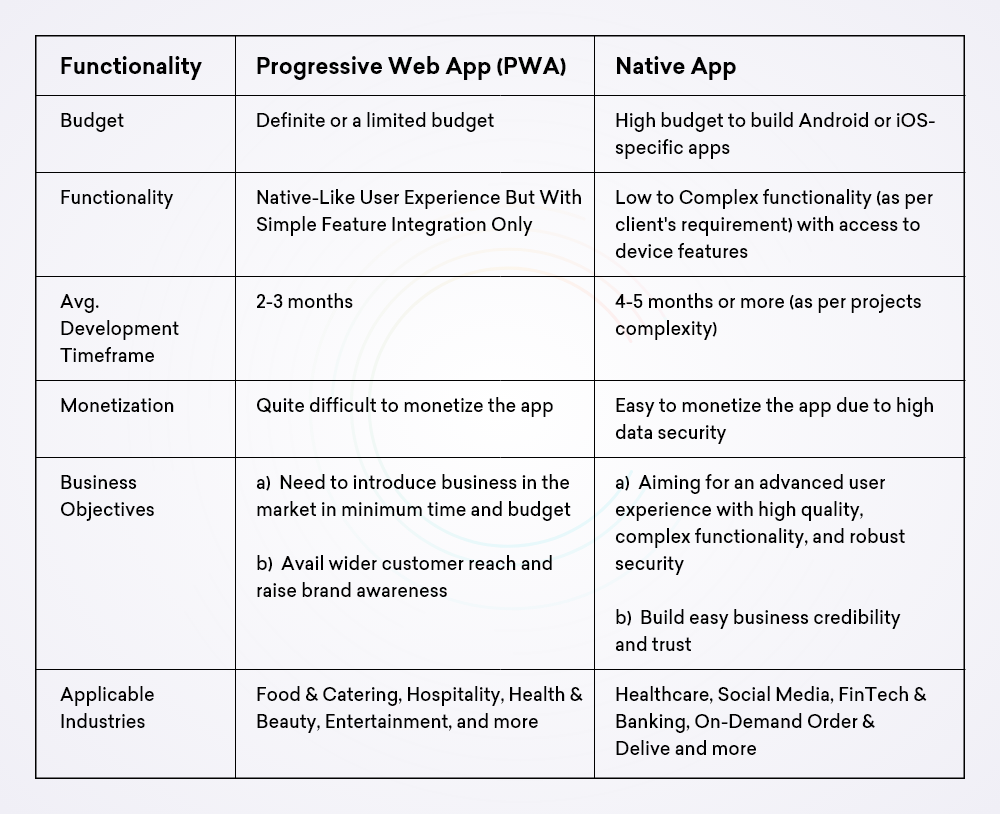
Considering the rising adoption of mobile apps among customers for a quick and handy reach to services, it has become a must for businesses to have an online presence to get a taste of success. Mobile apps have become a handy tool for businesses to offer a fantastic user experience with an outstanding outcome. To do so, the Native apps and PWA’s (Progressive Web Apps) have become highly competitive and even put people in the dilemma of choosing one of the aptest solutions for their businesses.

To deal with this dilemmatic situation and to understand the pros and cons of choosing a Native app and PWA, we are further going to carry out a detailed comparison of various factors. But, before we share our insights on which solution can best serve your business purpose, let’s understand the concept of PWA and Native App first.

What is a Progressive Web Application (PWA)?

Progressive Web Apps are something between a mobile app and a responsive website.

Such apps are mobile sites developed with modern JavaScript frameworks that are designed to work like a Native app. PWAs can be added to the home screen of a mobile device with an icon. These apps offer a full-screen experience to engage users but these are still a website.

Users can access a PWA on their browser through a URL, but gives an experience of the app on their browser, without downloading and installing. Some of the most appealing examples to understand the concept of PWA are SpotifyStarbucks, and Pinterest.

What is a Native Application?

Native mobile apps are platform dependent, they are designed to work ideally on either Android or iOS platforms. As a result, a native app can properly avail the usefulness that a device offers.

Unlike PWA, the user has to download the application on their mobile device from the respective Play Store or App Store. Native apps are probably the best choice for brands that aim to build a deeper customer relationship.

PWA Vs. Native Apps: Detailed Comparison

Languages Written

PWA: PWAs are built to run on a web browser and the programming languages used to develop such apps are HTML, CSS, and JavaScript.

Native App: Native apps tech-stacks are platform specific for mobile devices, such as Java for Android and Objective-C & Swift for iOS platform.

Development Costs

PWA: A single codebase can work effectively on multiple platforms. The current website can also be customized by using supported technologies rather than developing an entire app from the start. With responsive design, the upgrades or changes get easily reflected on all devices with the same version of the app. Such flexibility in development makes it quite cost-efficient and time-saving as well.

Native App: Native App development supports some specific tech stacks and requires a version to deploy upgrades. As a result, the Android and iOS app’s new version release requires at least another version in the backup. This takes a lot of time and money as per the project’s complexity.

App Development & Deployment

PWA: The PWA app development and deployment process is quite quick as compared to Native apps, it is so because;

  1. PWA is a website, which demands a single team of web developers to build it. Whereas, the deployment of the app is much faster as the service workers, Lighthouse, or other tools can manage it easily.
  2. It doesn’t require App Store validation or submission of the app on the App Store to seek its approval. Whereas, once the PWA is developed and published on the web server – it is available for users.

Native App: To develop Android and iOS Native apps, two separate teams of experts are required for each platform. If the development for both platforms is started at the same time, then also it will take longer development time to integrate the same functionalities on both apps.

On the other hand, to deploy the app, it seeks app deployment approval from the respective platforms which is also quite a time taking process of about 2 to 4 days.

Overall, Native app development requires comparatively higher development time and deployment time as well against PWAs.

App Installation

PWA: The user doesn’t need to download and install the app on their device. They can simply search the PWA site via Google and access it directly. If needed, the user can also allow the option of “Add to Home Screen” to fasten the site access in the future.

Native App: For Native apps, the user has to search for the presence of that specific app on the App/Play Store among the millions of apps, then download the app and install it. Then only the user can access the apps’ services for the very first time, however later on it would be easier to access those services.

Hence, installing a Native app takes comparatively more time, and struggle to find the right solution as compared to PWAs. So, PWAs can help to acquire more new users conveniently.

User Engagement

PWA: User Engagement is the essence that defines the business’s success – the more the user spends time on your platform, the more they will make purchases. For that, Push Notification is one of the crucial features to avail.

Only Android devices support push notification features with PWAs, whereas there is no such functionality support with iOS devices.

Native App: In native apps, the Push Notification works very accurately to promote user engagement. This feature does not rely on the Operating System or device model. Once the user installed the app on their device, they will start getting Push Notifications on their devices.

In this feature, the PWAs lack behind Native Apps.

Offline Accessibility

PWA: In Progressive Web Apps, the users can avail of the feature of accessing the platform in offline mode as well. Moreover, it works well in poor or low connectivity areas, as compared to native apps. The platform pre-caches or uploads the content, which the user can access later in the offline mode, but only the previously accessed pages, not the other pages.

Native App: In native apps, the app work quite effectively as it does in PWA in offline mode. In these apps, the content and functionality are shown, which is managed to be cached when the connection was on. All these details get available only because of local storage on users’ devices and smooth data synchronization with the cloud.

In simple terms, the capacity of PWA and native mobile apps is nearly the same. As they work differently, but offer almost a similar offline mode experience.

Device Feature Accessibility

PWA: For an app getting access to a multitude of mobile device features is an excellent marketing medium. As the PWAs run on the mobile browser, these apps lack such support and have to go with restricted hardware functionality access.

In Android devices, PWA only supports the features maintained by HTML5. In iOS, PWAs couldn’t work with primary features like Siri, Face & Touch ID, in-app payment, and more.

Native: Native apps support brilliant customer and business interaction by accessing the varied features of the device, such as camera, GPS, microphone, Bluetooth, etc. This helps businesses to reach out to their target audience, send relevant messages, and do other specific activities in a very precise manner.

Hence, with native Android and iOS apps, the device feature accessibility is very convenient, which also supports quick and easy marketing.

Security

PWA: The PWA app security relies on the browser on which the user is accessing the services. The browser sandbox and its capabilities are highly restricted, and can only access the browser’s resources, what the browser allows. This isolates the app from the mobile device hardware and the user’s sensitive data. So, the user data and interaction with the app are safe.

Native: Native apps can avail of multi-factor authentication and provide safer communication with certificate security. Additionally, enhances security with the respective platform’s Google Play and App Store authentication. As a result, native apps are highly reliable and secure than accessing the app from a URL.

When Do You Need To Create A PWA or A Native App?

Both PWA and Native Apps have some strengths and weaknesses. While selecting the one, you should look for the aptest option that supports your business growth and perfectly depicts your app vision.

Consider PWA if;

  • It is handy to go with PWAs if you are introducing your business in the market and aiming to deploy a simple app for your users. The PWA doesn’t require app downloads and ensures customer engagement via the Push Notification feature.
  • PWAs are comparatively budget-friendly and take less development time, with no such deployment time as with native apps.
  • PWAs are more like any website, so you can make them SEO-friendly to improve brand awareness and reach a wider audience at minimal expense.

Consider Native App if;

  • You can build your brand credibility by publishing the app on the respective app stores. As users highly rely and trust on such app stores for their quality services and addon securities norms. Hence, your apps are fulfilling all such criteria which build a trustable and reliable relationship with the user.
  • You can avail of advanced features of the user device by integrating various services like geofencing and sensor/detection, camera, Bluetooth, GPS, and more. Additionally, can also use device data to ensure the smooth working or quick processes of the app.

In the Nutshell

PWAs and Native apps are the two different options to take your business online but both have some advantages and drawbacks based on individual business requirements. Both models are going to stay in the market, and the selection can be made according to project demands and goals.

Here, at Codiant, we help our clients in introducing their digital solution which could be a PWA or a Native app. For further detailed discussion and assistance in choosing the right solution or app development services, you can reach out to our business experts. We assure to assist you with the best solution for your business.

How AI Symptom Checker Is Improving Healthcare Diagnosis?

We all are living in the age of the internet where it’s quite obvious to switch to Mr. Google to resolve even the minute of queries and the same is applied to healthcare.

Today, people find it more reliable to ask Dr. Google about their general health issues rather than visiting the doctor at the clinic; especially at the initial stage. And this is because the patients get to know temporary solutions for their benign symptoms. However, this practice is not good in the long term.

Avoiding benign symptoms can really take an individual’s life at risk.

Then what could be the best action to cope with such life-threatening situations? AI symptom checker will be the answer!

It is an online platform that not only offers the convenience of tracking an individual’s symptoms but also offers ease of improving a patient’s diagnosis to medical practitioners.

In this blog, we will deeply understand the basics of an AI symptom checker, how it works, its significant benefits, reasons to use the symptom checker platform, and the factors to consider before launching a symptom checker in your healthcare business game.

Read on to know more.

Symptom Checker- Definition

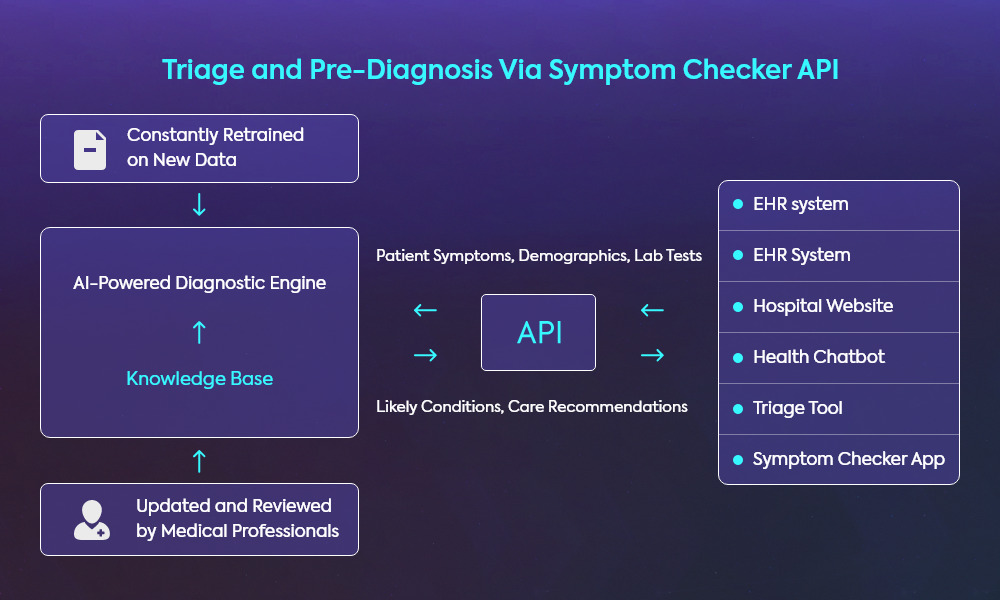
It is an AI-based technology that is used to analyze patients’ data by their inputs or it extracts the required information from the electronic health records. The information or data on the patient’s health gets recorded & analyzed in pieces to provide suitable care suggestions, likely diagnosis, or both of them.

The database of symptom checkers includes information related to chronic conditions, treatment procedures, and other diseases.

There is a regular update on patient data followed by a continuous review from healthcare practitioners.

The major aim of the platform is not about eliminating or reducing doctor interaction. However, it supports patients by disclosing the root cause of the disease which helps in taking an informed course of action.

Working Process of a Symptom Checker Platform


With the Use of Natural Language Processing, The Symptom Checker App Works in Three Simple Stages:

1. Diagnose/Check Symptoms

To get details on symptoms, patients need to share the current medical data of their health including all the visible symptoms. The stored data is then diagnosed using machine learning algorithms to provide suitable care suggestions. The AI technology also considers other essential parameters like the patient’s medical history, sex, age, weight, etc.

Every solution suggested on the platform is unique as compared to other individuals. It also clearly detects the patient’s level of urgency and severity.

2. Get In-Depth Knowledge

Once the user is well aware of the type of symptoms, he/she can explore further information about the disease.

To begin with diagnosis, a person can first understand the criticality of the disease i.e. whether it can be cured with self-care or whether there is a need to check with virtual, specialty, or clinic care specialists.

The next step will be to check the list of prescribed treatment options by multiple healthcare practitioners. However, in case of some critical conditions, the platform immediately gives the alert and suggests emergency care actions to the patients.

3. Initiate a Chat with Doctor

After identifying all the symptoms of the disease, the patient can find a suitable doctor to connect with and share their personal health conditions.

Also, they can further interact to get better diagnoses, treatments, or opinions for better results.

Benefits of Symptom Checking App for Patients and Practitioners

Benefits for Patients

  • Informs patients about the disease ahead of time.
  • Minimizes patient’s risk of critical disease.
  • Increases the use of telemedicine services.
  • Prevents unnecessary visits of patients to the clinics or hospitals.
  • Connects patients to desired practitioners for personalized care services.
  • Enhances disease clarity and offers the convenience of the right care at the right time.

Benefits for Practitioners

  • Provides better analysis of emergency conditions
  • Offers authenticity to the gathered patient information and data
  • Acts as a convenient tool to check the severity of a patient’s disease
  • Saves a lot of time and cost on care that is poorly coordinated
  • Reduces unnecessary patient diagnosis appointments

Top Reasons to Opt for A Symptom Checker Platform

1. Provide Early Diagnosis of Critical Health Conditions

There are some illnesses or diseases that display benign symptoms.

But by using a symptom checker users can put all of them in the records and can easily find the severity of the disease.

For instance, if a user enters jaw pain, muscle pain, and feels dizzy most of the time then these symptoms may add up to a heart attack.

2. User Can Experience the Sense of Relief

If an individual is experiencing any symptoms that are giving tension and worry then it is not good for overall health.

However, unlike Google, symptom checker provides a solid solution based on pre-recorded patient data and activities.

The symptom checker platform provides users with the confidence that the disease can be cured by a doctor. Also, it motivates a person that he/she will get the right set of advice from doctors which will give the required relief.

3. Assists User’s Medical Trainer with New Directions to Diagnose

Sometimes, when an individual gets stuck in some emergency situation their medical practitioners don’t get much time to diagnose.

However, with a symptom checker, there will be a proper record of the reasons why and how the patient turned into a critical situation.

Thus, a potential set of actions can be taken quickly without missing out on any critical info.

4. Ensure Individuals Get the Right Treatment at The Right Place

Symptom checkers do not at all talk about switching the doctor you were consulting before rather it is more about checking the right set of symptoms to get the right directions.

A symptom checker may help in suggesting which medical specialist you must consult and what all medications are required to cure the particular disease.

5. Enhance Patient’s Consultations with Their Doctors

While patients are already in panic mode after figuring out the symptoms of the disease. Therefore, many times, patients fail to share a detailed explanation of what they are going through.

But symptom checker makes the consultation process better by disclosing every minute detail of the patient’s health condition.

In this process, the patient becomes more active and can ask about more probable challenges related to the same.

Check These Factors Before Including Symptom Checker in The Digital Health Game

1. Feed Users with General Info About Symptom Checker

Symptom checker is really a good concept to smartly deal with health issues but users might find it challenging to use especially at the initial stages. Also, there are chances that users may not accept its existence or may have second thoughts about the security and safety of their (patients’) personal data.

Therefore, it is advised to educate users with proper data and instructions which can be done in the form of blogs, banners, new sections, videos, and more.

2. Allow Unlimited Access to Use Symptom Checker for All

Limiting the use of a symptom checker for unregistered users is not good. Rather try to give them unlimited access to use along with a list of benefits that attracts them to use.

However, in the case of registered users, keep sending continuous motivation by displaying the benefits.

Also, encouraging them to invite their close ones for better health diagnosis. The multiple uses of symptom checkers can range from updating patients’ electronic records, setting doctor’s appointments, checking the criticality of the disease, and more.

3. Ensure the Availability of Symptom Checker in Multiple Languages

Sometimes, it becomes very challenging for regional migrants and minor communities to cope with the language barriers.

So, it is essential to ensure that the symptom checker is available in multiple languages. It will allow users to seamlessly share and maintain personal healthcare records.

When users get the advantage of saving their personal information in the native language then it enhances the communication between patients and provides an improved assessment of the patient’s needs.

Summing Up!

With the introduction of a symptom checker, one can easily diagnose their disease and start initial precautions, especially when visiting a doctor is not possible.

The above blog has clearly defined how an AI symptom checker can improve individual health conditions by just diagnosing the symptoms. The online platform has aided human life with a convenient tool that helps in determining health emergencies, getting an authentic informational source, the convenience of maintaining anonymity, and more.

If you are also looking to integrate the robust services of the symptom checker platform in your healthcare industry then, contact experts at Codiant to discuss more it.

Why and How Businesses Are Integrating the Buy Now Pay Later System?

Have you ever gotten stuck in a situation where you are making an online purchase payment but you’ve lost your access to any debit/credit cards to buy products? Sometimes such scenarios spoil the charm of the moment and also affect your shopping plans.

Then, how do you satisfy your desires of fulfilling your Wishlist? Introduce yourself to the new mode of payment i.e. Buy Now Pay Later (BNPL). This method allows customers to complete their purchase process without even waiting for payment access.

The new trend is mainly used by the audience to buy everyday products right from groceries, and clothing to all other expensive lists of items. Using this method, users get the leverage of making a limitless purchase quickly and conveniently.

With the wide acceptance of this BNPL system, retailers are now planning to integrate this system and use a great opportunity to work in the market.

Let us go deep into the blog to know more about BNPL’s meaning, process, and reasons to use it in the business:

What Is Buy Now Pay Later?

Buy Now Pay Later is a payment method that is used by customers to purchase their daily use commodities on a credit basis without even using a credit card. This method is a type of loan whose repayment is done in installments after a certain period.

The reason for the popularity of this method is that it offers immediate access to finance product purchases without any delay. There are a variety of options available for loan repayment which are totally based on the total loan amount and the type of item purchased.

The most popular type of BNPL options includes Afterpay, Paypal, Klarna, Affirm, and Shopify.

How Does Buy Now Pay Later Work?

The process of BNPL works in these simple steps for both customers and retailers:

1. Customer Add the Items and Move to The Checkout Window

The BNPL process begins in a similar way as the other transactions are being performed. The customers get the option to complete the payment using BNPL which can be very quick and convenient.

2. Available BNPL Options Are Displayed by Retailers

When the customer is going to check out from the transaction, he/she will have the option to opt for the BNPL payment method just like other available credit/debit card methods.

3. Soft Credit Check Is Being Processed on The Customer

Once the customer chooses to opt for the BNPL method, the customer needs to fill up some of their personal details to provide authenticity to the BNPL money lender like name, address, contact number, etc.

After the customer is done with details, the BNPL lender runs a quick credit check on the customer’s information to get surety on the expected time and ability of loan repayment. Once the process is done, the vendor can easily move ahead in the process.

4. Owner/Vendor of BNPL Puts A Charge/Fee on The Retailer

A small percentage of the overall transaction is taken by the BNPL vendor which is directly paid to the retailer. The fee amount generally falls between 2%-8% which is deducted from the total sum of the transaction. The process is followed similarly as it used to be followed by credit card companies in previous times.

5. Balance Amount Is Being Paid Off by The Customers Over Time

Majorly, the BNPL process is interest-free for the customer in case they are able to repay the whole amount within 30 days. Or in case, if the customer takes much time to repay then, the BNPL vendor may share the lists of interest and different repayment plans.

It is very similar to the traditional credit card payment where the tenure of loan repayment decides the overall interest rate charged on the loan amount.

Explain the List of Reasons to Add BNPL (Buy Now Pay Later) On the E-Commerce Site

The BNPL process not only benefits the consumers but is very effective for e-commerce retailers as well. Let us see the impactful reasons why e-commerce sites should use Buy Now Pay Later:

1. Attracts A Huge Target Audience

The convenience of buying today and paying later is luring a huge audience base. Every other customer is opting for the buy now pay later method because of the no-interest features. After witnessing such excessive growth and demand for the buy now pay later method, retailers are opting to enhance their sales strategies.

Moreover, customers are also actively looking for stores that are offering them the option to use a super convenient mode of payment.

2. Builds A Strong Trust

No retailer like to offer a product trial service but by using a buy now pay later service, users can easily leverage the service. The ‘buy now pay later’ service does not bind the customer to buy the product, rather customers can try it and decide whether to buy it or not.

If the product fits their expectations then they can complete the purchase using the buy now pay later method or else they can return it without even thinking about the refund.

At the initial stage, the free return system may cost more but in the long run, it will help in building better customer relations and a sense of customer loyalty.

3. Decreases the Number of Cart Abandonment

The major reasons for the increase in cart abandonment are the poor payment options that frustrate the customers and force them to leave the items in the cart. However, adding a payment option of buy now pay later makes the checkout process simple and convenient. Using this method, customers do not have to indulge in the rush of adding card details. Just a simple option can fulfill the intention of the customer.

Other reasons to display how BNPL helps in less cart abandonment are customers need not to create an account to pay and do not have to share their card details with any untrusted site.

4. Ensures Customer Retention with Better Credit Solution

The BNPL method is good, especially for people who want to buy things on credit because there is no interest charged for the credit amount. This method allows customers to get relief from the budget constraint. Even if the customer is exhausted with the finances, the BNPL method allows them to make a quick purchase.

Moreover, the BNPL method is more suitable for customers because it is a better and safer form of getting credit. And thus, the customers get the freedom to become repeat customers by continuously using the BNPL method to complete the payment religiously.

5. Increases Overall Sales Margin

When the customer gets the freedom to make a purchase without paying immediately then they are more likely to repeat transactions which ultimately increases the sales margin of the retailers.

The BNPL makes the consumer confident about delayed payment and thus customers get the privilege to purchase even the high-priced product. So, now when a customer is going to purchase any product using BNPL, they need not to check their account balance, rather they can simply make the purchase.

Buy now pay later ensures that no customer is dropping any purchase because of the insufficient account balance at the moment rather they can split the total amount into small chunks and pay accordingly.

6. It is Highly Competitive

The market of “buy now pay later” is already high and giving unexpected results to all. Almost all organizations have successfully integrated BNPL into their checkout system. But if anybody has missed it then they are soon going to adopt this new trend.

Therefore, if you are planning to corner the market then you need to deliver services as per the customer expectations and fulfill the better market demands.

Top Reasons to Explain Why Buy Now Pay Later Is Suitable for Customers

The popularity of the buy now pays later method has skyrocketed in the market and therefore it is essential to educate the target audience about how the new trend can benefit customers.

  • Customers can benefit from the increased level of affordability
  • Customers can choose the repayment duration at their convenience
  • Customers can get instant access to the credit amount opted to buy the product
  • Customers can ensure a safe and secure process of transaction
  • Customers will get access to pay no-cost EMI
  • Customer will be able to follow the simple and transparent method of repayment

Summing Up!

Buy now pay later is a thoughtful solution for both e-commerce retailers and customers. It allows customers the convenience of buying products for which they have to pay later. E-commerce retailers are excessively using the method because it engages a huge audience base by allowing them access to buy expensive or emergency products.

So, integrating the Buy now pay later system will definitely help in increasing the sales volume and fulfilling business targets to great extent.

Also, the business will provide you with an effective way to enhance and share the pain of the huge audience who usually struggles with a large purchase. However, before you land on the final decision, it is suggested that you must calculate the extra cost that will be incurred by your business in the near future.

Top Use Cases of Extended Reality in the Healthcare Industry

Healthcare service offering has always been complex, but the advancement in technologies has brought unprecedented changes. Soaring healthcare expenses, rising demand for personalized healthcare services, an increased drive to deliver remote care, and an underserved population pose a new challenge for the healthcare industry. But to deal with such situations, the usage of Extended Reality technology has become a rescuer to a great extent.

Extended Reality technology is rapidly accelerating the adoption of immersive technologies in the healthcare sector. XR (Extended Reality) is an umbrella term that describes all kinds of immersive technologies, such as Virtual Reality (VR), Augmented Reality (AR), and Mixed Reality (MR).

As per MarketsAndMarkets Report, the Extended Reality market size is projected to touch the figure of USD 125.2 billion by 2026, at a growing CAGR of 30.6% from 2021 to 2026.

Innovation in these technologies and the rising market demand are carving a path in the healthcare industry. It is surpassing the limitations, enhancing access and results for the global population in healthcare services.

Moreover, to support improvement in medical education, patient well-being, and offering better treatments and surgeries, the usage of extended reality technology is playing a vital role in handling and minimizing the load on the healthcare industry.

Let’s discuss different use cases of extended reality technology in brief!

A. Use Cases of Extended Reality for Payers

1. Engaging and Demonstrating Insurance Plans to Customers

An insurance plan is a must for every individual to deal with highly expensive healthcare services. But manually it is quite a tiring and boring process to educate any person about it.

Availing of immersive extended reality technology; allows to build of an interactive conversation, minimizes complexity, and highlights the offerings to reframe the customers’ mind over purchasing the insurance plan. Apart from that, integrating extended reality technology in insurance plan demonstration will become an effective marketing track to engage with new prospects.

2. Marketing & Customer Engagement through Virtual Customer Care

The virtual customer care services allow real-time guidance to policyholders on filling claims forms, resolving billing issues, and fulfilling other service requests. It becomes possible for the customer to perform all these activities with ease at their comfortable place with the help of extended reality technology that facilitates virtual assistance. They don’t have to contact any insurance agent or visit a service desk.

3. Remote Employee Training & Guidance

The application of extended reality in healthcare can help to bridge the gap between new and experienced employees. Digital coordination supports quick and easy sharing of files, and data, engage with in-field staff, promotes real-time training, and empowers technical experts.

Remote employees can interact with each other and can even switch the live video interaction to present an accurate demonstration of discussion. It will help to gain guidance or suggestion from the counterpart, regardless of their presence in any part of the globe.

B. Use Cases of Extended Reality for Providers

1. Performing Virtual Surgery

In the healthcare sector, people require an extensive amount of practice to minimize the chances of errors. Especially the surgeons need to sharpen their skills by practicing only, but doing so on live subjects (humans) could be quite risky and may lead to unexpected results. However, with rigorous practice, it can be dealt with.

With the help of integrating extended reality in healthcare, the learners can sharpen their surgical skills without harming anyone. Using XR simulation, the practitioners can perform multiple iterations virtually and without worrying about any consequences.

2. Easy Patient Diagnosis

With the help of extended reality technology, healthcare specialists can scan the entire body of the patient and can make an easy and quick diagnosis. By using a 3D model with immersive technology, patients’ illness diagnosis becomes easy, such as tumors, fractures, etc.

The extended reality platform provides patient images and demonstrates the step-by-step process of their potential surgery. Such familiarization with the problem or medical condition and procedures helps to raise awareness and allows them to learn about proper usage, boost recovery, and make patients feel at ease.

3. Therapeutic Training and Rehabilitation

Physiotherapy and behavioral treatment are the new and rising categories in the healthcare industry. Using extended reality in physical therapy sessions is increasing patient engagement and improves physical transformation. The data from each physiotherapy session allows specialists to evaluate better results.

AR technology is carving a new method of studying cognitive behavior and offering a safe environment for patients to practice exercises. It motivates patients and enables caregivers to offer physiotherapy at home at minimal charges.

4. Medical Training and Education

To study the complex structure of the human body, medical students have to go through a queue of monotonous lectures and usually have a hard time visualizing them. However, by integrating extended reality into healthcare education, visual teaching, and learning gets easy and more interactive.

With XR technology and 3D image projections, the visualization and understanding of human anatomy become easier. Also, enable us to examine each body part individually.

5. Remote Assistance

Extended Reality supports the convenient and distant reach of specialists without traveling anywhere. It helps to eliminate the hassle of reaching out to patients and offers much more advanced and quality services.

Even in the case of any epidemic or outbreak, extended reality in healthcare support specialists perform remote inspection and assistance, track patients’ vitals, and prescribe treatment in the minimum time frame.

C. Use Cases of Extended Reality for Medical Devices

1. Device Operating Training

To educate and train any healthcare device operator – all this becomes convenient through extended reality technology. This technology supports remote and digital assistance that enables people to connect easily and learn their training courses in an interactive environment in no time.

2. Device Maintenance and Troubleshooting

The extended reality technology helps device assistants monitor devices, avail preventive maintenance and suggest steps to deal with issues. All this becomes convenient to understand with proper training. Also, supports learning to troubleshoot problems.

3. Marketing Materials

Sales representatives can gain education and training by using extended reality in the healthcare industry. The technology also helps sales personnel to demonstrate the product experience to the healthcare providers, deep dive into the technical specifications, and gain a 360-degree perspective of the specific device and its operations.

D. Use Cases of Extended Reality for Promoting a Healthy Lifestyle

1. Healthy Diet

The advanced technology integrated into mobile applications helps people to gain good habits. The extended reality in a healthcare application will help users to extract nutritional details, motivate them to follow a healthy diet, and monitor progress as well.

2. Fitness Training

The fitness instructor and people can connect anywhere and anytime. People can get easy access to professional trainers, gain guidance and education to use proper technique, proper usage of equipment, and monitoring training sessions.

3. Physical Therapy

The healthcare application integrated with extended reality offers an interactive artificial environment that boosts patients’ morale to gain a healthy lifestyle and achieve their targets. The technology keeps track of patients’ progress and helps them to form strategies accordingly to step ahead in their recovery.

Wrapping Up

The proper usage of extended reality technology in the healthcare industry is already supported to a great extent to save more lives, provide health assistance as soon as possible, improve patient care quality, and many more. It is ultimately making healthcare assistance more affordable and easily accessible for millions of people at a time.

As the healthcare industry continues to grow, the cost of XR technology, hardware, and software will decrease. Shortly, it is expected to witness a significant rise in demand for extended reality in healthcare to treat patients.

Are you looking to integrate XR technology into your healthcare services? At Codiant, we have a team of experts in building advanced solutions. For us, customer satisfaction and quality tool development always remain the priority while understanding your needs and expectations. For detailed discussion and assistance, you can reach out to our experts.

How Digital Marketing Can Change The Real-Estate Game?

As a realtor, it is already known that online platforms are the first option today to be chosen by potential buyers when looking for a property.

Every buyer wants an instant response to the queries generated in their minds and therefore, Google search engines serve best as compared to other offline modes.

According to a recent poll, more than 90% of house buyers use search engines to identify properties that perfectly match their criteria.

But, with a quick escalation in market competition, real-estate businesses are struggling to engage their target audience and get leads.

So, wave off the expensive traditional ways and embrace real estate digital marketing strategies that help you acquire new clients and sell more real estate properties.

Before you jump into the new arena of digital marketing, it is essential to understand the significance of digital real estate marketing and the tips to turn leads.

Top Reasons That Explain the Significance of Digital Marketing for Real Estate:

1. Cost-Effective Tool of Marketing for Real Estate

Digital marketing allows converting typically a face-to-face real estate business into a tech-forward space which allows easy virtual meet for both customers and users.

Realtors can simply convey/showcase property specifications and increase their brand awareness among a huge target audience.

The adoption of digital marketing brings a huge scope of growth for real estate businesses and boosts brand visibility to a great extent. Moreover, realtors can even overcome communication barriers and can effectively provide interesting and useful content to attract potential clients.

2. Mark Your Availability on Search Engines

Search engines are on the priority list of people while searching for information so, adopting digital marketing allows real estate businesses to increase their digital presence. Also, realtors can easily corner the market competition by ensuring strong brand visibility that doesn’t let people miss out on your brand in their searches. Moreover, it serves as a convenient and cost-effective way to build trust and a healthy relationship with the target audience.

3. Ease of Getting Reviews Online

Reputation and credibility are the pillars of a real-estate business that can be built strongly with customer reviews. When a brand showcases its proven track record of how it helped clients, then the company can simply entice a huge audience base.

A list of a few positive reviews from clients helps customers to build trust especially when reaching out to your brand for the first time. So, the role of digital real estate marketing is crucial to collect customer reviews and turning their expectations into real big property investments.

4. Chance to Showcase Your Creative Skills

Creativity always allows you to be on top. Real estate clients look for the product, price, place, and promotions and digital marketing tactics allow you to unblock old patterns and think out of the box. Realtors can step out of their comfort zones to challenge presumptions from their past experiences.

They can use the hit-and-trial method with multiple marketing approaches like creative campaigns, video tours, email marketing, hosting events, and more.

Moreover, such creative skills are not just easy to apply in your real-estate business but digital advertising for real estate is also a cost-effective way to get success. So, whenever any good idea clicks into your mind, don’t just let it go, rather incorporate it into your business and experience magical results.

5. Join the Race of Opponents (Go Digital)

The digital trend is already on the rise and everyone in real estate is following it. So, to entice your target audience, you need to showcase your products and skills digitally. Choose to create videos and use mobile marketing tactics to showcase the list of top-class venues you have.

Build a strong impact on the audience by creating engaging digital campaigns and publicizing the most valued possessions of real estate. Furthermore, virtual home tours are other exciting methods that are enhancing the digital experience and making it convenient for sellers to sell their properties without moving an inch.

Strategies That Realtors Can Use to Maximize Leads

1. Professional Website Is A Must for Realtors

Aesthetics and functionalities are the two major elements that can level up the game of your real estate website. Especially, when you talk about the real estate niche, you need to understand that you are compelling an audience to give a huge part of their savings into investment.

So, pay more attention to offering good site speed, quality content, simplified navigation, high-resolution pictures, etc. on your real estate website. Embedding such elements makes your website looks professional and gives you the added advantage of getting better leads.

Moreover, avoid overloading the site with advertisements, and remember to keep your site updated with new content and required elements.

2. Take Your Visitors to A Video Walkthrough

Real estate is a field that demands a realistic representation of the property that you are dealing with.

Thus, to satisfy and attract your potential target audience, focus on providing a good video experience. A video walkthrough does not necessarily need to be in a high-resolution 3D structure rather a simple good quality video showcasing your property details will work.

This marketing strategy will give a clear view of the property that how the place will actually look in person. Realtors can simply enhance their lead count by investing a small amount of effort and resources.

3. Leverage the Power Of Content Marketing

Content persistently rules the market. The content marketing strategy works well in the real estate business as it deeply educates the audience with the right information. Content marketing must include features like clarity, quality, and credibility that attract customers and help in getting potential leads.

Conduct market research to find out the list of best sites and platforms that are publishing content. The content marketing/publishing on the relevant sites help real estate business to link back their resources having similar yet unique and useful content. Some of the popular platforms that can be used to publish content include Medium, Quora, LinkedIn, etc.

4. Create A Robust Referral System

Referrals are one of the best ways for reaching out to the target audience. As a realtor, you need to plan a strategy to carry out this referral activity in your business. Putting down the referral info in the e-mail signature performs well as you can simply share it with a lot of people. However, you can also launch a referral strategy or ask your clients directly for referrals after a few transactions.

Some real estate brands are also using the tactic of offering some rewards in exchange for referrals which also excites client and help in maintaining a healthy relationship with them. In another way, it is your call to decide the suitable pitch for the client referrals and assure them of good quality service.

5. Make Use of Email Marketing Campaigns

Email marketing is a traditional yet effective way of converting real estate visitors into your clients. You can make use of email marketing tools to find the list of potential email addresses to target. This marketing tactic in real estate may sound old-school but it will definitely help you to get the potential leads and earn the desired amount of money.

However, applying this marketing tactic is not as simple as it looks. To be a top realtor and to attract a huge audience, you need to design a unique template, use catchy email headers, put appealing call-to-action, etc. In short, you need to add value collectively to your market campaign to get desired results.

Summing Up!

Every other realtor is trying hard and playing with hit & trial strategies to revamp the overall scenario of their real-estate business. But when we talk about digital marketing in the real estate sector, it is nowhere a choice rather it has become a necessity for realtors.

Now, more focus is on how brands can make use of digital strategies to enhance the consumer experience by upgrading real-estate services.

Doing the guesswork by choosing multiple social platforms, adding upgraded content, embedding appealing videos and pictures, etc. are a few ways to corner the market competition.

So, if you are also into real estate and looking to upgrade your business then adopt the digital methods of solving problems and reaching out to potential customers.

You can also begin with market research and competitive analysis to create a well-measured and well-planned strategy.

How AI Can Help Hospitals To Manage Bed Blocking?

Bed Blocking has become a major concern for hospitals globally. But with intelligent management, accurate extraction and analysis of the patients’ medical details can help to deal with this issue to a great extent. All this becomes easier and streamlined with the use of AI in healthcare businesses.

Usually, long-term patients are considered the great reason against occupying hospital beds and demand more staff and resources. Such patients seek additional care and attention; thus, it is difficult to discharge them – which exacerbates the bed blocking issue.

On the other hand, the untimely availability of beds in hospitals often ends up with severe results or deteriorating patients’ conditions. Hence, to ensure an optimal level of care, hospitals are emphasizing increasing bed count, controlling the effective usage of resources and forecasting the existing patients’ stay.

Digitalization and integration of AI in healthcare can support effectively in analyzing patients’ data and predicting their stay to manage bed blocking, which has now become a great demand in the healthcare industry.

Let’s take a look over some of the top tactics that can be implemented in managing bed blocking by integrating AI into healthcare applications, but before that we understand the bed blocking concept.

What is Bed Blocking?

Bed Blocking – a term in the healthcare industry is referred to the situation when hospital beds are occupied by patients when they really don’t need them.

In most cases, such situations arise when a patient is well enough according to the specialist doctor to be discharged home, but due to some unavoidable reasons, the discharge gets delayed. This type of situation in hospitals is termed as ‘bed blocking’.

It may also cause a delay in the treatment of other patients or the patients couldn’t get admitted to the hospital on time.

The bed blocking situations may arise due to the following reasons;

  • Incomplete discharge paper before relieving the patient
  • Delay in prescribing medicine and checking the patient before allowing the discharge
  • The patient may require some especial facility or vehicle and its unavailability causes a delay

These are some of the common factors that hamper the flow of patients in the hospital. Apart from that, lack of resources – staff, equipment and more could be the factor that causes bed blocking.

Most Efficient Ways To Manage Bed Blocking with AI in Healthcare

1. Improves Patient Flow and Reduces Stay Duration

Every day, the hospitals witness a flow of thousands of patients. Thus, with a centralized system, it’s easier to manage patient flow and gain all the operational insights over patients.

The effective utilization of AI in hospital management systems can promote predictive analytics. Additionally, it becomes easier to manage the patient flow actively. The availability of detailed health data of patients makes it easier to study and predict their health condition.

Ultimately, such a detailed study helps to define the patients’ stay in the hospital. All these processes become much easier and more convenient with AI in healthcare which helps in studying data and making relevant decisions.

2. Enables Networked Decision-Making in the Hospital

To carry out enterprise-wide management of patient flow requires more than a centralized system that can monitor and manage patient capacity and patient flow. Along with the automated system, it also requires senior’s affirmation to act in real-time and anticipate the patient flow across departments.

Considering both aspects together helps to deduce a reliable forecast and helps to avoid any bottleneck situation and provides suitable insights.

To facilitate patient management all the patient details should be available to all the team members and in actionable form. The use of AI in healthcare helps to study all the data and make predictions accordingly. The predictive algorithm helps to analyze early symptoms that help specialists to make decisions accordingly and within time, which can help to save lives.

3. Extends Care Coordination from Hospital to Home

Using remote diagnosis and monitoring, the centralized care system can be extended to home care as well. In this context, predictive analytics in healthcare could also make a difference. These remote diagnosing tools are equipped with Artificial Intelligence and Machine Learning.

For instance, when a patient is under remote monitoring at their home, then the monitoring machines analyze their vital sign and biometrics. If there is any concerning fluctuation in vitals, it will alert the concerned healthcare specialists for further clinical evaluation. This will help to avoid any emergency later on.

The remote monitoring system integrated with AI in healthcare has demonstrated its worth in managing chronic diseases or any long-term disease.

4. Implements a Hospital-wide Patient Tracking System

A hospital-wide tracking system provides a detailed understanding of the patient’s current presence at the place or department of the hospital. All these details are critical in decision-making for the hospital staff regarding bed allotment, transfers and discharge planning.

Without a proper automated tracking system, the patient may have to experience issues or disruptions in continuing the treatment. But, the integration of AI in healthcare application systems can help to track the entire management system and avoid bed blocking issues.

Importance of Hospital Bed Management

Bed management highlights the requirement of which department in the hospital requires further support and from where the required need can be fulfilled. It is evident that the bed requirement has increased but the bed supply can’t be increased instantly.

The nature of hospital services and admission is changing as more people are admitted but not for a longer duration, this increases the in-flow and out-flow of patients. As a result, it is important to monitor their progress and maintain the patient’s ins and outs properly to serve more patients in a minimum time duration with the help of AI in healthcare applications.

Thus, for the well-being of the patients, the bed manager should be the responsible source for hospitals to ensure smooth hospital operation, which keeps patients and staff satisfied and the entire process well-organized.

  1. Avoiding the scenario of bed blocking provides a much better and safer environment for patients. Promoting coordination between all other hospital branches, departments, and their wards. This reduces delays in patient assistance and improves their satisfaction with the care offered.
  2. Proper allocation of beds helps staff to focus on other important tasks. The overworked or overloaded staff are at great risk of committing mistakes and it may risk any patient’s life as well. Thus, hospitals demand effective management along with managing and blocking for better services.
  3. Proper monitoring and communication within the staff through AI-equipped management software ease the bed allocation process as well. A smooth system prevents staff to deal with too many patients at a time and manage bed blocking issues as the demand arises.

Conclusion

Bed management is a critical activity for any hospital to avoid any possible bed blocking situation and serve patients effectively. The most convenient way to manage bed blocking is by automating the process through a centralized bed management system and integrating AI into healthcare applications. It will optimize the patient flow and avoid overcrowding on the premises and in the patient rooms too.

Thus, to facilitate your patients in the best possible manner and streamline the entire hospital system the use of AI in healthcare can provide the most feasible solution. To do so, you require an efficient AI development company having expertise in building hospital management systems.

Codiant – an expert healthcare web and app development company can help you to deploy a tailor-made solution to cater to your specific requirements. We devise suitable strategies and integrate advanced technologies like Artificial Intelligence and Machine Learning to automate your healthcare operations. For more details and discussion, you can connect with our experienced business analysts and get your working solution.

Hire Codiant’s Healthcare Experts to Develop Advanced Hospital Information Management Application

Get in Touch

How Digital Healthcare Is Empowering Patients and Providers

No industry is left untouched by the influence of technology. Such an amazing technology advancement in offering digital healthcare has spell bounded the entire world in the last few years.

Gradually, with digital healthcare solutions, our day-to-day lives have changed in many ways and made it somewhat effortless. The last few years have witnessed a massive participation of tech-supported health solutions in serving better and remote patient care.

Digitalization in the healthcare system has become its nervous system. It is accelerating the identification and eliminates the wide-scale disparities in local, regional, global, and individual healthcare. Digital health technologies like AI, ML, IoT, Data AnalyticsBlockchain, Robotics, and Cloud Computing are carving a niche in the healthcare industry.

Gradually, all these tech-integration in the healthcare sector are transforming our way of living in the form of digital healthcare apps. People are becoming more conscious about their health and well-being and keeping it on their priority list to stay fit.

Digital healthcare apps have made a positive influence on the healthcare industry, where people are now managing their health effectively through these apps.

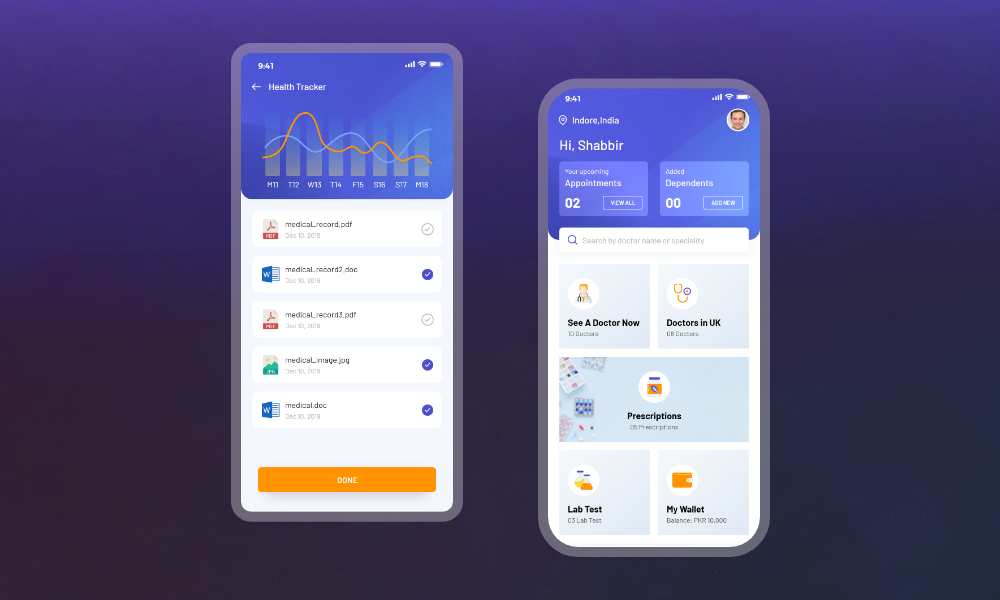
The smartphone-based digital healthcare solutions allow users to access details and book appointment with a doctor at their fingertips. Such a convenient process has now become a new norm.

These healthcare apps offer better communication and cordial care services between patients and the entire staff.

Digital Healthcare for Personalized Assistance

With the rising reach of technologies at fingertips, people are becoming more health conscious as they get instant access to information that influences positive decision-making.

But the traditional approach to healthcare is comparatively very complex and burdensome.

Digital solutions for healthcare can streamline the patients’ entire journey by offering them quick and personalized solutions based on their current health status.

In this manner, every patient and their family can easily plan about coping with their health issues and seek necessary resources that holistically support them.

Digitalization of all healthcare services has made it possible to fetch, store and analyze high-quality patient data.

Such detailed data study provides a guided and deep understanding of patients’ conditions and helps to draft the right decisions to treat the patient based on their medical history and current conditions.

We believe that future healthcare services are intertwined with patient care plans, diagnosis, treatment, and outcomes.

All these phases are monitored closely to extract the right solution for the patients at the right time. To make all this possible, advanced technologies like Artificial Intelligence and health data play a vital role.

Top Reasons: Why Healthcare Apps are Preferred?

1. Handy Healthcare Services

The digital healthcare apps support patients to feel more relaxed and in control of accessing services, making appointments, and following medication routines.

When the need arises, the patient can easily, directly, and instantly connect with healthcare professionals through mobile apps. They don’t have to always look for a specialist or any family support to deal with any health-related activities.

The healthcare apps allow the user to manage their health and medicine regime on their own.

If needed the patient can directly book an appointment with the doctor without any additional charges, and can easily find the nearest hospitals, blood banks, medical stores, pathology labs, and more.

Patients get all these details and guidance at a centralized place and at their fingertips, which makes them feel more confident and independent.

2. Centralized Health History

Digital healthcare apps make it easier for both patient and the healthcare specialist to share and store all the treatment and health status history in a centralized place.

This makes it easier for both parties to access and share details with the concerned persons in no time.

The electronic form of data storage is quite an easier mode to keep data safe and secure.

The doctors and healthcare assistants can access patients’ medical previous and current reports at any time, or whenever they require. Handy access to reports makes it convenient for them to diagnose and keep a close tab on the patient’s health progress.

3. Effective Medicine Reminder

The healthcare apps support patients in managing their medications with doses and set reminders for the same. It helps them to ensure timely medication with the appropriate doses and monitor their health progress in real-time.

If despite the app reminder, the patient still misses the dose or takes medicines at improper intervals, then the app notifies for the same to both parties i.e. patient and doctor.

In this case, the doctor or nurse can directly connect with the patient to educate them about it and make them accurately follow the medicine routine. This helps in avoiding any health complications.

4. Integrates Tools to Track Health Status

These digital solutions for healthcare can even track all the minute details of the patient’s health status 24×7.

It is not just an information-sharing or a reminder app but also a health monitoring tool. Healthcare professionals can track and study the patient’s health status at any time and from anywhere.

Then, accordingly can even update or suggest medications or suitable treatments for them.

These health tracking apps even alert the patient and the doctor about the declining patient’s condition or any rapid fluctuation. All these details help the practitioner to provide suitable advice to the specific patient or can call for an in-person medical check-up if needed.

5. Highly Versatile, Yet Economical

Healthcare apps are smart decision, which facilitates patient and doctors at the same time and also offers multiple services. It is not just an intelligent invention but also provides a more economical path for patients to access a load of healthcare services at their fingertips.

To promote healthcare services reach, the apps can follow marketing strategies, such as a discount on services through healthcare app that attracts more users. It will make them avail of varied services of the app instantly and be future-ready.

The patients can directly communicate with their respective health specialists and nurses through the app and save traveling expenses as well as avail of minimum consultation charges.

Wrapping Up!

Digital health technologies have transformed the way we live our lives. These digital healthcare apps support patients during their entire journey, transform their connection establishment and make them connected to their healthcare professionals.

All these services and support from the application will back the patient’s experience and make them prefer the digital healthcare app services whenever required.

Evidently, users are already enjoying the online shopping facility and other services, so it’s no surprise they expect a similar experience with healthcare businesses. Providing a smooth digital patient experience will help you to increase your patient acquisition and retention rates.

So, if you are thinking of developing a digital solution for healthcare, then it’s time to act.

Healthcare mobile applications are the highly demanding and useful tools available in the customer services sector.

So, don’t miss out on the opportunity and look for the most suitable Healthcare Mobile App Development Company. For this, Codiant can be your most suitable and convenient technology partner to take your healthcare operations into the real world.

How Does Art of Frugality in A New Venture Help Individual Life and Business?

In general terms, frugal living is a lifestyle that anyone can benefit from. On the other hand, in terms of IT or mobile app development – frugal innovation is carried out to minimize the use of resources during the pre-development, during-development, post-development, and deployment phases, or by leveraging them in a new manner to reduce the expenses and support money saving app development concept.

Such limitations in product development may lead to the misconception of providing low-quality products or results. However, the reality is quite contrast to this.

Companies prefer the concept of frugality to manage the budget of their app development process. Frugal innovation is the best option to build a high-end product or service for the target market within limited resources.

Doesn’t it sound incredible? If you want to explore the power of frugal engineering and like to build apps that help to save money, then keep going. Further, we are going to provide valuable insights about frugal innovation and how it helps individual life and businesses.

What does Frugality mean?

Frugal engineering is about doing simple things and making them effective. The process is implemented to minimize the usage of resources during development, production, and delivery and infuse new ways to lower the budget. It helps to carve new strategies for doing business and implementing innovative technologies while remaining cautious with budgeting app development.

By implementing, a frugal top-down approach, businesses can increase their chances of long-term success. This means, starting the business from the ground level by defining a definite goal, rather than planning strategies to generate money.

How Money Saving App Development Concept Could Benefit Businesses and Customers?

Frugal innovation helps both businesses and their end-users by minimizing the overall budget. It becomes possible by eliminating or reducing unnecessary resources and costs on both ends. As a result, the businesses can offer an easily accessible service while maintaining and taking care of projects’ stability and generating profit.

There are various ways that businesses can frugally innovate their money-saving app development concept.

  • Using a budget-friendly and new app that supports your app development services.
  • Searching for improved methods and new technologies to support your entire development team.
  • Eliminating unnecessary tools and resources during the app development process to carve a more profitable environment.

Not only app development companies, but any business can adopt and implement frugal innovation or money-saving app development concepts – it merely demands some innovation and creativity.

Benefits of Frugal Engineering in Software & App Development Business

The frugal engineering concept is not only about limiting the budget and saving resources but it can also encourage creativity and innovation across diverse industries. Additionally, budgeting app development can help companies to manage their overall expenses, increase customer satisfaction and gain a competitive edge in the business world. Let’s figure out some of the key benefits of implementing a frugal engineering concept in the software and app development process.

1. Optimized Resources & Budget

Optimizing and managing the proper and planned usage of resources, tools, and expenses helps in saving time and reducing the overall cost of software development. The frugal engineering concept help development companies plan and manage their resources as the requirement arises and ensure no delay in the development process.

2. Increased Efficiency

Implementing a frugal engineering concept can help web and app development companies to introduce a highly scalable and streamlined solution. It enables developers to dedicate their valuable time in a much-organized manner and focus on the most critical features and functionalities while considering the projects’ timeline.

3. Improved Scalability

The developers can build scalable software easily by planning and arranging required resources with relevant tools. Moreover, the designers ensure to propose a simplified web and app design, which eases the scalability process. The straightforward flow of the software eases the introduction of new features and functionalities.

4. Enhanced User Experience

Money saving app development process ensures enhanced user experience. The optimized use of resources and a planned project development ensures smooth and hassle-free project development which ultimately delivers an enhanced user experience. Developers can build intuitive user interfaces by using frugal engineering innovations.

5. Rapid Development

A frugal development system supports the implementation of reused modules and codes to initiate quick and reliable development. Apart from that, expert developers can easily build or code new applications having the same type of pattern or industry. It is only possible when development companies understand the expertise of their resource and use them accordingly.

6. Increased Innovation

Completing a task with minimum resources or just with the available resources – demands a high-level creativity to achieve the specific goal with minimum resources. The developers and the entire software development team can plan out the software development process and can even introduce innovation by using cloud-based solutions and containers.

7. Environmental Sustainability

Budgeting app development demands a lot of creativity and planning to define the project’s specifics, such as features, design, and other elements. The team can eliminate non-value-adding features in the app and also define the timeline for each module, which keeps a close tab on the project’s progress and ensures quick and reliable project development. Hence, the rapid development of the project supports minimizing carbon emissions and making it budget-friendly too.

Future Scope of Frugal Engineering in Budgeting App Development

Frugal engineering method for money management app development has the potential to define the future of any app development company following or implementing it accurately. The method can be applied in any business or industry to optimize the overall budget and time management of the project.

Frugality has a wider scope to solve or handle diverse problems and technical issues. As far as, software development is concerned, it can help to minimize software development costs and optimize the development process and resources. Moreover, can increase the sustainability and accessibility of the latest technological advancements and innovations.

With the well-planned and effective implementation of the frugal engineering concept in the software development process, the overall productivity of the organization can be increased to a great extent and can make a huge impact on the optimization of the organization’s funds.

Conclusion

Frugal engineering is associated with formulating operational strategies to streamline processes, such as leadership cost, niche strategy, and differentiation. The latest business trends, technologies, and emergencies will support companies to become innovative, gain lasting effects on the requirement, and build customer relationships.

The project differentiation and competition will be managed more effectively by mastering customer diverse requirements. Such types of concepts are highly efficient for companies – implementation of which keeps the company going even during tough times.

Considering the frugality concept to ensure the money-saving app development journey, at Codiant, we designed our team with the best talents and effective management techniques. With that, we ensure to provide maximum return on investment for our clients.

Would you also like to transform your idea into a working business model with high-end frugal engineering solutions? Then, look no further than Codiant– A Yash Technologies Company that can take your business to new heights.

GPS-Tracking Platform for Business and Service Providers: Features, Benefits & Cost Covered

Commuting to new areas has always been difficult and it becomes worse when you are not aware of the routes to your destination. Then how do you deal with such challenges coming your way?

GPS tracking app development is the solution. It is an app platform with multiple features and functionalities that helps in finding optimized routes by sidestepping heavy traffic.

The app will not only help in reducing the commute time but also resolves the hustle of asking for routes from the people around.

For these reasons, the GPS tracking solution has gained much popularity among both travelers and residents. After seeing the success stories and popularity of navigation apps, many other businesses are planning to invest in the development of navigation apps.

The blog will further cover the aspects like GPS tracking apps, their benefits, features, and the industries that benefitted from them.

Read on to gain a better understanding of the topic.

What Is A GPS Tracking App?

The common surveillance of any location or particular area using the GPS (Global positioning system) that makes it easy to track any object or entity’s location remotely is known as a GPS tracking app. The platform also tells about the ground speed, longitude, latitude, and course direction of the target. The technology can be used via mobile phone to know the customer visibility.

These GPS tracking solutions are widely used in the current times because they help in maintaining the efficiency, security, and productivity of the business.

Benefits of GPS Tracking for Businesses

GPS tracking app development tools are great ways that save business efficiency, security, and productivity and they ultimately act as a time saver and money saver for people. Here are the benefits of using GPS-tracking apps in businesses:

1. Eliminates Inappropriate Fuel Cost

Fuel costs in any organization are the major expense that is totally dependent on the driver’s behavior. The GPS tracking solutions allow fleet drivers to choose the easiest and shortest route which saves a lot of time, effort, and money.

Along with directions, the platform also instructs in managing speed and consistency which saves a huge amount of fuel. Moreover, the platform also gives tracking status of the driver’s behaviors which helps them in monitoring the drivers who are spending a lot of fuel and adding up to the highest fuel rates.

2. Supports in Theft Recovery

Theft is one of the common issues faced by businesses which creates severe financial complications.

However, integrating GPS tracking in business operations can help in eliminating situations like theft and also supports in item recovery.

The employees can clearly keep a track of the company’s assets and ensure that they are in the right hands always. Information on unauthorized access can be immediately tracked and it can help in saving the cost of expensive assets and managing insurance claim costs. Additionally, GPS tracking simply monitors the asset location and helps in setting and preparing the calendar where it is expected to be used which clearly showcases the unauthorized use of it.

3. Minimizes the Operational Cost

Building GPS tracking provides access to real-time business data which ultimately helps in making informed decisions and minimizes the overall operational cost.

The whole process of collecting data is digitalized by GPS trackers which ensures the collection of the right and useful information which is accessible at a centralized location for all.

The digitalized method of GPS tracking process also allows pre-trip inspections, and delivery fleet proofs and provides job dispatch of the fleet just to streamline and improve the administrative processes.

4. Improves Overall Labor Cost

GPS tracking app development provides a better ability to dispatch products to customers by optimizing the finest routes to reach. The system ensures smooth communication between the managers and employees who are working in the field.

Any updates can be received or sent to them using the online GPS portal. Also, the daily routine time sheet can be easily tracked which displays exact working hours and eliminates the manual entry of timesheets. Thus, employees do not skip their working hours which ultimately increases their productivity to a great level.

5. Enhances Safety

Employee or fleet safety is one of the major concerns of any organization and for which vehicles must be maintained well. But employee safety is also dependent on their driving behavior. However, integrating a GPS tracking system will allow organizations to manage drivers’ behaviors with an integrated accelerometer. Using such a system can help managers and drivers in getting alerts about harsh speeds, acceleration, and breaks.

Moreover, some GPS tracking platforms are integrated with AI-enabled dashcams which allow deeper visibility and help in distracted driving, red-light violations, and tailgating.

Features to Be Included in The GPS Tracking App

GPS tracking must be integrated with such features that help businesses and organizations in achieving the common goal.

1. Real-Time Mapping

Turn on the GPS tracker in your device to track the real-time location of the fleet. This feature not only provides the required information but also eliminates unnecessary communication between the managers and field staff. The features automatically provide the required whereabouts to both parties. Thus, it helps in reducing time and saving money.

2. Voice Navigation

The importance of this feature is clearly displayed while driving. Using this feature, the vehicle driver can easily listen to the voice navigations like turn right, continue straight, or how many meters left, etc.

In case, if you find the speech recognition distracting then you can also turn it off as per your wish.

3. Rerouting

A rerouting feature is introduced to ensure that drivers may continue on their path even when they are met with an accident or taken a wrong move. The feature then automatically suggests the best route and provides appropriate directions as needed. It is useful for the drivers because they do need not to set the destination again or wait for the app to analyze the route again.

4. Push Notifications

The push notifications feature is used to showcase the messages of the user attractively. As the driver enters a particular location, the message can be sent to their chat box, or via push notification just to ensure that the user is being informed about the app.

5. Vehicle Maintenance Alerts

Vehicle management is not just about connecting with the drivers but it also includes vehicle maintenance and it becomes quite difficult to manage them all manually. Some of the vehicle maintenance is done based on time period but some are done based on mileage. However, this feature automatically sends vehicle maintenance alerts and improves the whole logistics process of the organization.

6. Social Networking

Integration of social media accounts in the app helps in providing authentication and incentives. Almost every business prefers to integrate social media handles because they can easily enhance customer experience and reduces the risk of authentication. Also, users get the ease of signing in easily using social media credentials which reduces the task of creating a new user account.

7. In-App Chat

The in-app chat feature will allow the team members to connect and communicate easily with each other and they can easily share any query and issues related to the products and services offered. Using this feature, users are able to build a sense of trust and loyalty within the business.

8. Panic Button

The panic button can be added to the app just to ensure the security and safety of the employees. This button can be used by employees in the case when they feel that they are in a critical situation. The GPS tracking platform development will immediately send a message to the concerned person and they will get help immediately. This is generally useful for people who are frequently traveling for business purposes like security and delivery personnel.

What All Industries Can Benefit by Integrating Vehicle Tracking Solutions in The Business?

It is not just the travelers or local residents who make use of the GPS tracking app solution rather there is a list of industries that are pacing up with the trend.

  • Construction industry
  • Restaurants and catering services
  • Pharmaceuticals
  • Mining
  • Emergency services
  • Cab aggregators and rental vehicles
  • Transport and Logistics

How Much Does It Cost to Build a GPS Tracking App?

The cost estimation of the vehicle tracking app development is quite difficult to predict because a list of factors is considered like fees/charges of a development company, the complexity of the program, variety of app features, etc.

One must always begin by developing something which is easy, smaller, and simpler. This will help in managing the development budget of the app. Developing MVP is one of the best ways of getting quick price estimation of the app.

MVP is known as a minimum viable product where the basic components are included which explains the sustainability, and product idea and helps in analyzing the overall performance of the application in the market. Though, the estimated cost of developing the GPS tracking will cost around $30,000 to $400,000. But you can get detailed information and more deep insights on the cost estimation and feature list by connecting with our business development experts.

Summing Up!

The Vehicle Tracking App Development has already taken the front seat in the market and still captivating a huge target audience across the world. Now, almost every person is aware of the benefits of the GPS tracking solution discussed above but is still confused about the decision of making investments.

However, this can be managed with the help of tech experts who clearly understand your targets and provides the best suitable solution.

Now, let everyone monitor their valuables and ensure better protection of the items, vehicles, and drivers. Also, enjoy rerouting your way when missed or failed just to take the next exit your way.

Are you curious about how you can improve work efficiency in your business area by just ensuring tracking activities or upgrading the overall management system? Connect with our experts.

The Top 5 Free Push Notification Services to know in 2023

Do you also jump on to the website/app when you receive any exciting information or offers via push notifications?

Definitely yes!

And this is how push notifications are attracting a huge audience and allowing businesses to grow.

Today, push notifications are considered powerful marketing instruments benefitting the world beyond expectations. Marketers are using push notifications to upsurge their website’s engagement, traffic, and sales. But how about using this service for free?

Are you surprised? Well, don’t be!

There are a huge number of FREE push notification services floating in the market, you just need to figure out the right one for you.

In this article, we are going to discuss the top 5 free push notification services that you can use to achieve your business and marketing goals.

List of Top 5 Free Push Notification Services

1. PushEngage

PushEngage is one of the well-known and best notification services that allow its users to subscribe for a lifetime free plan. With a huge list of notification packages, this tool allows marketers to stay connected with their target audience even after the person has left the website.

It’s a unique feature to send multiple customized text notifications as per the customer needs helps in achieving business targets. However, the feature list of PushEngage is huge that will surely meet your expectations of achieving pre-decided business goals.

  • It can be easily set up by both beginners and other advanced users
  • It is more effective on HTTP and HTTPS sites
  • It offers a variety of options to create personalized messages
  • It helps in easy goal tracking and provides advanced analytics for further use
  • It offers an extensive list of automated push notifications campaign

2. VWO

VWO which was known by the name PushCrew offers a simple and super clean interface for its users and helps them in sending push notifications for any device i.e. desktop/mobile. The special feature that attracts users towards this tool is triggered push notifications i.e. the automated push notifications which are generated automatically as the subscriber takes any action on the site. The subscriber action includes activities like clicks or time spent on a particular product to check.

Some of the excellent features offered by VWO include:

  • It allows conducting A/B testing
  • It helps in setting up cart-abandonment campaigns
  • It ensures notification scheduling as per the subscriber’s timezone
  • It automatically adds CTA to the required push notifications
  • It takes custom dimensions while segmenting the audience

3. OneSignal

This is another popular platform that has almost similar features as PushEngage but the limited options make it different from others. The tool offers limited free plans which automatically turn up to paid plans i.e. notifications can be sent for only up to 10,000 subscribers with its limited list of optimization and personalization features. The starting amount of paid plans is $12 and it ends at 1000 subscribers.

Coming down to its features, it offers a variety of options:

  • It allows the creation of customized push notifications
  • It conducts A/B testing to get desired outcomes to find more effective results
  • It sends notifications based on visitors’ actions like their language, their frequency of visiting the site, or set other attributes as per your target choice
  • It ensures delivering real-time notifications and also shares analytics if the visitor is converted
  • It automatically sends a notification every time something is posted on your website

4. WebPushr

This platform looks like a combination of both VWO and PushEngage. It carries a simple interface like VWO and allows the integration of all essential features and functionalities like PushEngage. The platform is preferred by businesses because it offers a similar feature on every package which makes it unique and the only difference is the number of subscribers on multiple plans.

Listing down its unique features to give more understanding about the platform:

  • It ensures a high level of data privacy to keep users’ trust
  • It provides effortless migration i.e. once you integrate with WebPushr, the current subscribers automatically get transferred to the WebPushr
  • It helps you in sending target-segmented notifications based on your preferred location, time, demographic conditions, etc.
  • It can be simply integrated with the tools like ShopifyWordPress, Drupal, etc.
  • It offers highly flexible and easy-to-use APIs which allows for integrating applications in almost 5 minutes.

5. PushAssist

PushAssist is a new tool in the category but it supports the user’s business with all the essential and new features by allowing access to significant browsers. The ability to become a publisher partner just like PushEngage attracts more users.

The extensive feature list includes various functionalities like:

  • It supports all popular browsers like Firefox, Safari, and Chrome.
  • It offers a diverse list of templates to share personalized notifications as per subscriber needs.
  • It delivers real-time notifications to visitors.
  • It generates compelling text messages based on subscribers’ interests.
  • It sends actionable messages direct to the desired webpage and keeps the subscribers informed.

Summing Up!

Push notifications are a significant choice that every business owner must opt for to bring better engagement to their websites/apps. It is a smart and easy method to communicate essential aspects of the business that attracts more subscribers and maintains a level of trust.

But everything which is tried for the first time on the website i.e. any tool or approach looks appealing when it is offered with zero cost; the same concept is applicable to push notifications.

The top 5 Free Push Notification tools have been discussed above with their special features and functionalities.

Now is the time to take the right move. Analyze, plan, and strategize to craft your own way to deliver unique push notifications. Other important actions include delivering the original copy, including relevant media, and sending them on the most relevant time slots.

To know more detailed information about push notifications and their integration into your desired platforms, let’s plan a call.

Enhancing Traveler’s Online Booking Experience with Safari & Trekking App Platform

Travel and Tourism have become a billion-dollar industry. More than 70% of people search on their smartphones to find the most appropriate and suitable traveling destination for them. According to UNWTO, people are spending around 130% more each year, which depicts the escalating craze among global travelers and the rising demand for streamlining the entire booking and travel experience for tourists.

To ensure a handy and seamless booking service and manage all the travel-related requirements through a mobile application, we at Codiant ensure to provide the best mobile app design along with a robust and trending technology stack to deliver and deploy the market-ready mobile app platform.

Moreover, we strive for the best and are always open to constructive feedback and also remain cautious in fulfilling our client’s specific requirements during the development phase.

Acknowledging the fact, that about 80% of travelers make last-minute reservations via mobile apps; with our Safari and Trekking booking mobile app services, we offer our global clients to eliminate all the travel-related hassles and enable their customers to do easy bookings by using their smartphones.

Considering all these aspects on priority, let us demonstrate how we are offering and enhancing travelers’ online booking experience with our customized safari and trekking mobile app development services.

But before that, let’s take a quick walkthrough on the significant advantages mobile apps have to offer in travel and booking industry:

Why Mobile Apps are Preferred for Travel and Bookings?

  • Supports easy search and books hotels, trips and air tickets to ensure a smooth safari and trekking experience.
  • Provides better personalization in booking a trip with specific destinations.
  • Enable travelers to schedule various adventure sports, sightseeing places, etc.
  • Allows to book vacation packages at multiple destinations.
  • Helps in finding nearby banking, hotels, restaurants, medical facilities and more.

On these terms, we also ensure to deliver custom build solutions for our clients catering to their specific and unique requirements. Overall, our entire team aims to deliver the aptest solution that enhances the end-user’s entire experience with your safari and trekking mobile application.

How Our Safari and Trekking Mobile App is Offering the Best Online Booking Experience!

1. Providing Clear and Crisp Designing & Details

We keep in mind to design the platform in a manner that can present all the required details of the package in a proper and organized manner. It not only includes the destinations and time but also the other details. Here’s a useful shortlist of the things to include:

  • All the destinations, times, and public transportation details are mentioned
  • Cancelation details, whether it is possible or not and if it’s free
  • What kind of tickets are accepted i.e. printed or mobile copy
  • Commonly known and spoken languages of the destination
  • Duration of the stay

Apart from that, any specific terms & conditions, age restrictions, ID, and other requirements are mentioned in the clear form under a well-organized app design.

2. Simplifying Payment System with Multiple Options

After finalizing the tour package and activities, the last thing customer expects is to have their payment method supported. We ensure not to let them down and suggest multiple widely used payment systems to facilitate wider customers. The payment facility is quick, secure, seamless, and in line.

Besides credit and debit cards, mobile users prefer digital wallets to carry out their online transactions, it includes Google Wallet, PayPal, Stripe, Master Card’s Masterpass, and others. So, we ensure and suggest our client’s not to restrain your users in terms of payment options. As it is easier to download the new app rather than setting up a new payment method.

3. Intelligent Booking Systems

In the safari and trekking mobile app development, we integrate an intelligent booking system that helps travellers to perform various functions, such as setting up reminders, viewing new discounts and offers notifications, price comparison, suggesting new destinations based on previous trips, carrying out multiple bookings, and others.

It is a very intelligent feature that can fit accurately into anybody’s lifestyle and can enhance the user experience by multiple folds.

4. Search Engine Optimized App Platform

To provide a seamless booking experience, we can also focus on specific keywords that a user can search within the app quickly and find the most suitable, preferred and visited destination or package. All this becomes possible with a strong social media presence and seamless design which makes sure users can find conveniently what they are looking for.

To make all this possible, effective SEO comes into the picture. The apps optimized for local SEO enhances user experience by presenting localized suggestions based on their location and preferences.

5. Advanced App Development Tools

The selection of appropriate technologies plays a vital role in developing a user-friendly safari and trekking app to streamline the entire booking experience. Some of the trending and top-notch development tools and technologies preferred are;

Android App: Kotlin, Android SDK, Android Developer Tools and Android Studio

iOS App: Swift, Apple Xcode, iOS SDK

Hybrid App: JavaScript, HTML, CSS, C#, Dart, TypeScript, Ionic, React native, Flutter, Xamarin, Apache Cordova

Back-end Development: Php, Ruby, Python, Node.JS, Java, Laravel, CakePHP, Ruby on Rails, Django, Flask, Spring, Express. JS

Why Hire Codiant For Safari & Trekking App Development Services?

Codiant is a leading development company with 13+ years of experience in designing and developing Apps and Web Platforms for travel industry businesses. We have offered our services for travel app development, travel API integration, hotel booking solution development, safari and trekking experience development, property management system, and other related services.

Our mission is to deliver value and tech support to businesses and offer the best end-user experience with our high-quality solution. We follow the path of building a trustable relationship with our clients and deploying tailor-made solutions.

For further inquiry related to travel app development solutions, feel free to connect with us.

How AI and AR Are Helping to Enhance Marketing Game?

Excelling traces of AR and AI are already swirling around us in terms of market engagement and targeted growth. Now, the technological progression and improved focus on customer preferences have compelled marketers to invest more in marketing ideas.

While AI is creating an interesting shopping experience for users, AR is allowing them a close brand interaction by presenting available solutions to make the right purchasing decision.

Due to convenience and customer satisfaction, users have shifted from physical to the digital mode for a long ago. But increasing shopping barriers like frequent product returns because of mismatched size, color, or unsatisfactory product features have embraced tech innovations in the market.

Right from small businesses to huge enterprises, tech innovations are allowing them to aid their customers with real-time product experience and excellent purchase predictions.

This stands amazing for both marketers and customers in reaching unmatched growth potential.

To provide you with a close overview, let’s go ahead with the facts on how AI and AR are fostering the marketing game and helping marketers to drive better sales.

What Are AI And AR Technologies?

Artificial Intelligence (AI)

AI is defined as a collective set of multiple technologies that help computers in performing advanced functions by acting as a simulation of human intelligence. AI in marketing provides automated decisions that are based on collected data of the audience from their collective actions. In simple words, AI reduces human interaction or efforts by analyzing and observing customer profiles to serve marketers with tailored tactics.

Augmented Reality (AR)

Augmented Reality is the technique of creating an interactive environment that combines digital information and real-world content together. In terms of marketing, AR includes attractive visuals, audio, and other sensory information about real-world practices that enhances individual experiences. In short, AR allows individuals the convenience of getting immersed in the desired services and products using their mobile devices.

Market Predictions of AI & AR- Stats

The impact of both AI and AR is addressed closely by marketers across boundaries and almost every business is trying to leverage its excellent benefits. The recent revenue generation with AI integration in marketing was around 15.84 billion US dollars in 2021 which is expected to grow to the value of around 107.5 billion by the year 2028.

AR technology tools have also forayed the aspects of marketing. Now, around 66% of people wish to use AR technology tools while shopping for products. The future prediction depicts that around 71% of the population is likely to shop more with AR-integrated tools and platforms. And the total market revenue generation is expected to grow up to $50 billion by the year 2024.

How are AI and AR Used in Marketing?

Use Cases Of AI

1. Conduct Sales Forecasting

Planning your sales or marketing strategy as per the customer requirements/expectations is one of the best ways to achieve success in any business. And AI excellently helps in doing that.

The AI technology predicts customer expectations based on their previous purchase history and collected data. This technique helps marketers to promote particular products and services as per the market need that drives higher sales and supports in balancing inventory.

2. Allows Natural Language Processing

Natural language processing (NLP) is the technique that clearly understands the human voice to get deep insights into language. It basically understands the intentions of the audience and helps marketers in the creation of more efficient and smarter marketing strategies.

The technology aids in developing content, personal experiences, data analysis, competition tracking, and enhancing the experience of customer service bots for users.

3. Ensures Automated Image Recognition

Marketing strategies hit better when they are targeted to the desired customers. The use of AI tools helps in facial recognition which provides deep insights about individual profiles in a better way.

Some of the big brands like Amazon, Pinterest, and Facebook use AI face recognition tools to identify people, images, videos, and objects that help users in tagging and find their friends automatically.

Moreover, marketers can also use this technology to send real-time discounts, offers, and other sets of customized messages to customers individually.

4. Promotes Dynamic Pricing

Personalized pricing is one of the greatest strategies for managing customer loyalty. The AI technology is used to analyze the customer’s data and purchasing patterns including searches, history, cookies, and other activities, and based on this analysis, it suggests the pricing strategy.

One of the best examples of dynamic pricing is the ride-sharing app. These price fluctuations on such apps are decided on the demand and supply basis i.e. with an increase in demand the price rises and vice-versa.

5. Craft Personalized Customer Experience

Delivering personalized content and providing offers as per the customer’s needs helps in better customer retention. Marketers integrate AI-generated tools and techniques in their marketing strategies to understand individual customer needs.

AI tools excellently provide custom product recommendations based on past purchased items and suggest the best option that customers will definitely like. In this way, AI excellently improves the customer experience in real-time and drives more sales and engagement.

Use Cases Of AR

1. Allow Visit To The Virtual Shop

Heavy workloads, busy schedules, and an increase in poor human health are the factors abstaining people from visiting physical stores and malls. But with the use of AR, users have been given easy access to virtual stores. The users are now able to experience the products and services virtually using the app and even try the product for a better experience.

Recently, the Mercedes brand has launched the AR version of their store where customers are allowed to experience the features of the new automobiles. The integration of AR technology to highlight this feature can help the brand to build better customer connections and increase the overall sales ratio.

2. Ensures Better Brand Promotion

Virtual reality helps in creating a whole new connection between the brand and the customers by delivering a high-impact presentation of the products and services available. The brand promotion and display of deep research and information become easy. Recently, marketers have started placing QR codes in their product packaging that allows customers to fetch essential information and data instantly. Some of the well-known FMCG brands like Coke and Pepsi have created a strong market buzz in the market.

3. Improves B2B Market Strategy

The VR tools and technology help in simplifying the overall chain of sales by bridging the gap between customer expectations and suppliers’ ability to realistically offer the products and services. It is especially useful when the dealers have to deal across geographies.

Virtual reality eliminates the burden of taking thick and heavy brochures, flyers, and other promotional models used in traditional times. Now marketers and suppliers are able to present 360 degrees view of their offerings in an improved manner using Augmented reality tools. Thus, it can help in making the brand more favorable for the customers.

4. Offers Augmented Brochures and Catalogues

The brochures and catalogs can become more interesting by adding the virtual reality factor to the elements printed on the brochures. The AR will enable better interaction of the customers with the brand and help marketers in getting the desired marketing result. Also, the AR factor can let the customers jump on directly the website where they can find related information about the business. Thus, AR eliminates the extra space taken up on the brochures.

5. Boosts Sales by Offering Try Before Buy Feature

Purchase decisions of customers become more conscious when they are backed by known proof. The VR technology allows easy virtual trials of the products before the customers actually buy them. This technological advancement not only gives users a better perspective but allows them to explore multiple options without exposing themselves to unsafe public places.

The trend has got a higher boost, especially after the pandemic, and now helping both marketers and customers in enhancing the shopping experience. Now, with just a few clicks, customers can try clothes, accessories, and makeup, or can test cushions, bedsheets, furniture, and more.

Summing Up!

Considering the mountains of customer data, your team wouldn’t have the time to wrestle every day, and to cope with such a situation, integrating technology in the organizations is the best way.

Always remember that even if you are adopting a small bit of AI & AR into your organization, every single step towards a tech-powered future will definitely boost your brand.

Upscale your marketing strategies to leverage abundant data points and optimize the measurement of the such framework as per decided targets and metrics of your business.

Now is the time to crush all your revenue goals and take yours ahead in this accelerating competitive world.

Get more insights and details about how AI and AR can be applied to the modern retail and e-commerce industry and how organizations can leverage the emerging tech trend to their benefit.

How Advanced BI Tools Help in Decision-Making

For informed and accurate decision-making, companies are nowadays heavily relying on data. To deduce into right conclusion advanced Business Intelligence tools are used to process and transform raw and unstructured data into structured form.

The BI tools follow the process of analyzing and presenting the data in a human-understandable form and provide answers to varied questions, such as how the business progress is going and what are the loopholes where the business is lacking, and for that what strategies can be integrated to improve the business.

Business Intelligence tools are also used by experts for data mining. So, let’s learn in detail how advanced BI tools help in decision-making, but before that let’s first understand the term Business Intelligence (BI).

What is Business Intelligence (BI)?

The primary goal of Business Intelligence is to deliver data-driven decisions to the users to gain insights into varied aspects of the operations carried out in an organization.

In simpler words, Business Intelligence is the process of fetching, organizing and analyzing data for an organization to learn about a variety of business aspects and make informed decisions. It covers a wide range of technologies and processes to organize and analyze the data and the way to report all the findings.

Business Intelligence is used to understand the previous performance of the company and the basics behind its performance. An advanced BI tool strategy prioritizes;

  • Analysis of self-service flexibility
  • Handle data on reliable and trustable platforms
  • Empower business users
  • Quick understanding and data analysis

An organization needs to understand how to use the data from the initial stage to finish to execute a successful BI strategy.

1. Data Collection

A business must understand how and through which medium they can extract a range of data from customers and visitors. Apart from that, how the collected data can be organized in a meaningful manner and analysed to deduce results.

2. Data Storage

For effective utilization of varied data, it is important to store the data properly with tools like SQL Database. The data storage tool should be advanced and easy to update, which ensures easy and reliable access of the organized data by the stakeholders.

3. Data Analysis

The BI tool studies the data and analyses it to answer the questions, such as the past and present history of your company, along with what are the reasons for the current performance of the organization.

4. Data Reporting

All the detailed research and study of data will make no sense if the findings are not shared accurately with the stakeholders and the decision-makers. The BI should convey data and insights in an easy-to-understandable form with minimum text, which helps the reader to quickly conclude over right decisions.

How Do Business Intelligence Solutions Contribute to Informed Decision-Making?

1. Real-Time Visualization

The user can access data and results in a very appealing and interactive form by using the business intelligence tool. Apart from that, access company-level results with Power BI services. On these tools, the data can be accessed anytime and the user can update it in real-time which ensures the accurate and instant delivery and accessibility of the data.

The instant data update allows to deduce real-time results and make intelligent decisions, as the business demands.

2. Manage and Control Varied Data

Business operations and decisions rely on a diverse range of data. To study those data and for marketing analytics, several tools were used. As a result, the companies have to experience inefficiencies and shortcomings in handling their business and strategizing future processes.

But with Power BI, companies can easily and accurately gain insights from the collected data. Those insights can help you to take the right decisions and remain informed in advance about your brand’s performance.

3. Generate Reports with Valuable Insights

Report preparation and sharing is a crucial part of every business. Usually, businesses prepare reports for various purposes ranging from inventory management to accounting to sales. Every department prepares its individual report to maintain and present the current business condition in multiple forms.

Business Intelligence consulting service extend their assistance to enterprises in detailed report preparation, which helps to share valuable information about the company’s sales, revenue, inventory, marketing, past performance, and more.

4. Data Visualization to Study Reports Easily

The data visualization tools are quite convenient and easy for employees to work with and barely require any training to operate them. The purpose of using such tools is to present the data in an organized, simple and easily readable manner, such that the viewer or the reader can understand it quickly.

The employees can update the features available on the dashboard by using drag-n-drop option and update the file in real time. This helps the reader to study and analyze the various factors that could affect the overall performance of the business. Moreover, all this can be done without much effort.

5. Unlock the Worth of Unstructured Data

Unstructured data is stuffed with a variety of data, thus in the traditional method the businesses lack the aspect to explore all the varied data at a time and work on it. Rather, the organizations have to work with structured data through traditional tools, which hampers the capability of deducing in-depth insights from data.

Advanced business intelligence software can help derive insights from data that has been not processed. To find a pattern and trend in those data, these tools integrate advanced levels of Machine Learning algorithms. These patterns and insights will help your organization to understand the market trends and get ready for what is about to come.

6. Track Daily Progress for Better Performance Management

In any organization, the performance goals are different for each resource as per their hierarchy i.e. job roles and responsibilities. Employees have their specific individual targets, and departments comparatively have big goals to achieve, whereas the company has much larger and more complex goals that can only be achieved after the successful completion of the task by each individual and group.

To do so requires detailed and accurate progress tracking of every employee. For that, Business Intelligence tools help SMEs to track each employee’s progress and even understand the team’s progress as well. Overall, such details help enterprises to monitor and upgrade their overall performance, as per requirement.

All the progresses can be studied and analysed in the graphical report form with the help of BI tools that support organizations to make quick decisions and even avoid any mistake before things become out of control.

7. Track Real-Time Sales Progress

It is a very important job of business intelligence service providers to generate and increase awareness about advanced business processes and markets.

If businesses are unaware of the opportunities and the technologies then how can they avail it for their best and gain higher market share? Thus, Business Intelligence automation help management to remain aware of new market trends and remain ahead to grab the most appropriate opportunity without any delay.

Additionally, to maintain progress and stay updated every time, it is also important to be aware of the most suitable targets and the negative things as well, so you can avoid those before things get worse.

8. No More Guesswork

When you can access hard facts and figure to streamline your business operations and elevate the entire organization’s ROI, then why need to compromise with it?

As the BI tools can track the real-time progress of each employee and can save you from committing any business disaster, then there is no need to take risks. The business intelligence automation software can generate accurate, detailed and meaningful reports and update it with real-time data.

This will help your business to make the right decisions based on facts rather than going with any guesswork. A small mistake or a wrong decision could be a disaster for your business and may even lead to losses of millions.

9. Optimized Usage of Valuable Resources

To become a profitable business, it is a must for the organization to use the available resources at their best and avoid wastage of same. It will help to figure out the worth and availability of each resource and optimize the best usage of limited resources.

For instance, in any emergency or during a critical situation, Business Intelligence tools can help your organization to pool the available resources or find an alternate method/work to sustain itself into the market. The Business Intelligence and Data Analytics generated reports support liquidity-based decision-making.

10. Streamline Business Operations

Business automation is a convenient process to streamline operations. Usually, businesses have to deal with recurring tasks, but with automation, SMEs can avoid human errors and shorten the product life cycle. Business intelligence technology can help businesses to streamline their varied operations and properly align them to minimize time and resource wastage.

Business automation ranges from sourcing raw materials to delivering the final product to the end user and also improving the user experience. To make all this possible and easier, Business Intelligence tools can track and analyze every step and progress carried out in the business.

BI tools ultimately promote the best decision-making by eliminating any manual errors, duplication and automating recurring tasks, which also promotes product development, deployment and other related processes.

Conclusion

In today’s business world, organizations mostly rely on a huge amount of data from multiple sources. Thus, if the data is not used appropriately, then it could cost a lot to the business – ranging from wrong business decisions to revenue losses. But handling such huge data manually is a tedious process and causes complications, whereas, with Business Intelligence technology, enterprises can do so effortlessly and can easily deduce results from the valuable insights.

With Business Intelligence different technologies can be integrated, such as Artificial Intelligence and Machine Learning. It will not only optimize the business process and data but also can automate everything to achieve better results.

Codiant is a team of experienced data analysts, data engineers, strategists, data scientists and machine learning experts. Our services also include data extraction to visualization to help enterprises make accurate use of Business Intelligence tools that are suitable for your industry standards and compliance. If you are looking for robust data analytics implementation strategies for your business, then connect with our business executives to take things ahead.

Guide to Develop Speech-To-Text Transcription App in 2023

People often experience language-barrier while communicating with people during a meeting or on phone calls from different locations. It might also hamper their experience and the purpose of communication.

Thus, to ease your piece of work, a speech-to-text transcription app came very handy, which transcribe audio file into text and save time in making notes or for future reference to that conversation.

It is also a handy tool for journalists who seeks a better way to record their interactions or interviews without wasting time on transcribing. Not only journalists but even more and more businesses are adopting this technology.

Due to inclining dependency on technology, a great number and variety of such apps and software are entering the market. Likewise, if you are also planning to develop an advanced and feature-rich speech-to-text converter application, but looking for more details about it, then this blog post is for you.

This blog post will fill you with a lot of relevant information about a transcription app, its features, costs, use cases, and many more.

What Is Speech-To-Text Transcription?

The process of speech-to-text transcription is converting an audio or video file’s speech into text form. This can be performed manually through the transcription app or software, or can perform automatically by using advanced technology.

More often, such software’s use to create the transcript of an interview, meeting, or lecture.

Manually transcripting is quite a time taking process and can face accuracy challenge, where typing of spoken words is done as they sound. However, it offers some benefits like accuracy and affordability.

On the other hand, tech-assisted transcription is carried out through software to convert an audio file into textual format. This style of transcription offers multiple benefits over the manual method, it includes accuracy, speed, and cost-effectiveness.

Different Types Of Transcription

1. Verbatim Transcription

A verbatim transcription considers every sound and pause that occur in the conversation or audio. It could be a verbal pause, filler, laughter, and many more, such as yeah, um, you know? etc. The verbatim transcription even includes all the sounds like a phone ringing and door slamming.

2. Intelligent Verbatim Transcription

Intelligent Verbatim eliminates the flaws that are included in the verbatim transcription i.e. it eliminates the irrelevant content from the text, such as needless repetition and fillers. In this type, the script is more intelligent, concise, and readable which maintains the value of the original audio in every other way.

3. Edited Transcription

As the name suggested, the edited transcription is the advanced version of intelligent verbatim transcription. The transcription is revised to delete any unnecessary text, make grammatical corrections and complete the unfinished statements. It delivers quite a formal representation of what is said, but in a simplified manner to read and understand the edited transcription as compared to the original version.

4. Phonetic Transcription

This type of transcription uses symbols to record phonetic sound rather than actual spoken words. In phonetic transcription, the same process is followed for all languages, where symbols represent the same sound. Phonetic transcription is very useful in learning the correct pronunciation.

Reasons To Transcribe Audio To Text

1. SEO

SEO is the essence of any website or business success. Hence, transcribing audio to text is good for SEO, which ultimately helps the content rank better on Search Engines.

Providing proper captions to videos and audio allows search engines to understand, evaluate and rank the content easily. Therefore, it is important to convert audio into text format so that the search bot can crawl the audio with the help of its text.

To ensure the text of the audio or video is SEO friendly – the text must include relevant keywords, minimum or no error, and highlight the important audio/video content in the textual form.

2. Customer Loyalty

Introducing automatic transcription of the video and audio elements in a website improves customer experience and helps to build a good reputation and strengthen brand loyalty. It depicts the goodwill and responsible attitude of the organization and demonstrates a company’s customer orientation.

Such that, no visitor should be excluded from finding out about the company’s offerings and services due to a language barrier or hearing problem, or any other physical issue.

All these facilities from the company generate a sense of confidence among customers to return to the website which ultimately builds a loyal customer base.

3. Communication

Automatic transcription app tools are a very handy solution for meetings and discussions and make the content available in multiple languages. It takes a few days to do so manually, whereas the same can be done in real-time with digital transcription and translation tools.

While selecting the speech-to-text transcription tool, some important aspects should be considered. It includes a software program that can recognize multiple languages automatically and cloud-based software accessibility become quite easy and handy at any time, any location and any device.

4. Quality

The speech transcription to text enhances the quality of the video/audio. The viewers can easily review the content because of the available subtitles in the audio/video. Can understand the message or summary of the video due to the language barrier.

Viewers can also watch the video on mute with the help of subtitles. The text version of the video makes it easy to share, as the size of the text file is comparatively very small than the video/audio file.

5. Cost Efficient

The high-quality speech-to-text transcription app tools are available at a very cost-efficient price or may demand a one-time payment. Whereas, human labor demands hourly charges and even more when it is about translation from exotic languages.

The translation quality of software regularly improves with the help of Artificial Intelligence technology integration. Moreover, the high-quality tools are loaded with add-on features such as plagiarism checks.

Popular Use Cases Of Transcription Apps In Businesses

1. Meetings

Meetings are a very often event in any business and may also include several associates or attendees from around the world. For them easily grasping the other language could be difficult and might be misinterpreted too. But, the full-text transcription of meetings ensures to communicate the right and accurate context of the entire discussion.

2. Interviews

You can either deduce a promotional video from the interview or share the conversations with internal stakeholders, just by adding the text to the video. It will make the video more easily understandable for the viewer and can also work as a guide.

3. Mp3 Audio to Text Conversion

The audio files are more often converted into text formats, which boosts their global search and readability. It is now becoming a common practice with mp3 files, as they contain typically smaller size of transcription data as compared to video or audio files in other formats.

4. Education & Learnings

In the education industry transcription app or services can be used in schools, colleges and universities to improve teaching standards and ease the accessibility of learning material to students. The educational stuff i.e. books and notes or the entire lecture or seminar in the textual form make it easier for students to search for the most relevant and required material in a few seconds.

5. Insurances

To automate and fasten the insurance process, insurers can record audio statements from claimants or witnesses, which would be under recommended legal guidelines. Under legal terms, it is important to record every word of the statement/interview with accuracy. Later on, the transcription of an audio statement in the textual form will be considered a suitable legal document, which can be used to further process and access the insurance claim.

6. Market Research

Market research as the name depicts is extracting data and learnings of various experts from different sources, which could be in various languages and in text/audio/video format too. Therefore, to analyze and deduce the right result from that research and market study, transcription software’s required to convert the spoken words to make them quickly searchable and easily understandable documents.

Features Required To Develop Speech To Text Transcription App

1. Audio Input Types

Accept different audio file formats, such as MP3, WAV, ACC and FLAC.

2. Audio Timestamp

To provide an easier search, can add a timestamp to each word or statement with specific start and end times.

3. Noise Reduction

Improve transcription accuracy by identifying and minimizing background disturbances or noise.

4. Diarization

Identify and distinguish every speaker by their statements to streamline readability and represent who said what, with the speakers’ names.

5. Interim Transcription

During streaming, transcriptions are shared immediately and transcriptions are updated as more audio becomes available for analysis.

6. Numerical Formatting

Numbers can be formatted as words or digits in transcribing speech to text.

7. Batch or Pre-Recorded Transcriptions

Can take or fetch pre-recorded audio understand it and transcribe it into text format.

8. Profanity Filtering

Filter any irrelevant/religious/obscene content from transcription.

9. Capitalization & Punctuation

To improve readability and understanding add capitalization and punctuation into transcription.

10. Keyword Boosting/Custom Vocabulary

Add industry-related words/phrases, unique product names and jargon that will enhance the vocabulary database size, which ultimately boosts the accuracy of the transcription apps.

11. Real-Time or Streaming Transcription

Supports instant delivery of captions or transcribing audio files to text in real-time while the audio is being streamed.

12. Confidences

Each word of the entire transcript is rated on confidence that the text or transcript is correct and accurate.

13. Language Detection

Ability to detect the audio of the language and convert the transcriptions to the correct or demanded language.

14. Redaction

Automatically hide or remove sensitive and personal details like bank account details, credit/debit card details, online banking, personal health information, social security number and many more from transcripts to maintain secrecy.

15. Customized Speech Models

Ability to easily customize the speech model based on the user’s dialect, accent, terminology and noise.

16. Multi-Lingual

Supports multi-languages to facilitate wide users to transcribe their speech to text or vice-versa.

17. Deep Search

Unlike text search, the deep search looks for audio/words/phrases on similar audio wave patterns that may be transcribed incorrectly.

18. Multi-Channel

Easily transcribe multiple-channel communication audio. Such as, in a phone call two channels are involved i.e. sender and receiver, whereas a 5-person conference call is a 5-channel communication.

19. Sentiment

Understands the sentiment or mood of the speaker either by audio or text, such as is the speaker is sad, happy, neutral, mad, etc.

20. Deployment

The ability for speech recognition solution deployment, i.e. on-premises, in the cloud or on a private cloud.

21. Named Entity Recognition

Recognizes alpha-numerics in the speech and eliminates whitespaces between the characters in the speech-to-text transcription.

22. Utterances

Analyzes speech and segments the audio into meaningful statements as the speaker may pause and then resumes talking, that will be two utterances.

Cost To Develop A Transcription App

It is quite difficult to deduce the exact development cost of the speech-to-text transcription app, as it is based on many influential factors.

However, considering those influential factors, the cost to develop a speech-to-text transcription app may range between $40,000 to $100,000 or more.

The key factors that define the development cost of the transcription app are framework, platform (AndroidiOS or Cross-Platform), features and functionalities, development team size and location, developer’s expertise, standard development charges of the service provider, tech stack, advanced technologies integration, and many more.

Thus, before you define your budget to develop the speech-to-text transcription application, you should consider all these factors and other details on priority. For more help and guidance can also connect with the transcription app development company to understand the overview and estimated budget as per your project requirement. It will help you in the long run to update or scale your application.

Key Takeaways: Speech To Text Transcription Apps and Software

Speech recognition technology has already made its entry into people’s living rooms to working places through AI-enabled devices, such as Alexa, Google, Cortana, and Siri. Speech recognition technology will soon bring a monumental change to people’s life to the work culture and the way customer support centres are running.

However, the technology is still at a premature phase, despite that, we are no longer the slaves of human transcribers who may or may not deliver the results right and accurate. Rather, these automated speech-to-text transcriber applications and software are making it possible for us to manage our writing effortlessly.

On the other hand, with the ongoing work and development in this field, we can frequently witness some novel implications in the coming years that make our working and interactions much easier and more accurate with minimal or no human assistance.

So, if you are looking to enter into this interesting and an industry that is overloaded with opportunities and new introductions, then it’s the right time to get into this. For your further assistance and development of the tech-advanced speech-to-text transcription app, Codiant can be your best partner.

We are a highly reliable and experienced software and app development company. For further assistance, you can connect with our expert business manager, in any manner they can.

How Mobile Apps Are Benefiting the Oil and Gas Industry?

The oil and gas industry is a highly technical field that requires precision and agility in order to be able to make the right decisions when dealing with complex situations. The constant evolution of technology has completely changed our way of doing business, and it is now much easier than ever before for companies in this field to remain at the forefront of technological developments.

Mobile apps for the oil and gas industry are a great way to keep your collaboration processes on track. The potential of mobile apps in oil and gas is huge, and it is something companies cannot miss but only leverage.

To accelerate the business growth, streamline communication, and get real-time visibility across the business, the companies prefer to automate their operations and integrate customized oil and gas mobile app development solutions for their organization.

Why Mobile Apps for the Oil and Gas Industry?

It is evident to every individual how tedious it is to manage the varied processes and operations of oil and gas mining companies. Almost every day they have to face new problems and challenges but, having a tech-advanced intelligent solution-providing tool can be a great life savior to them.

A custom oil and gas app for the business owner can help to boost productivity, adopt safety procedures, take care of their employees and streamline almost every operation involved in the business.

To propose the most suitable IT solution for the Oil and Gas industry, app development companies usually prefer the latest technologies i.e. Artificial Intelligence (AI) and the Internet of Things (IoT). These technologies support businesses to mark their glorious presence in the global environment by automating, monitoring and securing oil and gas business processes.

The oil and gas digital solution apps can also help the stakeholders in formulating strategies to minimize expenses and generate more profits.

Different Sectors / Segmentation of Oil & Gas Companies

The process of the oil and gas company is divided into three segments. They are;

1. Upstream

Most companies either work in the upstream, midstream, or downstream sectors. However, large-scale companies integrate all three processes.

The main purpose of this sector in the oil and gas industry is to explore the existence of crude oil and gases available underground. Then the companies extract the available resources by digging wells and using the required machinery. For oil and gas companies, the search and extraction of reserves is the key to the company’s future earning and to ease the process, companies often prefer advanced devices and software.

2. Midstream

Midstream companies often deal with the processing, transportation and storage of oil and gas. The companies are also responsible for the distribution and maintenance of gas and fuel pipelines for transport to various storage stations.

Midstream companies have to deal with an enormous amount of data. Thus, to keep all data secure, the companies now used to prefer custom oil & gas app solutions. The apps enable easy management of field workers, fuel and other resources, maintain records, pipeline maintenance status details and many more.

3. Downstream

Downstream-based companies deal in refining, manufacturing and marketing of gas and petroleum products. The raw material extracted in the upstream process is filtered in this downstream stage. To manage such an enormous amount of data, retail distribution requires mobile apps to interact with their clients and customers.

The companies know that downstream processes can help them to make good profits or lose huge at the same time, as compared to the upstream process. Therefore, to avoid all these situations companies prefer to use mobile apps to remain on a safe site.

Types of Oil and Gas Mobile Applications


The companies can raise demand for custom oil and gas apps based on their requirement and specific processes they like to automate. Considering this, there can be multiple types of oil and gas apps that can be designed and developed, which are as follows;

1. Disaster Management Apps

Such apps equipped with advanced technologies and sensors can be developed by oil and gas app development companies – the apps will help companies to raise an advanced warning in case of any natural calamity or the inappropriate working of the system that can be hazardous in case of any further negligence. These apps are quite handy to use and get instant responses on issues.

2. Health and Safety Apps

The oil & gas companies are not only confined to indoor offices and employees but are employing numerous on-field manpower to find and extract raw materials for further processing. To find and connect with those employees is a challenging task.

In such cases, intelligently designed health and safety apps helps in making connection and communication easier with them. It includes sharing images or videos with their manager and providing regular updates on safety and health-related concerns.

3. Communication Apps

These types of apps in the oil and gas industry allow employees to stay connected with each other regardless of being on any easy or difficult terrain. Employees can share audio, video, images, files, and make group call instantly.

4. Reporting Apps

With oil and gas apps, employees can report all details and progress on time with the required details to inform their managers. These apps save a lot of time and transfer information to the right person within seconds and also help employees to organize and keep information’s on the app without any paper trail.

5. Project Management Apps

To manage complicated and long duration projects, such types of custom oil and gas app management solutions could be no less than a guarding angel to them. These apps simplify the business operations for employees by allowing them to organize the processes and keep a close tab on the processes, activities, expenses and data in real-time.

Benefits of Mobile Apps in the Oil and Gas Industry

1. Real-Time Data Collection & Validation

The oil and gas industry heavily rely on data and have to deal with data-intensive activities that demand a lot of fieldwork carried out by a skilled team. Traditionally, all these data were accessed and processed manually, which causes a delay in performing operations and other processes.

In contrast to this, the oil and gas systems use mobile devices and equipment for Supervisory Control and Data Acquisition (SCADA) systems integrated with a network of sensors to collect, share, process and analyze data.

During the process, the data which is collected through oil and mobile applications have to go through rigorous verification and validation process before transmitting it to other departments. As a result, the devices can also organize the data and remove irrelevant information and summarize it into easily understandable forms i.e. graphs, 3D models, etc.

2. Asset Tracking, Maintenance and Monitoring

The oil and gas companies own heavy machinery, tools and other equipment, which are no less than an asset for the organization. Using these assets companies perform drilling, exploring, refining and supplying the products. To do so, the company requires perfect and good quality equipment, as no error can be afforded while performing any process, therefore, proper inspection, tracking and maintenance are performed over those assets.

Thus, to easily check the status and history of any of the tools, it is assigned with unique barcodes, which makes it simpler and easier for custom oil and gas apps to track and identify the condition.

On the other hand, the field equipment’s are fitted with GPS (Global Positioning System), GIS (Geographic Information System) and RFID (Radio Frequency Identification) to accurately track their accurate status and whereabouts details.

3. Collaboration and Workforce Management

The on-field and off-field employees in the oil and gas organization face difficulty while communicating or sharing details with each other and maintaining the deadline as well. To rescue them from such issues, oil and gas software solutions are used to ease and fasten the entire data transmission process and maintain accuracy at the same time.

Apart from that, the work schedules, rotations, policy updates, production targets, etc. can be instantly monitored and updated.

These mobile apps in oil and gas companies are quite a handy solution for field employees. They can easily monitor, extract and share details or work records and reports in real-time. The mobile apps also help organizations maintain transparency by tracking the employee’s location and work efficiency.

4. Enhances Safety and Security

In the oil and gas industry the well-being of employees and following strict guidelines while maintaining the deadline is the success mantra of companies. To manage all these things and avoid the on-site kiosk and accidents – the oil and gas digital solutions are used.

On-field employees can share field data and instant updates on any progress or accident or potential hazards and can even file evidence of accidents too on the mobile app. Organizations can also create interactive maps to help employees in accessing the right location and find the correct route without wasting any time. The accurate and instant availability of data accelerates decision-making and raise productivity level to a great extent.

Wrapping Up!

The oil and gas industry are on the verge of automation to streamline and fasten the process and minimize the demand and availability gap in the market. Businesses can break down the barrier and rather than relying on the traditional approach can use machinery and advanced technologies to manage their day-to-day operations efficiently.

The on-demand apps for the oil and gas industry are helping businesses to eliminate flaws by advancing the operational processes and raising the bar of safety and work delivery.

If you are in the same industry business and looking for a custom oil and gas solution that caters to your specifications, then our app developers have all the expertise in the store for you.

At Codiant, our expert developers have a good command on custom oil and gas mobile app development which can support your business to become a high-performing unit.

How Top Augment Reality SDKs Benefitting Brands

Augmented Reality (AR) technology is showing an exceedingly great potential to excite things for the future. Business processes are transforming with the touch of AR technology.

However, with a few limitations, this technology has opened a new world of opportunity.

Such advancement in technology has triggered; the requirement for tech-advanced development tools that can promote AR technology-enabled apps and game development.

Software Development Kits are the main tools that work effectively in the development of various software.

There is a great range of SDKs for Android and iOS app development available in the market packed with unique features that developers require to build an AR application.

Let’s check out some best SDKs available in the market and discuss their functions. This will help you to understand their functional pros and cons and allow you to pick the most suitable one for your project.

Top 5 Augmented Reality SDKs in 2023

1. ARKit

ARKit was introduced by Apple during Apple’s Worldwide Developer’s Conference in 2017 (WWDC17).

This framework is exclusively developed by Apple i.e. iOS devices for developing AR-based applications. ARKit is an open-source tool for developers to access from anywhere and anytime.

This framework enables developers to avail the benefits of the latest integrated functions with their advanced devices and develop augmented reality software. The latest version of this Augment Reality DevKit available today is ARKit 3.0.

The key features of ARKit are object detection, light estimation, space recognition using SLAM, multi-player support, and a continuing AR experience through ongoing sessions.

The best iOS apps built with ARKit are, AirMeasure, WiTag, Solarscene, Dance Reality, etc.

2. ARCore

ARCore is a Google-supported open-source SDK for developing AR-based applications and was presented in the market for the final users in March 2018. The developers can effectively use this SDK for both Android and iOS app development.

To integrate with this Android SDK platform tool, the developers require at least an Android 7.0 operating system or above, as all previous versions of Android OS are very old and don’t support ARCore’s feature. On the other hand, for iOS app development, ARCore demands iOS 11 OS or above.

The key features of ARCore SDK are motion tracking, lighting estimation, flat surface recognition, and environmental understanding.

Some of the top examples of ARCore apps are, Just a Line, Molecatch, Measure App, AR Stickers, Beer Pong, Stack Tower, etc.

3. DeepAR

The DeepAR SDK was initially built for app developers who aim to build high-quality, fully-optimized, Snapchat and Facebook-style 3D lenses and masks. It also supports special effects via Android, iOS, HTML, and Unity platforms.

DeepAR is known for its simplicity to integrate with new projects and a wide range of lenses, masks, and filters to develop an AR-based application that can make real-time changes with human faces.

It is quite a fast, accurate and reliable DevKit, which can easily recognize more than 70 facial features in real-time, it includes anger, happiness, sadness, fear, and many more.

The key features of the DeepAR software development kit are face recognition, emotion detection, face tracking, and mobile-optimized AR images, and can work with existing software like Blender and Maya.

Some of the top brands that leverage the exceptional AR features of DeepAR SDK are Ray Ban, Armani, and Sephora.

4. Wikitude

Wikitude SDK was specially designed to develop AR apps and prototypes suitable for smartphones, smart glasses, and tablets. The SDK tools’ first version was released in 2008, and since then about 9 updated versions have been introduced in the market.

It supports Android, iOS, and Windows devices along with Vuzix and Epson Moverio smart glasses. Its’ trial version is available for free with a watermark for non-commercial uses, however, other versions are chargeable.

The key features of the latest version of Wikitude SDK are object and scene recognition using SLAM, the ability to identify about 1,000 images and can identify more than one image at a time, 3D model rendering, cloud recognition, location-based service and instant tracking that allows placement of a virtual object in the real space.

Wikitude SDK is compatible with multiple app development platforms i.e. Xamarin, Unity 3D, Appcelerator Titanium, and Cordova/Phonegap.

5. MaxST

MaxST an Augmented Reality SDK supports iOS, Android, Windows, Mac OS, and Unity, along with many HUDs and smart eyewear products like ODG R-7, and Epson MOVERIO BT-300, 350.

This AR SDK provides the following functionalities; visual SLAM, instant tracking, image tracking, object tracking, marker tracking, and QR/barcode scanning functionality. It is one of the most comprehensive AR SDKs that offers a great range of tools for objects and image recognition.

The key features of the MaxST AR SDK are a 2D image tracker that can track almost three flat images simultaneously, an instant tracker, cloud recognition and visual SLAM, and a 2D object tracker. Its version 4.1 allows the development of a 3D map by using a pin and bounding box.

Some of the successful apps built with MaxST SDK are AR Money, Canada AR, Volvo AR Stories, and many more.

Benefits of Mobile SDKs For Your Brand

1. Faster Integration

Quick performance is the soul of the mobile application, and integrating SDKs ensures that. These platform-specific SDKs allow developers to fasten the development process. Through SDK, developers can easily have all the features and resources that are required to be integrated into the app development, which ultimately influences the development process and time.

Moreover, the dedicated SDKs shorten the sales cycle and provide quick and easy integration with the existing tech stack. As a result, quick integration with mobile SDKs provides shortened sales cycles.

2. Efficient Development & Quick Deployment

With the rising demand for mobile applications in the market, custom app development is at its peak. Thus, it is not at all possible for developers to write codes for each module from scratch. From that, SDK toolkits came to their rescue, in which developers can find the code for the individual services that work accurately on the specific platform and devices.

These DevKits increase developers’ efficiency leading to quick development and also bridging the development gap – further saving money as the businesses only have to pay for the development or productive time of the developers. This maintains efficient development, which ultimately leads to quick development.

3. Minimizes Risks

The SDKs provide advanced control over the details of user interface elements.

These kits make it easier for the developers to manage the integration of the app with other apps and take care of the entire user interface i.e. how it looks.

Such control in app designing and development allows developers to eliminate the risk of delivering the best possible user experience. SDKs ensure efficient browser services and allow to deliver the much advanced and quality services.

4. Increased Business Reach

If you are integrating SDK into your application product and are allowing the smooth transfer of data or information, then you are on the journey of building the best combination for success. There is a great possibility that other tools will like to integrate with your product.

A great product with a great SDK builds an exceptional end-product, which formulates the path to increase your business reach.

Wrapping Up

AR technologies’ acceptance in the market is depicting a very promising future and potential to transform all industries and infuse a new height to the customer experience. So, if you are a brand or business and are likely to introduce AR technology in your business or develop AR-enabled software, then it couldn’t be a better time than now.

AR technology is increasingly becoming sophisticated and the SDKs are advancing and expanding rapidly.

Likewise, the number of AR-enabled commercial opportunities is also increasing exponentially. So, this is the best time to invest in AR technology and capitalize on the advanced possibilities the AR app development toolkits are offering.

If you are still unsure about the selection of the right and suitable DevKit for your development requirements, then we suggest having professional assistance.

At Codiant, we have a proven, expert team of developers who are well-versed in AR technology. For further assistance connect with us, and we will work with you to figure up your AR app development specifications and support you in finding the most optimized and cost-effective solution.

Top 6 Problems Artificial Intelligence Solves in Transportation and Logistics Industry

Transformational Artificial Intelligence technology has awarded a new height to the business world and demonstrated its impactful presence across many industries. Likewise, for the transportation and logistics industry, AI has changed the face of business operations.

According to McKinsey, AI will craft an entirely new paradigm for the transportation and logistics industry by 2030 and will outshine humans in performing repetitive yet result-oriented tasks.

Despite that, the rising demands among customers and unforeseen challenges in the entire process are demanding the usage of advanced transportation and logistics technologies to tackle issues in a much more proper and humane manner.

Here’s a look at how artificial intelligence in transportation is curbing the industry’s problem.

Solutions AI is Offering to Transportation & Logistics Industry

1. Warehouse Automation

Artificial Intelligence is transforming warehouse operations to a great extent, ranging from data collection to inventory process management. It is ultimately helping in improving efficiency and raising profit.

By studying the organization’s ongoing trend, AI technology is helping in predicting the upcoming market demand for the product. Based on such predictions, the companies can prepare their stocks and inventory to meet the requirements. This will help the transportation & logistics companies to save a huge amount of transportation costs and reduce goods wastage.

The companies having multiple warehouses, AI is helping to operate centrally and helping businesses to draft the best solution for transporting goods.

Ocado– a British supermarket has developed an automated warehouse. The robots and machines easily move, lift and soft the products and pack them properly to take them out for delivery. Their robot ‘hive-grid-machine’ used to easily manage and fulfill over 65,000 orders in a week.

2. Autonomous Vehicles

Autonomous vehicles are self-driving automobiles that help to minimize labor and fuel cost by boosting the supply chain. Without a doubt, self-driving cars will benefit the entire transportation and logistics industry. Some companies have already replaced their fuel-engine vehicles with autonomous vehicles, but still, it’s a long way to go to automate the entire industry.

The advanced tech-enabled vehicles are equipped with smart sensors and cameras to provide a 360-degree view of the surroundings. The authorized person can also track the whereabouts of the logistics and pick the most optimized route to minimize the distance, time, and expenses simultaneously.

Waymo– was the first company to integrate driverless technology into their taxi services in the year 2018 in selected cities. Now, they are planning to develop self-driving trucks to try their hand with Artificial Technology in transportation and logistics.

3. Better Cost Savings and Lower Carbon Footprints

Transportation and logistics companies have to deal with a considerable amount of cash on a daily basis, such as employee wages, system, and equipment maintenance, and more. However, these expenses could rise and might hamper accuracy and productivity during operations.

The usage of AI in transportation and logistics automates the company’s processes and helps to reduce operational costs. It will also minimize direct and indirect labor costs.

The technology also supports maintaining and analyzing a huge amount of data which could be a great asset for business data analysts to study and formulate strategies to enhance processes efficiency.

Automation in a traditional transportation and logistics business means inventory, warehouses, and transportation all the processes get smart and automated with sustainable equipment. Such operations and units save energy and reduce carbon emissions from warehouses and vehicles.

4. Improve Customer Experience with Predictive Analytics

Integration of AI in transportation and logistics companies is not only used to manage the data but also to study and predict upcoming requirements. Because if the demand is going to rise in the market and the company fails to figure out or lack in its preparations, then the company will have to experience some serious losses.

Artificial Intelligence and Business Intelligence Supply Chain tech solutions are majorly preferred to predict the latest market trends and are considered better than human experts. This technology can easily understand and track all the required concerns to improve the customer experience by analyzing demand prediction.

Smart and intelligent usage of AI can infuse positive changes to promote customer experiences. Dealing with customers’ specific concerns will promote personalization, and enhance their experience, which results in building customer loyalty.

5. Accurate Inventory Management

In inventory management, accuracy is very important, and smart technologies can do so easily as compared to manual management. The AI-integrated inventory management system will maintain the accuracy in the in and out flow of the products from a warehouse.

The inventories can be categorized into multiple sections, such as order processing, stocking, and packing and this requires a lot of time and manpower. However, with automation, all such processes can be eased and done in an error-free manner.

Additionally, with accurate inventory management, situations like overstocking, inadequate stock, and untimely stock-out can be avoided. But all these situations can be easily taken care of with AI-driven tools.

These AI-supported tools and software can handle and analyze a huge amount of data and predict the customer’s demand or market trends. Such operations will help to manage stocks and avoid situations of overstocking or stockout.

6. Reduces Operational Costs with Upgraded Security

AI is no less than a boon for the supply chain system. It can simplify all the operations ranging from customer assistance to warehouse management and work error-free in minimum time duration. The warehouse management robots can do the tasks quickly and with the required precision and accuracy.

All of this minimizes the requirement for manpower, save time, reduces expenses, and achieves a high level of productivity. On the other hand, the use of AI in logistics can provide smart tools and software as well to streamline operations, carry out smart planning and upgrade material security.

AI can also analyze workplace safety data and warn administrative staff about any possible risk. Such prior warnings will help to plan strategies and upgrade the security system accordingly.

Conclusion

As you see, there are a number of benefits and solutions that are being addressed with AI in transportation and logistics processes every day. If you are thinking about a transportation and logistics app development or integrating AI technology in your specific business operations, then it is the right time to do so.

At Codiant, we have a team of developers specialized in transportation and logistics app development and are experts in integrating AI technology to streamline your business operations. For details and assistance connect with our business analysts to take your idea into the market.

How Machine Learning & AI Technology Are Benefitting Small Businesses

Such a rapid expansion and reach of advanced technologies is letting the digital marketplace be fiercely competitive, regardless of business size. As a matter of fact, these days advanced tech i.e. Artificial Intelligence and Machine Learning are not just confined to leading corporations like Facebook and Amazon.

Small and medium-scale businesses are also getting benefitted from these technologies. With each passing day, AI integration in the core business functionalities and processes is becoming more accessible and affordable for all types and sizes of businesses.

AI technology is replacing human resources and filling their shoes very accurately. For small to medium-scale businesses, it is a fantastic technology to take the businesses ahead. Let’s learn some more ways – how AI can help small businesses and how your business can be benefitted from these advanced techs.

What is Artificial Intelligence (AI) Technology?

Artificial Intelligence technology refers to the recreation of human intelligence in machines. The machines are equipped with smart software programs that make machines think like humans and depict their actions.

The technology can also be applied to any machine that possesses some humanized characteristics, such as learning and problem-solving. The ideal characteristic of AI technology is its ability to understand the situation and take the most appropriate actions to achieve a specific goal with the required perfection.

What exactly is Machine Learning (ML) Technology?

Machine Learning technology is a subset of Artificial Intelligence that enables software programs to work and respond more accurately in different scenarios without being explicitly programmed to perform the task.

The ML algorithms use previous or existing historical data as input and deduce new output with that. Recommendation engines, spam filtering, fraud detection, predictive maintenance, and business process automation are some of the common use cases for Machine Learning technology.

7 Ways ML and AI Technology Can Benefit Your Business

1. Enhances Marketing Techniques

One of the most significant benefits of AI in businesses is marketing automation processes that can also integrate Machine Learning to boost customer targeting, develop communication that is quite more accurate and deduce a conclusion as per their behavior.

AI can boost marketing campaigns, improves efficiency, and reduce costs – all these aspects ultimately result in an increased Return On Investment (ROI). Businesses can make more personalized offers by studying the target audiences’ preferences with the help of advanced AI technology.

It is a very powerful tool for studying and analyzing a huge amount of existing data that supports predicting future activities. Likewise, the benefit of AI in business can be about studying and learning about customer interest, global events, and other details that help to identify a certain product’s demand rise.

2. Promotes Customer Services with Chatbots

The intelligent and automated chat software supports small businesses to boost their customer engagement rate, user experience, and release of resources that are required for critical customer interactions. Chatbots are AI-powered digital assistants that design an interactive environment for people to communicate.

Chatbots offer quick, easy, and personalized customer services anytime and anywhere. These smart tools can also handle complicated issues or situations that require expert and qualified hands to deal with.

Moreover, Machine Learning for small businesses can also be used to predict the minimum and maximum time and duration of the call, which could help in defining the optimal usage of all the existing and available resources.

Some of the popular use of AI in business as chatbots are Pop Geo- National Geographic Channel, Wall Street Journal Chatbot, Whole Foods’ Facebook Messenger Bot, and many more.

3. Automate Content Marketing Strategy

A great number of consumers now and then used to search for products and services online that can fulfill their specific demands. To deliver customer requirements, businesses have to present their products and services accurately, such that it reaches a wider audience.

All this can be done by implementing a powerful content marketing strategy.

As the name depicts, it is a marketing tactic implemented for engaging, attracting, and delighting customers by introducing valuable content. In content marketing, an Artificial Intelligence company uses algorithms to analyze the existing data and formulate the best strategies to market the content.

AI also helps to decide what to write with relevant keywords, publishing frequency, and more. Overall, AI technology can help to write high-quality and high-ranking content.

4. Facilitates Data-Driven Decision-Making

Businesses can find the most suitable solution empowered with AI, ML, or Big Data very often. Such solutions can extract data from various departments of the company, such as marketing, accounts, finance, customer services, and more.

Expert professionals can study all these varied data to deduce the most suitable business strategies, streamline internal processes and enhance decision-making. Additionally, with cloud computing, AI for small business marketing facilitates problem-solving, strategic development, and business management.

Machine Learning for small businesses is often considered a great technology, which provides valid outcomes by forecasting future growth. Well, not only businesses but even varied departments in the businesses are implementing the benefits of ML technology under a limited area and data to promote data-driven decision-making.

5. Forecasts Sales To Grow Your Business

To remain competitive in the market, sales forecasting is very important for businesses. It helps organizations to identify and fix the issues in advance before they could hit the business growth to worse. Such, professional ideation can even help to make the right decisions in different aspects of the business.

The AI-powered sales forecasting software uses Machine Learning algorithms to study, forecast, and improve sales forecast accuracy. The AI services company can do it very effectively through software and study all the historical to latest data and predict the future trends of the business with much-needed accuracy than performing it manually. It helps organizations to make informed and improved business decisions.

AI in business facilitates accurate forecasting, which tends to improve the sales team’s efficiency and productivity. Not only this, but sales forecasting also minimizes the administrative burden on sales representatives and revenue operations by automatically updating sales activities.

6. Price Optimization

The price of any product or service is the key factor that influences a customer’s buying behavior from a company or a retailer. There are various responsible factors that influence the prices, it includes brand image, price history, quality, demand, competition, operating costs, etc.

AI for small business marketing uses mathematical and marketing analysis to understand how customers are going to take the change in prices across channels.

Evidently, every business exercises a pricing strategy to maximize its profit, but before that, it requires a detailed market study and a study of customers’ behavior – such that how customers are going to react to the price change strategy.

AI technology associated with ML algorithms can study and scan a huge amount of data, can deduce endless pricing scenarios, and suggest and select the most relevant price for your products or services.

7. Strengthens Cybersecurity

Maintaining digital transactional security against any fraud or monetary loss is not only a headache for financial institutions. But rather, cybersecurity is a concern for all types of businesses and industries, including retail, automobiles, telecom, consumer products, etc.

With the increasing adoption of business digitalization, the risk of data theft and cyberattack increases exponentially. There are a variety of threats a business can experience, such as bank account details, identity theft, vindictive ransomware, etc.

The AI software for small businesses can easily deal with cybersecurity issues in various ways i.e. phishing detection, network security, vulnerability management, behavioral analytics, etc. All these and various other strange behaviors can easily be detected with AI and machine learning technology.

Wrapping Up

The market is still in the early phase of integrating AI technology in organizations to automate processes. However, a wave of experiments harnessing technology can be witnessed in no time. The early movers can experience a significant upper hand against their competitors, especially those who cater the factors, like seasonality, customer behavior, and promotional activities.

So, to keep your customers happy and witness a ballooning effect on your revenue generation, then you must integrate AI technology into your automated business and propose the most feasible solution to your customers.

If you plan to develop a tech-advanced AI-powered mobile app solution, then we can be your best partner to cater to all your business requirements. Contact us to build the solution and find the best tools for your business.

How Cashier-less Checkout System Improving In-Store Shopping Experience?

Despite the inclining customer shopping interest in e-commerce, the physical channel in traditional brick-and-mortar stores is still playing a vital role in customer experience.

Traditional retail stores are implementing upgrades by leveraging technologies to stay afloat.

A cashier-less checkout tech system is one of the modern trends to hold customers with physical stores.

Integrating the cashier-less checkout system with the physical store supports a single shop assistant to run almost 6-10 stores at a time. According to Statista, in 2018, there were about 350 stores globally, and is anticipated to reach 10,000 stores by 2024.

Overall, cashier-less stores are a new and a very fascinating business tactic in the retail space that is rapidly gaining retailers’ and customers’ attention. So, let’s dive deeper to gain more details about the concept and how retailers can enhance the in-store shopping experience.

What is Cashier-less Technology?

The term, ‘cashier-less’ depicts the elimination or no need of the person sitting at the cash counter at any retail store. Any retail business owner can adopt this concept. However, it was initially introduced by Amazon Go.

The Amazon Go stores’ cashier-less technology allows the customer or buyer to enter the store by scanning the ‘Go app’ and the customer can exit without standing at the billing/checkout line.

On the other hand, there could be a possibility that the customer intentionally or by mistake forgets to scan any of the product(s) they acquired. But, it’s not a loophole anymore. This issue can be resolved with some advanced technologies. It includes pre-trained AI models, edge computing, biometric authentication, multi-angle cameras on product shelves & stores, and many more.

It will help retailers to deal with such issues and take care of revenue losses while minimizing the number of in-store staff at the same time.

The cashier-less concept typically follows the three-step process i.e.; Check-In, Grab and Go.

Working in Cashier-less Checkout System

The cashier-less checkout system can be simply divided into three phases or say 3 activities where only the customer is involved in this process. The process follows; Check-In in (enter), Grab or Put products into the Cart, and Go (check out).

1. Check-In:

First and foremost, the customer had to enter the store which is equipped with a cashier-less checkout system. To do so, the customer needs to download the mobile application and scan the store’s QR code to link their device with the store’s billing system.The customer remains under the store’s monitoring system that tracks all their activities, right from entering to exiting the store.

2. Grab:

Customers take the smart device-equipped cart to put all the items they like to purchase. The device on the cart scans the product barcode, and the product shelf also tracks the in and out of the product along with the customer’s detail. The smart device parallelly maintains the bill of the customer.If the customer, later on, removes any product from the cart, the device deletes the product and manages the bill accordingly.

Once, the customer finalizes the cart and asks for checkout, then receives the final bill on the cart device and the linked mobile device as well.

3. Go (Check-Out):

When the customer receives the bill on the mobile device, s/he can make payment from their mobile app or by scanning the QR code from the smart cart device. After successful payment, the customer can exit the store with all the items s/he paid for.

Working of Amazon GO Cashier-less System

1. Check-In:

The Amazon Go stores are only accessible through mobile app services. The customer can install the app, sign in and choose the payment method.To enter the Amazon Go store, the customer has to scan the app’s QR code before entry. This will acknowledge the customer’s account and monitor their activities while being inside the store. The customer can even scan their companion too for check-in.

2. Cameras and Smart Sensors Track Activities:

Amazon Go store is equipped with advanced technologies and cameras that monitor the customer’s every activity. The devices are equipped with an AI system that automatically tracks every action of each customer in the store and manages their virtual cart with bills accordingly.Amazon’s cashier-less grocery store offers ‘Dash Carts’ that are fully automated and make the customer’s shopping experience even more efficient. The customer can instantly scan the QR code on the cart to activate it and map their activities.

The sensors on the cart track the products and manage the bill, based on the ins and outs of the products in the cart. This will help the customer to keep an eye on their expense.

3. Add Item To Your Actual & Digital Cart:

The smart cart is equipped with a weight sensor and PLU codes (defines product code, quality, and freshness) and defines product IDs as well. All these methods allow Amazon to track the product quickly and accurately.However, it is suggested to the user to only pick products from the shelf for themselves, and not for others. If they do so, then cameras will assign them as the payer, not the other.

For assistance, reporting a problem, returning the product, and other issues, customers can directly call the staff.

4. Check-Out After Shopping:

After shopping, when one is about to walk out of the store, a user has to visit the special lane to unload the items before leaving the store. Or can simply put the items in their shopping bag to walk out of the store.Either way, the customer doesn’t have to stop and pay. At the checkout lane, the amount automatically gets paid from the customer’s credit card, which is associated with the Amazon account.

The Technologies Supporting Cashier-less Checkout System

1. Computer Vision

Computer Vision is an AI-enabled technology that allows a computer system to present meaningful information from digital images, and videos by analyzing and processing the motion. It also uses object movement detection and recognition.

In general terms, computer vision technology is based on teaching computers to process images and understand them, pixel-by-pixel. In a cashier-less system, computer vision cameras can recognize products without relying on barcode scanning. All such easiness improves customer experience and fastens the entire checkout process.

2. Sensor Fusion

The sensor is a movement detection device that tracks all the movement in its environment and sends the details to the system. On the other hand, sensor fusion is software that integrates all the available sensor data for the study. Based on that data, the software improves the system’s performance by providing accurate results.

In simple words, the sensor fusion-enabled cameras in the retail store are placed in such a manner to track people’s activities and product movement as well. It also helps to avoid the situation of shoplifting or track the shoplifter, if needed.

3. Deep Learning

Deep Learning is a subset of Machine Learning that allows computers to study and understand images. Cashier-less retailers use machine vision to track customers in the store. However, to infuse perfection, facial recognition technology should be integrated to identify customers’ faces.

The system can store an immense amount of data to train and enhance the machine’s capability. It further helps the system and fastens the recognition when encountering the same data. As a result, machines become capable of recognizing and taking decisions.

Key Players To Watch On Cashier-less Projects

Cashier-less Checkout System Is Moving Into The Mainstream

The cashier-less checkout system for any traditional store can streamline the entire shopping process. With autonomous checkouts, the shopping experience will become quite faster and more convenient for the customer and the shopper.

Evidently, over the past couple of years, Amazon has single-handedly been the leading player in delivering a cashier-less experience through its physical retail stores. However, now many established brands are following such a trend to fascinate their customers. Considering the ongoing inclination of shoppers and customers to cashier-less technology, it is safe to say that indeed it is going to be the future of brick-and-mortar outlets.

To integrate this system, one requires a combination of advanced technologies. It includes Artificial Intelligence, IoT, and Machine Learning to introduce this revolutionary shopping format. But to deliver such a tech-advanced experience to your customer, you require an experienced tech partner. Only the right technology partner can help you to infuse these complex technologies and build an efficient and seamless retail shopping system.